In brief
ZATCA's published RCM example uses Field 9 and a value adjustment for non-deductible input. Preserve gross liability and eligible deduction without double entry; historical 5% examples and current 15% extensions are distinguished.
RCM reporting must preserve the qualifying supply value, gross customer VAT liability and actual deductible input amount, even when their net effect is zero. ZATCA’s current explanatory guideline uses Field 9 for taxable imports subject to reverse charge and an adjustment for non-deductible input. A generic instruction to place purchases into a standard sales field or “Box D” is not a reliable substitute for those mechanics.
Confirm that the transaction belongs in RCM
Agreement Articles 9 and 41 and Saudi Article 47(1) provide the liability framework. Establish the actual supplier/customer, residence, Saudi place of supply, taxable nature and relevant period. An overseas hotel service, exempt financial service, border import of goods and Saudi domestic stock supply by a non-resident can have different treatment.
Article 62(2)(d) addresses values of goods and services received where VAT is payable under RCM. This is not a universal services-only provision. It also does not mean every foreign invoice must appear as a standard-rated RCM item. The mechanism guide and imported-service workflow explain the classification first.
Use the official Field 9 example correctly
ZATCA’s Imports and Exports guideline, second edition May 2026, section 6.3, Example 7, pp. 32–33, describes Al-Safaa Bank. Its British legal-services invoice is SAR 100,000 after conversion, dated 21 June 2018. Recovery of shared input VAT is 70%. At the example’s historical 5%, the bank enters SAR 100,000 in Field 9 and SAR 30,000 in the adjustment field for the non-deductible portion; the resulting VAT payable is SAR 1,500.
Dariba reconciliation of the official facts: gross output VAT is SAR 5,000, deductible input is SAR 3,500 and the net is SAR 1,500. The SAR 30,000 adjustment is a value, not VAT of SAR 30,000. The guideline’s example is not a statement that today’s ordinary rate is 5%.
Section 6.3 explains that the form automatically treats the input as deductible and requires adjustment where full deduction is unavailable. Follow the actual current form and its instructions. This article explains the published mechanics; it does not independently certify every later portal version or ERP mapping.
Apply current-rate and deduction assumptions explicitly
Dariba extension — qualifying standard-rated supply at 15%, same SAR 100,000 value and applicable 70% shared recovery:
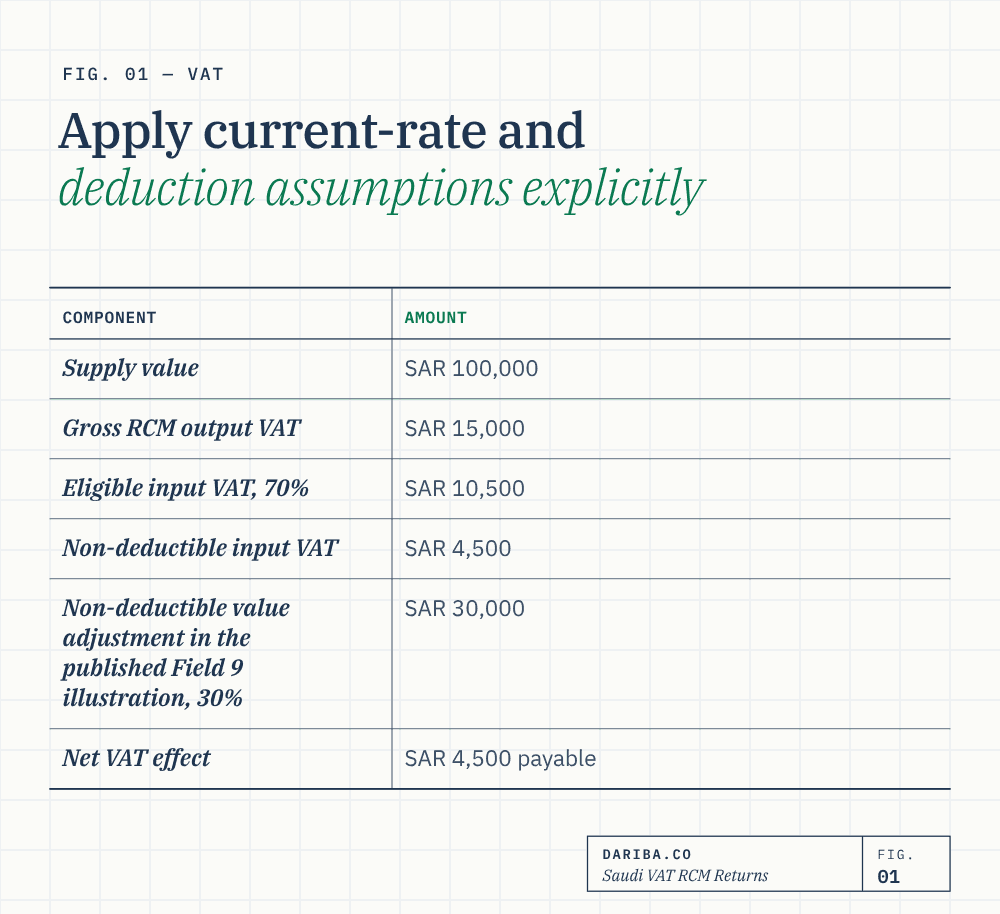
| Component | Amount |
|---|---|
| Supply value | SAR 100,000 |
| Gross RCM output VAT | SAR 15,000 |
| Eligible input VAT, 70% | SAR 10,500 |
| Non-deductible input VAT | SAR 4,500 |
| Non-deductible value adjustment in the published Field 9 illustration, 30% | SAR 30,000 |
| Net VAT effect | SAR 4,500 payable |
The form’s combined result must reconcile to liability less permitted deduction. Do not additionally classify the recipient’s own purchase as ordinary external sales merely to force a separate output entry, or deduct the input a second time elsewhere. Actual form instructions govern the data entry.
If input is fully deductible on the actual facts and timing, the net effect is zero. If it is not deductible, the gross liability can remain a cost. A business with mixed activities does not automatically apportion every purchase: first directly attribute costs and then apply the relevant shared-cost method under Articles 49–51.
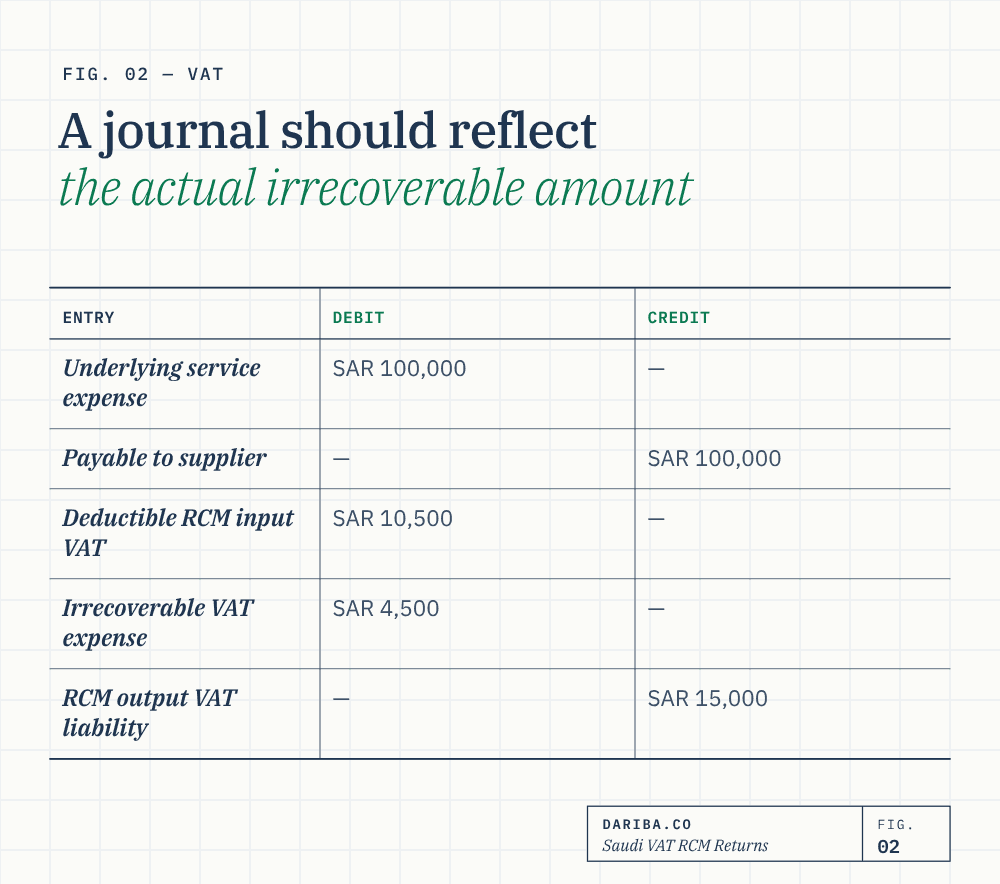
A journal should reflect the actual irrecoverable amount
For the original 15%/70% Dariba illustration, assume the underlying service is an expense, the supplier has not charged Saudi VAT, and the liability/deduction arise in the same period. One possible internal posting is:
| Entry | Debit | Credit |
|---|---|---|
| Underlying service expense | SAR 100,000 | — |
| Payable to supplier | — | SAR 100,000 |
| Deductible RCM input VAT | SAR 10,500 | — |
| Irrecoverable VAT expense | SAR 4,500 | — |
| RCM output VAT liability | — | SAR 15,000 |
Debits and credits each total SAR 115,000. The combined VAT effect is SAR 4,500; the customer does not owe SAR 115,000 to the foreign supplier on these assumptions. If the underlying expenditure is properly capitalised or uses different accounting recognition, account for that separately. These entries are an original illustration, not ZATCA-prescribed chart-of-accounts codes or a financial-reporting opinion.
Keep tax timing separate from receipt and posting
Agreement Article 23’s ordinary rules and Saudi Article 20’s continuous-supply rules determine when tax becomes due. Payment can itself be a relevant event; “never use the payment date” is therefore incorrect. The invoice’s issue date, receipt date and ERP posting date are also different facts.
Dariba illustration: an ordinary service completes in October with no earlier relevant invoice/payment and is invoiced to the customer in December. On those assumptions, delaying processing does not shift the October liability into December. Change the advance-payment, continuous-supply or other legal facts and the result must be reviewed.
Article 61’s prescribed Saudi Central Bank conversion uses the actual due date for tax. Retain the selected rate and calculation. An accounting accrual may help identify unbilled services, but it does not create a universal legal right to move every later price difference into the invoice-receipt period. Distinguish an original error from a genuine later event under the applicable adjustment rules.
Correct past omissions according to the actual result
Under Article 63, establish the original output and input errors, periods, discovery and net-tax effect. Do not automatically describe omission of a fully deductible pair as a gross net shortfall of the entire output amount. Required disclosures still matter even where the net result is unchanged, and the appropriate correction route needs the actual facts.
Dariba illustration: if the omitted qualifying SAR 100,000 service at 15% has the assumed valid 70% recovery in the same period, its net omission is SAR 4,500. Assuming no other relevant errors alter the result and Article 63(3)‘s conditions apply, that is below the strict SAR 15,000 small-understatement threshold and may be corrected in the discovery period. This is not a universal rule for unrelated offsetting errors or missing input evidence. Exactly SAR 15,000 is outside that exception.
Other understatements require the applicable Article 63(1) notification/correction within twenty days of awareness. Overstatements and their time limit are separate. See return corrections; no blanket penalty reduction is promised merely for voluntary action.
Reconcile supplier VAT and marketplace documents
If a supplier or platform shows VAT, determine which country’s tax it is, who actually supplies and whether Saudi VAT has been correctly charged by the person liable. A foreign VAT charge is not automatically deductible Saudi input VAT or proof that Saudi RCM is absent.
Article 47’s marketplace rules can change the deemed supplier, but a marketplace label alone is not a universal exemption from customer reverse charge. Reconcile the legally correct treatment and seek corrected documentation where appropriate. Do not deliberately account twice for the same Saudi liability, or simply switch RCM off because the invoice contains a tax-looking line.
Retain the calculation that explains the return
The review file should bridge the supplier ledger and unbilled services to qualifying RCM values, tax points, rates, gross liability, deductible inputs, Field 9 adjustments and any corrections. Preserve contracts, actual supplier/recipient evidence and relevant source documents under Article 66.
The official guideline section 6.3, page 32, does not require the recipient to issue itself a tax invoice merely for RCM, but requires retention of the supplier invoice supporting the calculation. Internal workings should explain the return; they do not replace all entitlement/evidence requirements. A well-supported zero result is different from simply omitting the transaction.
Key takeaways
- The official guideline uses Field 9 and adjusts the non-deductible supply value, not a generic Box D.
- Historical bank VAT is 5,000 output less 3,500 input, giving 1,500 net at the example's 5% rate.
- The original 15% extension gives 15,000 output, 10,500 input and 4,500 net under the assumed 70% entitlement.
- Do not duplicate the same input deduction or force the purchase into ordinary external sales.
- Timing and correction depend on actual facts; omission of fully deductible gross entries is not automatically a gross net-tax shortfall.
- Supplier/platform tax-looking lines do not alone determine whether Saudi RCM applies.
Sources
- Controlling Arabic VAT Implementing RegulationsTenth edition April 2025. Articles 20-25,47,49-51,61-63,66,77; pp. 21-25,44-45,48-53,62-64,67-69,79-80. Arabic controls.
- GCC VAT Agreement — official Arabic textArticles 1,9,16,18-23,41,44,50-52; pp. 3-6,9-11,15-16,18-19. Read with Saudi law, implementing provisions and applicable transitional rules.
- ZATCA Imports and Exports guidelineSecond edition May 2026. Sections 6.1-6.4, pp. 29-33, Examples 3-7; Field 9, exempt/outside services, branch/subsidiary and qualifying received-supply threshold effects. Historical5% is preserved.
- ZATCA Input Tax Deduction guidelineThird version May 2026. Actual entitlement, evidence, blocked costs and attribution must be tested; registration or a foreign invoice does not guarantee deduction.
General information only. Actual supplies, facts, applicable periods and controlling Arabic legislation determine the result. Official examples are distinguished from Dariba analysis and original illustrations. Seek advice or clarification where the arrangement or source material leaves a specific issue unresolved.