In brief
Corporate restructuring is not one universal RETT exemption. Identify the actual contribution or transfer route, Saudi-established entities, direct and indirect ownership, required accounts and continuing period. Article 3(c) and capital-increase scope rules have separate conditions.
A Saudi group reorganisation may transfer property even when economic ownership appears unchanged. The Zakat, Tax and Customs Authority’s Implementing Regulations of the Real Estate Transaction Tax Law provide several distinct routes. Choose the paragraph that matches the actual transfer, rather than combining their conditions into a generic restructuring exemption.
Map the route
| Regulations provision | Actual route and principal conditions |
|---|---|
| 3(a)(11) | Property contributed in kind to the capital of a company established in Saudi Arabia; retain the corresponding interests for at least five years from ownership and maintain the stipulated externally audited statements throughout. |
| 3(a)(17) | Natural person to a Saudi-established company or investment fund whose interests that person alone wholly owns, directly or indirectly; preserve the ownership percentage for at least five years from the property transaction. |
| 3(a)(18) | Specified transfers among Saudi-established companies/funds with the required wholly-owned direct or indirect relationship; preserve the recipient ownership specified in the paragraph for at least five years from the property transaction. |
| 3(a)(20) | No-consideration property transfer to a Saudi-established company/fund wholly owned, directly or indirectly, by a qualifying registered and supervised endowment; preserve the endowment percentage for at least five years from the property transaction. |
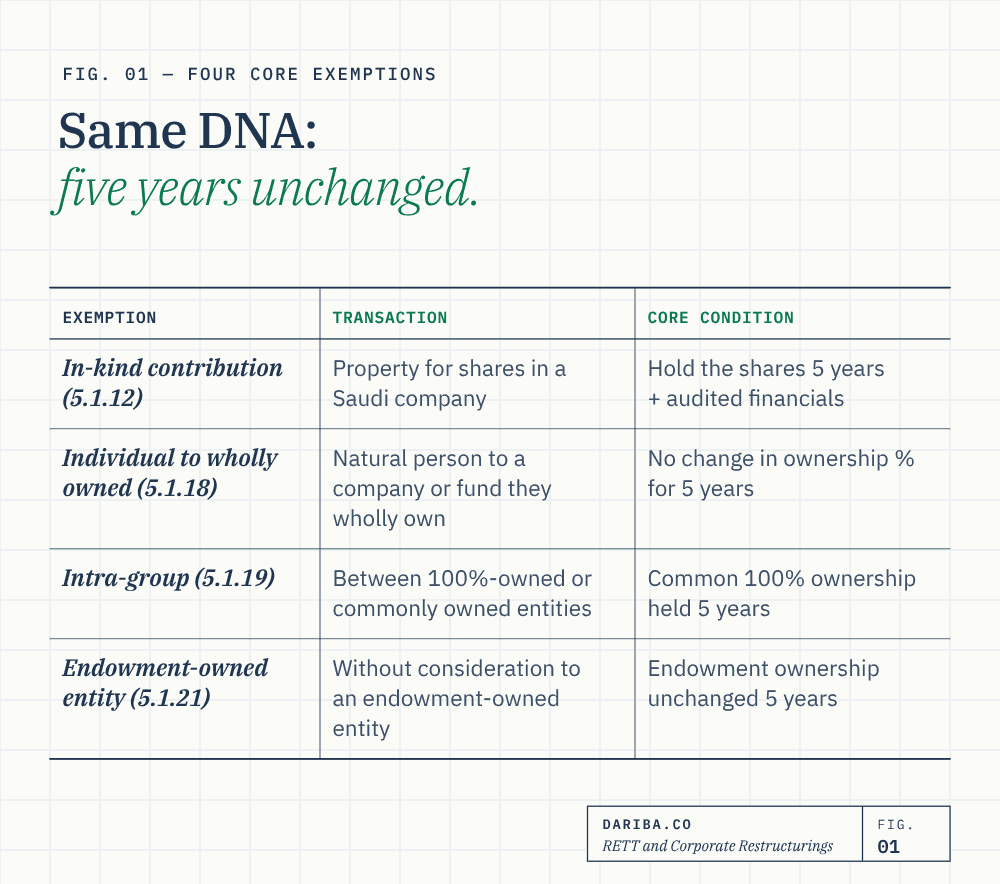
The illustration summarises these routes. It does not replace their Saudi-establishment, ownership, evidence and other conditions. A partly-owned subsidiary is not treated as wholly owned simply because it is consolidated in the accounts.
Mergers and acquisitions use the separate Article 3(a)(16) requirements. A real estate fund contribution under 3(a)(13) has its own unit-retention rule. Do not impose the company contribution’s audited-accounts criterion on every other route merely because they appear in the same planning discussion.
Contribution shares and actual dates
For Article 3(a)(11), identify when the contributor owns the interests corresponding to the in-kind contribution. Its five-year period runs from that event. The company must maintain the required financial statements audited by an accredited external auditor throughout the specified period.
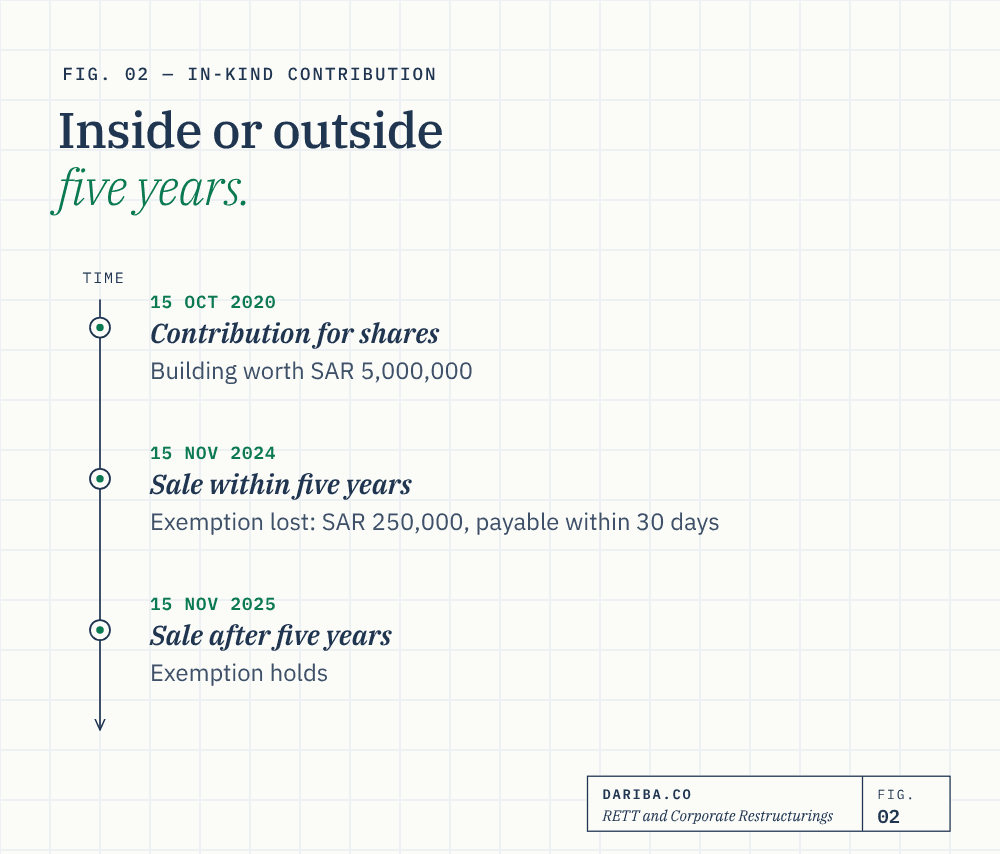
The retained timeline illustrates historical 2020 contribution facts. Current-law analysis should not be silently projected backwards; the law and transition applicable to an actual historical transaction must be checked.
Dariba current-law example: assume a SAR 5 million building contribution in 2026 satisfies Article 3(a)(11). A later unprotected disposal of the corresponding shares inside its retention period can breach the condition. At 5% of the assumed original taxable base, the tax is SAR 250,000. Regulations 5(a)(2) gives 30 days from the breach for payment. This is conditional exemption analysis, not an automatic tax-deferral election.
Direct and indirect group ownership
Article 3(a)(18) specifies transfers between wholly-owned companies, between a company and its wholly-owned fund, and between the stipulated entities wholly owned directly or indirectly by the same person. The Saudi-establishment conditions apply.
Retain structure charts and the actual share/unit registers. A chart labelled “same group” is insufficient if the operative ownership percentages or persons differ. The period is measured from the property transaction, with the ownership of the recipient that the paragraph actually protects.
Dariba group illustration: assume a SAR 20 million property transfer meets Article 3(a)(18). If an actual unprotected ownership event later breaches that route, 5% of the assumed original base is SAR 1 million. An alternative contribution route may have different criteria; do not treat both exemptions as automatically interchangeable.
Permitted changes require their own tests
Regulations Article 3(c) addresses public subscription in the transferee company/fund, an exempt disposal executing a competent court’s forced-sale order, and exempt M&A with the remaining relevant holding period completed.
A listing is not enough to protect every secondary sale. A court order does not by itself establish the forced-sale exemption. A merger must itself satisfy the applicable exemption, and any new conditions remain relevant. See the holding-period guide before concluding that the old condition is either breached or waived.
Capital increases are a separate scope question
Article 2(j) says ownership of new interests through a real estate company’s capital increase is not a property transaction in two specified cases: existing owners subscribe without their ownership percentages changing, or new owners subscribe while existing owners keep their pre-increase interests for five years from the increase.
That rule addresses the new interests. An accompanying property contribution still needs its own RETT treatment. New shares being outside the selected scope rule does not make the underlying land transfer automatically exempt.
Dariba unit-count illustration: an owner holds 100 existing shares; a new investor subscribes for 25 new shares. The old owner still has 100 shares but now owns 80% of the 125 total. Article 2(j)(2) concerns retaining those 100 pre-increase shares for its stipulated period. It should not be rewritten as a universal requirement that the pre-increase 100% ownership percentage remain unchanged.
Check indirect share-disposal scope accurately
Regulations Article 2(h) includes the revenue-generation purpose of the Saudi property and the at-least-50% fair-market-value asset test at the transfer date or during the preceding 365 days.
Article 2(i) then addresses aggregate disposals of at least 30% through linked transactions by a person or concerted group within the specified three-year period, beginning on or after that person or group held at least 30%. It is not accurately summarised as any purchaser simply crossing a 30% acquisition threshold.
Assess the actual holdings, disposals, concerted parties and related series. Then review any actual exemption. A group restructuring file should reconcile the property transaction, any share transaction and each continuing condition separately.
Preserve the evidence
Keep the transaction documents, relevant registrations, ownership evidence, consideration and valuation, required audited accounts, and later-event analysis. Use the breach and correction rules if a condition actually fails. Neither registration nor voluntary correction guarantees immunity from reassessment or fines.
Key takeaways
- Map the actual exemption paragraph instead of combining contribution and group conditions indiscriminately.
- Saudi establishment is an operative requirement for the relevant company, fund and group routes.
- Company contribution shares run for five years from ownership, with the required audited accounts; wholly-owned routes use the property transaction date.
- Article 3(c) protects specified changes conditionally, including completion of the remaining holding period for exempt M&A.
- Regulations 2(j) addresses acquisition of new interests in capital increases; it does not itself exempt every property contribution.
- Indirect share-disposal scope requires the real estate company definition, relevant holdings and linked/concerted disposal thresholds.
Frequently asked questions
Is any transfer inside a corporate group RETT-exempt?
No. Article 3(a)(18) specifies Saudi-established entities and the relevant wholly-owned direct or indirect relationships, followed by its five-year ownership condition. A group label or accounting consolidation alone does not satisfy the route.
Are audited accounts required for every restructuring exemption?
Article 3(a)(11) expressly requires the Saudi company to maintain the specified externally audited financial statements throughout the contribution period. Do not automatically import that particular criterion into every other paragraph; those routes have their own requirements.
Does capital-increase treatment exempt a property transfer into the company?
Regulations Article 2(j) concerns ownership of new interests arising from a capital increase under its stated conditions. The underlying property contribution or transfer still needs its own RETT analysis.
Is restructuring relief just deferred tax?
These are conditional statutory exemptions. They are not an automatic payment-deferral election. If the actual exemption condition is later breached, the original transaction and the separate payment rules must be reviewed.
Sources
Checked against the Arabic RETT Law and Implementing Regulations on 20 November 2026, with ZATCA's Detailed Guideline version 6 (May 2026) as secondary explanation. The Arabic instruments control. General information, not advice on a particular transaction. Dariba is independent of ZATCA.