In brief
The Law and current committee rules govern the route. Decision 25 expressly deleted the older Regulations Articles 61–62 and replaced Article 60; reproduced historical text must be distinguished from the current procedure.
Identify the challenged decision and the competent body
Income Tax Law Article 66(a) gives the person affected by a ZATCA decision the right to object under the applicable committee procedural rules. Article 67 establishes the tax adjudication and appeal framework. Those provisions must be read with the current Rules of Procedure of the Zakat, Tax and Customs Committees issued under Royal Order No. 25711.
The amended Law’s Article 66 footnote expressly identifies those rules as replacing the earlier Royal Order No. 26040 rules and cancelling conflicting provisions. A statutory reference to committees is therefore not a reason to apply an outdated timetable from an older guide.
Dariba recommendation: identify the issuing body, the actual decision, the taxpayer and regime, the amount and relief sought, and the relevant notification. A ZATCA objection, settlement referral, claim before an adjudication chamber and appeal against a chamber’s decision are different procedural stages.
Check the original deletion of the older committee provisions
Ministerial Decision 25 dated 8/1/1445 AH approved the attached amendments to the Income Tax Implementing Regulations. The original annex replaces Article 60 with a reference to the committee procedural rules issued under Royal Order 26040 and their subsequent amendments or orders. It expressly deletes Articles 61 and 62, which had contained the older initial-objection and appeal-committee arrangements.
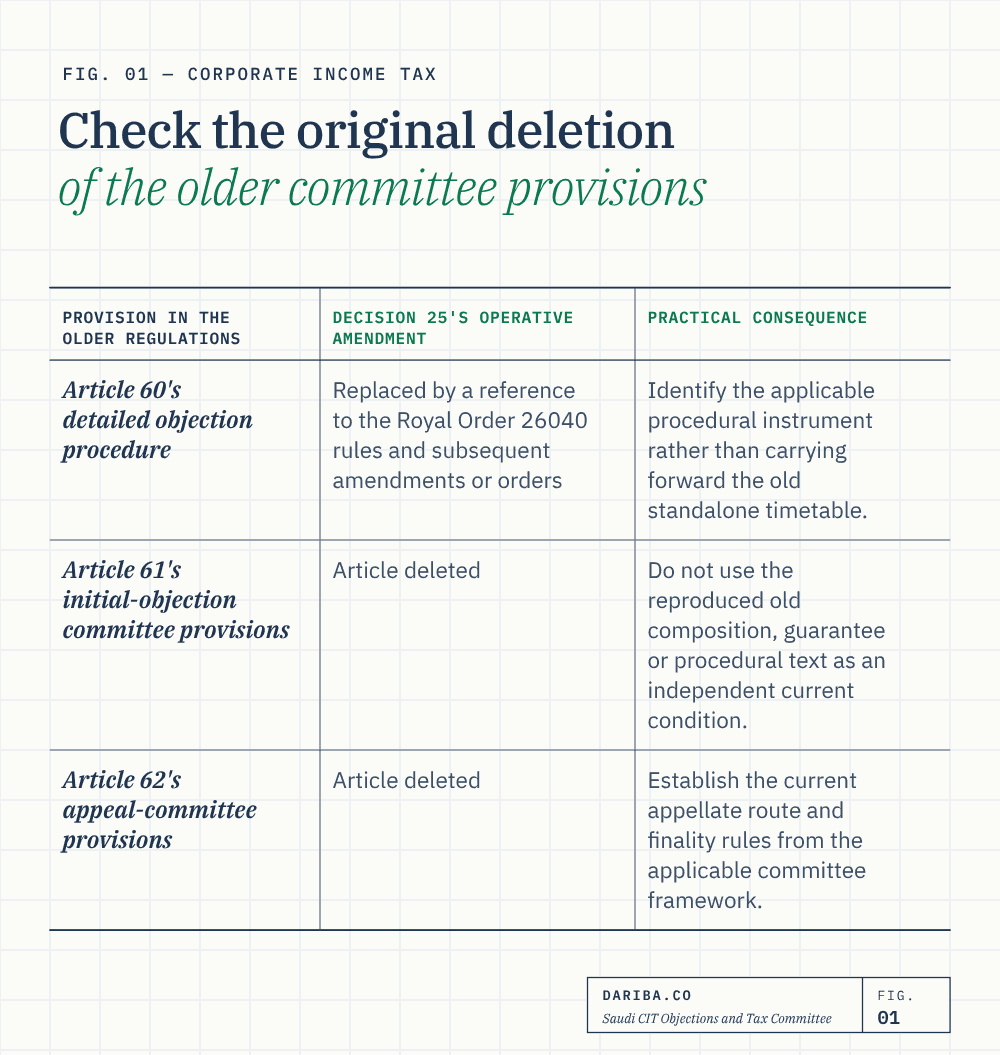
The before-and-after table matters. The current Arabic Regulations compilation still reproduces the older Articles 61–62 alongside amendment footnotes. Their continued visibility is not evidence that those deleted procedures remain operative. Read the amendment column of the original annex, then apply the actual current committee rules and relevant transition provisions.
| Provision in the older Regulations | Decision 25’s operative amendment | Practical consequence |
|---|---|---|
| Article 60’s detailed objection procedure | Replaced by a reference to the Royal Order 26040 rules and subsequent amendments or orders | Identify the applicable procedural instrument rather than carrying forward the old standalone timetable. |
| Article 61’s initial-objection committee provisions | Article deleted | Do not use the reproduced old composition, guarantee or procedural text as an independent current condition. |
| Article 62’s appeal-committee provisions | Article deleted | Establish the current appellate route and finality rules from the applicable committee framework. |
The present official committee catalogue links the rules issued under Royal Order 25711. The Law’s current Article 66 note identifies their replacement of the earlier 26040 rules. Decision 25’s historical reference to 26040 therefore needs to be read through that later procedural framework; it does not freeze the procedure at the earlier instrument.
Decision 25’s clause Second states that it operates from publication. The Gazette’s official decision page is dated 12 September 2023, and the annex bears an electronic-publication notice dated 27/2/1445 AH. Issue 4998 itself has the later printed date of 15 September 2023. Preserve that distinction when investigating a historical procedural event. The printed cover date alone does not establish the applicable cut-off for every pending case.
Dariba recommendation: keep the original amendment, applicable committee rules, notification evidence and each procedural step in the case file. An identical number of days in an old and a current rule does not establish that their triggers, conditions or remedies are identical. A historical case requires its actual dates and transition position examined; this guide does not reopen a final decision or determine admissibility.
Sources: Decision 25’s official approval and publication clause; Gazette issue 4998, decision and annex, pp. 13–14. The current rules and current Law remain separate sources for today’s procedural route.
Preserve the objection route and the undisputed payment obligation
Article 66(b) states that challenging an assessment does not remove the obligation to pay the tax due under the Law that is not disputed. Current Committee Rule 7(1) preserves the corresponding distinction for Zakat and tax cases.
Rules 5–6 govern the ordinary initial objection and subsequent referral or litigation. The settlement guide explains the sixty-day initial objection, ZATCA’s ninety-day decision period and the actual subsequent thirty-day triggers and choices. Missing a stage cannot safely be cured by treating an informal discussion as the required filing.
Dariba analysis: reconcile the disputed issues and undisputed dues separately. Payment of the undisputed amount does not decide the merits of the disputed balance. Equally, filing an objection does not establish an unrestricted freeze on every collection measure. Identify any actual payment, guarantee or collection provision applicable to the particular amount and route.
Distinguish tax jurisdiction from customs jurisdiction
Article 67(1) gives the tax adjudication committee jurisdiction over the specified violations, disputes, public/private-right claims arising from tax legislation and objections to ZATCA decisions applying that legislation. Paragraph (2) provides for specialised chambers under the statutory framework.
Current Committee Rule 3(1) identifies the Zakat and tax chambers’ jurisdiction, while Rule 3(2) separately addresses customs matters. Rule 3(3) assigns challenges to adjudication decisions to the appeal chambers. The existence of one secretariat or filing platform does not make every case interchangeable.
Rule 4 permits a case to be heard by a chamber with the appropriate subject-matter competence without ordinary territorial restriction, preserving the stated customs-smuggling exception. That provision does not give a party a right to select an unqualified chamber or disregard the secretariat’s filing requirements.
Dariba recommendation: explain why the challenged decision falls within the relevant tax jurisdiction. A contract or commercial dispute that happens to involve a taxpayer is not, solely for that reason, an objection to a ZATCA tax decision.
Understand the statutory composition without assuming the actual bench
Article 67(3) provides for an adjudication chamber of three principal members and a fourth reserve, with the prescribed legal or accounting expertise. At least the chair and one other member must have legal qualifications. The provision excludes personnel of the bodies concerned with supervising tax work from membership.
The chair and members are appointed by Royal Order for four years, renewable. If the term ends without reconstitution or renewal, the provision continues their work until the relevant Royal Order is issued. Paragraph (6) provides the corresponding specialised appeal-chamber composition, qualifications, appointment and continuation framework.
Dariba analysis: these are statutory composition and qualification provisions. They do not identify the members assigned to a particular case or establish a defect merely because a nominal appointment term has elapsed. Review the actual constitution, appointment and procedural facts before advancing a case-specific challenge.
Prepare evidence for a body with investigative powers
Article 67(1) gives the committee the necessary investigation and adjudication powers, including summoning witnesses, ordering evidence and documents, issuing decisions and imposing penalties within the applicable law. Current Rule 3(4) states those powers for the chambers.
The filing and evidence guide explains representation, required claim information, separate claims for separate Authority objections and the submission process. The hearings and expert-evidence guide explains the related hearing and expert procedures.
Dariba recommendation: connect each ground of challenge to the facts, source documents and requested outcome. A decision to obtain expert evidence is a procedural step; it does not by itself establish that the taxpayer’s valuation or accounting treatment is accepted. Nor does the committee’s investigative power make a general assertion a substitute for supporting the actual case.
Separate majority decisions, ordinary appeals and limited further procedures
Article 67(4) provides for majority adjudication decisions and the ordinary appeal framework; paragraphs (5)–(7) establish the appellate function, majority decision-making and finality. These provisions must be applied with the current procedural rules governing the particular decision and route.
Current Rule 33 includes final first-instance cases, including amounts payable not exceeding SAR 50,000, expiry of the appeal period and the specified settlements. A general statutory reference to appeal does not make every decision appealable regardless of the applicable finality rule.
The decision and appeal guide explains the distinct correction, interpretation, appeal, absentia and reconsideration procedures. It also identifies the different scheduled-delivery and actual-receipt wording in Rules 31 and 34. Preserve both date records and resolve the actual applicable trigger rather than assuming every thirty-day period starts on the same event.
Limited correction or reconsideration procedures are not an unrestricted new merits appeal. Match the requested remedy to the decision and the actual procedural grounds.
Do not use the general claim bar as an objection extension
Article 67(8) states a five-year bar for hearing tax-dispute claims measured from the due date of the amount claimed or knowledge of the disputed event, subject to an excuse accepted by the committee. It does not replace the separate shorter objection, referral and appeal conditions.
Dariba analysis: a claim being within that general period does not establish compliance with Rules 5–6 or an applicable appeal deadline. Conversely, an argument about an accepted excuse requires the actual facts and competent decision; it should not be presented as guaranteed admission of a late case.
Keep the claim’s legal basis, relevant starting event, notification record, initial objection and each subsequent step in one timetable. Do not calculate one general date and assume that it preserves every procedural right.
Distinguish the framework’s administration from the merits
Article 67(9) addresses preparation and Royal issuance of procedural rules. Paragraphs (10)–(11) address member/adviser/staff remuneration and the resources needed for the committees’ work. These administrative provisions do not determine the taxpayer’s substantive assessment or replace the adjudication and appeal functions described above.
Dariba recommendation: use the current official rules and actual case documents to identify the forum, route, evidence, dates and relief. A process chart supports a case only if it reflects the actual decision and statutory stage. This guide explains the framework without deciding a particular claim’s admissibility, composition challenge or merits.
Key takeaways
- An Authority objection and a committee appeal are different stages.
- Undisputed tax remains a separate payment obligation.
- Subject-matter jurisdiction differs from filing location.
- Statutory composition does not establish the actual case bench.
- General claim limits do not extend shorter procedural deadlines.
- Finality and limited remedies depend on the actual decision.
- Decision25 expressly deleted Regulations Articles61–62; reproduced older committee text does not restore those provisions.
- The original amendment’s electronic-publication notice and the later printed issue date must be distinguished.
Sources
- Saudi Income Tax Law, current amended Arabic textArticles 66–67: objection rights, undisputed payment, committee competence/composition, decisions, general claim bar and administration.
- Rules of Procedure of the Zakat, Tax and Customs Committees, Royal Order No. 25711Rules 1–8: definitions, filing, jurisdiction, ordinary objection and settlement stages, finality and undisputed payment; linked guides explain the later filing/hearing/appeal rules.
- Current Arabic Income Tax Implementing Regulations compilationArticles 60–62,pp.32–34: read the amendment footnotes with Decision 25’s original annex; older61–62 text remains reproduced despite express deletion.
- Umm Al-Qura issue4998: Ministerial Decision 25 and original annexDecision 25 dated8/1/1445AH,approval and publication clause,p.13; Article 60 replacement,p.13; express deletion of61–62,p.14. Electronic publication27/2/1445 differs from printed15September2023 issue date.
- Decision 25 official approval pageDated12September2023; approval of attached amendments and operation from publication.
- GSTC current committee-rules catalogueOfficial catalogue rechecked31October2026; links RoyalOrder25711 rules. Website update date is not legislative commencement.
General information only. Actual supplies, facts, applicable periods and controlling Arabic legislation determine the result. Official examples are distinguished from Dariba analysis and original illustrations. Seek advice or clarification where the arrangement or source material leaves a specific issue unresolved.