In brief
Apply Zakat profit adjustments with official revenue, loss and expense examples, preserving the higher-of rule, evidence and signed base difference.
Adjusted profit has two connected uses: it helps determine the signed adjustment added to the ordinary Zakat base and it matters in the conditional Article 27 alternative. Neither use means adding all adjusted profit again to closing retained earnings. The starting book result, accepted expenses and actual information-difference rules must remain traceable.
Start with the specified book result and preserve its sign
Current amended Arabic Zakat Implementing Regulations Article 23(3), p. 15, uses the difference between adjusted net profit/loss and the specified book net profit/loss after Zakat and tax. The Zakat General Guideline, first version October 2024, section 5.2.2, pp. 162–164, explains the connection with retained earnings.
The Guideline for Zakat Base Additions, version 1 January 2025, section 5, pp. 155–164, develops the same bridge. A negative book result must retain its sign when calculating the difference.
Dariba recommends reconciling the actual book starting point to the financial statements. Substituting profit before Zakat for an after-Zakat figure without explanation can change the adjustment and prevent a reviewer from reproducing the calculation.
Apply the general and expense-specific acceptance controls
Article 62, Arabic text, p. 32, requires actual expenses, connection with the activity and supporting documents acceptable to ZATCA. Its wording preserves the stated treatment of relevant previous-year expenses and Article 63(9)‘s provisions created during the year.
Article 63 adds category-specific conditions. The accepted-expenses guide explains the ten categories; the bad-debt guide addresses Article 65.
Do not assume every accrued item fails because it has not been paid, or every expense caption qualifies because it is in audited statements. Payment is expressly relevant for certain items, while each provision needs its actual conditions.
Use the official ordinary profit reconciliation
Official General Guideline Example 66, pp. 172–173: net book profit is SAR 70,000. Unsupported purchases SAR 15,000 and donations to entities outside Saudi Arabia SAR 13,000 are added in reaching adjusted profit SAR 98,000.
The guide then adds the SAR 28,000 difference through the base adjustment. It expressly explains that the book result is already reflected within retained earnings, so the whole SAR 98,000 is not added again for this purpose.
Dariba analysis: keep the activity-result reconciliation separate from the balance-sheet addition schedule, then connect them with the signed difference. This makes duplicate inclusion visible instead of hiding it inside a combined profit figure.
Apply the higher-of rule for understated revenue
Article 60, Arabic text, p. 31, concerns revenue information differences without conflicting with Article 103’s amendment provisions. Where the return’s revenue is below the amount established in ZATCA’s information, it adds to adjusted profit or reduces adjusted loss by the higher of: the difference multiplied by the return’s gross-profit-to-revenue ratio; or the difference multiplied by 15%.
Dariba original assumptions: an established revenue difference of SAR 100,000 and the relevant return ratio of 20% give SAR 20,000 versus SAR 15,000, so the higher comparison amount is SAR 20,000. At an assumed 10% ratio, SAR 10,000 versus SAR 15,000 gives SAR 15,000.
These are original arithmetic illustrations of the stated rule, not numbered ZATCA examples or a general 15% Zakat rate. Use the actual relevant gross-profit measure, not net profit, and establish the information difference before calculating.
Apply the dedicated guideline’s loss-to-profit example
Official example: the Guideline on Modification of the Activity Result, November 2024, section 4.3, Example 8, uses total revenue SAR 7 million, gross profit SAR 980,000 and a SAR 20,000 book loss. An established SAR 200,000 revenue discrepancy produces SAR 28,000 at the 14% gross-profit ratio and SAR 30,000 at 15%.
The higher SAR 30,000 adjustment changes the SAR 20,000 loss into SAR 10,000 adjusted profit. The comparison uses gross profit relative to the relevant return revenue, not the negative net-profit margin. The example establishes the activity-result adjustment; the final Zakat base still needs its separate statutory comparison.
Dariba recommendation: reconcile the affected revenue stream to the return and establish the actual discrepancy before applying the ratio. A difference between VAT-reported supplies and financial-statement revenue needs analysis of timing, scope and the actual evidence; a data mismatch alone does not prove the same amount is undeclared Zakat revenue.
Compare expense differences and valuation errors without a revenue percentage
Official example: section 4.4, Example 9, compares SAR 30,000 advertising expense in the return with SAR 40,000 in ZATCA’s information. The return amount prevails under that direction of Article 61; the example does not automatically increase the expense or reduce adjusted profit.
Official example: section 4.5, Example 11, identifies SAR 210,000 rent booked against a SAR 190,000 certified annual contract, giving a SAR 20,000 adjustment. It also identifies a USD 40,000 maintenance invoice booked at SAR 4 per dollar rather than the example’s evidenced SAR 3.75 rate, giving SAR 10,000 more. The two corrections total SAR 30,000.
These are the official example’s facts and exchange-rate assumption, not a prescribed universal rate for every currency or transaction. The point is the supported actual expense. The Article 60 revenue-percentage comparison should not be applied mechanically to these expense overstatements.
Preserve the other revenue and expense-difference directions
Under Article 60(1), where return revenue exceeds the established information amount, the return prevails without changing the adjusted result through that paragraph. That is not an automatic downward adjustment of the declared revenue.
Article 61 adds the difference where return expenses exceed the amount established in ZATCA’s information, increasing adjusted profit or reducing adjusted loss. Where return expenses are lower, the return prevails without an automatic adjustment to the result under that paragraph.
Dariba recommends reconciling both amounts and the relevant evidence before applying a direction. These information-difference rules should not be read as eliminating Article 103’s actual amendment route or deciding every contested accounting fact without review.
Distinguish non-actual values from ordinary disagreement
Article 64, Arabic text, p. 33, permits ZATCA to re-evaluate an expense or revenue proved non-actual or recorded at other than its true value, read with Articles 58–59. It is not limited to one account caption.
General Guideline p. 164 distinguishes non-accepted expenses, inflated-expense differences, undeclared revenue and non-actual or incorrectly valued items. Identify the actual provision and evidence rather than adding the same adjustment under multiple descriptions.
Dariba analysis: an information discrepancy, an unsupported expense and deliberate false information are not automatically identical findings. This article explains the calculation provisions; it does not independently determine every penalty, transfer-pricing or dispute consequence.
Keep book losses and provision expenses distinct
Official General Guideline Example 68, pp. 175–176: a SAR 20,000 book loss is adjusted by SAR 150,000 of related-party bad-debt expense to reach SAR 130,000 adjusted profit. The stated SAR 70,000 of provisions created during the year is not an additional disallowance in that example.
The signed difference is SAR 150,000. The example does not require adding SAR 130,000 on top of that difference, nor does it erase the separate closing-provision classification under Article 24.
The distinction between an expense and a balance-sheet addition is essential. A provision can have an accepted expense treatment while its closing balance has its own equity/liability analysis under the applicable provisions.
Follow the comprehensive examples from the book result
Official example: ZATCA’s Guideline on Modification of the Activity Result, section 5.12, Example 38, starts with SAR 405,000 net book profit after the stated Zakat charge. It adds SAR 15,000 of related-party bad debt and SAR 20,000 donated outside Saudi Arabia. The adjustment difference is SAR 35,000 and adjusted profit is SAR 440,000. The other expenses are accepted on the facts supplied, including the SAR 10,000 doubtful-debt provision.
Dariba analysis: the official bridge does not restart at the SAR 480,000 profit before Zakat or automatically disallow every provision. Apply the specific expense route and retain the separate closing-provision analysis. Example 38 does not remove Article 63(10)‘s paid wording for the paid-Zakat route; the tax-cost guide explains that distinction.
Official example: section 5.12, Example 39, begins with a SAR 175,000 book loss. Four adjustments total SAR 1,181,000: SAR 430,000 private-residence rent, SAR 125,000 unsupported professional fees, SAR 560,000 partner remuneration not registered with GOSI and SAR 66,000 tuition outside the contract or company rules. Adding SAR 1,181,000 to negative SAR 175,000 produces SAR 1,006,000 adjusted profit.
The book loss is therefore not conclusive. The accepted-expense guide explains why the employment contract and exceptional management approval do not cure the particular failed conditions in that case. The example’s treatment of its other items should not become a universal foreign-tax credit or expense rule.
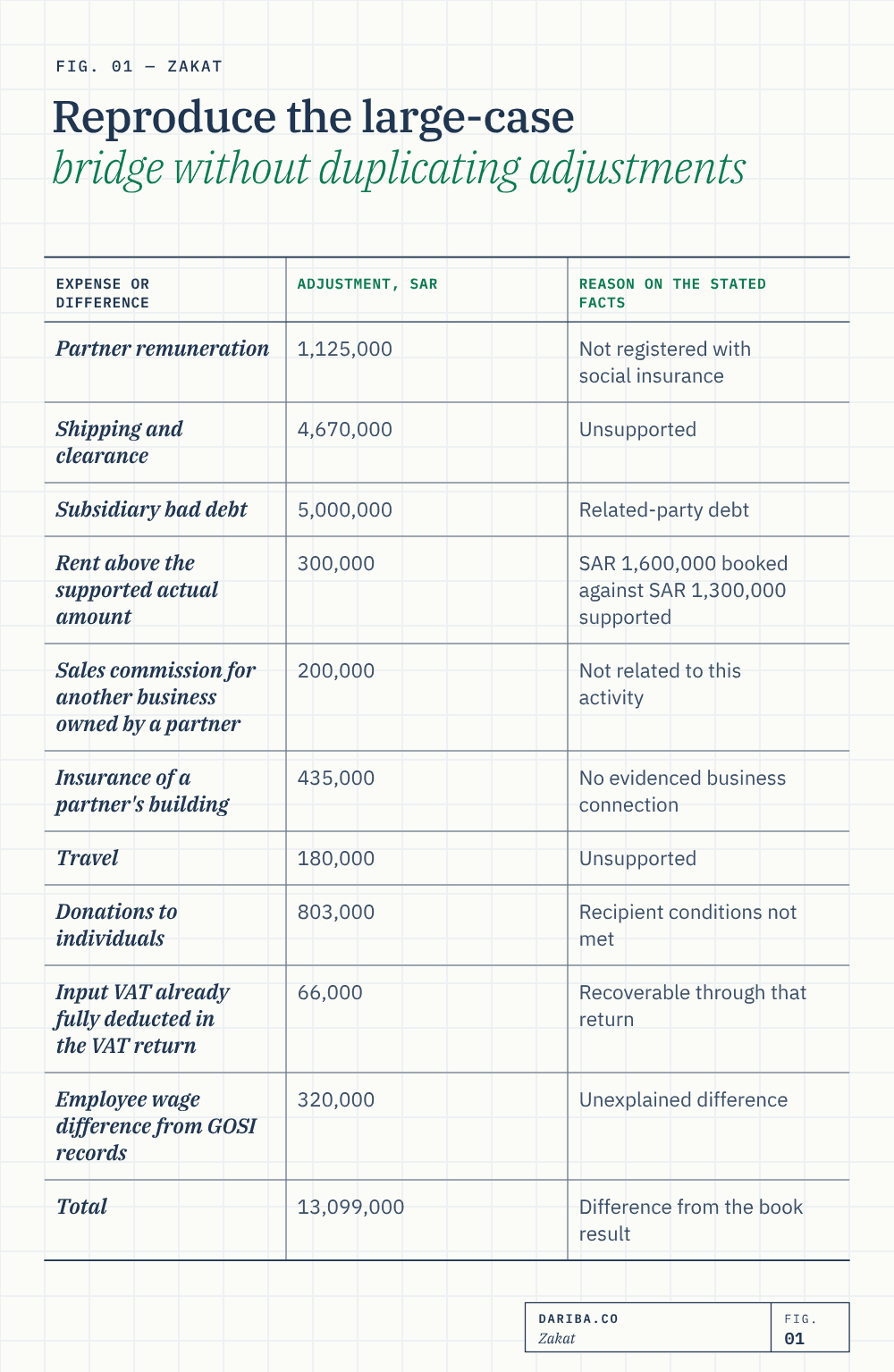
Reproduce the large-case bridge without duplicating adjustments
Official example: section 5.12, Example 40, starts from SAR 23,911,000 net book profit and identifies these ten disallowances:
| Expense or difference | Adjustment, SAR | Reason on the stated facts |
|---|---|---|
| Partner remuneration | 1,125,000 | Not registered with social insurance |
| Shipping and clearance | 4,670,000 | Unsupported |
| Subsidiary bad debt | 5,000,000 | Related-party debt |
| Rent above the supported actual amount | 300,000 | SAR 1,600,000 booked against SAR 1,300,000 supported |
| Sales commission for another business owned by a partner | 200,000 | Not related to this activity |
| Insurance of a partner’s building | 435,000 | No evidenced business connection |
| Travel | 180,000 | Unsupported |
| Donations to individuals | 803,000 | Recipient conditions not met |
| Input VAT already fully deducted in the VAT return | 66,000 | Recoverable through that return |
| Employee wage difference from GOSI records | 320,000 | Unexplained difference |
| Total | 13,099,000 | Difference from the book result |
The official result is SAR 23,911,000 plus SAR 13,099,000, giving SAR 37,010,000 adjusted profit.
Dariba recommendation: assign each adjustment a unique account reference, amount and failed condition. An unsupported related-party item may raise more than one concern, but the same expense must not be disallowed twice. A wage difference also needs its own evidence analysis: Article 63(6) permits a supported excess; this example concerns an unexplained amount.
This reproduces the official case’s activity-result arithmetic. It does not determine the final Zakat base or resolve the separate equity-method/minimum-profit question discussed in the comprehensive-income guide. Do not remove all associate-company profits automatically or substitute adjusted profit for the required base comparison.
Reconcile the bridge with the final calculation and evidence
The base-information discrepancy guide separately addresses Article 57 balance-sheet items. The unrealised-gains and comprehensive-income guide distinguishes income-statement amounts from OCI and closing equity.
The base guide and limits guide explain the ordinary and conditional alternative calculations. The adjustment difference and adjusted result have different jobs and should not be substituted for one another.
Keep the book-result reconciliation, general/specific expense tests, information-difference evidence, applicable formulas, signed adjustment and final base calculation together. Resolve any unsupported data or unexplained double counting before approving the return.
Dariba recommends a clear conclusion for each adjustment: what changed, why the provision applies, the evidence and the resulting amount. That provides an advisory analysis while preserving questions the available facts or official sources do not settle.
Key takeaways
- Locate the amount before deciding its Zakat adjustment.
- Unrealised does not automatically mean excluded.
- Article64 preserves verification of the actual value.
- OCI is distinct from the relevant net book result.
- Use actual signed closing equity and avoid duplicate adjustments.
- Official examples retain their conditions and calculation route.
Sources
- Zakat Collection Regulations 1445H, current Arabic textArticles 62–65: general and specific expenses, supported wage differences, created provisions, paid tax and bad-debt conditions; connected base provisions remain relevant.
- Zakat Collection Regulations 1445H, official English translationRead with the current Arabic text; existing linked statutory framework retained.
- ZATCA General Guideline for Zakat Collection 1445HExisting general examples and base framework retained; comprehensive activity-result cases do not establish a final base.
- ZATCA Guideline on Modification of the Activity Result, November 2024Section 5.12, Examples 38–40: comprehensive expense conditions and book-to-adjusted-result bridges.
General information only. Actual supplies, facts, applicable periods and controlling Arabic legislation determine the result. Official examples are distinguished from Dariba analysis and original illustrations. Seek advice or clarification where the arrangement or source material leaves a specific issue unresolved.