In brief
Resolution 319 treats a qualifying fund investor as a holder for government-bearing Zakat relief. The calculation uses the fund’s base and adjusted profit, allocates by investor ownership and applies an express ceiling.
An investor holding government sukuk through an investment fund should not assume that indirect ownership eliminates government-bearing Zakat relief. Ministerial Resolution 319 adds an express fund-investor route to Resolution 2218. It also prescribes how to calculate and cap the amount. The relevant holding, fund information and investor eligibility still have to support the claim.
Identify the specific fund-investor provision and period
Resolution 319 adds Clause Three bis to Resolution 2218, as amended by Resolution 1343. It treats a Zakat payer investing in an investment fund that holds covered government sukuk or bonds as a holder of those instruments for this purpose.
Its commencement clause applies the amendment to fiscal years beginning on or after 1 January 2023. This is a fiscal-year test, not a rule allowing every earlier holding to be claimed from the amendment’s publication date. The Zakat calculation framework applicable to the actual year must also be used; the current 1445 AH Regulations’ general 2024 commencement is a separate question.
Ministerial Resolution 1007 preserves Resolution 2218 as amended. Government-bearing relief is therefore a specific mechanism that must be examined alongside the current Zakat computation, rather than assumed to have disappeared or been replaced by a general investment deduction.
Establish that the underlying instruments are covered
Resolution 319 applies only to government sukuk or bonds covered by the government-bearing decision. A fund’s description as “fixed income”, “government”, “Saudi” or “low risk” does not prove that every investment qualifies. A state-owned company’s sukuk should not be treated as a Ministry of Finance issuance merely because the company has government ownership.
Resolution 1343 amends Clause One by reference to instruments issued domestically in Saudi riyals by the Ministry of Finance through maturity. The original Resolution 2218 also contains historical programme and period wording. For a particular issue, reconcile the instrument, relevant period and amendments rather than use an original sunset clause or a broad summary as a complete eligibility list. This guide assumes the fund’s instrument-level eligibility has been established; it does not certify every current or historical issue.
Obtain the issuance identity, currency, issuer, relevant programme, maturity and a supported schedule of the fund investments actually covered. Separate non-qualifying holdings instead of applying the fund’s headline allocation to its whole portfolio.
Preserve the holder’s conditions and payment ceiling
Resolution 2218 Clause Two requires the holder to submit its return within the statutory period and pay the amount due, to be assessed by reference to financial statements under ZATCA’s procedures, and not to be an exempt entity for the relevant Zakat or income tax. It also prevents the government-bearing amount exceeding what the taxpayer has actually paid to the Authority.
The fund extension does not make every unitholder a qualifying taxpayer. Identify the investor’s status, its financial year, filed return and payment evidence. A fund’s information return and an investor’s own liability are different matters.
Government bearing should not be described as permission simply to omit the holding or withhold payment of an otherwise due return amount. The current fund-compliance guide explains the separate fund and investor obligations.
Calculate at fund level before allocating to the investor
Clause Three bis refers back to Resolution 2218 Clause Three, using the fund’s Zakat base and adjusted profit, then the investor’s ownership share in the fund assets. It does not direct the investor to substitute its own group profit margin for the fund’s figures.
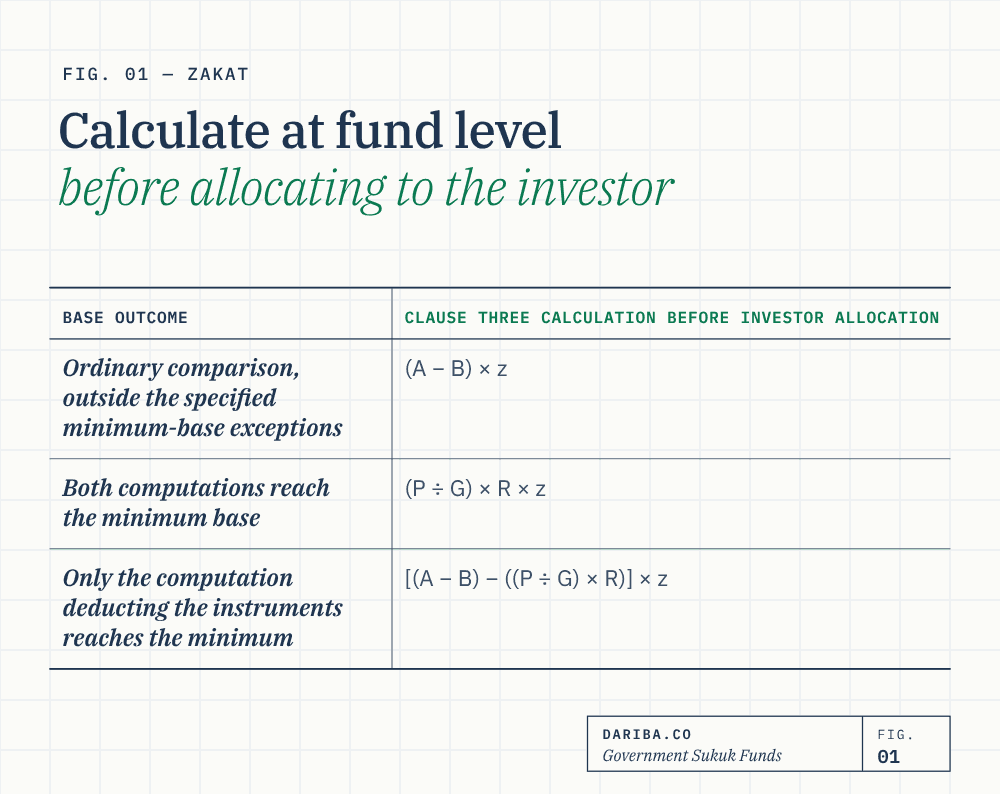
Define A as the fund base without deducting the covered instruments, B as the base with the deduction, P as adjusted net profit, G as gross profit, R as annual returns on the covered instruments and z as the prescribed Zakat rate. Clause Three sets out these distinct calculations:
| Base outcome | Clause Three calculation before investor allocation |
|---|---|
| Ordinary comparison, outside the specified minimum-base exceptions | (A − B) × z |
| Both computations reach the minimum base | (P ÷ G) × R × z |
| Only the computation deducting the instruments reaches the minimum | [(A − B) − ((P ÷ G) × R)] × z |
Use fund-level inputs for this fund-investor route and preserve the actual branch conditions. These calculations must not be collapsed into “holding value × 2.5%”.
The current year’s base rules and actual fund rate must be reconciled with the preserved decision. The fund-base guide explains the underlying computation. Unusual losses, a zero denominator or an unresolved interaction with a minimum-base calculation require specific analysis; do not invent a substitute ratio to make a formula produce an answer.
Apply the express investor ceiling
Resolution 319 states the maximum government-bearing amount for the fund investor by this formula:
Fund investments in the government sukuk or bonds whose Zakat is borne by the state × investor ownership share in the fund assets at the Zakat calculation date × the fund’s Zakat rate.
This is a ceiling, not a substitute for the prior calculation. Calculate the amount under the referenced method, allocate to the investor, then test the express ceiling and the applicable payment condition. The allocation percentage and the covered investment schedule should use the legally relevant date and consistent values.
The rule does not support including a fund’s ordinary corporate bonds in the ceiling merely because they sit beside qualifying government instruments. Nor does the ceiling alone establish that the investor has paid enough or otherwise meets the claim conditions.
Use a clearly limited calculation example
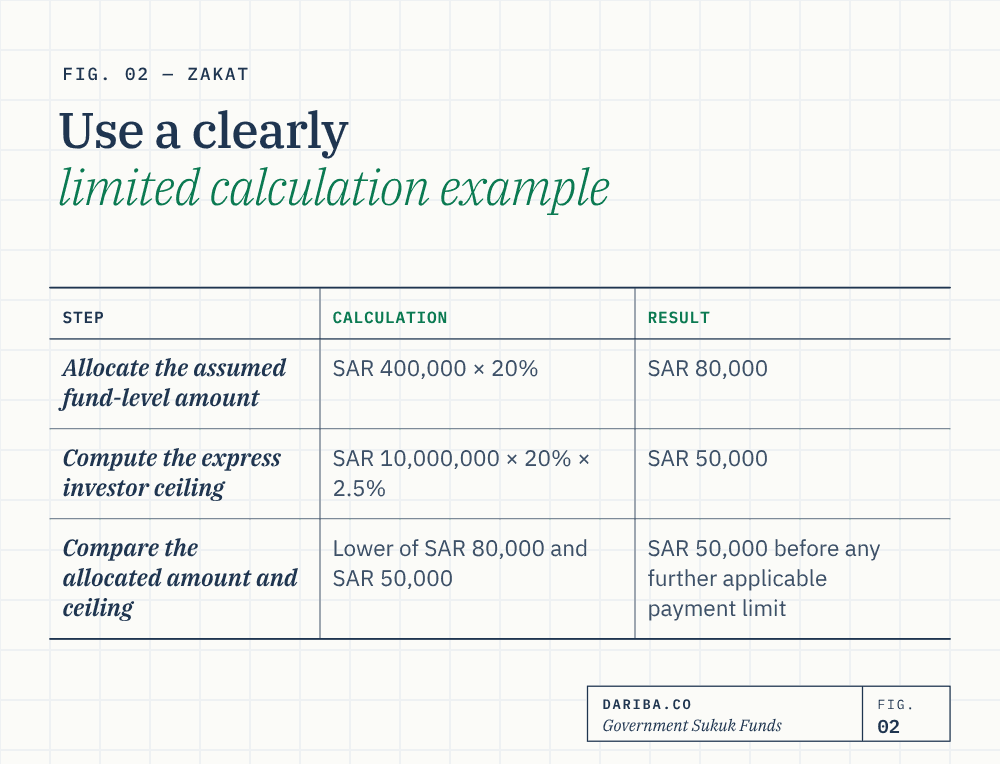
Dariba original illustration: assume a qualifying investor owns 20% of the fund assets at the relevant calculation date. Assume SAR 10,000,000 of fund investments have been established as covered government instruments and the verified fund Zakat rate for the illustration is 2.5%. Also assume a separately supported Clause Three calculation gives a fund-level bearing amount of SAR 400,000, before investor allocation and the Clause Three bis ceiling.
| Step | Calculation | Result |
|---|---|---|
| Allocate the assumed fund-level amount | SAR 400,000 × 20% | SAR 80,000 |
| Compute the express investor ceiling | SAR 10,000,000 × 20% × 2.5% | SAR 50,000 |
| Compare the allocated amount and ceiling | Lower of SAR 80,000 and SAR 50,000 | SAR 50,000 before any further applicable payment limit |
The illustration demonstrates allocation and the ceiling only. It does not derive the assumed SAR 400,000 from a complete fund return, and does not certify that amount for a particular fund. Assume the other eligibility conditions are met and the actual payment ceiling does not reduce the result further. The 2.5% rate is an illustration input, not a universal rate for every financial year.
Keep this relief separate from other investment and tax routes
Non-government instruments may engage Regulations Article 55’s issuer capital-treatment conditions. Fund-unit deductions require their own investor-purpose, calculation and payment analysis. Financing-activity taxpayers have separate Article 70 routes. A single holding should not be used to claim overlapping relief without reconciling the relevant provisions.
Government-bearing Zakat relief is separate from the underlying withholding-tax position. Ministerial Resolution 59510, Clause One, excepts the state’s bearing of withholding on the specified returns paid to non-residents from government sukuk and bonds issued in Saudi riyals from the conditions in Resolution 2218 Clause Two. Its Clause Two links that exception to fiscal years within Resolution 2218 Clause Five’s scope. This is an exception to those scheme conditions; it is not withdrawal of government bearing or an exemption of the underlying withholding tax. Determine the instrument, applicable period, administrative route and any treaty position separately.
The sukuk issuer/investor guide distinguishes the non-government route. Neither that deduction nor the fund extension should be treated as a blanket exemption for every sukuk structure.
Assemble the evidence before requesting the benefit
Maintain the investor’s return and payment evidence, relevant year, fund calculation and adjusted profit, qualifying instrument schedule, ownership percentage at the calculation date, actual fund rate, allocated amount and ceiling calculation. Reconcile the information to the fund manager’s data and the investor’s records.
For more complex chains, such as a fund investing through another fund, do not assume Resolution 319 itself supplies an unlimited look-through rule. Establish the applicable legal and evidential route before attributing underlying government instruments to the ultimate investor.
A useful advisory report should show why the investor qualifies, why the specific underlying issues are covered, how the fund-based amount was calculated and how every ceiling affected the result. It should also identify any unresolved instrument-period or calculation issue before a refund or bearing amount is presented as available.
Key takeaways
- Resolution 319 adds a specific fund-investor route for covered government instruments.
- It applies to fiscal years beginning on or after 1 January 2023.
- The underlying instrument must itself be covered by the government-bearing scheme.
- The calculation uses fund-level figures and the relevant investor ownership share.
- The express cap uses covered fund investments, investor ownership and the fund’s Zakat rate.
- Government-bearing relief does not create a blanket deduction or WHT exemption.
Sources
- Implementing Regulations for Zakat Collection, 1445 AH, controlling Arabic textArticles 26(8), 42, 55 and 70(7)–(9): non-government sukuk issuer/investor conditions, trading controls and financing-activity distinctions. Ministerial Resolution 1007 preserves Resolution 2218 as amended.
- ZATCA English publication of the Zakat Collection RegulationsReading aid for Articles 42, 55 and 70; controlling Arabic text and exact paragraph conditions retained.
- ZATCA General Guideline for Zakat Collection, 1445 AH frameworkSection 5.3.3.5, Example 82: SAR 25 million non-current sukuk investment without issuer capital-treatment evidence. Section 2.1 explains the preserved government-bearing decision.
- Ministerial Resolution 2218, government-bearing controls for sukuk and bondsClauses Two and Three set eligibility, payment ceiling and calculation mechanisms. Original issuance-scope and historical-period text must be read with subsequent amendments.
- Ministerial Resolution 1343, amendment to Resolution 2218Amends Clause One to identify the relevant Ministry of Finance domestic Saudi-riyal instruments through maturity. Instrument-specific scope and applicable period require reconciliation.
- Ministerial Resolution 319, government-sukuk relief through investment fundsAdds Clause Three bis to Resolution 2218: fund calculation, investor allocation and cap, from fiscal years beginning 1 January 2023. Its recital references the separate Resolution 59510 government-bearing WHT conditions exception.
- Umm Al-Qura, Ministerial Resolution 59510 on sovereign-debt withholding amountsClause One excepts the stated government bearing of non-resident WHT from Resolution 2218 Clause Two conditions. Clause Two links the exception to fiscal years covered by Clause Five. This is not withdrawal of state bearing or an exemption of the underlying tax.
General information only. Actual supplies, facts, applicable periods and controlling Arabic legislation determine the result. Official examples are distinguished from Dariba analysis and original illustrations. Seek advice or clarification where the arrangement or source material leaves a specific issue unresolved.