What Is Zakat?
Zakat is an Islamic fiscal obligation — one of the five pillars of Islam — and in Saudi Arabia it functions as the primary corporate-level tax on Saudi and GCC national-owned businesses. Understanding it is non-negotiable for any finance professional working in the Kingdom.
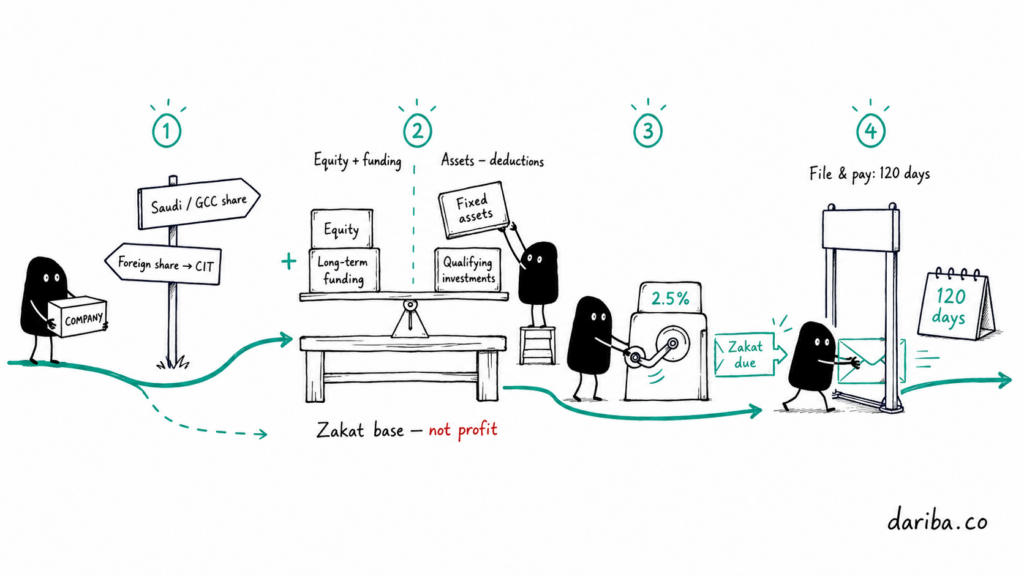
In the Saudi business context, Zakat is not calculated on profit. That’s the first and most important thing to understand. While Corporate Income Tax (CIT) is computed on taxable income, Zakat is assessed on what is known as the Zakat base — a figure derived from the equity and funding structure of the business, with specific additions and deductions applied. This distinction matters enormously in practice: a company can be making losses and still owe Zakat.
The Zakat rate is fixed at 2.5% of the Zakat base (prorated for the actual days of a Hijri year if the fiscal year differs). At first glance, 2.5% sounds modest. But applied to a large equity base — rather than a profit margin — the actual Zakat liability can be substantial, and getting the base calculation wrong is one of the most common and costly compliance failures in the Kingdom.
Legal Framework
The collection of Zakat in Saudi Arabia is governed by the Zakat Implementing Regulations, issued by the Zakat, Tax and Customs Authority (ZATCA). These regulations clarify the obligations and rights of Zakat payers, the methodology for calculating the Zakat base, filing procedures, enforcement powers, and dispute resolution mechanisms.
Under Article 9 of the Regulations, approved accounting standards endorsed by the Saudi Organization for Chartered Accountants (SOCPA) apply for financial reporting purposes, unless the Regulations specify otherwise. This means your IFRS-based or SOCPA-compliant financial statements are the starting point — but Zakat-specific adjustments then apply on top. The financial statements are the foundation; the Zakat base is a separate and distinct calculation built from them.
The primary legal basis for Zakat collection in Saudi Arabia is the Zakat Implementing Regulations issued by ZATCA. Article 21 governs the Zakat base calculation, Articles 23 and 26 govern additions and deductions respectively, and Articles 98–102 govern filing and payment obligations.
Who Pays Zakat in Saudi Arabia?
Under Article 3 of the Zakat Implementing Regulations, the following persons are subject to Zakat:
| Zakat Payer Category | Description |
|---|---|
| Resident Saudi national practising an activity | Any Saudi national resident in the Kingdom who holds a commercial licence or practises an activity |
| Sole corporation owned by a Saudi person | A one-person company established under Saudi law and owned by a Saudi national |
| Saudi-owned share in a resident company | The proportionate Saudi/GCC-owned share in a resident capital company, including shares held by government agencies |
| CMA-licensed Finance Funds | Finance funds licensed by the Capital Market Authority (CMA) |
| State-owned and Public Investment Fund-owned resident companies | Per applicable Royal Orders and Ministerial Resolutions |
| Saudi shares in Saudi Exchange-listed companies | Shares held by Saudi nationals in listed companies, excluding shares held by non-Saudi founders per articles of association |
GCC nationals are accorded treatment similar to Saudi nationals for Zakat purposes under the definition of “Saudi” in the Regulations. This means a Bahraini, Emirati, Kuwaiti, Omani, or Qatari national resident in Saudi Arabia and practising an activity is a Zakat payer, not a CIT payer.
Residency thresholds matter. Under Article 4, a natural person is considered a Saudi resident if they have a permanent residence in the Kingdom and are physically present for at least 30 consecutive or aggregate days in the Zakat year, or if they are present for at least 183 days without a permanent residence. A legal person is resident if incorporated under Saudi laws or if its principal headquarters is in the Kingdom.
Zakat vs. CIT: The Ownership Split Rule
This is the most important concept in Saudi business taxation — and the source of the most confusion. The answer to “does this company pay Zakat or CIT?” almost always comes down to one thing: who owns it.
Saudi Arabia operates a split system. Zakat applies to Saudi and GCC-owned interests. Corporate Income Tax (CIT) applies to non-Saudi-owned interests. In a company with mixed Saudi and foreign ownership, both regimes apply simultaneously — each in proportion to the ownership split.
Al-Harbi Manufacturing Co. is a Riyadh-based company with a Zakat base of SAR 40 million. Ownership is 70% Saudi national, 30% German company.
Zakat applies to 70%: SAR 40M × 70% = SAR 28M Zakat base → Zakat due: SAR 28M × 2.5% = SAR 700,000
CIT applies to 30%: The German-owned portion is assessed under the CIT framework on taxable income proportionate to the 30% interest.
Both obligations arise in the same year, from the same company, and both must be filed with ZATCA.
Persons subject to the Income Tax Law — including shares directly or indirectly owned by non-Saudis — are explicitly excluded from Zakat under Article 6 of the Regulations. Similarly, shares held in hydrocarbon-producing companies by persons engaged in oil and gas production are excluded from Zakat (subject to specific carve-outs for listed company shares).
How the Zakat Base Works — An Overview
The Zakat base is not profit. It is not revenue. It is a specially constructed figure under Article 21 of the Regulations, built by starting with the equity and funding of the business and then applying prescribed additions and deductions.
The simplified framework is:
| Component | Direction | Key Items |
|---|---|---|
| Property Rights & Equivalents | Addition (+) | Total equity, retained earnings, capital, owner loans, undistributed profits |
| Non-current Liabilities | Addition (+) | Long-term debt, deferred tax liabilities, lease obligations, provisions |
| Profit Difference Adjustment | +/− Adjustment | Difference between amended net profit and net book profit after Zakat/tax |
| Net Fixed Assets | Deduction (−) | PP&E at net book value, assets under construction, finance lease assets |
| Intangible Assets | Deduction (−) | Non-trading intangibles at net book value |
| Long-term Investments | Deduction (−) | Investments in subsidiaries, associates, funds (if non-trading) |
| Statutory Deposits | Deduction (−) | Deposits required by regulators on which no return is paid |
| Deferred Tax Assets | Deduction (−) | As recognised in financial statements |
There are important minimum and maximum base rules under Articles 27 and 28 that prevent the base from being eroded to zero in loss-making scenarios. The minimum base provisions ensure that even where the calculated base falls below adjusted net profit, a floor applies.
Each of these components has detailed rules governing how they are measured, classified, and applied. The cluster articles below cover each element in depth.
The Zakat Rate and How It Is Applied
Under Article 15 of the Regulations, Zakat is levied at 2.5% of the Zakat base for a Hijri year. If a business uses a Gregorian fiscal year (as most Saudi companies do), the rate is prorated using the following formula:
Zakat % = (2.5% ÷ number of days in Hijri year) × actual number of days in the Zakat Payer’s fiscal year
In practice, for a standard 365-day Gregorian year vs. a ~354-day Hijri year, this results in a rate slightly above 2.5%. Most businesses treat this as approximately 2.5782% in practice, though the exact figure should be recalculated each year.
A fiscal period of less than 354 days at the commencement of activity is not subject to Zakat collection (Article 15(3)). Similarly, a short period at the conclusion of activity is exempt from collection (Article 15(4)). The minimum Zakat payable for ZP-AA (entities assessed on an arbitrary basis) is SAR 500.
Al-Tamimi Trading Co., a Riyadh-based wholly Saudi-owned distributor, has the following year-end position:
Total equity: SAR 25M | Long-term loans: SAR 8M | Net fixed assets: SAR 12M | Long-term investments (non-trading): SAR 4M
Additions: SAR 25M + SAR 8M = SAR 33M
Deductions: SAR 12M + SAR 4M = SAR 16M
Zakat Base: SAR 33M − SAR 16M = SAR 17M
Zakat Due (approx. 2.5%): SAR 17M × 2.5% = SAR 425,000
This is a simplified illustration. The actual base requires full application of Articles 23–26 adjustments, minimum base rules, and any industry-specific provisions.
Filing and Payment Obligations
Under Article 98 of the Regulations, every Zakat payer must register with ZATCA before the end of its initial fiscal year. This is not optional, and failure to register does not exempt a business from Zakat liability — ZATCA can register it independently and assess Zakat accordingly.
| Obligation | Deadline | Method |
|---|---|---|
| ZATCA Registration | Before end of initial fiscal year | ZATCA E-System (Zakat.gov.sa) |
| Zakat Return Submission | Within 120 days of end of Zakat year | ZATCA E-System — Accounting-books Zakat Payer return form |
| Zakat Payment | With return submission (120-day deadline) | Bank transfer via Sadad system or other ZATCA-accepted means |
| Activity Cessation Notice | Within 60 days of cessation | Written application to ZATCA |
| Return Amendment (if error found) | Request before ZATCA issues assessment; amendment within 30 days of approval | Via ZATCA E-System with supporting documents |
All supporting documents submitted to ZATCA must be in Arabic. Documents must be presented by an authorised person. ZATCA has 5 years from the return deadline to issue an assessment or correction — extended to 10 years in certain non-compliance scenarios, and unlimited in cases of Zakat evasion.
Where the deadline falls on an official holiday, it extends to the first working day following the holiday.
Penalties and ZATCA Enforcement
ZATCA takes Zakat compliance seriously. The enforcement framework in the Regulations gives ZATCA significant powers — including the ability to seize assets, block bank accounts (through SAMA), freeze real estate disposals (through MOJ), and seize imports. These are not theoretical — they are used in practice.
| Violation | Consequence |
|---|---|
| Late filing or non-filing of Zakat return | ZATCA may issue an estimated assessment; 10-year reassessment window applies |
| Late payment of Zakat dues | ZATCA issues three sequential payment demands (each 30 days apart); legal proceedings follow non-response |
| Submission of incorrect/false information | ZATCA may refer to competent authorities for legal action; unlimited reassessment window in evasion cases |
| Failure to register | ZATCA can register independently and conduct an assessment without a time limitation |
| Non-payment after assessment becomes final | Asset seizure: movable and immovable assets, bank account blocking, import seizure, third-party debt recovery |
Where a Zakat payer disputes an assessment, the process flows from ZATCA’s Internal Committee → Dispute Resolution Departments → Appellate Departments. Zakat due becomes legally payable and final at the earlier of acceptance by the payer or expiry of the 60-day objection period without an objection being filed.
Where the owner of a sole establishment dies with outstanding Zakat, the Zakat due must be collected before distributing the estate. Heirs who receive their share before Zakat is settled become personally liable in proportion to their share of the estate.
Common Mistakes Businesses Make
- Treating Zakat like a profit tax. The Zakat base is equity-based, not income-based. A loss-making company with a large equity base can still owe significant Zakat. Many finance teams do not model this correctly.
- Incorrectly classifying investments as deductible. Investments are only deductible from the Zakat base if held for non-trading purposes. Trading-portfolio investments are not deductible. This distinction requires careful analysis of the investment’s nature and how it is managed.
- Failing to apply minimum base rules. When the calculated Zakat base falls below certain thresholds set out in Article 27, the minimum base provisions apply. Ignoring these leads to under-assessment that ZATCA can reassess.
- Missing the 120-day deadline. The return and payment are due within 120 days of the fiscal year end. Given the complexity of the base calculation, many companies leave this too late — especially where the financial statements are not finalised promptly.
- Incorrect treatment of the ownership split in mixed companies. In joint ventures with foreign partners, some companies apply Zakat to the full base rather than the Saudi-owned proportion only. Others do the reverse. Both are wrong. The split must be applied correctly.
- Ignoring related-party transactions. ZATCA’s transfer pricing instructions (Board Resolution No. 6-1-19, January 2019) apply to transactions between the Zakat payer and related persons. Pricing that does not reflect arm’s length terms can be re-evaluated by ZATCA.
Frequently Asked Questions
Is Zakat a tax in Saudi Arabia?
Zakat is not classified as a tax in the conventional sense — it is an Islamic religious fiscal obligation that the Saudi government collects on behalf of eligible recipients. However, for practical business compliance purposes, it operates like a tax: it is assessed, filed, paid to ZATCA, and enforced with the same tools used for corporate tax collection.
What is the Zakat rate in Saudi Arabia?
The Zakat rate is 2.5% of the Zakat base, calculated for a Hijri year. For businesses using a Gregorian fiscal year, the rate is prorated, resulting in an effective rate of approximately 2.578%. The rate is fixed — there are no tiered rates or income bands.
Do foreign companies pay Zakat?
No. Fully foreign-owned companies pay Corporate Income Tax (CIT) at 20%, not Zakat. In a mixed-ownership company (part Saudi, part foreign), Zakat applies to the Saudi-owned portion and CIT applies to the foreign-owned portion.
When is the Zakat return due?
The Zakat return must be submitted and Zakat dues paid within 120 days of the end of the Zakat year (fiscal year end). If the deadline falls on an official holiday, it extends to the next working day.
What happens if I don’t pay Zakat on time?
ZATCA will issue three sequential payment demands, each 30 days apart. If the Zakat payer does not respond, ZATCA can initiate legal enforcement including asset seizure, bank account blocking through SAMA, property disposal restrictions through the Ministry of Justice, and seizure of imports.
Can a loss-making company owe Zakat?
Yes. Because Zakat is levied on the Zakat base — which is fundamentally equity-based — a company can have negative profits and still have a positive Zakat base. The minimum base provisions in Article 27 also mean that even where the base calculation produces a low figure, a floor may apply.
Are there any Zakat exemptions?
Yes. Charitable associations, non-governmental organisations, and public benefit entities may apply for annual Zakat exemption by submitting a request to ZATCA within 120 days of the Zakat year end, subject to conditions including that returns are disbursed to public or charitable purposes rather than specific persons (with some limited exceptions for NGOs).
Do GCC nationals pay Zakat or CIT in Saudi Arabia?
GCC nationals are accorded treatment similar to Saudi nationals under the Zakat Regulations. A GCC national who is a resident of Saudi Arabia and practises an activity there is a Zakat payer, not a CIT payer.
Deep-Dive Articles in This Series
This pillar article provides the framework. The cluster articles below go deep on each component — with worked examples, compliance traps, and ZATCA positions on each topic.
- Zakat is levied at 2.5% of the Zakat base — not on profit. This distinction fundamentally changes how the liability is modelled and managed.
- The Zakat base is built from equity and long-term funding, with prescribed additions for liabilities and deductions for fixed assets, intangibles, and qualifying investments.
- Saudi and GCC nationals are Zakat payers. Non-Saudi investors pay Corporate Income Tax. In mixed-ownership companies, both regimes apply in proportion to the ownership split.
- The Zakat return and payment are due within 120 days of fiscal year end. ZATCA has 5 years to reassess (10 years in certain cases; unlimited for evasion).
- ZATCA’s enforcement tools are broad and actively used — from asset seizure to bank account blocking. Compliance is not optional.
- Loss-making companies can still owe Zakat. Do not assume a low-profit year means low Zakat.