In brief
Employee benefits need their own category and evidence. The capital-company fund route requires independent status, the stated liability limit, audited disclosures, contractual benefits and specified fund information; employee contributions remain separate.
Payroll is a starting point, not the entire deduction test
Employee expenditure may include salaries, performance bonuses, school fees, pension funding and end-of-service settlements. Each needs the general taxable-income connection under Law Article 12 and Regulations Article 9(1), together with the conditions for its particular category. An employment cost can be commercially genuine and still fail a specific tax condition.
ZATCA’s Guideline on the Conditions of Deductible Expenses, second version May 2026, sections 3.3.1–3.3.3, provides the detailed employee-payment framework. Its examples should be read alongside Regulations Articles 9(6)–(8) and 10. The employer’s contribution, the employee’s contribution and an unfunded accounting provision are different amounts.
Establish the bonus entitlement and approvals
Section 3.3.1 identifies conditions for bonuses and incentives: legally employed staff, an employment-contract basis consistent with Saudi labour law, an employment policy explaining calculation and award, the stated approval of financial policy regulations by the Ministry of Labor, and management-approval records. The guideline uses that ministry description; do not replace the approval condition with a payroll officer’s sign-off.
Section 3.3.3, Example 2, describes a performance-reviewed annual bonus supported by the employment contract, approved company policy and formal management decision. The deduction follows those facts and the general conditions. Dariba recommends retaining the approved policy version and calculation with each award, so a discretionary payment is not retrospectively described as a documented contractual entitlement.
School-fee relief has a local-school condition
Regulations Article 9(7) and guideline section 3.3.1 require payment to a licensed local school and an express employment-contract benefit. An invoice showing that the employee has school-age children does not establish both requirements. Nor does an internal allowance description necessarily demonstrate that the payment meets the specified school-fee category.
The advisory implication is to collect the school’s licence details, payment support and contract clause before reimbursement. Fees for a school outside the Kingdom do not satisfy this particular local-school route. If a payment has another asserted legal basis, establish it separately rather than extending the official category beyond its wording.
Separate the employer and employee fund shares
Regulations Article 10(9) and the final wording of Article 9(8) restrict the employee’s own pension or savings-fund contribution. The employer paying that amount does not transform it into an employer contribution. Section 3.3.3, Example 2, rejects payments representing employees’ subscriptions to both the specified Saudi fund and an overseas savings arrangement on its stated facts.
For a non-capital-company employer, Article 9(8) limits its qualifying contribution, individually or collectively, to 25% of each employee’s income before the employer contribution. It also requires a fund established under Saudi rules, documented participant conditions and rights, a contractual or constitutional obligation, and an independent fund with separately audited accounts.
Capital-company fund contributions follow their own conditions
Article 9(8) has a separate capital-company route. It addresses independent legal personality, separately audited accounts, the stated unfunded-liability limit, identification in the company’s audited financial statements, contractual benefits and information supplied to ZATCA. The funds can be established inside or outside the Kingdom under this route; that does not remove the other conditions.
The current Arabic defines the relevant unfunded obligations by reference to employer contributions due from the beginning of the deduction year and unpaid at its end. Do not treat an old opening reserve, all cash paid to any fund, or 25% of payroll as a universal capital-company deduction. The May 2026 guideline’s table in section 3.3.1 should be reconciled to that controlling wording.
Document the capital-company fund information
Law Article 20(b) and Regulations Article 9(8) give the capital-company contribution route its own conditions. Within that route, the Regulations require the relevant unfunded obligations to be clearly identified in the company’s financial statements audited by a legal accountant licensed to work in the Kingdom. The employee’s contract must also provide for the benefit for which the contribution is paid.
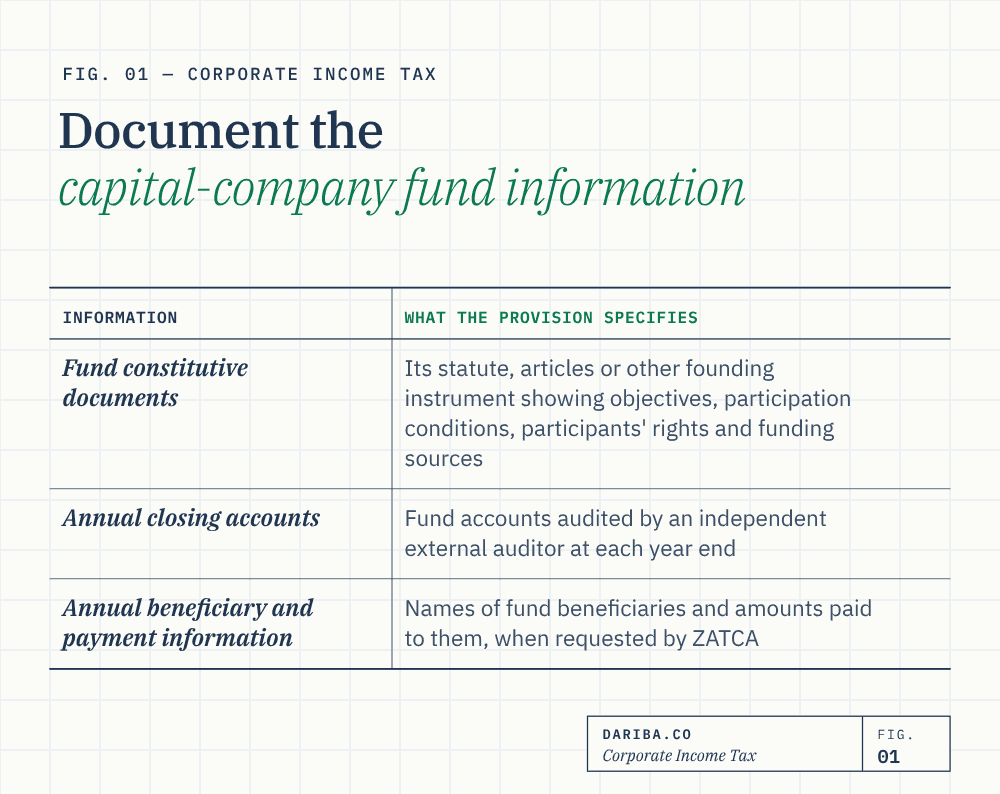
The information supplied to ZATCA about the funds must include the following Article 9(8) items:
| Information | What the provision specifies |
|---|---|
| Fund constitutive documents | Its statute, articles or other founding instrument showing objectives, participation conditions, participants’ rights and funding sources |
| Annual closing accounts | Fund accounts audited by an independent external auditor at each year end |
| Annual beneficiary and payment information | Names of fund beneficiaries and amounts paid to them, when requested by ZATCA |
The on-request wording belongs to the beneficiary/payment item. It should not be converted into an invented universal annual submission date, or used to say that every other fund-information requirement applies only after a request. Keep the actual notice and applicable submission instructions where they arise.
Dariba recommendation: maintain the fund documents and annual accounts alongside the company’s audited disclosure, contribution schedule and relevant employment contracts. Trace the persons and amounts in a requested beneficiary schedule to those records. This is a practical way to support the stated requirements; it does not certify a fund’s regulatory approval, the deduction of every contribution or a particular foreign scheme’s compliance.
The rule allowing an eligible independently constituted fund inside or outside the Kingdom does not remove the other conditions. Nor does compiling these documents make the employee’s own contribution deductible: the separate restriction in Law Article 20(c), Regulations Article 10(9) and the final wording of Article 9(8) remains relevant.
Source: current Arabic Income Tax Law, Article 20, p. 15, and Regulations Article 9(8), pp. 9–10, and Article 10(9), p. 11.
End-of-service provision use needs its tax history
Regulations Article 9(6) and section 3.3.1 address use of an end-of-service provision where the amount was previously added back and the qualifying expenditure is paid or incurred in the year with supporting documents. Accounting recognition when a provision is first formed does not establish the same relief.
Dariba illustration: assume SAR 300,000 was previously added back and SAR 80,000 is genuinely used this year for an otherwise qualifying, documented obligation. The relevant utilisation is SAR 80,000, subject to the statutory conditions; the remaining SAR 220,000 is not an additional current deduction merely because it remains in the reserve. Keep reversals and utilisation separately to prevent duplicate claims.
Owner remuneration and entertainment require separate review
Article 10(1) addresses wages and equivalent benefits for owners, partners and shareholders and names parents, spouse, children and siblings within its family wording, while expressly retaining the joint-stock-shareholder exception. Establish the actual recipient, relationship and company form before applying the restriction. Article 10(2) also addresses excessive property or service compensation. Section 3.3.3, Example 1, concerns profit distributed to a non-resident shareholder but recorded as salary. Its conclusion follows that disguised-profit fact pattern.
It should not be used to erase the express joint-stock exception or to assume that every director payment has identical facts. Entertainment under Article 10(3) is another separate restriction: a team party or leisure trip does not become deductible merely because employees attend or management considers it useful for morale.
Reconcile entitlement, settlement and the tax adjustment
Maintain a benefit register covering the employee, contract, policy, approvals, beneficiary institution, payment or accrual period, provision history and tax category. Review payroll codes for employer/employee fund splits and private benefits. Reconcile the schedule to payroll, audited accounts and the return.
This evidence allows the tax team to distinguish an acceptable recurring salary from a conditional benefit, a restricted contribution and utilisation of a previously disallowed provision. It also makes missing documents visible early. The main deductions guide explains how these conclusions feed the annual computation; this article does not independently determine labour-law entitlement or certify a fund’s regulatory status.
Key takeaways
- Payroll booking alone does not establish a deduction.
- Bonus contracts, policies and approvals need evidence.
- School fees require the specified licensed local-school and contract conditions.
- Employee and employer fund shares must be separated.
- Capital-company and other-employer funding routes differ.
- Previously added-back provisions require a utilisation history.
- Capital-company fund information includes constitutive documents and annual independently audited fund accounts.
- Annual beneficiary names and payment amounts are supplied when requested; no universal submission date is invented.
Sources
- Saudi Income Tax Law, current amended Arabic textArticle 20,p.15:separateemployer/capitalcompanyfundroutes andemployeeowncontribution restriction. Other retainedemployeeexpenseprovisions remain separately relevant.
- Income Tax Implementing Regulations, current amended Arabic textArticle 9(8),pp.9–10:capitalcompanyunfunded-liabilitylimit,independentfund,auditedcompanydisclosure,contracts andspecifiedfundinformation. Article 10(9),p.11:employeeownfundshare restriction. Otherretained9(6)–(7)/10 rules remainrelevant.
- ZATCA Guideline on the Conditions of Deductible Expenses, second version May 2026Relevant section and numbered examples are specified in the analysis. English guidance is read with controlling Arabic legislation.
General information only. Actual supplies, facts, applicable periods and controlling Arabic legislation determine the result. Official examples are distinguished from Dariba analysis and original illustrations. Seek advice or clarification where the arrangement or source material leaves a specific issue unresolved.