In brief
Tax depreciation follows statutory groups and movements. Article 17(e) specifies the measure for referenced transfers/distributions, and 17(g) uses its stated50% disposal-compensation comparison. Other asset, repair and historical conditions remain separate.
A tax asset schedule has a different purpose from the accounts
Income Tax Law Article 17 permits depreciation for qualifying tangible and intangible assets, excluding land, where value declines through use, deterioration or obsolescence, the asset serves taxable income wholly or partly, and value remains after the tax year. Regulations Article 9(4) adds the actual use, depreciable nature and ownership-document conditions. An asset bought for resale is not placed into this depreciation route merely because it appears in an asset listing.
The tax result follows statutory categories and group balances. Accounting useful life, impairment or a financial-reporting depreciation charge does not replace that calculation. The resulting book/tax difference can be a timing difference rather than a permanent disallowance.
Put the asset in its statutory category
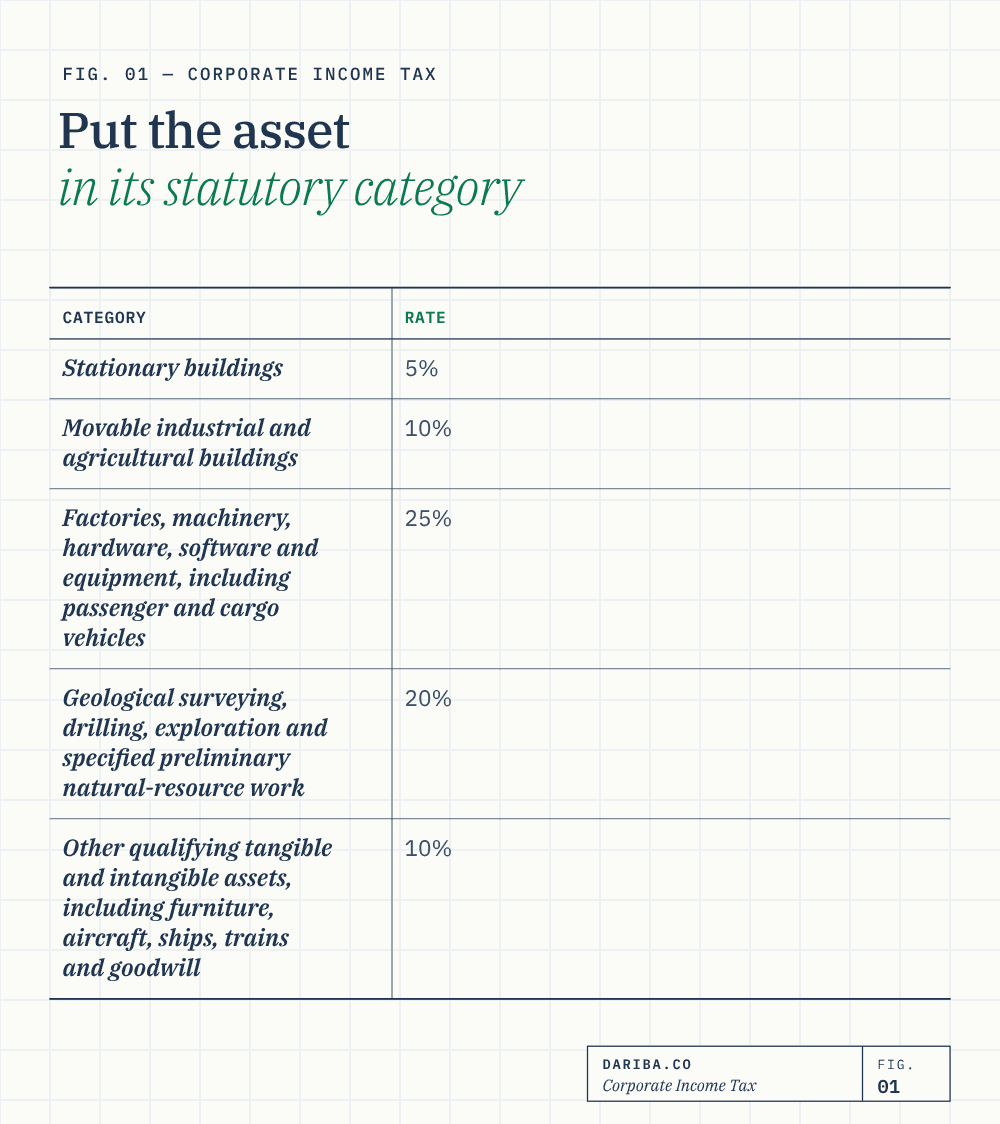
Article 17(b) specifies the following rates:
| Category | Rate |
|---|---|
| Stationary buildings | 5% |
| Movable industrial and agricultural buildings | 10% |
| Factories, machinery, hardware, software and equipment, including passenger and cargo vehicles | 25% |
| Geological surveying, drilling, exploration and specified preliminary natural-resource work | 20% |
| Other qualifying tangible and intangible assets, including furniture, aircraft, ships, trains and goodwill | 10% |
Classification matters before arithmetic. A software asset and goodwill are not assigned the same rate merely because both are intangible. For mixed land and building purchases, Article 17(j) requires a reasonable split to establish the building amount; land does not become depreciable through a single combined purchase price.
Use current and previous-year movements correctly
Article 17(d)–(e) applies the category rate to the calculated year-end group balance. Start with the previous closing balance after the previous year’s depreciation, add 50% of the cost basis of assets placed in service in the current and previous years, and subtract 50% of the compensation for disposals in those two years, subject to the statutory rules.
The previous-year component is important: the method is not simply half of every new purchase in every future year. Maintain in-service dates and the two years’ movement schedules. The amended paragraph also addresses specified transferred or distributed assets by reference to the statutory cost-basis provisions; ordinary sale proceeds should not automatically be substituted for those special amounts.
Measure the specified transferred and distributed assets correctly
Article 17(e) does not leave every non-cash movement to an assumed sale price. For the transferred or distributed assets it identifies by reference to Law Articles 9(m) and 10(c), it directs the compensation measure to the cost basis specified in Article 9(m)(1).
That referenced basis uses the transferor’s net book value, subject to the stated market-value ceiling. Establish the relevant amount under the actual provision before bringing it into the depreciation movement schedule. A nominal share amount, a consolidated-account valuation or a hypothetical full market-value sale price does not independently replace the prescribed measure.
Dariba analysis: the transaction’s eligibility and its measurement are separate steps. Article 17(e)‘s cross-reference does not establish that every internal transfer meets Article 9(m)‘s wholly owned group and two-year conditions, or that every distribution qualifies under Article 10(c). Equally, the absence of cash does not automatically make the relevant movement nil.
Use the group-transfer guide for the asset and issued-share basis rules and the exempt-income guide for the separate distribution conditions. Preserve the current/prior-year movement treatment where applicable; the special measurement is not permission to restart the recipient’s depreciation at a preferred valuation.
Source: current Arabic Income Tax Law, Article 17(e), p. 13, read with Article 9(m)(1), p. 10, and Article 10(c), p. 11. The compilation records the paragraph’s stated 2018 amendment effect; historical transaction treatment and the full amendment chain require their own review.
A Dariba pool illustration
Assume a qualifying 25% category has an opening balance of SAR 1 million after prior depreciation. Current in-service additions cost SAR 400,000 and the relevant previous-year additions cost SAR 200,000. Current disposal compensation is SAR 100,000 and the previous-year amount is nil. Ignore repairs, special transfers and other adjustments for this illustration.
The balance before current depreciation is SAR 1 million + SAR 300,000 − SAR 50,000 = SAR 1.25 million. Depreciation is SAR 312,500 and the remaining balance is SAR 937,500. This is Dariba’s original example applying Article 17, not an official ZATCA worked example or approval of any particular asset classification.
Disposals generally affect the pool
Law Article 9(b) and Regulations Article 8(1) direct depreciable-asset disposals into the statutory depreciation mechanism rather than an ordinary stand-alone book gain/loss calculation. Article 17(g) addresses the stated 50% amount of disposal compensation for the current and previous tax years exceeding the relevant remaining group value. The group is reduced to zero and the excess enters taxable income under that provision. Preserve that statutory 50% measure and the relevant group balance; comparing all sale proceeds directly with an unrelated accounting figure would not apply the stated test.
Article 17(h) permits deduction where the remaining group balance after the stated depreciation is less than SAR 1,000. Article 17(i) separately permits the remaining amount where all assets in the group have been disposed of. “Less than SAR 1,000” should not be changed to “SAR 1,000 or less”, and a single asset disposal does not establish that the entire group is empty.
Use changes and partial use need evidence
Article 17(f) treats conversion to private use or permanent cessation of taxable-income use as disposal at market value. Article 17(k) addresses the part used to generate taxable income. Keep a supportable use split rather than claiming full depreciation for a materially private asset.
Regulations Article 9(4)(d) also states that temporary cessation during the year does not itself prevent depreciation. Distinguish that situation from permanent withdrawal under Article 17(f). Dariba recommends recording the reason for downtime, intended use and disposal or withdrawal date so a temporary shutdown is not automatically treated as either continuing business use or a final exit without factual analysis.
Repairs and project contracts have separate provisions
Law Article 18 addresses repair and improvement expenditure by group, with a deduction limit of 4% of the stated year-end group value and addition of the excess to the group. The rule is not a universal immediate deduction for all costs described as maintenance. Reconcile the actual group, qualifying expenditure and statutory balance before applying the limit.
Article 17(l) provides an exception for BOT and BOOT contract assets, allowing depreciation over the contract period or remaining period when acquired or renewed during it. Establish the actual contract and asset facts. This CIT rule does not determine eligibility for the distinct Zakat operating-project deduction.
Geological and natural-resource rights require their own group
Law Article 19(a) deducts geological-survey and preparatory natural-resource extraction expenditure through amortisation at the rate specified in Article 17(b), with that expenditure forming a separate group. The relevant Article 17(b) category rate is 20%. Article 19(b) also applies this treatment to intangible expenditure incurred to acquire rights for geological surveying, processing and exploitation of natural resources.
Dariba analysis: the legal character of the acquired right matters. An expenditure within Article 19 should not automatically be assigned to the residual intangible category at 10% merely because the financial statements call it intangible. Equally, a project name or a broad mining-sector label does not establish that every cost falls within Article 19.
Keep the licence or rights agreement, acquisition scope, work records, cost support and separate group schedule. The amortisation rate is distinct from the income-tax rate applicable to the taxpayer’s activity. This section does not determine every oil, gas, mining, royalty or sector-specific tax question, or replace the actual group and timing calculation with an unsupported straight-line assumption.
Preserve the original-law opening basis for earlier assets
Law Article 81(a) addresses an asset purchased in a tax year before the original Law came into force. The amount introduced into the appropriate group is the asset’s cost less depreciation previously obtained by the taxpayer. The transition does not supply a general reset to market value or an accounting revaluation amount.
Dariba illustration — the historical opening amount only: assume an eligible asset within Article 81(a) cost SAR 1 million and the taxpayer previously obtained SAR 200,000 of depreciation. The amount entering the appropriate group is SAR 800,000. The illustration does not calculate a later year’s depreciation or determine the category without the actual asset facts.
Dariba recommendation: retain the original cost and prior tax-depreciation history in legacy asset and acquisition files. An accounting valuation or an incomplete opening register does not establish an additional tax basis. Article 81(a) concerns this original transition; later acquisitions, restructurings and legal changes require their own basis rules.
Establish the group-transfer basis before calculating depreciation
Law Article 9(m) and Regulations Article 8(2)–(3) contain the specific wholly owned capital-company group-transfer route. It requires the actual ownership chain and two-year external-disposal condition, sets the recipient asset’s book-value-based amount subject to market value, and continues the transferor’s depreciation method.
The group-transfer guide explains the distinct recipient asset and issued-share basis rules. A related-party label alone does not establish this route. Reconcile the actual basis and transfer history with Article 17’s particular group-movement provisions rather than treating every internal transfer as a fresh market-value purchase.
Reconcile the tax pools throughout the asset life
Retain acquisition and ownership documents, category, cost basis, in-service date, tax-use share, current/previous-year movements, special transfer basis, repairs, disposals and closing pool. Reconcile book depreciation and disposal gains to the tax adjustments. A purchase register without disposal history cannot support the full computation.
The May 2026 Guideline on the Conditions of Deductible Expenses, section 2.1, confirms the distinction between non-capital expenses and capital expenditure; the detailed mechanics above come from Law Articles 17–18 and Regulations Article 9(4). Sector-specific natural-resource treatment, unusual valuations and accounting deferred-tax recognition require their own analysis rather than assumptions taken from this ordinary pool illustration.
Key takeaways
- Tax depreciation follows statutory assets and conditions.
- Land is excluded and statutory categories have different rates.
- Pool movements include the specified current and previous-year amounts.
- Book disposal gains do not replace the tax pool mechanics.
- Temporary shutdown and permanent withdrawal differ.
- Repairs and BOT/BOOT contracts have separate statutory rules.
- Geological and specified natural-resource rights expenditure forms its own group.
- Article17(e) directs the specified transfer/distribution compensation measure to the Article9(m)(1) cost basis.
- Article17(g) uses the stated50% disposal-compensation amount for current/prior years in its comparison.
Sources
- Saudi Income Tax Law, current amended Arabic textFocused Article 17(e)/(g),p.13:specifiedtransfer/distributionmeasure by9(m)(1),p.10,and 10(c),p.11;50percentcurrent/prior-disposal comparison. Retained17–19/80–81 asset,repair,resourceandhistoricalrules remain relevant.
- Income Tax Implementing Regulations, current amended Arabic textArticle 74 states the original commencement and tax-year/payment distinction. Article 11(2) addresses excluded loss origins; other cited computation provisions remain.
- ZATCA Guideline on the Conditions of Deductible Expenses, second version May 2026Existing overview guidance retained; the added historical conditions follow the Law and Regulations directly.
- GSTC Explanatory Guide to the Income Tax Law and its Implementing RegulationsArticle 9, pp. 71–75: statutory transfer and basis framework. Current Arabic Law and Regulations govern; this is not a blanket current accounting or procedural source.
General information only. Actual supplies, facts, applicable periods and controlling Arabic legislation determine the result. Official examples are distinguished from Dariba analysis and original illustrations. Seek advice or clarification where the arrangement or source material leaves a specific issue unresolved.