In brief
Article 69(5) distinguishes set-off and retention; Article 59(8) separately addresses VAT credits against other taxes due. Official Example 27 concerns the same company’s unpaid fines, not automatic group-wide pooling or every disputed assessment.
A refundable VAT amount is not necessarily the amount paid into the bank. Article 69(5) permits set-off against specified amounts due to ZATCA and retention pending outstanding assessments. Article 59(8) separately addresses a VAT credit balance against other taxes due. These provisions require an account and legal-status analysis, not an assumption that carrying credit forward removes every offset risk.
The practical questions are whose credit it is, what amount is due, whether a set-off or retention decision has been made, and how the remaining credit or cash is reconciled. Common ownership of companies does not by itself answer those questions.
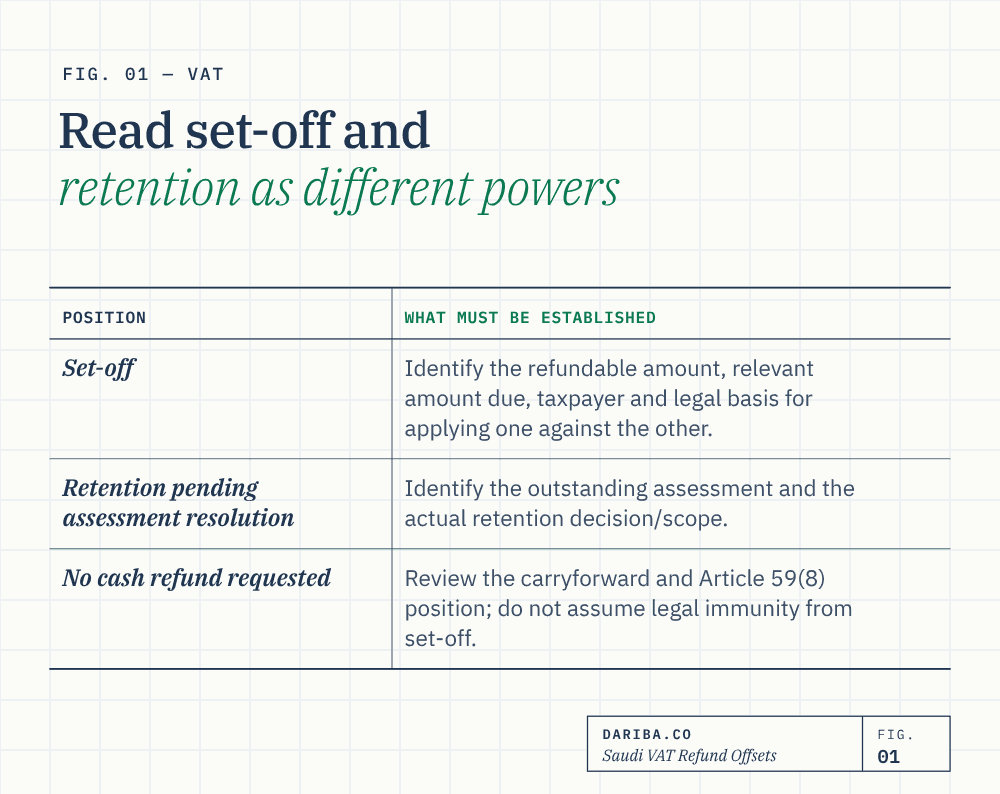
Read set-off and retention as different powers
Article 69(5) permits refundable amounts due to the taxable person to be set against tax, penalties or other amounts due under other laws supervised by ZATCA. It separately permits retention of the amount pending resolution of outstanding assessments issued against that taxable person.
| Position | What must be established |
|---|---|
| Set-off | Identify the refundable amount, relevant amount due, taxpayer and legal basis for applying one against the other. |
| Retention pending assessment resolution | Identify the outstanding assessment and the actual retention decision/scope. |
| No cash refund requested | Review the carryforward and Article 59(8) position; do not assume legal immunity from set-off. |
The existence of a disputed assessment does not establish that it is automatically a finally available offset amount in every case. Conversely, the retention limb should not be ignored merely because the dispute is unresolved. The applicable assessment, collection and objection position matters.
Source: Arabic VAT Regulations, Article 69(5), p. 70.
ZATCA’s example: unpaid import/export fines
Example 27, section 2.13 of the VAT Implementing Regulations Amendments Guideline, first issue, April 2025, p. 43, describes Company A’s second-quarter 2024 VAT return showing a net credit while import/export violation fines remain unpaid. ZATCA says those fines may be deducted from the refundable VAT due to that company. Read Example 27.
The example supports the cross-regime scope on its stated facts: a credit and unpaid fines of the same company. It gives no numerical amounts, and does not decide every disputed assessment, group-company liability or notification question.
The guideline describes the amendment as affirming the power’s scope. This article therefore does not repeat the unsupported historical claim that all pre-amendment offsets were limited to VAT alone. Current powers can be explained without inventing a categorical earlier-law position. A guideline issue date is also not, by itself, proof of a universal commencement date for every amendment.
Dariba illustration: calculate the remainder only after the legal tests
Assume a taxpayer has SAR 8 million properly established as refundable and SAR 5 million of its own amounts that are due and lawfully available for the described set-off. If ZATCA sets off that SAR 5 million, the remainder is SAR 3 million. Those amounts and assumptions are Dariba’s original illustration, not figures in Example 27.
Change the fact: the SAR 5 million is an assessment under dispute. Do not assume from the dispute label alone either that no action is possible or that exactly SAR 3 million must be paid now. Establish the actual legal status of the assessed amount and whether the Authority is applying set-off, retention or another applicable collection process. The article does not determine the result of that particular dispute.
This is useful for cash-flow planning because the accounting credit, refund approval, set-off and cash transfer can be different entries. Forecast the remaining cash from the actual decisions, not from the gross credit shown on the return alone.
Carryforward is not a universal shelter from set-off
Article 69(6) provides for requesting a refund or carrying excess credit forward. Article 59(8), however, permits set-off of a VAT credit balance against other taxes due from the taxpayer and requires notification. It is therefore too broad to say that avoiding a formal cash-refund application automatically avoids all offset powers.
The two provisions have their own wording and scope. A business should consider the expected use of the carried credit, relevant due amounts and Authority decisions rather than choosing a route on a promise of immunity this legislation does not give.
Sources: Article 59(8), p. 62; Article 69(6), p. 70.
Match the taxpayer and the actual decision
The provisions refer to the taxable person’s credit and obligations. A corporate group is not automatically a single tax account for every regime merely because its entities share an owner. Establish registration, any applicable group/joint-liability rules and the legal link before forecasting Company A’s refund against Company B’s standalone assessment.
Article 59(8)‘s notification requirement should be applied to the credit set-off it describes. Article 69(5) should not be rewritten to invent a universal pre-consultation requirement or a precise notification sequence absent from that paragraph. Retain the actual formal decisions, notices and account entries and reconcile what was applied and what remains. A disputed or unexplained entry needs review, not a guess about which power was exercised.
Retention does not establish an automatic permanent loss
Article 69(5)‘s retention limb is pending resolution of outstanding assessments. It does not mean every appeal automatically cancels the refund entitlement or that the taxpayer has no procedural rights. Nor should an article promise immediate cash simply because an objection has been lodged.
For an actual decision, identify its grounds, taxpayer, scope and the applicable review/objection route. Article 68 refers to the governing committee procedures; this guide does not invent an appeal deadline or decide whether collection is suspended in a particular case. Preserve the relevant rights and seek a clear account reconciliation.
The financial decision should compare a properly calculated refundable amount, legally relevant liabilities, possible retention, expected future VAT use and actual procedural status. Continue to refund claims and the VAT assessments overview for the distinct request, approval and examination rules.
Key takeaways
- Refundable amounts and legally relevant due liabilities must be identified before computing any cash remainder.
- ZATCA Example 27 concerns one company’s net credit and unpaid import/export fines; it gives no numerical amounts.
- The prior categorical claim that pre-amendment set-off was VAT-only is not repeated; the guideline affirms the current cross-regime scope.
- Dariba’s 8 million/5 million/3 million illustration assumes its own amounts are due and lawfully available for the described set-off.
- A disputed assessment can raise a separate retention question; it does not automatically establish the precise set-off or cash result.
- Carryforward is not immunity from Article 59(8), and common ownership does not itself establish one account across all taxes.
- Notification and review rights follow the actual provision and decision; no invented universal timing, automatic permanent loss or objection deadline is asserted.
Sources
- ZATCA - VAT Implementing Regulations, Arabic tenth edition, April 2025Articles 58-59 pp60-62;60-64 pp62-66;69 pp69-70;74 p78. Controlling Arabic text.
- ZATCA - VAT Implementing Regulations Amendments Guideline, first issue, April 2025Section 2.13 Example 27 p43: same-company refundable credit and unpaid import/export fines; Example 26 on overstatement correction p43. Issue date is not universal commencement proof.
General information only. Actual supplies, facts, applicable periods and controlling Arabic legislation determine the result. Official examples are distinguished from Dariba analysis and original illustrations. Seek advice or clarification where the arrangement or source material leaves a specific issue unresolved.