In brief
Article 66 establishes six years from period end, asset-cycle plus five and record controls. ZATCA states a fifteen-year property floor and distinguishes resident-server and permanent-establishment arrangements; a local login alone is not a universal offshore-storage approval.
Saudi VAT records must explain how transactions became the amounts in a return, and remain available in the required form, language, location and period. Article 66 therefore requires more than keeping a folder of invoice documents.
The general retention period is six years from the end of the related tax period. Capital assets, real estate, electronic invoices and particular taxpayer arrangements require further analysis. A system’s convenient deletion setting is not the legal retention policy.
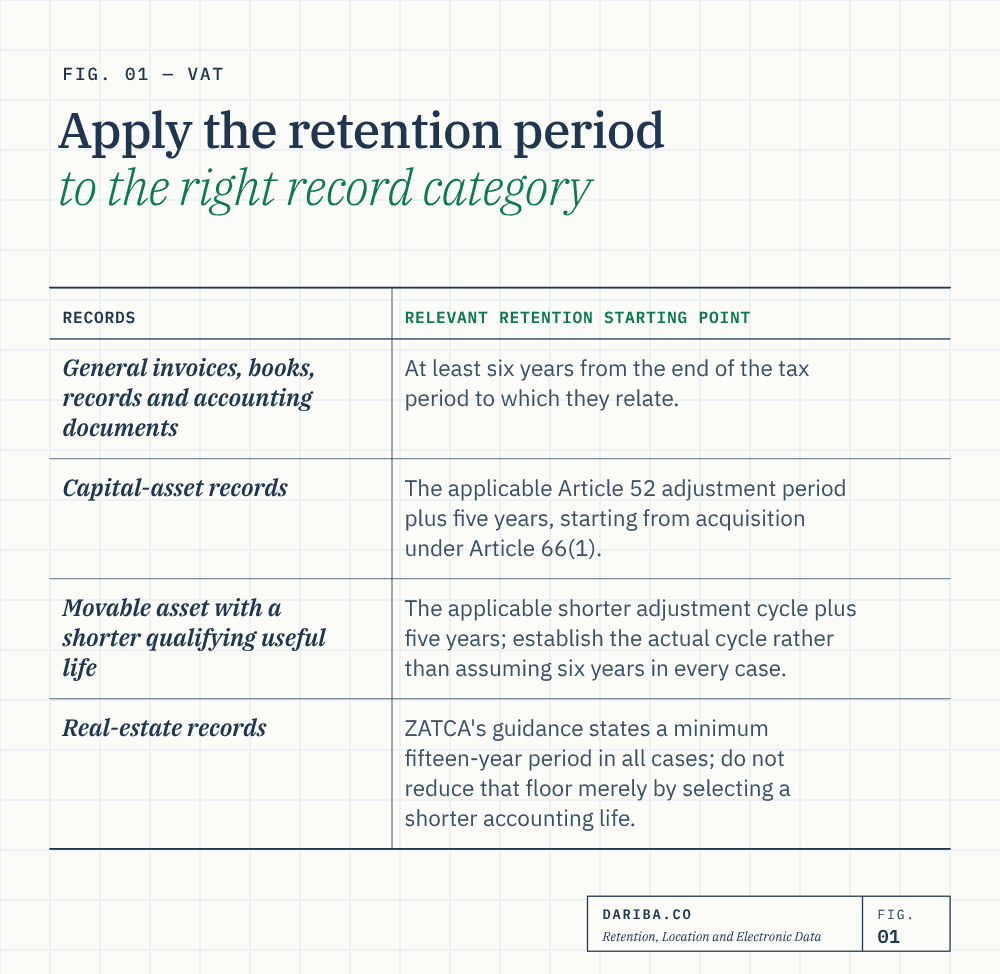
Apply the retention period to the right record category
| Records | Relevant retention starting point |
|---|---|
| General invoices, books, records and accounting documents | At least six years from the end of the tax period to which they relate. |
| Capital-asset records | The applicable Article 52 adjustment period plus five years, starting from acquisition under Article 66(1). |
| Movable asset with a shorter qualifying useful life | The applicable shorter adjustment cycle plus five years; establish the actual cycle rather than assuming six years in every case. |
| Real-estate records | ZATCA’s guidance states a minimum fifteen-year period in all cases; do not reduce that floor merely by selecting a shorter accounting life. |
Sources: Arabic Regulations, Article 66(1), p. 67; Tax Invoicing and Records Guideline, version 3, May 2026, section 8.3.3, p. 42.
The guideline explains a six-year ordinary movable adjustment cycle plus five, or eleven years, and the shorter-useful-life case. Article 52’s ordinary immovable cycle is ten years, giving fifteen with the additional five. These are different from the ordinary six-year-from-period-end calculation. Other applicable retention requirements and specific open matters still need review before disposal.
Dariba illustration: a return archive is not an asset archive
Assume a general record relates to the quarterly period ending 31 March 2026. Six years from that period end reaches 31 March 2032. That is a minimum-period calculation, not blanket approval to delete everything on the following day.
Now assume a movable capital asset acquired in 2026 has the ordinary six-year adjustment cycle. Six plus five gives an eleven-year retention duration from acquisition. If the applicable cycle is a qualifying four years, the formula gives nine. These are Dariba’s original duration illustrations, not numbered ZATCA examples; actual acquisition dates, asset classification, property rules and other obligations remain material.
The practical implication is to classify records by their longest applicable use and obligation. An acquisition invoice may support the initial return, an asset adjustment and later disposal analysis. Deleting it merely because the initial return’s ordinary archive period has ended can remove evidence still needed for the asset.
Retain the calculation chain, not invoices alone
Section 8.2, p. 40, gives an illustrative, unnumbered list including issued/received invoices, accounting records, contracts and correspondence, bank/financial records, import/export/shipping documents and other VAT calculation/return material. It is not an exhaustive inventory of every business’s records. Read ZATCA’s list.
Apply that principle to the actual decisions in the return: rate and exemption evidence, customer status, tax-point events, SAMA conversion calculations, direct attribution, apportionment, adjustments and correction explanations. Retain relevant self-billing agreements/acceptance records and the links between invoices and notes. These applications explain the record’s purpose rather than inventing a prescribed universal spreadsheet layout.
For each material item, a reviewer should be able to trace from the return through the calculation to the transaction and supporting evidence. Outsourcing bookkeeping or retaining only a summary ledger does not necessarily preserve that trail.
Arabic and location requirements need separate attention
Article 66(2) requires Arabic records and Arabic invoice information, with other languages permitted alongside. Paragraph (3)(b) qualifies electronic data entry by what is practicable while preserving other legal obligations and consistency with the underlying records. That qualification is not a general exemption from Arabic invoices.
Article 66(3) addresses keeping records in the Kingdom in paper or electronic form with the required Kingdom access point. ZATCA’s section 8.3.1, p. 41, further states that a resident taxpayer’s computer/server must be in the Kingdom, while describing a permanent establishment’s central overseas system with a local workstation providing access to its VAT data. Do not turn that specific explanation into a claim that every resident company’s offshore-only cloud arrangement is compliant merely because somebody can log in from Riyadh.
The Arabic provision, the guidance’s distinction and the other rules expressly preserved by Article 66(3) must be considered for the actual architecture and taxpayer. Where a proposed storage arrangement relies on a broader reading than that guidance, resolve the specific point rather than certify it from access alone. Article 66(2)–(3), pp. 67–68 supplies the controlling legislative context.
Electronic records must remain usable and protected
Article 66(3) includes retrieval on request, consistent electronic entries, original supporting documents, documented data-entry/accounting procedures, controls against tampering and possible review of the systems. The business needs a usable audit trail, not merely a successful cloud backup notification.
Paragraph (3)(h) additionally requires electronic invoices and notes to be preserved in the applicable format and manner. The published implementation resolution’s clause Fifth, p. 6, addresses storage and archival. Preserve the required electronic invoice and associated data; printing and deleting the underlying structured record is not an equivalent compliance method. A compliant PDF/A-3 containing the required XML is also different from an ordinary print-to-PDF file, so “all documents are invalid” would be too broad.
Sources: Article 66(3), p. 68; published E-Invoicing Implementation Resolution, clause Fifth. The resolution’s English text is a translation; Arabic controls.
Third-party custody and requests do not remove responsibility
Article 66(4)(a) permits a resident taxpayer to appoint a Kingdom-established third party while retaining its responsibility. Paragraphs (4)(b) and (5) distinguish a non-resident without a Kingdom tax representative from one whose representative holds the records. Sections 8.3.4–8.4, pp. 42–43, explain those arrangements.
Ensure contracts preserve access, export and continuity if a provider changes. These are practical controls for operating the obligation, not a claim that appointing any overseas service provider satisfies the Kingdom third-party conditions.
Retention, ZATCA’s examination/assessment powers and the response date in a particular records request are different matters. Do not replace Article 66’s rules with an assumed universal five- or twenty-year archive, or assume every examination provides the same notice period. For an actual request, preserve the relevant material and establish its scope and deadline. The advisory priority is to keep the evidence available and reconstructible, then apply the correct legal process.
Key takeaways
- General records require at least six years from the related tax-period end; asset and property records need their separate periods.
- An ordinary six-year movable cycle plus five gives eleven years; a qualifying four-year cycle gives nine. Property guidance retains a fifteen-year floor.
- ZATCA’s unnumbered section 8.2 list illustrates invoices, contracts, financial/shipping records and other VAT calculation evidence.
- Arabic records and invoice requirements remain; electronic-entry practicability is not a blanket Arabic-invoice exemption.
- The guidance distinguishes resident-server and permanent-establishment cases. Do not certify offshore-only storage from Kingdom access alone.
- Required electronic data and audit trails must remain usable; a PDF/A-3 containing required XML differs from an ordinary printout.
- Third-party custody does not remove the taxpayer’s responsibility; examination/assessment and retention clocks are distinct.
Sources
- ZATCA - VAT Implementing Regulations, Arabic tenth edition, April 2025Articles 20 pp21-22;49(7)-(8) p49;53-54 pp55-59;63 pp63-64;66 pp67-69. Controlling Arabic text.
- ZATCA - Tax Invoicing and Records Guideline, version 3, May 2026Section 4.5.2 Examples 9/9-A pp26-27;8.2-8.4 pp40-43;10.4 p49.
- ZATCA - Published E-Invoicing Implementation Resolution, English translationClausesSecond pp2-4;Fifth p6;Seventh p7. Current official legislation page links this resolution. Arabic version prevails.
General information only. Actual supplies, facts, applicable periods and controlling Arabic legislation determine the result. Official examples are distinguished from Dariba analysis and original illustrations. Seek advice or clarification where the arrangement or source material leaves a specific issue unresolved.