In brief
The recipient exemption in Article 3(a)(4) and the public-authority transferor exemption in Article 3(a)(5) have different conditions. Government ownership, public purpose and a nonprofit label do not by themselves establish every transaction's relief.
Government involvement is the start of a RETT enquiry, not its conclusion. Establish the actual parties, the direction of the transfer and the precise exemption. A public body’s purchase and its commercial sale can have different results.
Start with the direction and legal category
The Real Estate Transaction Tax Law and ZATCA’s RETT Implementing Regulations distinguish these routes:
| Route | Core enquiry |
|---|---|
| Article 3(a)(4): transfer to a qualifying recipient | Does the actual recipient fit a specified public or public-benefit category? |
| Article 3(a)(5): transfer from a public entity as public authority | Is the qualifying entity exercising public authority and meeting all three conditions? |
| Article 3(a)(6): expropriation or temporary taking | Does the actual statutory acquisition/taking framework apply? |
| Article 3(a)(12): foreign government or diplomatic category | Are the qualifying-party and reciprocity requirements established? |
The exemptions should not be collapsed into a rule that anything entering public hands is automatically exempt or anything leaving them is automatically taxable.
Transfers to public and public-benefit recipients
Article 3(a)(4) identifies four recipient categories. These include public entities or public legal persons, the specified civil-foundation/association category, government-directed public-benefit transfers, and entities or projects holding public-benefit status.
The Arabic wording matters. The civil foundation, مؤسسة أهلية, whose bylaws have the prescribed public-interest purpose, is distinct from an association granted public-benefit status by the competent authority. Do not treat every nonprofit association with worthy objects as automatically qualifying.
Establish the relevant constitutive document, status or government direction. Public share ownership alone neither proves public legal personality nor answers every possible category.
ZATCA’s Detailed RETT Guideline, Version 6, section 5.1.4, Examples 21–22, printed pages 26–27, illustrates a ministry buying for SAR 1.5 million and a public authority buying revenue-generating commercial property for SAR 10 million. The stated purchases are exempt. Consideration and revenue-generating use do not themselves defeat the qualifying recipient route.
Transfers from a public authority
Article 3(a)(5) requires public-authority capacity and three cumulative conditions: an instrument authorizing the relevant public-authority activities; a transaction not conducted according to economic or commercial criteria; and no competition with the private sector.
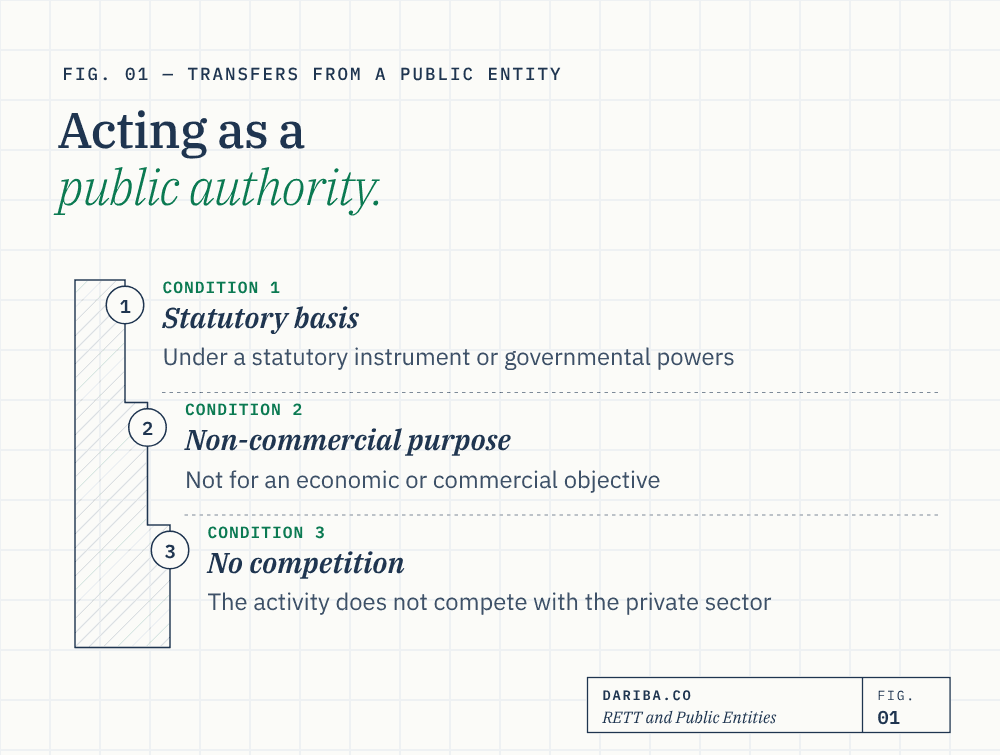
Assess the actual transaction and programme. A free transfer, subsidy or public policy objective does not alone prove all conditions. Conversely, the fact that a private party could hypothetically transfer similar property does not itself establish competition in the actual arrangement.
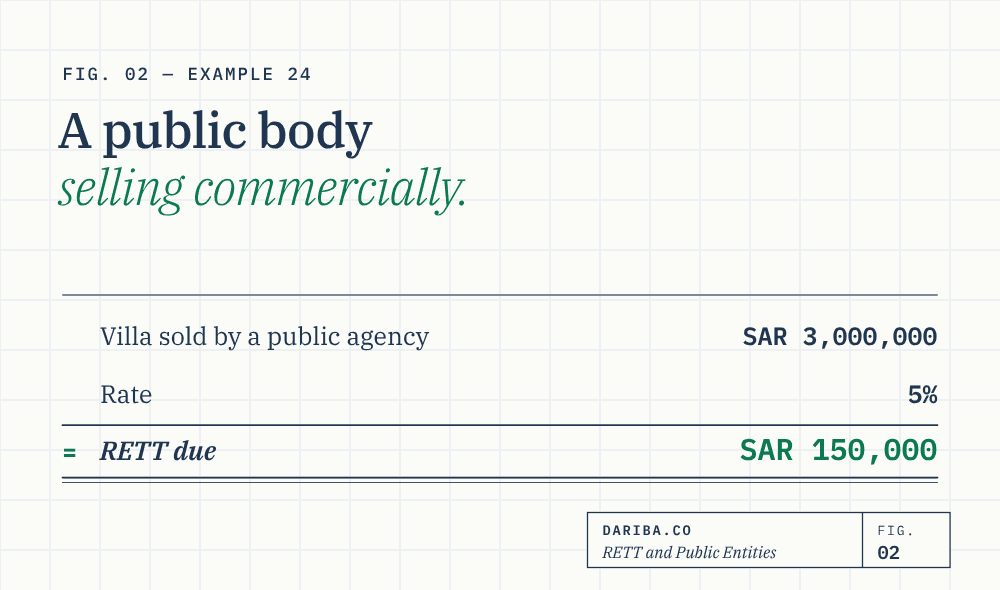
In section 5.1.5, Example 23, printed page 28, the ministry grants an apartment without consideration within its statutory housing role. Example 24 involves a SAR 3 million villa sold through an investment programme in commercial competition with the private sector. The latter is taxable on the stated facts; SAR 150,000 is Dariba’s 5% calculation.
If Article 3(a)(5) is not established, check other routes before declaring the transfer taxable. A commercial transfer to another independently qualifying public recipient may raise Article 3(a)(4). See the public-authority companion.
Expropriation is its own exemption
Article 3(a)(6) concerns the prescribed expropriation or temporary-taking process, including the specified return to the original owner. A negotiated sale does not become expropriation solely because a public road or national project motivates it.
Use the operative decision and applicable statutory process. The route is an exemption from RETT, rather than a statement that every public acquisition is outside the tax’s scope. The expropriation guide addresses that separate provision.
Record the actual basis
Keep the party’s legal identity, category and operative status evidence, transaction documents, valuation and exemption registration. Article 11(f)‘s five-year retention period runs from the relevant transaction date.
Law Article 7’s statutory responsibility is distinct from who agrees to fund tax or how a price is negotiated. An exemption does not itself prescribe a particular price reduction or create a refund credit. Use the recipient guide for the category analysis and the diplomatic guide for foreign-party reciprocity.
Key takeaways
- Identify the actual recipient, transferor and direction before selecting a public-sector exemption.
- Article 3(a)(4) has specified recipient categories; the Arabic foundation and association limbs are distinct.
- The recipient route can cover a purchase for consideration and the guideline's revenue-generating public-authority purchase.
- Article 3(a)(5) requires public-authority capacity and all three stated conditions; a subsidy or public mandate alone is insufficient.
- Failure of the selected route is not automatic failure of every other exemption.
- Expropriation is a separate statutory exemption, not a universal declaration that public acquisitions are outside RETT.
Frequently asked questions
Does government ownership alone settle RETT?
No. Identify the actual legal entity and applicable route. State share ownership alone does not establish public legal personality, public-benefit status or an actual public-authority transaction.
Is every nonprofit association a qualifying recipient?
No. The Arabic Article 3(a)(4)(b) distinguishes a qualifying civil foundation's public-interest purpose under its bylaws from an association granted public-benefit status by the competent authority. A general nonprofit or educational purpose alone does not establish the association limb.
Is a commercial sale by a public body always taxable?
A commercial sale does not qualify under the public-authority route merely because its seller is public. But another route, such as transfer to an independently qualifying public recipient, may still apply. Assess the transaction before declaring a universal result.
Does the recipient's commercial use defeat its exemption?
The guideline's Example 22 treats a qualifying public authority's revenue-generating acquisition as exempt. That does not remove the need to establish the actual recipient category and any instrument-specific conditions.
Sources
- ZATCA — Real Estate Transaction Tax Law (Arabic), Articles 3, 5 and 7
- ZATCA — RETT Implementing Regulations (Arabic)Articles 3(a)(4)–(6), 3(a)(12) and 11
- ZATCA — Detailed RETT Guideline, Version 6, May 2026Sections 5.1.4–5.1.6 and 5.1.13; Examples 21–25 and 39
Reviewed against the controlling Arabic RETT Law and Implementing Regulations and ZATCA's Detailed RETT Guideline Version 6 (May 2026). Entity status, operative instruments and any reciprocity must be established on the actual facts. Guidance does not amend legislation. Dariba.co is independent of ZATCA; general information, not transaction-specific advice.