In brief
RETT taxes qualifying property transactions at 5% under their actual scope, value and relief rules. Apply transaction-specific dates, separate VAT treatment and any distinct ownership-law fee independently.
Saudi Real Estate Transaction Tax (RETT) is generally charged at 5% of the taxable value of a qualifying property transaction. Start by identifying the rights transferred, the parties, the value and the transaction date. Then test any exemption and the applicable payment procedure.
The charge can arise even where the seller makes no profit. It also extends beyond an ordinary sale of a completed building: the Law covers specified transfers of ownership or use rights, and the Regulations address indirect interests, off-plan property and other arrangements.
Identify the current legal framework
The RETT Law issued by Royal Decree M/84 entered into force on 12 Shawwal 1446H, corresponding to 10 April 2025. The Implementing Regulations issued under Board Resolution 01-03-25 of 24 March 2025 took effect with it. The Law and Regulations are separate instruments, so identify which one an article reference belongs to.
RETT originally began on 4 October 2020 under the earlier framework. Saudi Arabia’s standard VAT rate had already increased to 15% on 1 July 2020. The introduction of 5% RETT should therefore not be described as preserving the VAT rate then applying to ordinary taxable supplies.
ZATCA’s Detailed RETT Guideline, version 6, May 2026, explains the current framework and includes historical examples. Keep an example’s actual period and facts when using it. Apply the transitional provisions where tax became due before 10 April 2025.
Establish what is being transferred
Law Article 1 includes transfers of property ownership, permanent use rights and use rights for a period exceeding fifty years, directly or indirectly. The actual arrangement determines whether a transaction falls within that definition.
| Arrangement | Point to establish |
|---|---|
| Sale of land or a completed property | Ownership, taxable value, transaction date and any exemption |
| Gift or estate distribution | The particular exemption and its conditions |
| Long-term usufruct | The rights granted, duration and specific valuation and date rules |
| Interest in a real estate company | Company classification, transferred interests and related-transaction rules |
| Off-plan sale or BOOT project | The transaction-specific date and valuation provisions |
| Financing arrangement | The parties and conditions for the applicable security or taxed-once provisions |
Regulations Article 2(b) also treats specified movable property placed by its owner in property they own as real estate when intended for its permanent service or exploitation. Article 2(d) includes inseparable permits and rights in the value. Support any allocation between property and other assets with the actual facts.
The transaction-scope guide and the provision companions below explain these categories in more detail.
Calculate the tax on the applicable value
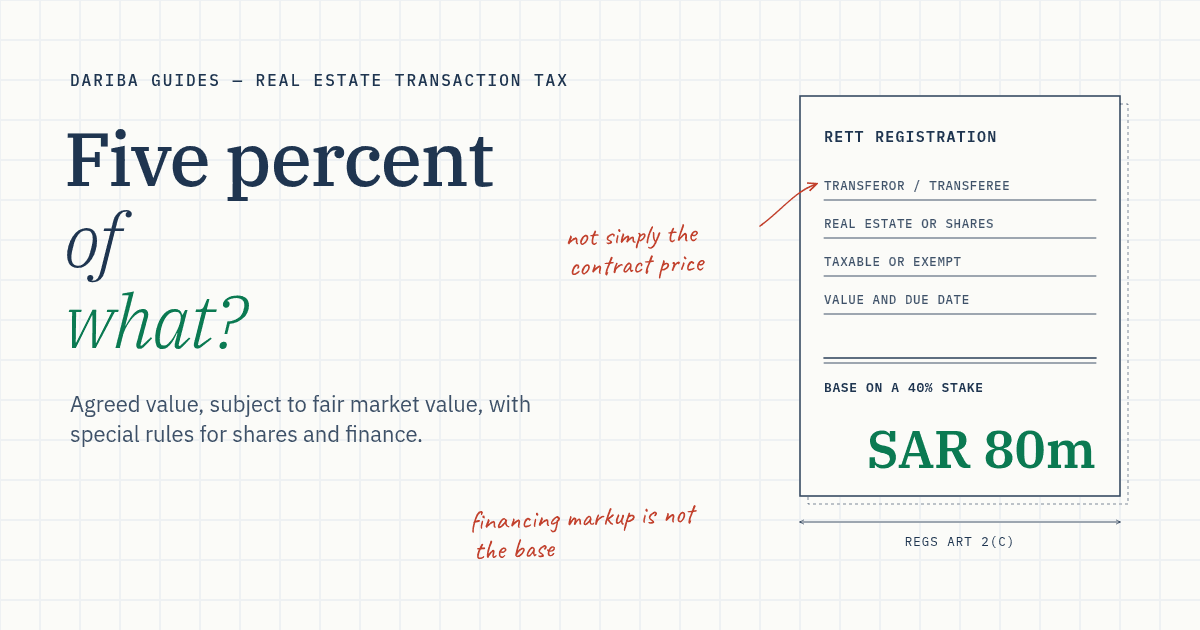
Law Article 2 and Regulations Article 2 use the agreed cash or in-kind consideration subject to the fair-market-value condition and the specific valuation rules. A related-party price, book value or allocation in a contract requires support.
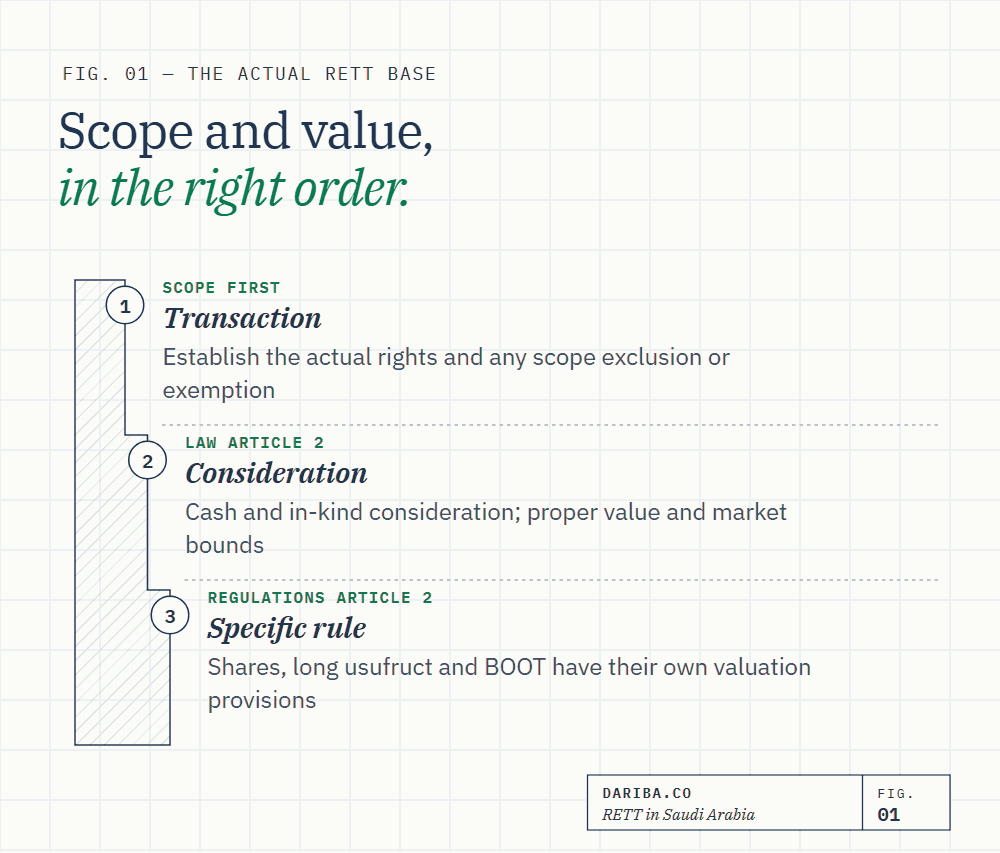
For taxable share transfers, usufructs and BOOT arrangements, apply their particular rules. An ordinary property sale calculation cannot simply be substituted for every indirect or long-term transaction.
Dariba illustration. Assume Khalid sells a villa for SAR 2,800,000, that the price satisfies the applicable valuation conditions and that no exemption or State support applies.
| Calculation | Amount |
|---|---|
| Taxable transaction value | SAR 2,800,000 |
| RETT at 5% | SAR 140,000 |
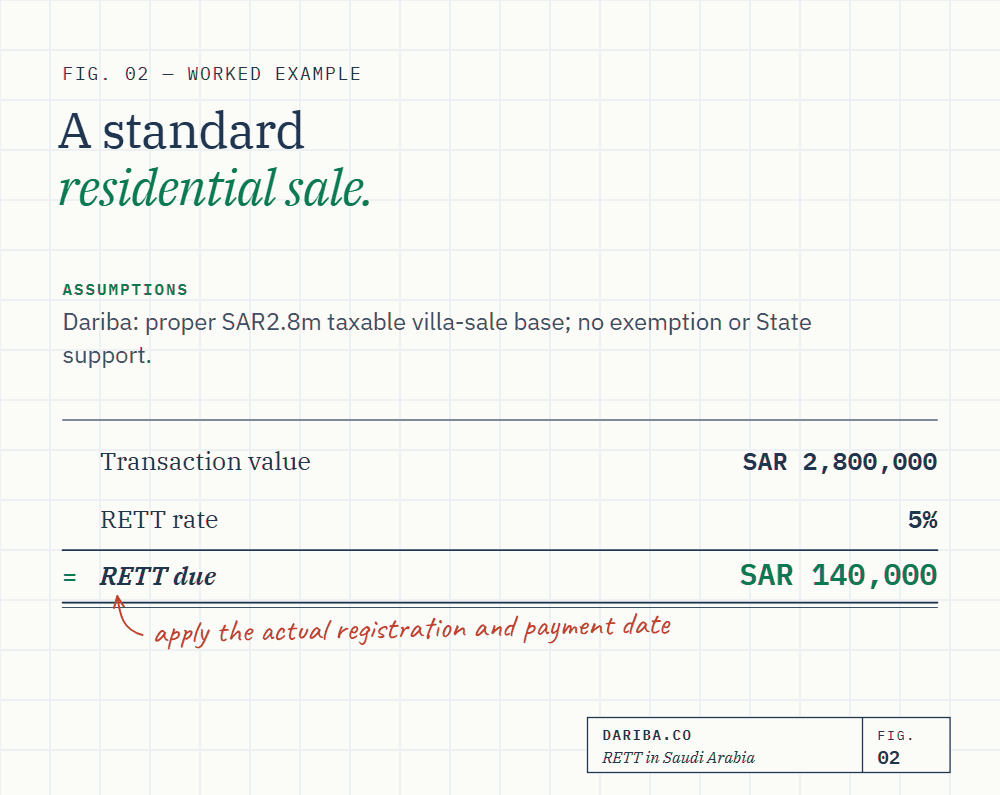
The illustration isolates the tax calculation. Complete the actual registration and payment process using the transaction’s applicable dates.
Check exemptions and first-home support separately
Law Article 3 sets out exemption categories; Regulations Article 3 supplies their conditions. Estate divisions, qualifying gifts, specified public-interest transfers, contributions, reorganizations and other transactions each need their own analysis.
An exemption may depend on continuing ownership or other conditions. A transaction’s label alone does not establish eligibility. The exemptions guide organizes the categories and their detailed companions.
First-home support is a separate State-bearing mechanism. For an eligible Saudi citizen’s qualifying first home, the State can bear RETT on up to SAR 1 million of home value, giving maximum tax support of SAR 50,000. Verify the current Sakani eligibility, certificate and ZATCA processing. The first-home guide shows the gross tax, State support and remaining amount separately.
Check the separate ownership-law fee
For a relevant non-Saudi disposal, the ownership legislation also provides a distinct REGA fee. Its prescribed 2% schedule and zero-fee cases have their own scope and conditions; they do not change RETT’s standard rate or automatically share its relief. See the separate disposal-fee guide.
Establish the liable person and the payment date
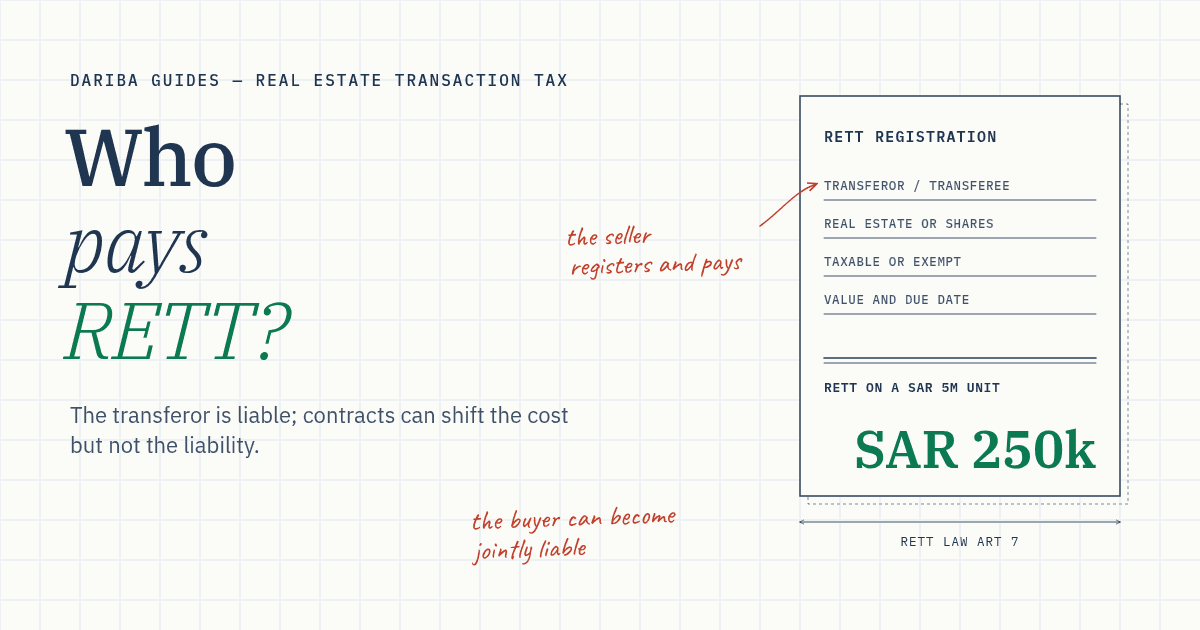
Law Article 7 makes the transferor responsible for payment. An agreement that the buyer bears the cost does not remove that statutory responsibility. The transferee can be jointly liable where ZATCA establishes the causal involvement specified in the Law.
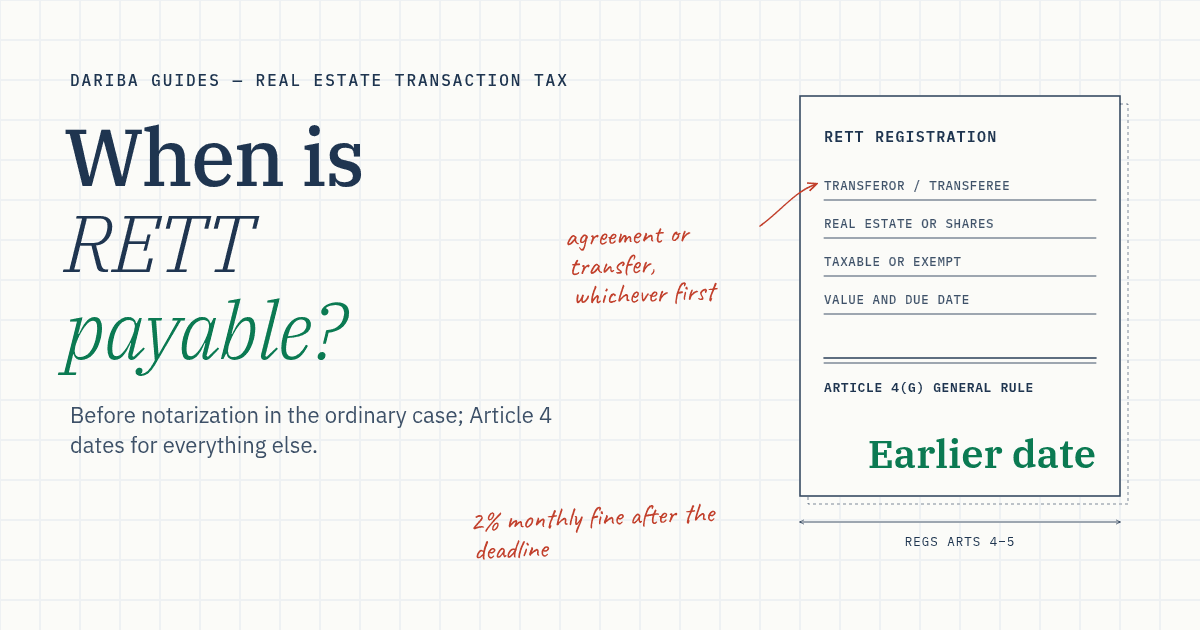
Law Articles 4–5 and Regulations Articles 4–5 distinguish the transaction date from permitted later payment. For an ordinary notarized transfer, complete the applicable tax process on or before notarization. Unnotarized transactions, share transfers, BOOT projects and failed conditional exemptions have their own provisions.
Keep the signed agreement, actual transfer, notarization and any condition-breach dates in the file. The payment-date guide explains why one universal signing-date rule is insufficient.
Apply VAT to the actual supply
VAT Regulations Article 30 exempts the specified supplies by transfer of property ownership and residential rental. Apply those provisions independently of the RETT exemption analysis. A RETT-exempt ownership disposal does not automatically become VAT-taxable.
| Ordinary supply, assuming its relevant conditions | VAT position |
|---|---|
| Disposal of property ownership within Article 30 | Exempt |
| Qualifying residential rental | Exempt |
| Taxable commercial rental by a taxable supplier | Standard rate, ordinarily 15% |
| Taxable construction or property-management services | Standard rate, ordinarily 15% |
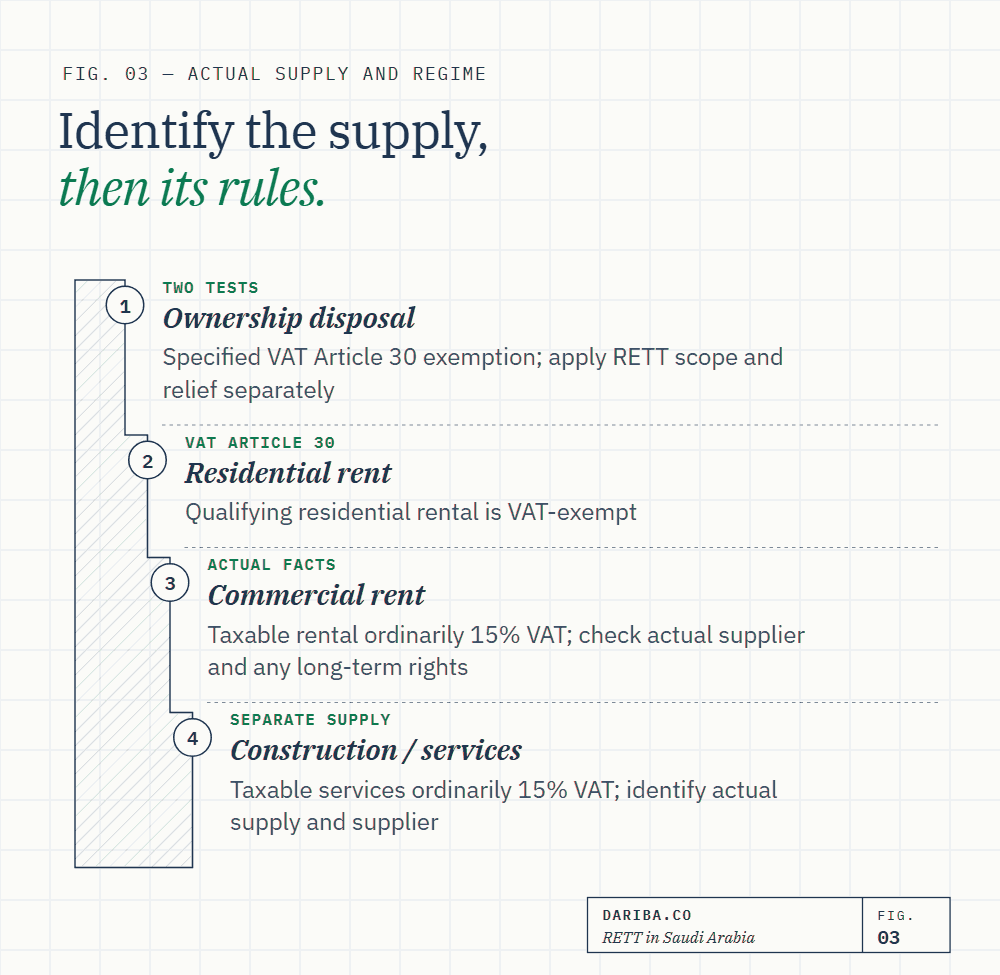
The diagram summarizes ordinary categories. Special rights, mixed supplies and the actual supplier still require their own classification.
A developer’s input VAT must also be reviewed separately. Exempt property sales affect ordinary recovery, while an eligible developer may have access to the separate authorized refund arrangements. RETT does not provide an input VAT credit against its own charge.
Keep assessment periods and records distinct
Law Article 8 and Regulations Article 8 distinguish ordinary disclosed transactions from unnotarized or undisclosed transactions, where the Authority’s awareness is relevant. They also preserve the exception concerning breached time conditions of exemptions.
For tax due before 10 April 2025, Regulations Article 14 contains separate transitional rules. The issuing decree’s historic-documentation route and Cabinet Resolution 206’s extension are another distinct question; see the 2026 correction-extension guide. A general statement that every transaction becomes protected three years after signing is insufficient.
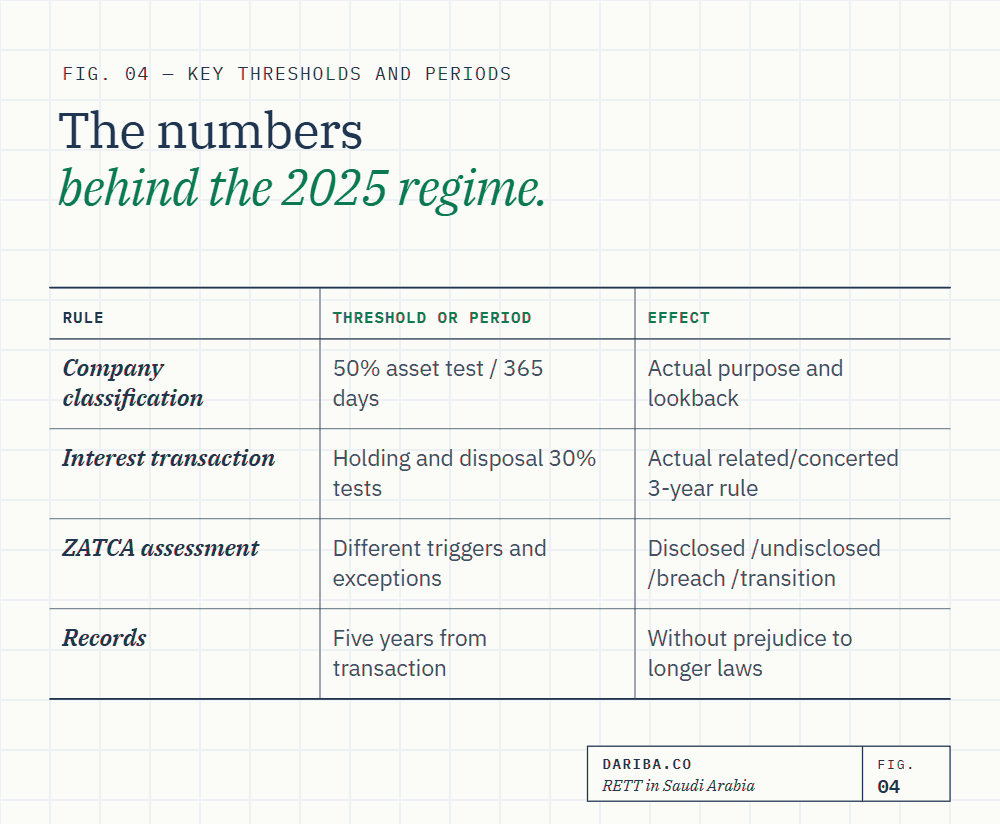
The selected company and interest tests require their actual purpose, holding, lookback and related-disposal conditions. Assessment periods have separate triggers and exceptions; they are not a single universal look-back. The value-verification guide explains them.
Regulations Article 11(f)(3) requires records for five years from the transaction date, without prejudice to a longer period required by another law. Keep the evidence supporting value, payment and exemption conditions retrievable; retain what is needed for an ongoing condition or actual dispute.
Close registration and payment with evidence
Register the transaction through ZATCA’s applicable process, recording the property, parties, value, rights and exemption basis where relevant. Exempt transactions retain their registration obligations. Confirm the actual payment or exemption outcome before completion.
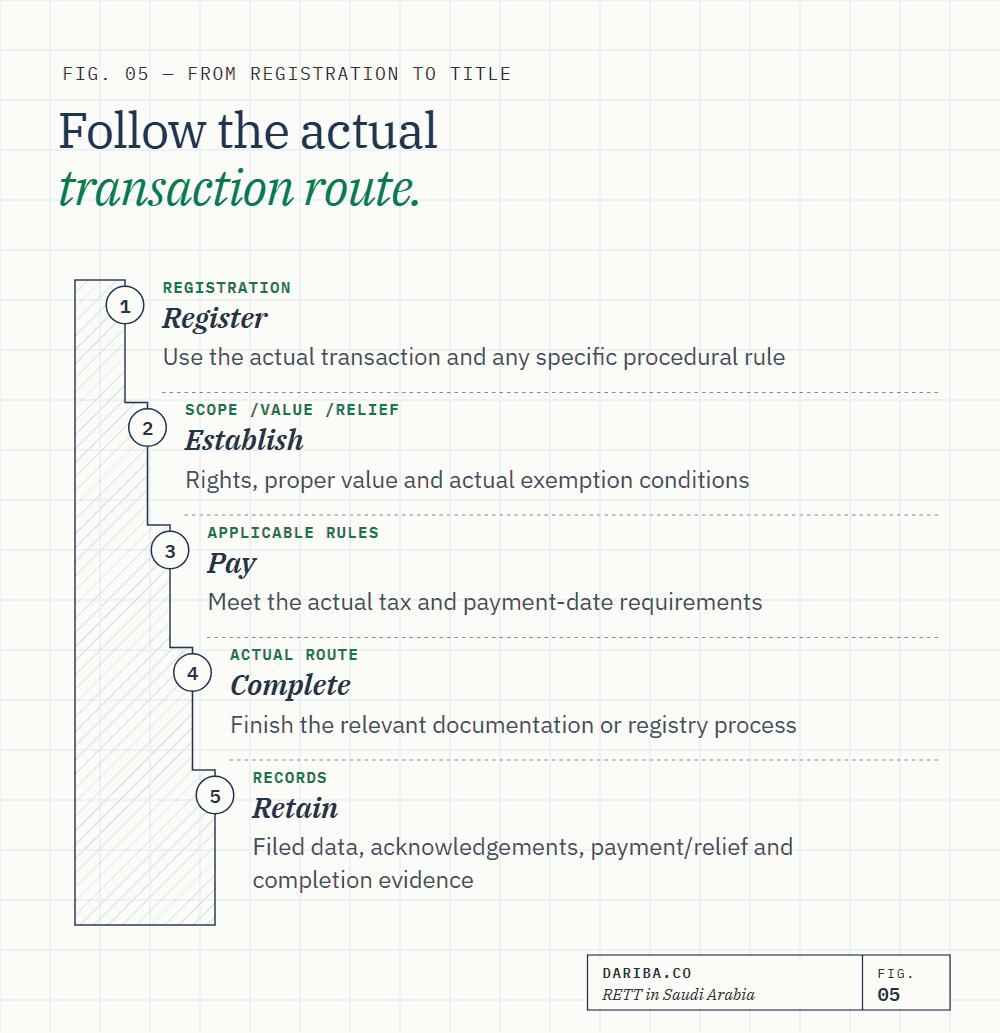
Keep the filed data, supporting documents, acknowledgement, payment and completion evidence together. The filing and payment guide describes the process. A portal entry does not itself prove that the valuation or exemption conditions are satisfied.
Article-by-article companions
These links organize the RETT section. Their presence is not a complete paragraph-level legal review; use the controlling source and facts for the actual transaction.
| Provision | Topic | Guide |
|---|---|---|
| Article 1 | Definitions: related persons, agreed disposal, merger, acquisition | Read |
| Article 2(a) | The 5% charge and its scope | Read |
| Article 2(b) | Movables deemed real estate | Read |
| Article 2(c) | Total value and fair market value | Read |
| Article 2(d) | Permits and rights in rem in the value | Read |
| Article 2(e) | Valuing share transfers in real estate companies | Read |
| Article 2(f) | Usufructs over 50 years | Read |
| Article 2(g) | BOOT projects | Read |
| Article 2(h) | Real estate company definition (50% test) | Read |
| Article 2(i) | The 30% share transfer threshold | Read |
| Article 2(j) | Capital increases in real estate companies | Read |
| Article 2(k) | Subdivision and partition of co-owned property | Read |
| Article 2(l) | Taxed once: murabaha, ijarah and finance lease | Read |
| Article 4 | Transaction (due) date for non-notarized disposals | Read |
| Article 5 | Payment deadlines after the transaction date | Read |
| Article 6 | Deceptive or hidden transactions | Read |
| Article 7 | Transferor liability and transferee joint liability | Read |
| Article 8 | ZATCA value verification, reassessment and collection | Read |
| Article 9 | Refunds | Read |
| Article 10 | Confidentiality | Read |
| Article 11(a) | Registering a transaction | Read |
| Article 11(b) | Correction requests | Read |
| Article 11(c) | Examination and inspection powers | Read |
| Article 11(d)–(e) | Notices and electronic forms | Read |
| Article 11(f)–(g) | Record keeping and representatives | Read |
| Article 12 | Guidelines, tax alerts and rulings | Read |
| Article 13 | Objection and grievance | Read |
| Article 14 | Transitional provisions for pre-April 2025 transactions | Read |
Key takeaways
- Establish the actual ownership/use rights, scope exclusions and exemption before calculating tax.
- The standard 5% rate applies to the proper taxable transaction value, with particular valuation rules for shares, long usufruct and BOOT.
- First-home State bearing has separate eligibility and certificate conditions.
- RETT transaction/payment dates and assessment periods do not share one universal trigger.
- Ordinary record retention is five years from the transaction, without prejudice to longer laws.
- Specified property ownership supplies and residential rental are VAT-exempt; actual other supplies require their own VAT analysis.
- The REGA non-Saudi disposal fee and historic correction extension are separate provisions.
Frequently asked questions
What is the RETT rate?
The ordinary rate is 5% of the taxable transaction value under Law Article 2, subject to the applicable exemption and valuation rules. It is not a tax on the seller's profit.
Is first-home support a RETT exemption?
It is a separate State-bearing mechanism for eligible Saudi citizens. It covers RETT on up to SAR 1 million of an eligible first home's value, giving maximum tax support of SAR 50,000. Verify the actual eligibility and certificate through Sakani and ZATCA.
Who is responsible for paying RETT?
The transferor is responsible under Law Article 7. A contractual agreement for the buyer to bear the cost does not remove that responsibility. The transferee becomes jointly liable where ZATCA establishes the statutory causal involvement in non-payment.
Is every RETT-exempt transfer subject to VAT instead?
Each regime must be applied to the actual supply. VAT Regulations Article 30 exempts the specified ownership-disposal supplies and residential rental; a RETT exemption does not automatically switch an ownership disposal into VAT. Commercial rental and services require their own VAT analysis.
Does ZATCA always have only three years to assess RETT?
No. Law Article 8 and Regulations Article 8 distinguish ordinary disclosed transactions from unnotarized or undisclosed transactions, and preserve the exception for breached exemption conditions. Regulations Article 14 adds separate rules for tax due before the new Law.
How long must RETT records be kept?
Regulations Article 11(f)(3) requires five years from the transaction date, without prejudice to a longer period under another law. Keep the evidence needed to substantiate ongoing exemption conditions and any actual review or dispute.
Sources
- Saudi Real Estate Transaction Tax Law, Royal Decree M/84, controlling Arabic textArticles 1–9 and 15: transaction scope, valuation, exemptions, dates, liability, assessment and penalties.
- RETT Implementing Regulations, Board Resolution 01-03-25 of 24 March 2025, Arabic textArticles 2–5, 8, 11(f) and 14: scope, dates, assessment clocks, five-year retention and transition.
- ZATCA Detailed RETT Guideline, version 6, May 2026Sections 1.1, 4.2–4.3, 6, 7.2 and 9–10; Examples 8–9. English reading aid; Arabic prevails.
- Ministry of Municipalities and Housing, Sakani first-home tax-bearing serviceCurrent service conditions, certificate process, SAR 1 million home-value ceiling and maximum SAR 50,000 support, checked 20 November 2026.
- ZATCA, About Value Added TaxVAT standard rate increased to 15% on 1 July 2020.
- Saudi VAT Implementing Regulations, current Arabic compilationArticle 30: exempt property ownership disposals and residential rental; these provisions are separate from RETT exemptions.
- Umm Al-Qura — Ownership Law Implementing Regulations (Arabic)Articles 9–10: distinct REGA disposal fee and zero-fee cases.
- Umm Al-Qura — Cabinet Resolution 206, 21 Safar 1448 AH (Arabic)Express extension of issuing Royal Decree Fourth(1), separate from Regulations Article 14.
Reviewed against the controlling Arabic RETT Law and Implementing Regulations, current VAT Article 30 and the separately identified ownership/correction provisions on 21 November 2026. Updated diagrams apply the same actual scope, value, relief and date distinctions as the text. Dariba is an independent information platform; general guidance does not certify an actual transaction or every historical instrument.