In brief
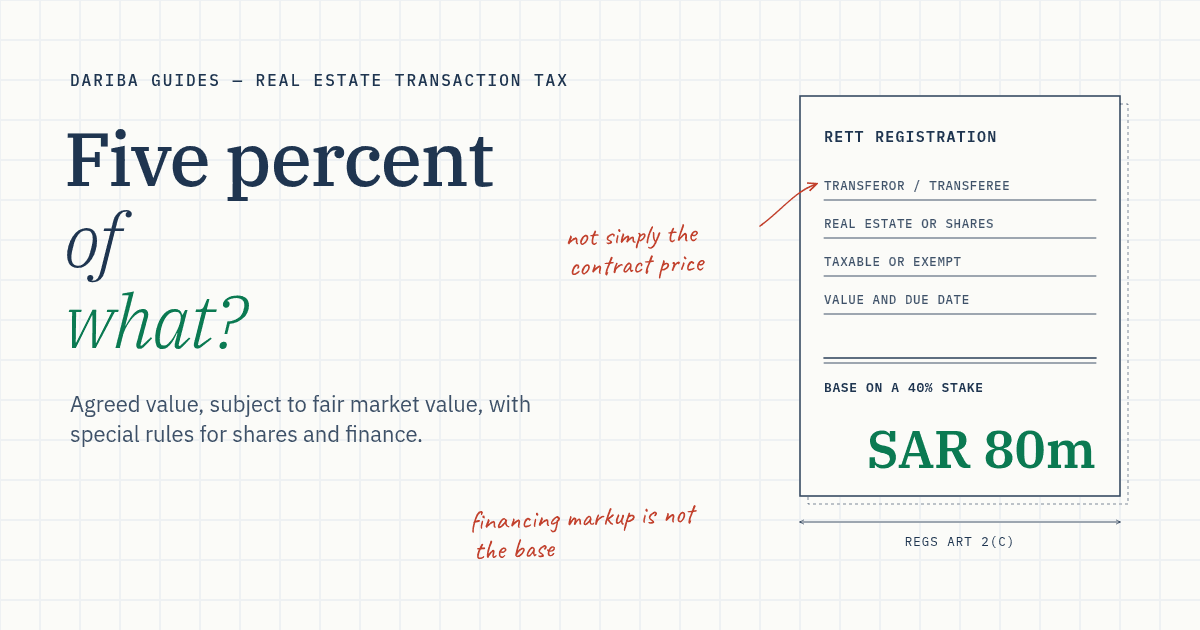
Article 2(c) addresses agreed cash or in-kind real-estate consideration within fair-market-value limits, subject to special rules. It does not automatically add every transaction cost or loan balance, nor exclude every amount labelled financing profit.
Article 2(c) of ZATCA’s RETT Implementing Regulations addresses the actual value of agreed cash or in-kind consideration connected with the real-estate transaction, within the fair-market-value framework and subject to Article 2’s special cases.
Identify the property consideration
Cash, exchanged property, share consideration, services or an assumed obligation may contribute value to a property disposal. Establish what the parties actually give for the property, rather than rely only on invoice names.
A separately documented amount may still be property consideration. Conversely, not every consultancy fee, financing payment or business acquisition cost is automatically part of the property base. Identify any genuinely separate services, rights and assets.
Law Article 6 and Regulations Article 6 concern fictitious or concealed arrangements and actual rights. They do not make every independent service fee a disguised price without the facts.
Dariba debt illustration: additional value or double counting?
Assume a buyer pays SAR 2 million and, in addition, legally discharges SAR 1.5 million of the seller’s property-related obligation as actual consideration. Assume the proper total taxable value is SAR 3.5 million, with no separate exclusion or relief. Tax at 5% is SAR 175,000.
That result depends on the additional-value assumption. If an agreed total price already includes the debt discharge, adding it again would count the same value twice. A buyer’s loan funding an already counted price is also not automatically extra consideration.
Likewise, identify whether an amount is genuinely financing-term cost, another obligation or property price. Debt balance is not a universal substitute for property value.
Preserve the official market-value and financing examples
ZATCA’s Detailed RETT Guideline, Version 6, section 4.2, Examples 8–9, printed page 17, gives:
| Official example | Stated facts and selected base |
|---|---|
| Example 8 | Related parties agree SAR 1 million for land; fair market value is SAR 1.5 million; the selected base is SAR 1.5 million |
| Example 9 | SAR 1 million home with approximately SAR 400,000 financing cost over ten years; the selected property base is SAR 1 million |
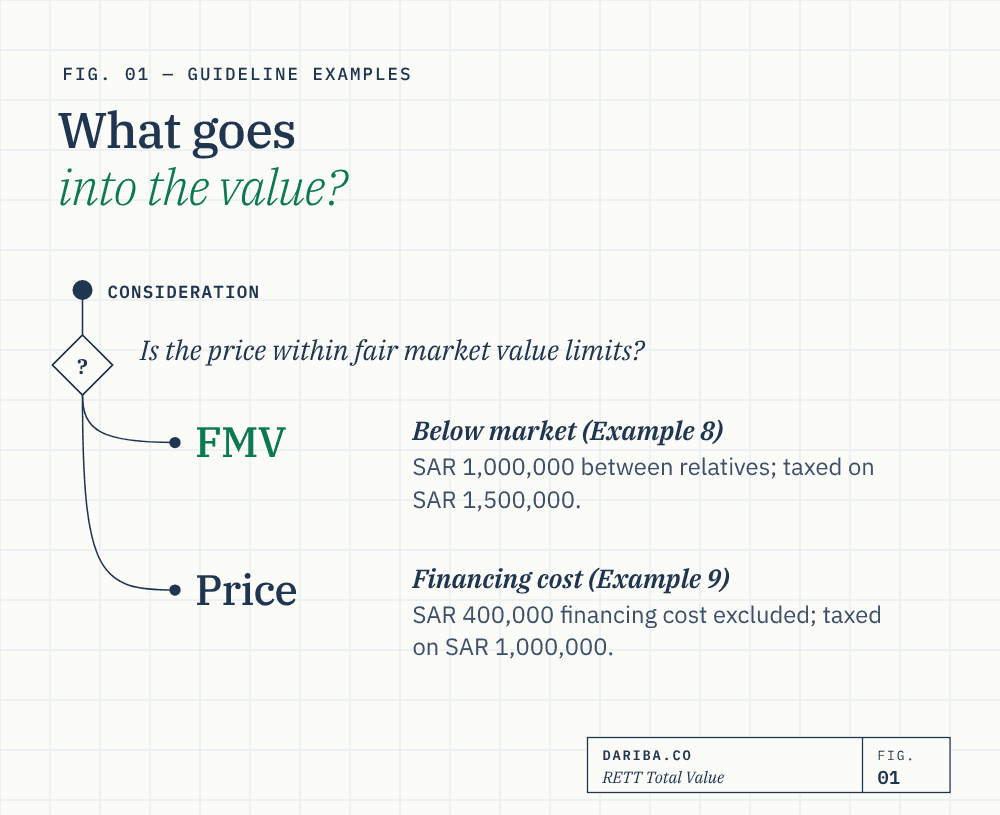
Dariba’s 5% calculations are SAR 75,000 and SAR 50,000, respectively. The second example does not establish a deduction for any amount merely called profit.
Law Article 2(2)‘s exclusion concerns term cost of financing from legally licensed entities. Keep the actual property consideration and financing-cost evidence distinct from Article 2(l)‘s linked-financing conditions.
Dariba exchange and premium-price cases
Assume two taxable property disposals without relief. A transfers a plot with proper value SAR 4 million. B transfers a plot worth SAR 3.5 million and pays SAR 500,000 to balance.
A’s assumed base is SAR 4 million, giving SAR 200,000 tax. B’s is SAR 3.5 million, giving SAR 175,000. The combined tax is SAR 375,000. The balancing cash must be reconciled with the actual reciprocal consideration, not added indiscriminately to both property values.
For a separate ordinary-sale illustration, assume genuine property consideration of SAR 6 million and fair market value of SAR 5 million, with no other components or relief. Do not automatically reduce the base to SAR 5 million merely because it is the lower valuation. On the assumed SAR 6 million proper ordinary-sale base, tax is SAR 300,000.
Special valuation rules still govern
The ordinary consideration/FMVs discussion is not a universal formula for every transaction. Article 2(e) has the company-interest calculation, Article 2(f) uses its stated present-value measures for long usufruct, and Article 2(g) governs relevant BOOT transfer-date market value.
The tax-base guide, usufruct guide and BOOT companion explain those distinctions.
Evidence and review
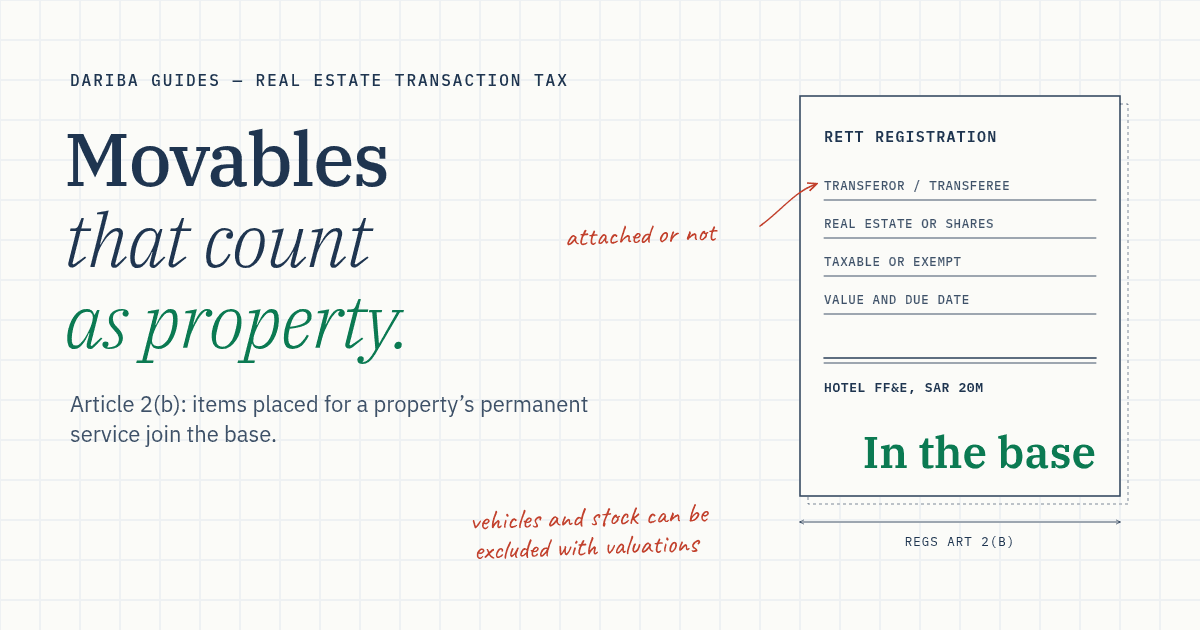
Keep the actual consideration schedule, property and other-asset allocation, debt discharge/funding evidence, financing split and valuation basis. Include relevant inseparable rights and qualifying movables once, without using a separate invoice as automatic exclusion or adding an already included component twice.
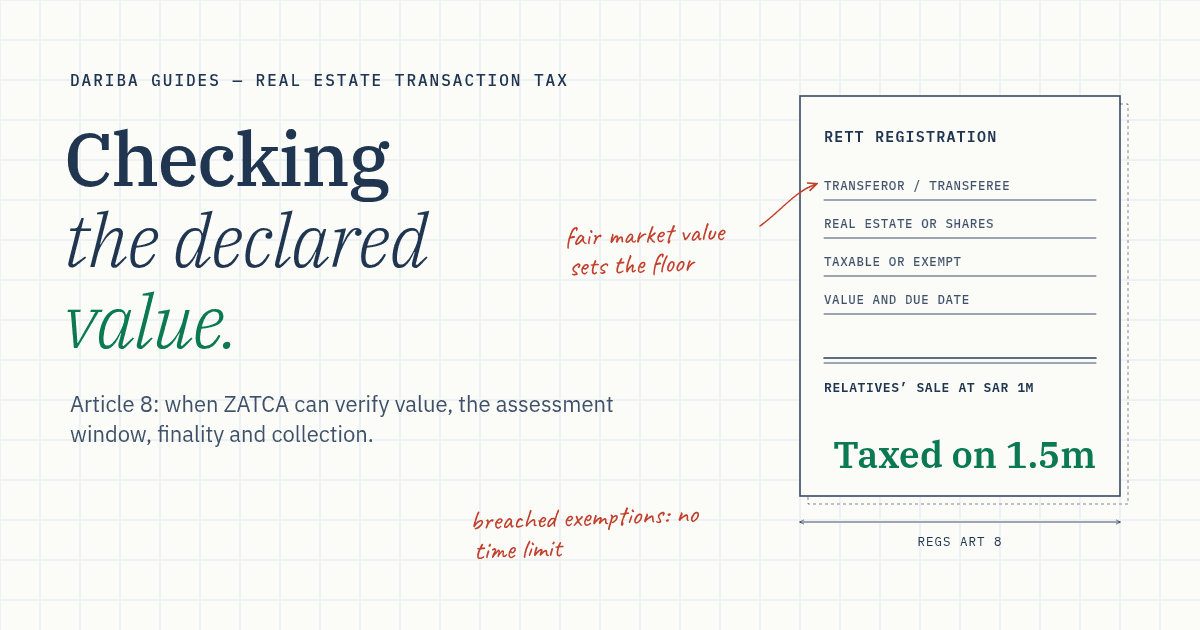
Regulations Article 8 permits valuation review in the stated circumstances. Related status does not itself mandate a particular adjustment, and an accredited report is evidence rather than guaranteed acceptance. Any gift relief requires its actual conditions, not simply a family relationship or a low agreed price.
Key takeaways
- A price, debt or side-payment label does not establish the actual consideration by itself.
- Additional debt discharge can be consideration; a loan merely funding an already counted price must not be added again.
- Genuinely separate services or rights need their own facts; every transaction-related fee is not automatically disguised property price.
- Licensed financing-term cost is excluded under Law Article 2(2), distinct from general profit or every deferred payment.
- The ordinary fair-market-value analysis does not replace the special company-interest, usufruct or BOOT bases.
- A family relationship alone does not establish gift relief or an automatic valuation adjustment.
Frequently asked questions
Is the mortgage balance always added to the cash price?
Establish whether actual additional debt discharge is part of the consideration or the amount is already included in the agreed price/funding. Do not count the same value twice or assume every outstanding financing amount is property consideration.
Are all consultancy fees and transaction costs included?
No blanket result follows from the label. Identify whether the amount is actual consideration for the property or genuinely separate services/rights. Article 6 addresses concealed or fictitious arrangements; it does not deem every genuine service fee disguised consideration.
Can any amount labelled financing profit be excluded?
Law Article 2(2) concerns term cost in legally licensed financing. Establish the actual nature and qualifying facts. It is not a deduction for every commercial profit, ordinary deferred price or debt balance.
Does fair market value always replace a higher genuine sale price?
For the ordinary consideration rule, do not assume a lower valuation automatically caps a higher genuine property price. Establish the actual base and any special provision. The share, usufruct and BOOT rules have their own valuation measures.
Sources
- ZATCA — Real Estate Transaction Tax Law (Arabic), Articles 1–3 and 8
- ZATCA — RETT Implementing Regulations (Arabic)Articles 2(b)–(g), 3(a)(14) and 8
- ZATCA — Detailed RETT Guideline, Version 6, May 2026Definitions of real estate; section 4.2 and Examples 8–9, printed pages 16–17
Reviewed against the controlling Arabic RETT Law and Implementing Regulations and ZATCA's Detailed RETT Guideline Version 6 (May 2026). Classifications and Dariba numerical illustrations require their stated ownership, rights, value and other facts. General information; no individual valuation or exemption approval is implied.