In brief
For tax due before 10 April 2025, Article 14 has separate assessment, penalty and refund rules. Preserve earlier conditions, actual notices and historical balances.
Start a pre-law RETT review by establishing when the tax became due. Regulations Article 14 addresses tax due before the current RETT Law entered into force on 10 April 2025. The date of a later payment or assessment does not by itself determine the transaction’s original regime.
Keep the original transaction, due date, disclosure, exemption terms, payments, assessments and notices in one file. Then apply Article 14’s separate provisions for assessment, fines and refunds.
Identify the assessment case
Article 14(a) distinguishes the following situations:
| Case under the provision | Relevant trigger |
|---|---|
| The stated disclosed transaction with value below the applicable fair-market-value bounds | Three years from commencement of the Law |
| The stated undisclosed transaction | Three years from the later of Authority awareness or commencement |
| Breached exemption conditions under the rules applicable to that transaction | The preserved exception to those restrictions |
The provision should not be reduced to one date covering every earlier transaction. An undisclosed case needs evidence of the actual awareness date; an exemption case needs the conditions in force for that transaction.
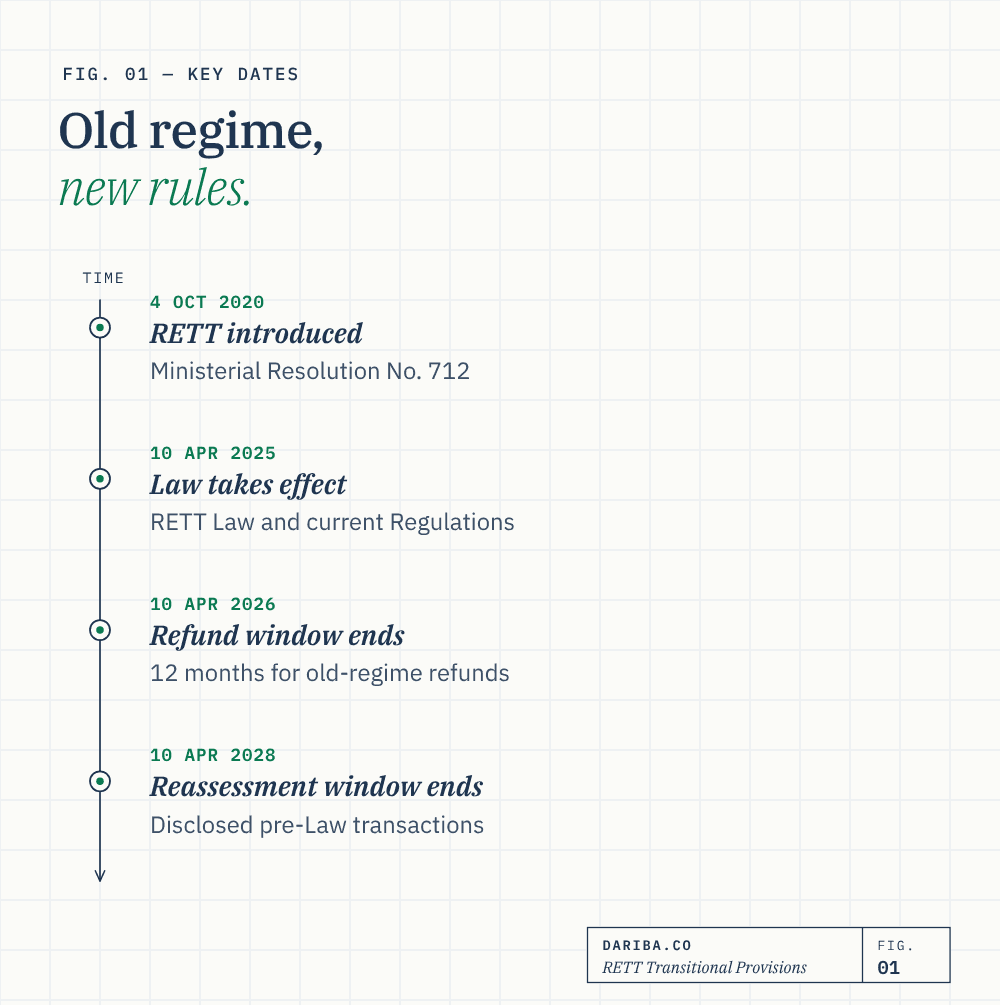
The diagram gives Gregorian anniversary illustrations for the ordinary commencement-based periods. It does not resolve the applicable calendar calculation for a real filing, an awareness-based period, an exemption breach or a later final-decision route.
Keep original exemption conditions in the review
Article 14(a)(3) refers to restrictions under the Regulations applicable at the transaction date. Preserve the original claimed exemption and the condition that was allegedly breached.
A current guide’s five-year example does not by itself establish the condition for every earlier transaction. Establish the actual instrument and facts before calculating a clawback or relying on an assessment restriction.
Dariba arithmetic. Assume a disclosed pre-law taxable transaction was reported at SAR 2 million and is properly reassessed using a SAR 2.6 million base. At 5%, the tax changes from SAR 100,000 to SAR 130,000: SAR 30,000 additional tax. This calculation does not establish the claim deadline or penalty.
Bridge fines across commencement
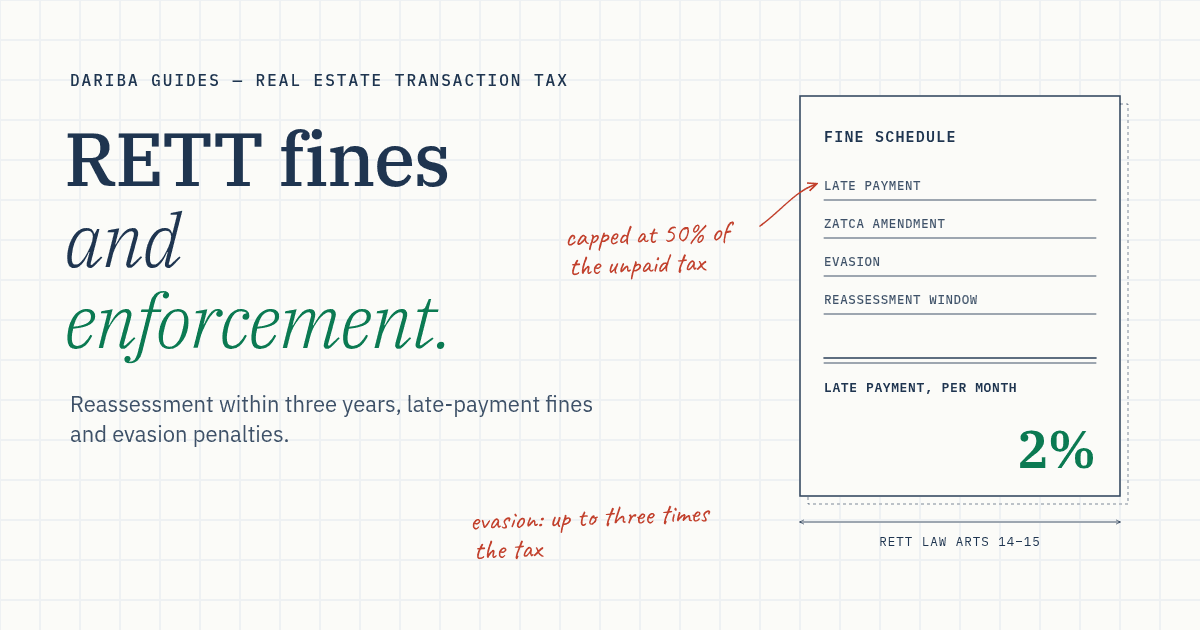
Article 14(b)(1) addresses the earlier fine period under Ministerial Resolution 712 and its amendments, and the 2% monthly-or-part-month calculation after commencement under the stated conditions.
It also addresses fines already calculated at commencement, including the case where those fines exceed 50% of the unpaid tax. Preserve that wording when reconciling the account. The provision does not state a general automatic refund or write-off of every older amount above the later ceiling.
Dariba illustration. Assume SAR 100,000 remains unpaid, a correctly established SAR 30,000 earlier fine balance, and four qualifying counted post-law months at 2%, with no other component in this illustration.
| Bridge | Amount |
|---|---|
| Stated earlier fine balance | SAR 30,000 |
| Illustrated post-law component: SAR 100,000 × 2% × 4 | SAR 8,000 |
| Illustrated combined balance before other items | SAR 38,000 |
The SAR 30,000 is an assumed established opening figure; the example does not calculate an old-regime rate. If an actual opening fine were SAR 60,000, comparing it with SAR 50,000 does not itself establish a SAR 10,000 refund. Review the historical assessment, payments and operative transition.
Apply the pre-law adjustment-notice rule separately
Article 14(b)(2) concerns the stated case where the Authority amended the due tax and notified the person before commencement. Its additional 1% trigger refers to thirty days after commencement or thirty days after notification, whichever is later.
Keep the actual notice and both timing points. The ordinary delay period cannot simply be reused as the additional-fine period. The penalties guide illustrates why separate counted periods matter.
Check the remaining refund route against the actual event
Article 14(c) requires the relevant old-regime refund request within twelve months from commencement, or within sixty days from the stated final judicial decision or Authority settlement decision.
As of 20 November 2026, the ordinary twelve-month period from 10 April 2025 has elapsed. A later decision or settlement needs to be a real qualifying event, with its actual date and procedure established. A planned claim or correspondence alone does not establish that route.
Section 7.2 of ZATCA’s version 6 guideline uses a “whichever is later” explanation for the transition. The Arabic Regulation states the alternatives without that express ordering. Preserve the controlling wording and obtain clarification where the interaction decides the claim; do not manufacture an extension for an unrelated case.
Keep the earlier refund entitlement, original due date, claim history and any final decision together. The refund guide addresses the separate current Article 9 process.
Leave a reviewable historical account
The final file should show which amounts arise from original tax, earlier fines, later fine components, payments and any adjustment. Record the source and trigger for each date.
Use the assessment guide for current Article 8 rules and the correction guide for registered-data changes. Neither replaces the transaction-specific transitional analysis.
Key takeaways
- Classify the case by when the tax became due, not merely the eventual payment date.
- Disclosed pre-law cases and undisclosed cases have different assessment triggers.
- Earlier fines and new-period fines require a bridge, not an automatic historical write-off.
- The pre-law adjustment notice rule has its own additional-fine trigger.
- The ordinary twelve-month transitional refund period has elapsed; a decision or settlement route needs its own facts.
Frequently asked questions
Does the current Law close every pre-2025 RETT transaction?
No. Regulations Article 14(a) provides separate powers and periods for the stated disclosed and undisclosed cases, with an exception for breached exemption conditions under the rules applicable to the transaction.
Do all older fines reset to 50% of the tax?
Article 14(b)(1) addresses previously calculated fines, including the case where they already exceed 50% at commencement. It does not state a general automatic refund or write-off of every historical excess.
When does the additional fine start for a pre-law adjustment notice?
For the case covered by Article 14(b)(2), the provision refers to thirty days after commencement or thirty days after notification, whichever is later. Keep the actual notice and applicable period in the file.
Can I still use the ordinary transitional refund period?
The twelve-month period from commencement on 10 April 2025 has elapsed as of 20 November 2026. Article 14(c) also identifies a sixty-day route linked to a final judicial decision or Authority settlement; establish the actual qualifying event and procedure.
Sources
- RETT Implementing Regulations, Board Resolution 01-03-25 of 24 March 2025, Arabic textArticle 14(a)–(c), pp.20–21: assessment, historical fines, additional pre-law notice trigger and refund alternatives.
- Saudi Real Estate Transaction Tax Law, Royal Decree M/84, controlling Arabic textArticles 8 and 15: current assessment and penalty framework, read with the transition.
- ZATCA Detailed RETT Guideline, version 6, May 2026Section 7.2, pp.53–54. Its transitional refund wording is kept distinct from the text of Article 14(c).
Based on the RETT Law (Royal Decree No. M/84, effective 10 April 2025), the RETT Implementing Regulations (ZATCA Board Resolution No. 01-03-25 dated 24 March 2025, unofficial English translation) and ZATCA's Detailed RETT Guideline Version 6 (May 2026). The Arabic text prevails. This article is general information, not advice on any specific transaction. dariba.co is an independent knowledge platform and is not affiliated with ZATCA.