In brief
Cabinet Resolution 206 expressly extends Royal Decree Fourth(1) by one additional Hijri year from 12 Shawwal 1447 AH. Establish the actual earlier transaction and distinguish the separate company-partner conditions.
Saudi Arabia extended a specific correction period for undocumented property transactions occurring before RETT began. The extension is relevant to establishing and documenting an earlier transaction; it is not a new general exemption for every property transfer completed in 2026.
The key is the paragraph actually extended. Council of Ministers Resolution No. 206 expressly identifies Fourth(1) of the Royal Decree issuing the RETT Law. The separate Fourth(2) company-partner provision needs its own analysis.
What Resolution 206 actually extends
The Royal Decree No. M/84 dated 19 Rabi al-Awwal 1446 AH approved the Real Estate Transaction Tax Law and supplied additional operative provisions outside the Law’s numbered articles.
Its Fourth(1) addresses persons who undertook an undocumented property transaction before RETT’s application on 14 Safar 1442 AH / 4 October 2020. It originally allowed one Hijri year from the new Law’s commencement to correct their position and document the earlier transactions under the applicable law, with the transaction date established before the competent authority.
The decree expressly permits the Council of Ministers to extend that period. It also provides for implementation controls agreed by the Minister of Justice and the chairman of ZATCA’s Board. The correction period does not replace those actual implementation requirements.
Council of Ministers Resolution No. 206 dated 21 Safar 1448 AH, published in Umm Al-Qura on 14 August 2026, extends the period under Fourth(1) for one additional Hijri year starting 12 Shawwal 1447 AH.
| Date or period | What it establishes |
|---|---|
| 14 Safar 1442 AH / 4 October 2020 | The original pre-RETT transaction cutoff in Fourth(1). |
| 12 Shawwal 1446 AH / 10 April 2025 | Commencement of the current RETT Law; distinct from RETT’s 2020 inception. |
| 12 Shawwal 1447 AH | The express starting date of the additional Hijri-year period under Resolution 206. |
| 21 Safar 1448 AH / 4 August 2026 | Resolution 206’s decision date. |
| 14 August 2026 | Its gazette publication date. |
Do not start the additional year at the August announcement or publication date, or replace a Hijri year with twelve Gregorian months. For an actual filing, establish the applicable calendar calculation and current official process rather than relying on a guessed Gregorian final day.
Establish the original transaction, not merely an old document
Fourth(1) requires the earlier transaction date to be established before the competent authority. A document’s age alone does not prove when the relevant property rights actually moved.
Identify the property, parties, rights and operative event. Link the agreement, payment or possession history, title records and other available contemporaneous evidence to that actual transaction. These are practical evidence considerations, not an invented universal list of mandatory portal attachments.
Dariba illustration — an asserted 2018 transaction. A party seeks documentation in 2026 and says the actual transfer occurred in 2018. If the transaction and its pre-RETT date are properly established and the remaining applicable conditions are met, Fourth(1)‘s correction route and the operative extension are relevant. The old agreement alone does not decide the result.
Dariba illustration — a 2022 transaction. An undocumented transfer actually occurring in 2022 does not meet Fourth(1)‘s pre-4 October 2020 cutoff merely because it predates the current Law’s 2025 commencement. Apply the tax, documentation and transitional rules relevant to that event instead.
The illustrations do not calculate a tax or certify a specific correction application. A later independent sale also needs its own scope and relief analysis, even if it follows successful documentation of an earlier transaction.
The separate company-partner provision
The issuing decree’s Fourth(2) concerns a partner’s earlier property transaction transferring property into the company’s name without documentation. Its express relief has conditions including:
- The stated documentation and evidence within the relevant period.
- Property recorded among the company’s assets before RETT’s application.
- Audited financial statements or a certified document from a licensed legal accountant proving the prescribed inclusion in company assets through the relevant transaction date.
The original clause provides a one-Hijri-year period from the Law’s commencement and permits a Cabinet extension. Resolution 206’s operative wording expressly references Fourth(1), rather than Fourth(2). Do not silently represent it as an express extension of the partner paragraph’s separate deadline or conditions.
Equally, do not infer from that distinction that every partner-related transaction is automatically disqualified from every correction route. Identify the actual event, the paragraph invoked and any independently applicable instrument. A paragraph-specific analysis is necessary.
ZATCA’s Detailed RETT Guideline, Version 6, May 2026, section 5.1.15, Examples 41–42, printed page 37, discusses historical company cases. Example 41 uses an August 2015 transaction and documentation on 10 June 2025. Example 42 uses an August 2015 transaction, the partner’s August 2020 exit and documentation in November 2025.
Those examples are not 2026 applications, and publication of the examples does not extend a statutory period. Preserve their actual dates when relying on them.
Use the Arabic decree’s pre-RETT company-asset condition. The English summary’s reference to the Law’s effective date should not be used to move that asset cutoff to 2025 or replace the decree’s prescribed evidence period.
Distinguish three other RETT procedures
| Procedure | Why it is different |
|---|---|
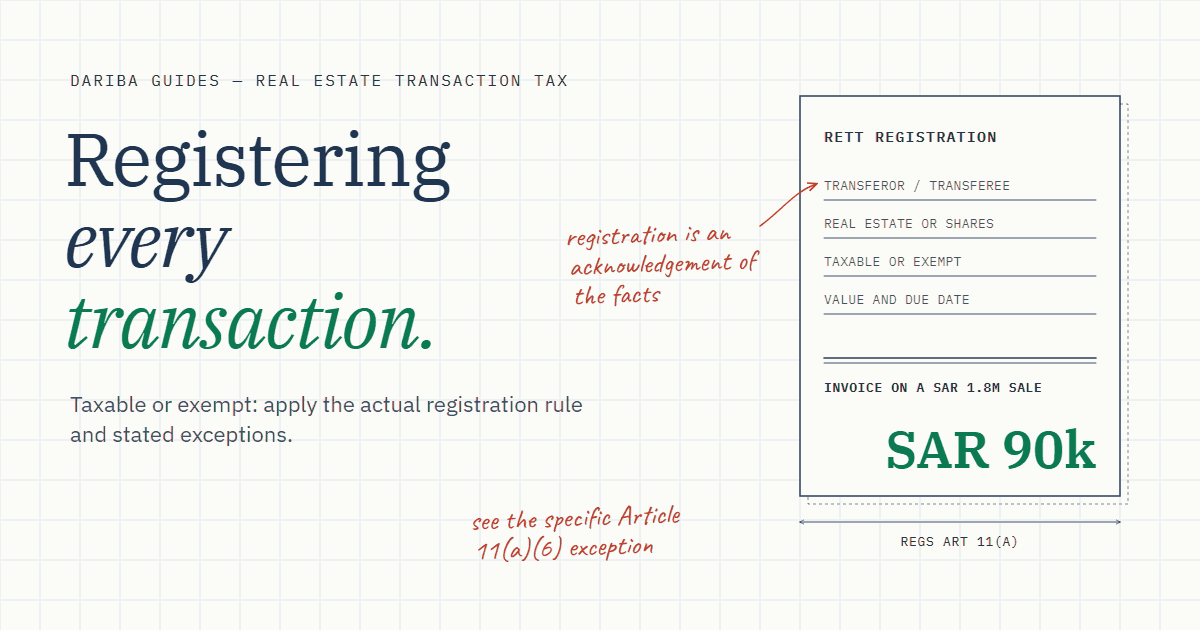
| Correction of registered transaction data under Regulations Article 11 | This changes the relevant ZATCA transaction record under its applicable process. It is not itself proof that Fourth(1)‘s historic documentation conditions have been met. |
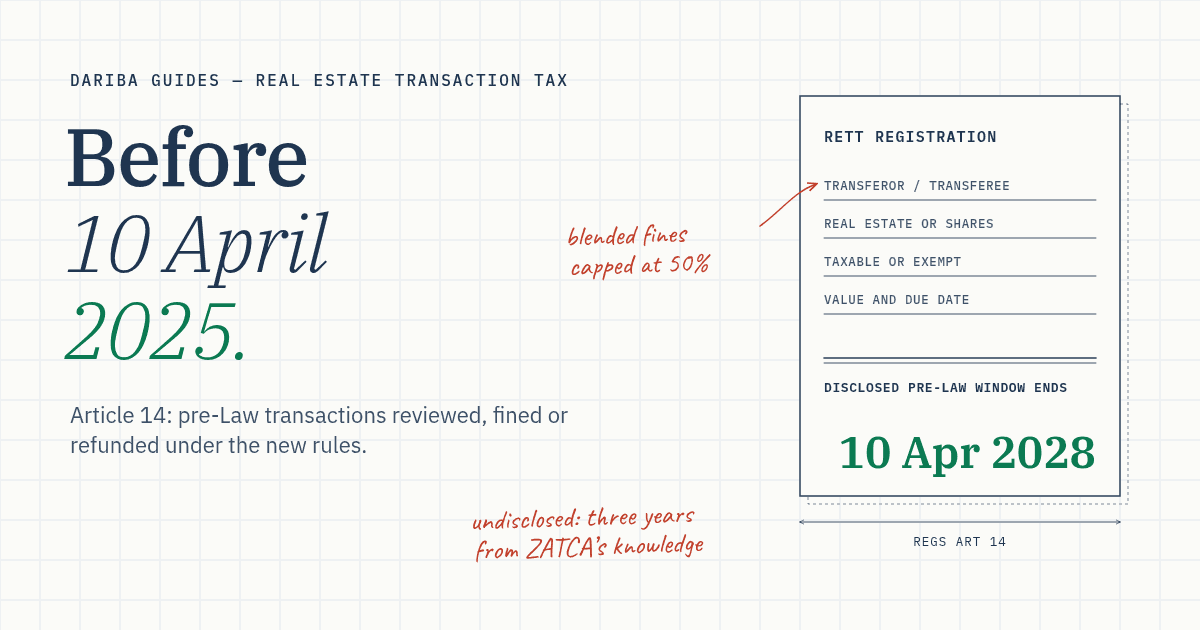
| Pre-law tax treatment under Regulations Article 14 | This addresses tax due before the current Law, with separate assessment, fine and refund provisions. A documentation-period extension does not automatically reset those clocks or cancel amounts. |
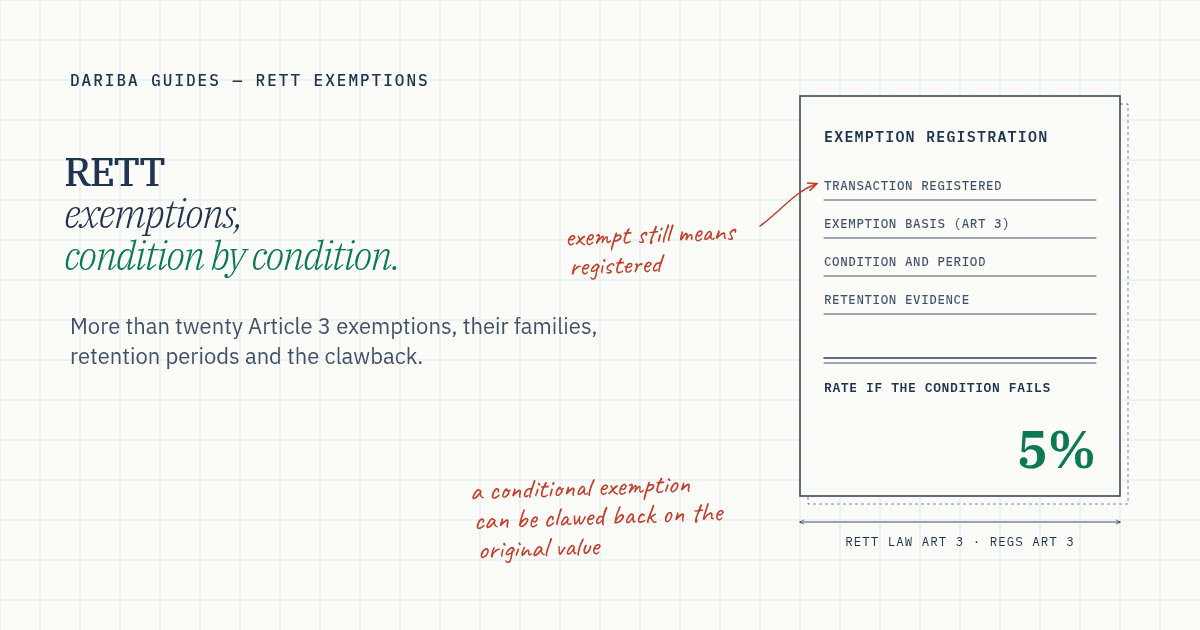
| Relief under Regulations Article 3 | Each actual exemption has its own conditions. A historic-documentation label does not replace its substantive requirements. |
See the registration guide, pre-law transitional guide and exemption map.
A practical file review
Record the actual original transaction and supporting date evidence, documentation status, exact decree paragraph and the operative extension relied on. For a company case, reconcile the partner’s capacity and the historical asset/accountant evidence with the precise provision.
Then verify the applicable competent-authority and ZATCA process, current implementation controls and period for the actual case. Keep submission and receipt evidence, any request for further information and the final documentation/tax outcome separately.
Resolution 206 resolves the scope and starting point of the extension it expressly grants. It does not by itself establish a particular applicant’s eligibility, every partner-route extension, completed title, a tax refund or the treatment of a later independent transfer.
Key takeaways
- The original general route concerns actual undocumented transactions before RETT began on 4 October 2020.
- Resolution 206 expressly names Fourth(1); its period starts 12 Shawwal 1447 AH, not its August decision or publication date.
- The additional period is a Hijri year; do not invent a Gregorian final filing day.
- The company-partner relief in Fourth(2) has distinct evidence and period conditions.
- Historical 2025 guideline examples do not themselves extend a deadline for a 2026 application.
- Data correction, pre-law tax transition and substantive exemption are separate procedures.
Frequently asked questions
Does the extension cover every undocumented transfer before April 2025?
No. The original Fourth(1) route concerns the stated transactions before RETT’s inception on 14 Safar 1442 AH / 4 October 2020. Establish the actual transaction date and other applicable requirements.
Does the extra year start in August 2026?
No. Resolution 206 expressly starts the additional Hijri year on 12 Shawwal 1447 AH. Its August decision and gazette dates are distinct milestones.
Did Resolution 206 expressly extend the company-partner provision too?
Its operative clause expressly identifies Fourth(1). Do not silently present it as an express extension of Fourth(2)’s separate company-partner conditions. Establish any independently applicable route or instrument for the actual case.
Does an old agreement prove entitlement?
No automatic result follows. Establish the actual property transaction and its date before the competent authority, and satisfy the current process, evidence and period requirements.
Sources
- Umm Al-Qura — Royal Decree M/84, 19 Rabi al-Awwal 1446 AH (Arabic)Fourth(1) and Fourth(2) are separate operative provisions.
- Umm Al-Qura — Cabinet Resolution 206, 21 Safar 1448 AH (Arabic)Operative extension of Fourth(1), one additional Hijri year from12Shawwal1447.
- ZATCA — Detailed RETT Guideline, Version 6, May 2026 (PDF)Section5.1.15, Examples41–42, printedpage37. Arabic decree controls the asset cutoff and evidence wording.
- ZATCA — RETT Law (Arabic PDF)
- ZATCA — RETT Implementing Regulations (Arabic PDF)
Reviewed against the issuing Royal Decree, operative Cabinet Resolution 206 and separate RETT framework on 21 November 2026. Arabic legislation controls. This guide does not certify a particular earlier transaction, filing outcome or unverified extension of another paragraph. Dariba is an independent information platform.