In brief
Article 11(c) provides cooperation, notice, access, entry and evidence powers with distinct conditions. A Governor decision alone should not be treated as a waiver of every notice or substantive requirement.
A RETT examination may involve valuations, exemption evidence, contracts, payments and the condition of property at transfer. Article 11(c) of the Implementing Regulations for the Real Estate Transaction Tax Law, administered by the Zakat, Tax and Customs Authority (ZATCA), provides both powers and procedural conditions.
The existence of a power does not establish that every possible use of it is permitted without the other requirements.
Your Rights and Obligations: apply the particular paragraph
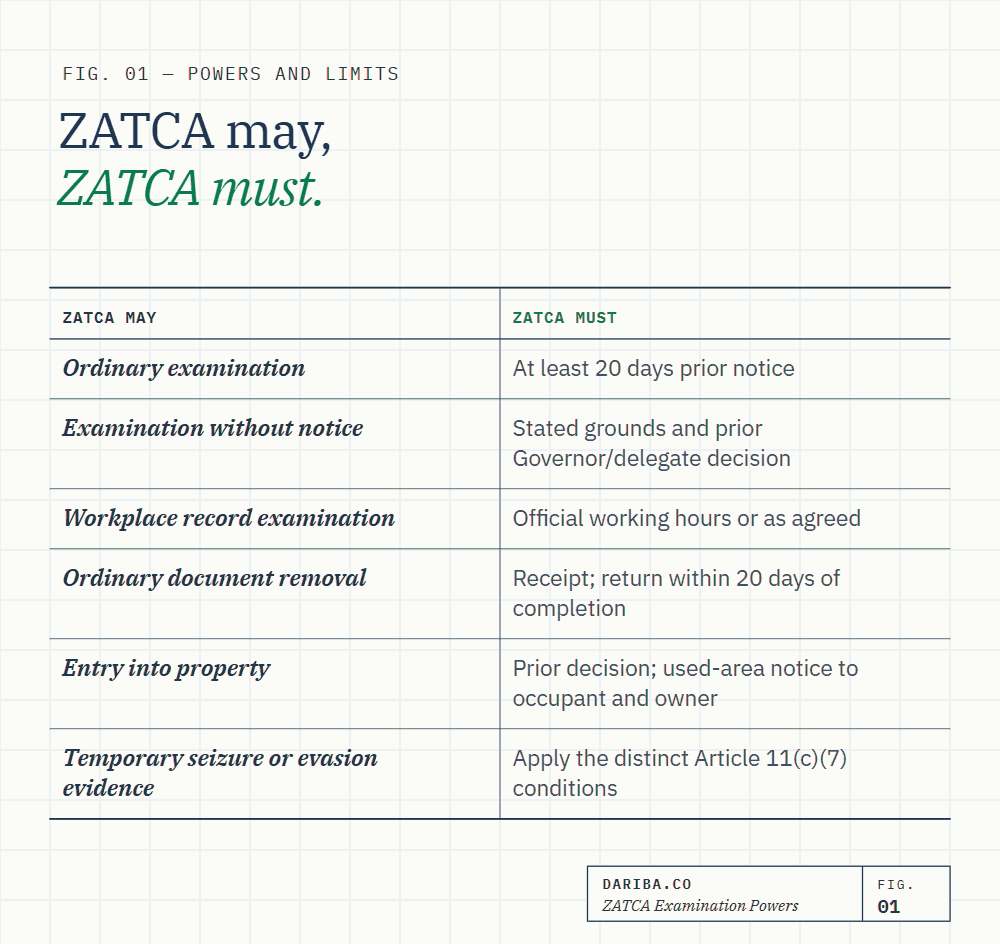
| Action | Conditions and safeguards |
|---|---|
| Ordinary examination at ZATCA or the person’s workplace, 11(c)(1)(a) | At least 20 days’ prior examination notice. |
| Examination without prior notice, 11(c)(1)(b) | Reasonable grounds to suspect a violation, or actual/likely refusal to cooperate, together with a prior decision of the Governor or delegate. |
| Workplace records examination, 11(c)(1)(c) | Official working hours or as agreed; access to the required books, records, invoices and accounting documents; relevant examination and copying powers. |
| Ordinary document removal, 11(c)(1)(d)–(e) | Give a receipt; return within 20 days of examination completion; retain copies where necessary. |
| Relevant premises and third-party locations, 11(c)(3)–(4) | Appointed officers, the relevant relationship and purpose, and the prescribed prior decision. |
| Property entry, 11(c)(5) | Appointed officers and prior decision; agreed or specified times; at least 20 days’ notice to occupant and owner before entering an area in use. |
| System-held records, 11(c)(6) | Provide paper copies or electronic files containing the requested information. |
| Non-cooperation, temporary seizure or suspected-evasion evidence, 11(c)(7) | Apply the distinct statutory conditions rather than a generic power to seize anything. |
Paragraph 11(c)(8) also requires notification of the assigned inspection personnel and their identification during official activity.
An approval is not a universal notice waiver
The unannounced-examination exception has stated substantive grounds and a prior-decision requirement. An approval alone does not replace those grounds. Likewise, do not automatically extend that exception to remove every safeguard attached to another entry power.
The workplace-hours provision has its own context. It should not be described as a universal rule that every action at ZATCA’s headquarters or every property visit must occur during the taxpayer’s business hours.
For property entry, preserve the actual requirement concerning areas in use and notice to both occupant and owner. The paragraph does not prescribe the identical notice formula for every unused space, nor make every unused area free of all other requirements.
Keep ordinary removal and temporary seizure distinct
For ordinary removal, record what left the premises and obtain the prescribed receipt. The 20-day return period runs from completion of the examination, not from the removal date. ZATCA may retain copies where necessary.
Article 11(c)(7) addresses non-cooperation and additional measures for obtaining relevant records, including temporary seizure where the stated risk of concealment, destruction or tampering appears. Suspected-evasion entry and evidence collection have a separate prior-decision requirement.
Do not infer an unlimited retention period from the word “temporary,” or treat any suspected inaccuracy as automatically satisfying every seizure or entry condition.
Information sources and valuation limits
Article 11(c)(2) permits the relevant use of information available to ZATCA and coordination with specified sources. That does not make every third-party statement conclusive or remove Article 10’s confidentiality conditions on disclosure.
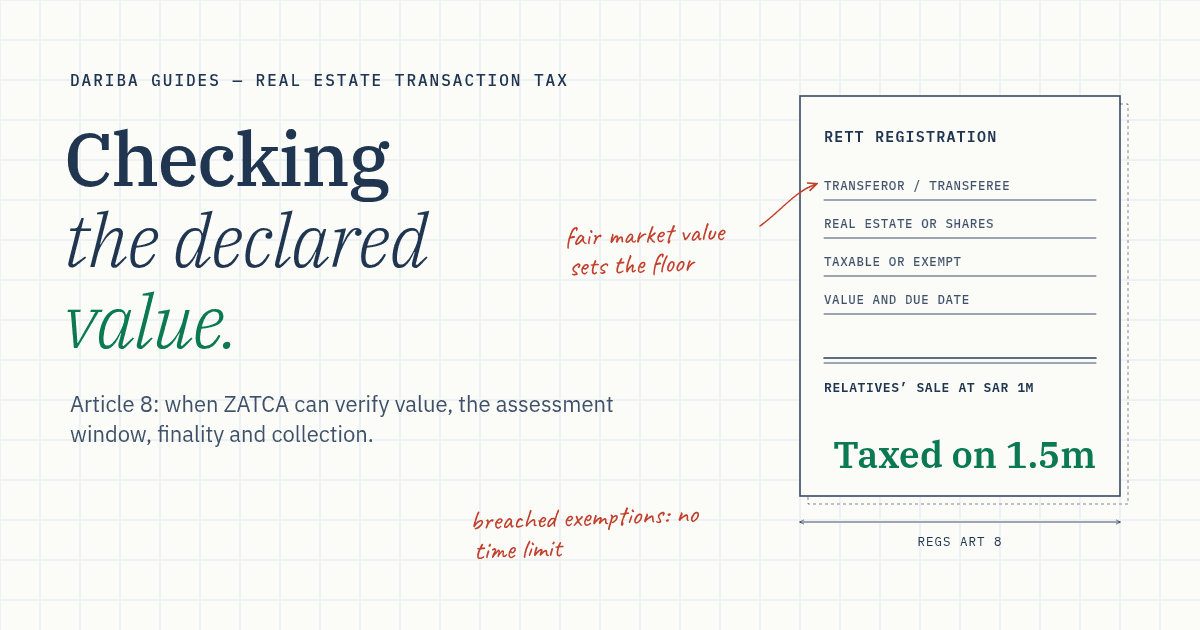
An examination also does not automatically establish an understated value merely because parties are related. Apply the actual value-verification rules, evidence and limitation provisions. A licensed valuation report requires consideration on its merits; it is not guaranteed acceptance.
Worked Examples
Dariba routine examination: assume proper notice on 1 March 2026 for an examination beginning 25 March. The interval is 24 days, exceeding the ordinary 20-day minimum. If examination completes on 20 April, the ordinary 20-day document-return date is 10 May, on those assumed facts.
For a proposed inspection of occupied property, identify the appointed officers, relevant prior decision, notified occupant and owner, intended areas and agreed or specified visit arrangements. A single notice to a tenant does not automatically establish notification to the owner.
For suspected side payments, separately identify the actual non-cooperation, evidence risk and entry grounds. A commercial disagreement or missing document is not by itself a finding of tax evasion.
Completion, results and response
Article 11(c)(1)(f) requires notice of examination completion and results, including the reasons for any resulting assessment or fine. Read the actual documents to identify whether an assessable or otherwise challengeable decision has been issued and properly notified.
Do not assume every informal results conversation starts the same objection period. Equally, do not ignore a formal decision while awaiting a different letter.
Keep the records request, authority and notice evidence, data supplied, removal receipts, correspondence, completion date and reasons together. Use the records guide and objection guide for the separate retention and challenge duties.
Key takeaways
- Ordinary examination notice is at least 20 days; an unannounced examination requires its stated grounds and prior decision.
- Workplace hours and agreed-time requirements apply in their actual context.
- Appointed-officer and prior-decision requirements differ from the specific notice rule for used property areas.
- Removed documents require a receipt and return within 20 days after examination completion, with permitted copies retained.
- Temporary seizure and suspected-evasion entry have their own conditions.
- An examination result and an appealable tax decision must be identified on their actual terms.
Frequently asked questions
Does a Governor decision always remove the 20-day notice requirement?
No. Article 11(c)(1)(b) provides an unannounced-examination exception with stated grounds and a prior decision. Other entry provisions have their own requirements; do not treat any approval as a universal waiver.
Must every property entry have the same notice?
Apply the actual paragraph. Article 11(c)(5) addresses entry under a prior decision at agreed or specified times and requires at least 20 days' notice to the occupant and owner before entry into an area in use. Do not erase the used-area qualification or other legal safeguards.
Can ZATCA keep removed originals indefinitely?
Ordinary removed documents must be receipted and returned within 20 days after examination completion under 11(c)(1)(d)–(e). Copies may be retained where necessary. A distinct temporary-seizure situation must meet its own conditions; it is not an unlimited ordinary retention power.
Sources
Based on the RETT Law (Royal Decree No. M/84, effective 10 April 2025), the RETT Implementing Regulations (ZATCA Board Resolution No. 01-03-25 dated 24 March 2025, unofficial English translation; minor formatting normalised) and ZATCA's Detailed RETT Guideline Version 6 (May 2026). The Arabic text prevails. This article is general information, not advice on any specific transaction. dariba.co is an independent knowledge platform and is not affiliated with ZATCA.