In brief
Read the ordinary manufacturing thresholds with the compensating provisions, preserve their caps and floors, and support the figures with product and workforce evidence.
The Saudi National Origin Rules allow specified flexibility between manufacturing value added and workforce localisation. The flexibility is often described too loosely: remaining above 20% value added and 10% localisation does not itself qualify a product. The compensating amount and its cap must also be satisfied.
This guide focuses on the industrial-product quantitative tests and related evidence. Passing them is one part of a wider origin conclusion; sufficient processing, direct shipping, valid proof, free-zone and other restrictions remain relevant.
Establish the relevant product, establishment and valuation
Article 1 defines the industrial product, originating/non-originating materials, customs value and ex-factory price. Articles 5–6 determine the ordinary manufacturing value-added calculation. The calculation broadly compares the prescribed net ex-factory price with the value of non-originating inputs under the Rules, rather than treating the supplier’s gross margin as local value added.
Apply the specified exclusions for taxes, duties, charges and transport in establishing the relevant price. The foreign-input valuation uses the prescribed purchase/customs basis, including the relevant CIF value at entry to the producing country; unrelated inland transport and other non-production costs should not simply be loaded into that input amount. Qualifying national materials require their own origin support.
Article 1’s non-originating-material definition also provides a fallback where the customs value cannot be known or verified: the first verifiable price paid on resale of the materials to an independent party. An intercompany invoice should not be treated as conclusive merely because it records a group transfer. Establish the prescribed value and the evidence supporting it; a corporate transfer-pricing report does not automatically replace this customs-origin rule.
Dariba original illustration: assume the correctly established ex-factory amount is SAR 1 million and relevant non-originating inputs are SAR 450,000. The difference is SAR 550,000, or 55% of the ex-factory amount. Those assumed inputs require proof. “Value added” here is a customs-origin measure, not a 55% VAT rate or an accounting profit margin.
References: National Origin Rules Articles 1 and 5–6.
Start with the ordinary 40% and 25% requirements
The ordinary manufacturing framework uses 40% value added and 25% national-workforce localisation in the industrial establishment. Read Article 5’s ordinary value-added rule together with Article 3’s express compensating provisions. Do not omit the flexibility, but do not replace its conditions with two independent low floors.
The workforce figure concerns the producing establishment’s certified national-workforce localisation. The Verification Rules require its prescribed documentation and twenty-six-week average. A single month-end headcount or an unsupported assumption about which employees count is not the required evidence.
Wholly obtained products under Article 4 follow their actual route. An industrial-manufacturing calculation should not be imposed indiscriminately on every natural product, nor should a wholly obtained claim be accepted without its own conditions.
References: National Origin Rules Articles 3–5; Verification Rules paragraph 5.
Compensate for localisation below 25% with sufficient extra value added
Article 3(2)(a) permits localisation below 25%, but not below 10%, where the value-added percentage exceeds 40% by the localisation shortfall. The added value must actually compensate; being at the 40% baseline is insufficient when localisation is lower.
The official example in Article 3’s first footnote uses 15% localisation. The ten-percentage-point shortfall from 25% requires value added of 50%: 40% plus ten points. This illustrates the condition, rather than a separate universally approved manufacturing margin.
Dariba analysis: a hypothetical 10% localisation figure needs 55% value added under that compensating relationship, subject to all other rules. A factory at 10% localisation and 40% value added cannot rely on the two lower floors to cure the missing compensation.
Reference: National Origin Rules Article 3(2)(a) and first explanatory footnote.
Higher localisation can reduce the value-added minimum within its cap
Article 3(2)(b) allows the excess of localisation above 25% to reduce the ordinary 40% value-added requirement, with the specified twenty-point cap and a 20% value-added floor.
The official second footnote uses 50% localisation. Although its excess over 25% is twenty-five points, the permitted reduction is capped at twenty points, so the illustrated value-added minimum is 20%. It is not 15% simply because 40 minus twenty-five equals fifteen.
Dariba recommendation: show the actual excess, the permitted capped reduction and the resulting minimum separately. This exposes a common spreadsheet error: applying an unlimited offset before checking the statutory floor.
Reference: National Origin Rules Article 3(2)(b) and second explanatory footnote.
Higher value added can reduce localisation within its separate cap
Article 3(2)(c) uses value added above 40% to reduce the ordinary 25% localisation requirement, with the specified fifteen-point cap and 10% localisation floor.
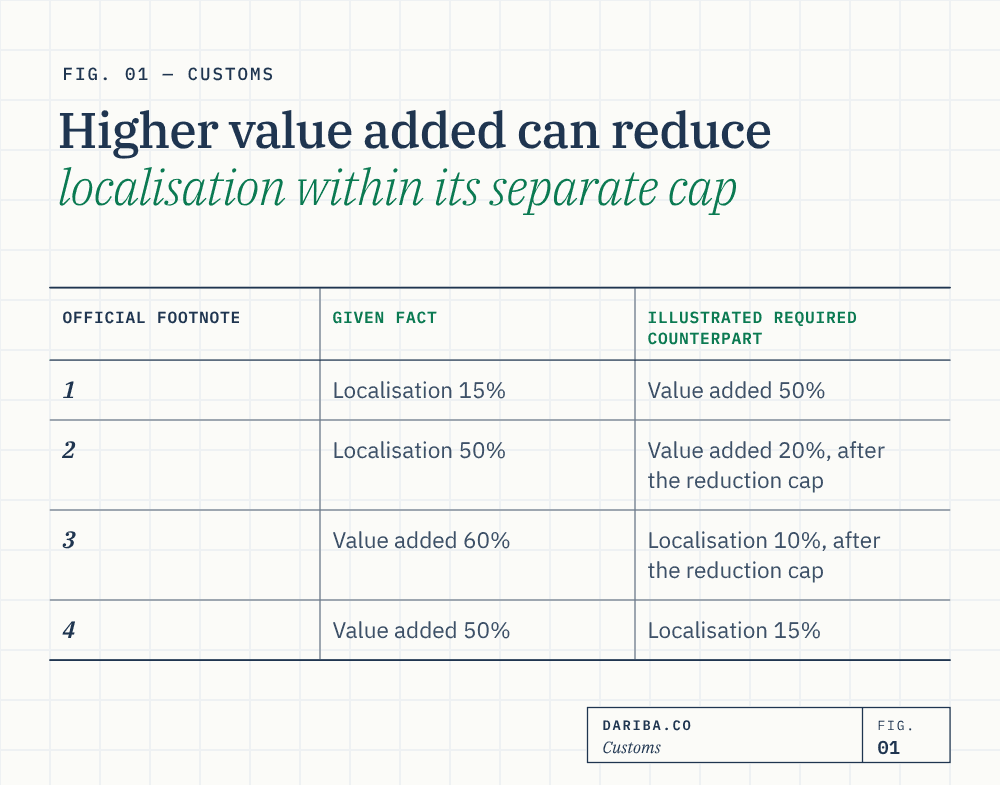
The official third footnote uses 60% value added. Its twenty-point excess does not reduce localisation to 5%: the reduction is capped at fifteen points, leaving a 10% minimum. The official fourth footnote uses 50% value added, producing a ten-point reduction and a 15% localisation minimum.
| Official footnote | Given fact | Illustrated required counterpart |
|---|---|---|
| 1 | Localisation 15% | Value added 50% |
| 2 | Localisation 50% | Value added 20%, after the reduction cap |
| 3 | Value added 60% | Localisation 10%, after the reduction cap |
| 4 | Value added 50% | Localisation 15% |
These are the official National Origin Rules’ examples of the quantitative mechanism. They do not establish that a particular shipment passes origin, transport, documentary or product-restriction conditions.
Reference: National Origin Rules Article 3(2)(c) and third–fourth explanatory footnotes.
Do not treat simple processing or free-zone trading as a percentage solution
Article 7 lists operations insufficient to acquire origin, including specified preservation, sorting, cleaning, packing, labelling and simple assembly. It also addresses combinations of such operations. Achieving a favourable accounting percentage does not automatically turn insufficient processing into qualifying production.
Article 15 treats the specified goods leaving free zones and free markets as foreign, including its stated local-material and previously duty-paid-input circumstances. Article 13 separately addresses free-zone transport and invoices/documents in the direct-shipping test. A free-zone intermediary should therefore be reviewed as part of the actual transaction chain, not hidden behind the manufacturing company’s mainland address.
Article 31’s component/production and ownership restrictions require the separate review explained below. None of these substantive conditions is waived merely because an authorised body issued an origin certificate.
References: National Origin Rules Articles 7, 13, 15 and 31.
Apply cumulation only to supported originating inputs
Article 8 permits the stated cumulation of qualifying originating materials from other GCC states, provided processing exceeds the insufficient operations in Article 7. It contains attribution rules where the producing country’s value added is compared with that of inputs from other GCC states, including its tie rule. The certificate’s observations must identify the specified cumulation and partner states.
A supplier invoice from a GCC country does not itself prove that the material originated there. Keep the originating-material proof and attribution working; do not relabel imported non-originating materials as local merely because they were purchased from a regional distributor.
Articles 9–12 separately address neutral production elements, the unit of qualification/packaging, accompanying accessories/spares and sets. Apply those provisions to the actual product rather than changing the unit of calculation to obtain a preferred percentage. A complex set or shipment may require more analysis than one average over unrelated items.
References: National Origin Rules Articles 8–12.
Test the Qualification Unit, Accessories and Mixed Sets
Article 9 identifies neutral production elements whose origin need not be determined for this purpose: energy and fuel; factories, machinery, equipment and tools; and the stated other goods that do not enter and are not intended to enter the final product. A material actually incorporated into the finished goods should not be relabelled neutral merely because it is inexpensive or bought by the factory’s maintenance department.
Article 10 starts with the particular product as classified under the Harmonized System. A qualifying assembly classified as one product is treated as the relevant whole, while a shipment of identical products classified under one heading still requires each product’s origin to be considered. Packaging included for classification under the stated General Rule 5 treatment is taken into account for origin. The container or total shipment value is not automatically the qualification unit.
Article 11 separately addresses accessories, spare parts and tools supplied with machinery, equipment, appliances or a vehicle under its price, invoicing and supply conditions. Keep those facts with the classification analysis; a loose spare-parts sale should not receive the same treatment solely because its customer also owns the main machine.
Article 12 concerns sets within Harmonized System General Rule 3. Where all their components originate, the stated set can have originating status. For a mixed set treated as one unit, the value of non-originating materials must not exceed 15% of the set’s ex-factory price. This is a specific set rule, not a universal allowance to disregard 15% of any product’s components or to bypass Article 31.
Dariba illustration: assume the goods genuinely form the relevant classified set, the prescribed ex-factory price is SAR 100,000 and all other origin conditions are satisfied. Non-originating materials valued at SAR 15,000 represent 15% and meet this quantitative limit; SAR 16,000 represent 16% and exceed it. These original assumptions do not establish the tariff classification, actual material value or final preference entitlement.
References: National Origin Rules Articles 9–12.
Review Article 31 Components and Producer Ownership Separately
Article 31 denies national originating status in the specified cases involving a component produced or manufactured in Israel, a component of the Article 5 value-added measure produced there, or producer capital wholly or partly owned by Israeli companies or companies on the Arab boycott lists concerning Israel. Read the actual component, production and corporate-ownership facts; the text does not provide a general minimum ownership percentage that can be assumed from a different rule.
This provision concerns originating status under these Rules. It should not be substituted for a complete analysis of import prohibitions, other restrictions or a live customs decision. A favourable value-added/localisation percentage, the set tolerance and an origin certificate do not themselves resolve the Article 31 conditions.
Dariba recommends obtaining a traceable bill of materials, actual manufacturing/origin evidence and the relevant corporate-ownership and listing support where the provision is engaged. A supplier’s trading address or an unsupported assurance about the group is not the same evidence as where a component was manufactured or who owns the producer’s capital. Record an unresolved fact rather than treating a missing document as proof of either qualification or disqualification.
Reference: National Origin Rules Article 31.
Support the figures with the actual verification evidence
Under paragraph 5 of the Verification Rules, the ordinary evidence includes the valid approved origin certificate, authenticated supporting invoices and the prescribed licensed accountant’s report. The accountant must meet the origin-country licensing and Saudi branch/SOCPA conditions and differ from the preparer of the factory’s annual final accounts.
The report addresses value added and the competent-authority-supported localisation average over twenty-six weeks. Supporting material can include production books, factory licence/location, raw-material import entries and bills of lading, manufacturing records, origin/value of inputs, production formulas and employee nationality/count/remuneration information. The underlying figures should reconcile with the product and establishment being tested.
Paragraphs 6–10 preserve further-document requests, deadlines, factory visits and authority-to-authority verification. Article 21 of the National Origin Rules requires the specified origin/supporting records for at least three years. The technical work is not finished merely when the percentage appears in a signed report.
References: Verification Rules paragraphs 5–10; National Origin Rules Article 21.
Check the competent-authority simplification and document the conclusion
The September 2025 paragraph 13 permits the specified origin/localisation certificates and invoices in place of requirements under the Verification Rules pursuant to an agreement between competent authorities, with supporting records retained by the origin authority for the statutory period. Confirm the actual agreement and requirements it replaces. The paragraph does not automatically remove the substantive calculations or apply identically to every GCC supplier.
The conclusion should state the tested product and establishment, valuation basis, actual percentages, applicable compensating rule/cap, sufficient-processing basis, originating-input evidence and any procedural agreement used. List facts that could change the outcome—such as workforce changes, a revised bill of materials, free-zone routing or a different production process.
For the separate guarantee, certificate-validity, ninety-day claim and further-review clocks, see the customs-preference guide. The analysis here is a source-based application of the quantitative and related conditions, not ZATCA approval of a factory or shipment.
Key takeaways
- Origin value added is a prescribed customs calculation, not VAT or a simple gross margin.
- The ordinary manufacturing framework uses 40% value added and 25% localisation.
- Lower localisation needs the compensating excess in value added, with a 10% floor.
- Higher localisation can reduce value added only within the twenty-point cap and 20% floor.
- Higher value added can reduce localisation only within the fifteen-point cap and 10% floor.
- All four official Article 3 footnote examples are distinguished from Dariba illustrations.
- The prescribed workforce evidence uses a twenty-six-week average.
- Passing the quantitative tests does not settle processing, shipping, free-zone or other origin conditions.
- Article 12’s 15% mixed-set limit is not a universal allowance for every product or component.
- Article 31’s component, production and ownership restrictions require their own evidence.
Sources
- Saudi National Origin Rules, Ministerial Decision 3852 dated 22 Dhu al-Qidah 1442 AHArticles 1–8 and 13–33; Article 3 official footnote examples; ex-factory/input definitions, insufficient processing, cumulation, transport, certificates, record retention and other origin conditions.
- ZATCA Rules and Conditions for Verification of Proof of Origin, current amended textAdministrative Decision 24841 and the September 2025 amendment. Paragraphs 1–13: guarantees, ninety-day requests, evidence, 120/30-day review, twenty-day response and competent-authority-agreement simplification.
- ZATCA current National Origin Rules and verification instrumentsOfficial publication links to the National Rules and current amended proof-verification rules.
- ZATCA Integrated TariffsTwelve-digit GCC implementation from 1 January 2025 and current amendment links; this is not a universal five-percent rate.
- ZATCA Integrated Customs Tariff InquirySearch the actual tariff line by code/description/chapter/section for the relevant period.
- ZATCA Arab trade agreement and origin annexSeparate agreement/origin route; product and country eligibility require the actual instrument and period.
- ZATCA GCC–Singapore free trade agreementDistinct schedule and origin provisions; no universal zero rate certified here.
- ZATCA GCC–EFTA free trade agreementListed EFTA partners Iceland, Norway, Switzerland and Liechtenstein; actual schedules/origin conditions remain necessary.
- Umm Al-Qura: addition of paragraph 13 to proof-verification rules, 19 September 2025Governor’s Decision 1447-99-303; simplified evidence depends on an agreement between competent authorities and preservation of supporting records.
General information only. Apply actual tariff classification, origin, production, period, transport and procedural conditions under the controlling Arabic instruments and any verified competent-authority agreement. Official Article 3 examples and Dariba original illustrations are distinguished. This review does not certify an HS code, shipment, factory, full agreement schedule or refund entitlement.