In brief
Build Saudi TP benchmarks using the tested party, comparable evidence, weighted data and screening; apply interquartile ranges and median-based corrections.
A transfer-pricing benchmark is useful only if its independent evidence fits the actual controlled transaction. A database search can produce many companies and a precise-looking range while still testing the wrong functions, risks or financial result.
Articles 5–13 of the amended Saudi Transfer Pricing Bylaws provide the comparability, method, aggregation, range and information framework. ZATCA’s Arabic Transfer Pricing Guideline, third edition 2024, sections 4.3–4.4, supplies important practical requirements, including three-year comparable data, loss-company exclusions, statistical ranges and the median-based adjustment approach.
Define the transaction before selecting the tested party
The functional analysis identifies what each party actually does, the assets used and the risks assumed. Method selection and the search for comparable evidence follow that analysis. Calling an entity a distributor or limited-risk service provider does not establish that its activities match the proposed comparables.
Section 4.3.1 generally identifies the less complex party as the appropriate tested party for the relevant one-sided analysis, because reliable comparison is easier. Its functions, risks and ordinary rather than significant unique assets matter. The Saudi entity is not automatically the tested party solely because the return is filed in Saudi Arabia.
Dariba recommendation: describe the transaction and tested functions before writing the search filters. Where an entity conducts several materially different activities, reconcile the tested segment to its accounts. A whole-company margin may conceal both an unrelated loss and a mispriced controlled transaction.
Apply both Article 5(a) comparability routes
Article 5(a) permits comparison where there are no material differences affecting the financial indicator examined under the appropriate method, or where an appropriate adjustment to the independent transaction’s indicator removes the effect of material differences. A shared business description is not either of those tests.
Dariba analysis: identify the metric that the selected method actually tests. A product or contractual difference may be especially important to a price comparison, while functions and accounting classification can be central to a margin comparison. Explain whether the difference is immaterial to that metric or how the supported adjustment removes its effect. An adjustment should improve comparability rather than create a desired outcome from fundamentally different businesses.
Review all six Article 5(b) factor categories
Article 5(b) requires the following factors to be considered at least to the extent relevant to the transaction:
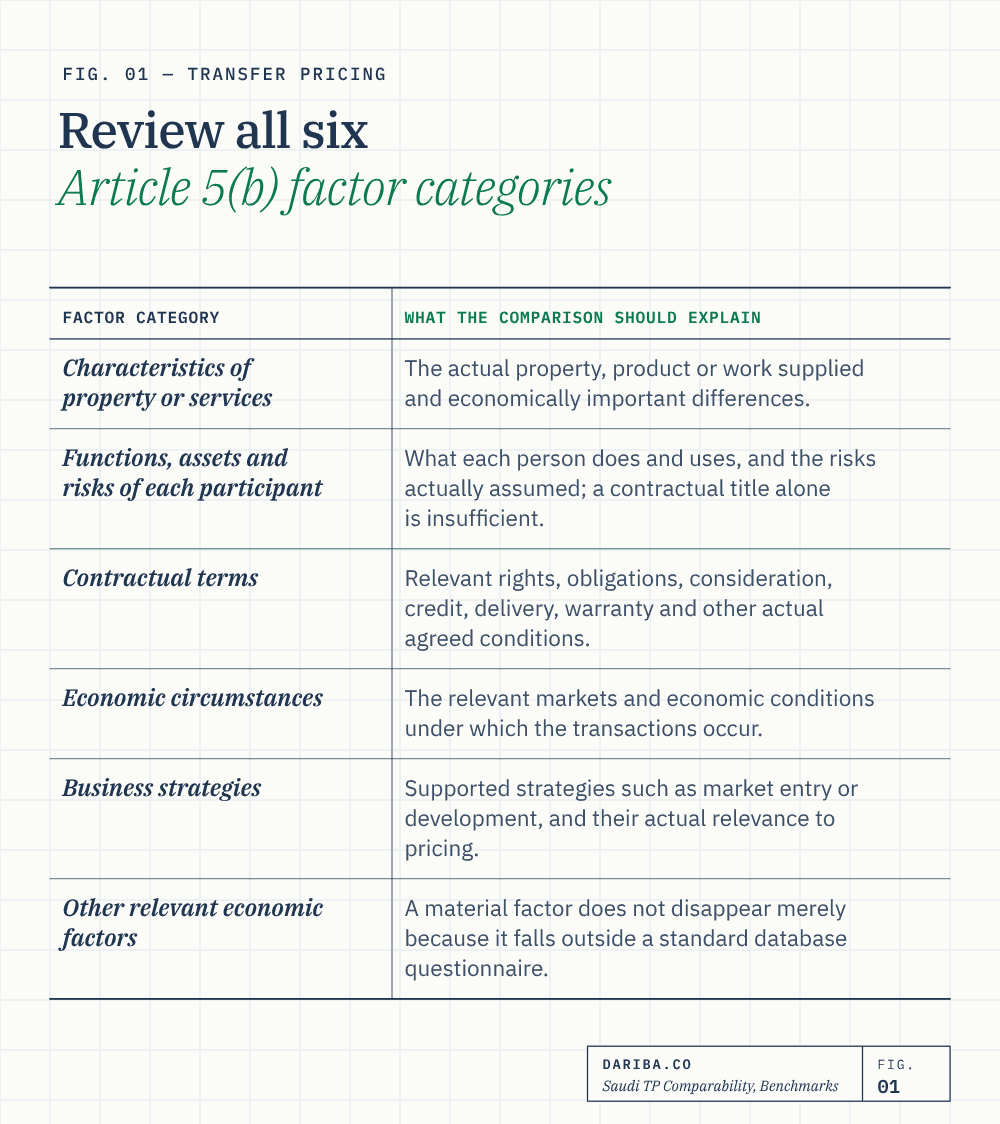
| Factor category | What the comparison should explain |
|---|---|
| Characteristics of property or services | The actual property, product or work supplied and economically important differences. |
| Functions, assets and risks of each participant | What each person does and uses, and the risks actually assumed; a contractual title alone is insufficient. |
| Contractual terms | Relevant rights, obligations, consideration, credit, delivery, warranty and other actual agreed conditions. |
| Economic circumstances | The relevant markets and economic conditions under which the transactions occur. |
| Business strategies | Supported strategies such as market entry or development, and their actual relevance to pricing. |
| Other relevant economic factors | A material factor does not disappear merely because it falls outside a standard database questionnaire. |
The statutory functions list includes design, manufacture, assembly, research, development, maintenance, procurement, distribution, marketing, promotion, transport, finance and management, without being exhaustive. Asset analysis extends to plant and equipment, valuable intangibles and financial assets, with relevant age, market value, location and ownership protection. Risk analysis includes market, investment, research/development outcome, product-liability, credit and financing risks. Identify the applicable factors rather than assume that every listed activity is performed by every entity.
The Arabic Guideline, section 4.1.2.1, pp. 41-45, develops contractual, functional and risk analysis. Its sales/distribution questions on p.43 ask who negotiates, controls inventory and quality, and bears warranty or defective-product costs. These are official practical questions, not a scoring formula or a complete checklist for all industries.
Dariba recommendation: connect the answers to personnel, decisions and operational records. Job titles and signed templates can be starting evidence, but they do not explain inconsistent actual conduct. A market-entry strategy should be supported by the plan, timing and economic effect; invoking the label after a disappointing margin does not establish comparability.
Choose evidence that can be obtained and examined
Article 13(a) says the taxpayer cannot use a comparable transaction or related information unless it is available to ZATCA or can be made available to it. Paragraph (b) separately prevents ZATCA from basing an adjustment on comparable information that was not available to the taxpayer or could not be made available to it; the stated base cannot be adjusted where the relevant comparable information is unavailable to the taxpayer. Guideline section 4.3.2 also rejects secret comparable information.
These are distinct availability protections and obligations. Do not treat a dataset accessible only within the taxpayer’s group as automatically usable evidence, or read the rule as cancelling ordinary duties to provide transaction records. Establish what evidence can be disclosed and examined by each party. Article 13(d) permits the guideline to specify conditions and restrictions on information use; a recognised database brand does not override those requirements.
The guideline does not prescribe one named commercial database. The taxpayer must explain why the chosen source suits the tested party and produces usable, verifiable information. Merely purchasing access to a recognised product does not establish the reliability of every entry retrieved from it.
Dariba recommendation: preserve the database, search date, version or data cut-off, filters, candidate list, supporting company information and calculations. Keep enough evidence for a reviewer to understand both the accepted companies and the reasons others were rejected.
Justify foreign comparables rather than assuming automatic acceptance
Article 13(c) permits ZATCA to accept foreign comparable transactions where domestic comparables are unavailable. The taxpayer must, on request, demonstrate compliance with the comparability requirements and consider geographical and other differences affecting outcomes, including price and profitability.
Foreign evidence is therefore neither automatically prohibited nor automatically equivalent to Saudi evidence. An industry code shared by a Saudi business and an overseas company does not resolve market conditions, functions, customer level, product mix, cost structures or risk differences.
Dariba recommendation: document the domestic evidence considered, the reason for extending the search and the economic case for the selected geography. Explain what the geographical filter achieves. A region chosen only because it produces a preferred margin is difficult to defend.
Apply the guideline’s data-period and loss-company requirements
Section 4.3.3 requires a search covering three consecutive years for normalising comparable data and calculates the range using weighted averages over the years covered. It also addresses the relevance of transaction-year and prior-year information to business and product cycles. Do not confuse comparable-company data smoothing with permission to average the tested taxpayer’s taxable results across any chosen three years.
Sections 4.3.3–4.3.4 exclude loss-making persons from the comparable set. This is a specific guideline restriction, beyond a generic statement that losses merely deserve investigation. Separately, section 4.4.3 recognises that a tested related person can incur genuine losses consistent with its actual functions, assets and risks. Excluding a loss company as a comparable does not prove that every taxpayer loss is artificial.
Dariba original illustration: assume an accepted comparable’s relevant sales are SAR 1 million, SAR 2 million and SAR 3 million, with operating profits of SAR 30,000, SAR 80,000 and SAR 150,000. For an operating-profit-to-sales indicator, aggregate profit of SAR 260,000 divided by aggregate sales of SAR 6 million produces a weighted margin of approximately 4.33%. A simple average of the annual 3%, 4% and 5% margins is 4% and gives a different result. The actual indicator and source financials determine the appropriate weighting; these figures are not an official comparable or Saudi benchmark.
Review each candidate and the reliability of adjustments
Section 4.3.4 requires examination of each selected person’s functions, risks, industry and other material characteristics. The guideline expressly rejects a database information dump as a sufficient comparability analysis. Statistical trimming cannot transform a fundamentally different business into a reliable comparable.
The same section restricts financial comparability adjustments to those that can be made with high precision, improve the analysis and address smaller differences without materially changing the comparable’s financial data. Article 5 supplies the overarching test of comparable transactions and appropriate adjustment for relevant differences.
Dariba analysis: quantify and support a proposed adjustment, including its assumptions and effect. If the difference is too fundamental or the adjustment too speculative, reject the comparison or revisit the method. Do not use an unexplained percentage to turn a full-risk manufacturer into a routine service provider.
Use a consistent profit indicator and build the actual range
Section 4.3.5 requires a supported profit-level indicator consistent with the tested party’s functions. It identifies gross or net margins measured against costs, sales or assets. A 5% mark-up on costs is different from a 5% margin on sales; gross profit and operating profit are also different numerators.
Section 4.3.6 recognises that a reliable method can sometimes produce a single result. Where comparable observations form a range, it requires scrutiny of unusual dispersion and a statistical approach to reduce outlier effects, identifying the interquartile range as appropriate for margins. An interquartile calculation is the result of screening and financial consistency, rather than a replacement for them.
Dariba recommendation: reconcile each company’s numerator and denominator to the source data, document accounting reclassifications and explain the statistical convention used. Show the full accepted observations, lower quartile, median and upper quartile. Readers should be able to reproduce the result without guessing which revenue or cost line was used.
Apply the median-based correction guidance with its exceptions
Bylaws Articles 11–12 define the range and ZATCA’s adjustment powers, with Article 11(b) allowing the guideline to specify the appropriate point. Sections 4.3.6 and 4.4.1 must therefore be considered alongside the Bylaws; a general statement that any point is always available omits material guidance.
Section 4.4.1 states that a result below the lower quartile is expected to be adjusted to the median. Departure requires exceptional circumstances demonstrated and supported by the taxpayer. For a result above the upper quartile, the guidance permits an adjustment to a point within the range, not below the median. It also requires support for a shift between points within the range and warns that an unexplained tax-driven adjustment may be disregarded.
Dariba original illustration: assume a reliable operating-margin benchmark has a 3% lower quartile, 5% median and 7% upper quartile. Relevant sales are SAR 10 million and operating profit is SAR 100,000, a 1% result. Applying the guideline’s median approach gives target profit of SAR 500,000 and a SAR 400,000 difference. Correcting only to 3% would leave the taxpayer short of the guidance’s median expectation unless the departure is properly supported. The assumed range does not establish a standard return for any Saudi industry.
For a result already inside the appropriate range, analyse the original policy, actual conduct and any proposed change rather than claiming that every amount below the median automatically needs a correction. Equally, an in-range result is not protected if the underlying transaction, method or comparables are unreliable.
Distinguish closely linked transactions from indiscriminate netting
Article 10 allows aggregation where controlled transactions are sufficiently closely connected or continuous that separate analysis is unreliable. Guideline section 4.4.2 discusses a portfolio approach under its specific same-person and reporting conditions.
Official example: section 4.4.2 describes sales of product A at a low margin or loss and product B at a higher margin to the same counterparty, with demand for B triggered by sales of A. The commercial link supports examining the combined return on the stated facts. It is not authority to offset any unrelated royalty, loan and goods transaction merely because their counterparties are in one group.
Dariba recommendation: identify the economic link, participating persons and reporting treatment before aggregating. Keep a separate explanation of why a combined test is more reliable than testing each transaction independently.
Keep annual monitoring separate from the full-search cycle
Section 4.4.4 generally calls for a full benchmark update at least every three years, with an earlier full or partial refresh where circumstances change. Section 4.4.1 separately expects ongoing monitoring of implementation. A three-year search cycle is not a three-year holiday from checking the actual business and financial result.
Section 4.4.3’s exceptional multi-year approach for a loss-making limited-risk entity requires evidence of the exceptional year and consistency of other profit-and-loss factors. Its official illustration considers combining years 1 and 2 under those assumptions. It is different from ordinary three-year comparable data and is subject to ZATCA’s acceptance.
Link the benchmark to the selected method, year-end implementation and documentation file. The conclusion should explain why the evidence fits this transaction, how the tested result was calculated and why the selected point complies with the applicable guidance.
Key takeaways
- Article 5(a) tests material differences or reliable adjustments against the indicator actually examined.
- Article 5(b) contains six relevant factor categories, including other economic factors.
- Functions, assets and risks require evidence of actual activity, not job titles alone.
- Article 13 distinguishes information available to ZATCA from information available to the taxpayer.
- Foreign comparables, weighted data, loss exclusions and range corrections retain their actual conditions.
- The guideline's practical distribution questions are useful evidence prompts, not a universal scoring formula.
Sources
- Saudi Transfer Pricing Bylaws, amended Arabic textArticles 5–13: comparability, selection, aggregation, range, adjustment powers and source information; Articles 14–24 remain relevant to the linked documentation, relief and APA discussions. Article 5, document pp.10-11: two comparability routes and six factor categories; Article 13, p.16: Authority/taxpayer information availability and foreign evidence.
- ZATCA Arabic Transfer Pricing Guideline, third edition 2024Sections 4.3–4.4, pp. 61–67: tested party, database, three-year weighted data, loss-company exclusion, comparable adjustments, interquartile range, median correction, portfolio, exceptional multi-year losses and refresh cycle. Section 4.1.2.1, pp. 41-45: contractual terms, actual functions, risk and economic comparability; section 4.3.2, pp.61-62: sources and secret comparable information.
General information only. Actual supplies, facts, applicable periods and controlling Arabic legislation determine the result. Official examples are distinguished from Dariba analysis and original illustrations. Seek advice or clarification where the arrangement or source material leaves a specific issue unresolved.