In brief
Diplomatic refunds require approved status, reciprocity or agreement terms, eligible non-commercial costs and timely claims. Specific invoice exceptions differ from ordinary recovery; the circular’s information clock must be read with Article 70(15).
A diplomatic mission’s Saudi VAT refund depends on its approved status, reciprocity or applicable agreement, actual expenditure and timely claim. It is not a general instruction to remove VAT from every invoice issued to an embassy or diplomat.
ZATCA’s second-edition diplomatic refund circular, May 2026, explains the Ministry of Foreign Affairs and ZATCA procedure. Read it with the controlling Arabic Article 70 and distinguish the qualified diplomatic-supplier zero-rating route and import relief.
Confirm the eligible entity and its approved affiliates
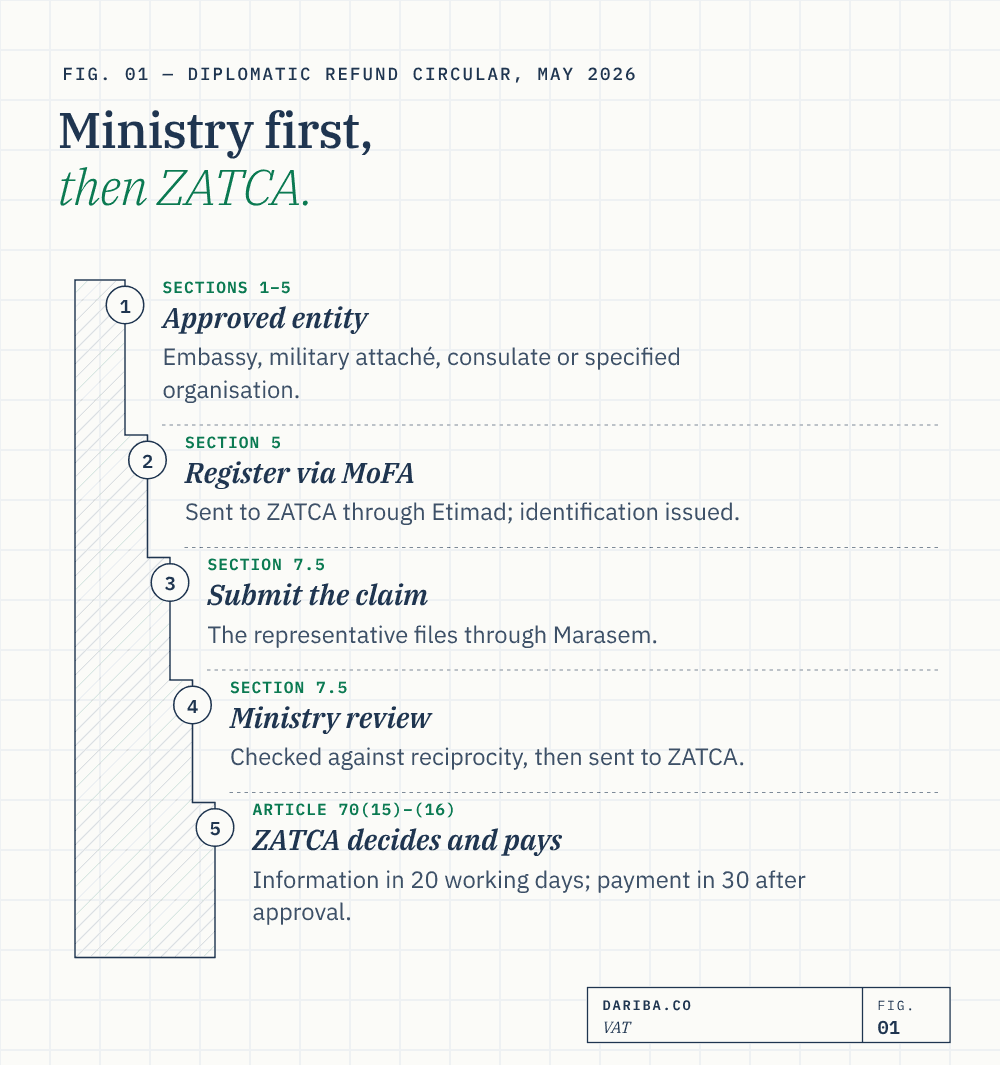
Circular sections 1–5 cover foreign embassies and military attachés with their affiliated technical/administrative offices, general consulates and specified international organisations/permanent delegations. The Ministry of Foreign Affairs verifies the relevant eligibility and reciprocity; the actual approved scope matters.
An affiliated individual does not independently register and claim directly with ZATCA merely because they work for a mission. The circular requires the official memorandum through the affiliated entity and the representative-led approval process. Do not assume every local employee, family member or unrelated purchaser is covered.
The approved entity and its affiliates receive the refund identification required by the procedure. This is distinct from an ordinary taxable person’s VAT registration. Keep the actual eligible-person approval, covered names and effective date under Article 70(4)–(6).
Sources: Arabic circular sections 1–5; Regulations Article 70(2)–(6).
Follow the representative-led ministry and ZATCA process
Section 5 describes the registration request through the Ministry of Foreign Affairs, transmission to ZATCA through the Etimad channel, and use of the issued identification in the Marasem procedure and refund correspondence. Section 7.5 describes the representative’s refund submission through Marasem, ministry examination against reciprocity and onward transmission to ZATCA.
These are the circular’s named channels, not a claim that the live authenticated portals have been tested here. The ministry’s eligibility/expense review and ZATCA’s review of the amount are distinct. A submission or identification number is not final approval or proof of payment.
Sources: circular sections 5 and 7.5; English circular sections 5 and 7.5.
Distinguish correctly charged VAT, zero-rating and imports
Circular section 3 explains the ordinary domestic charge and the possibility of a recipient refund; section 6 requires tax to have been correctly charged on a supply actually made to the eligible person and within the ministry-approved scope. A refund claim should not validate a supplier’s erroneous VAT charge.
Read the circular’s general domestic-tax wording with the separately headed diplomatic Article 36 bis (2), which provides the qualifying-supplier zero-rating route subject to its delegated mechanism. Do not infer either universal exemption or that the qualified route has disappeared. The supplier’s actual qualification and governing decision must be established.
Import exemption under the relevant customs/diplomatic conditions is another route. Neither a domestic refund nor qualified-supplier status proves customs relief for a particular consignment. Commercial activities carried out by the entity or affiliated natural person are excluded from the circular’s diplomatic expense route; ordinary taxable-activity deduction is analysed separately.
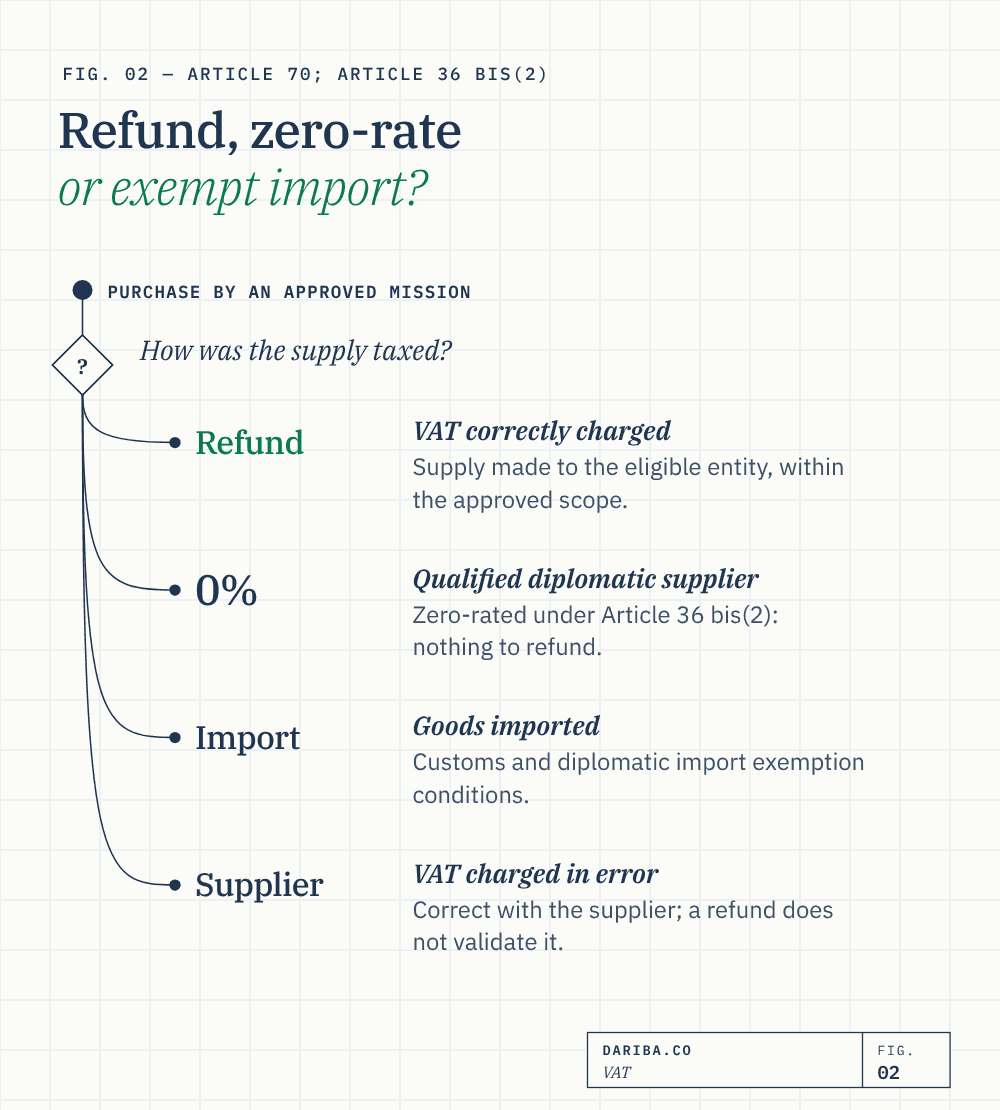
Sources: circular sections 3 and 6; Regulations, separate diplomatic Article 36 bis (2), and Article 70(9).
Apply invoice and expense exceptions only to the approved claimant
Section 6 requires the actual eligible recipient, correctly charged VAT, ministry approval and invoice/payment evidence. Its diplomatic-staff simplified-invoice procedure requires additional documents connecting the supply and paid tax to the eligible claimant, such as payment receipts or banking evidence. A receipt does not itself establish accreditation, reciprocity or qualifying expenditure.
Article 70(10) contains the specified foreign-government/international/diplomatic categories’ exception to the Article 50 blocked-cost exclusion, subject to reciprocity or applicable international agreements. This does not eliminate the actual category approval and non-commercial/eligible-activity requirements.
Article 70(13) separately addresses simplified invoices and the specified exception to its six-year retention requirement on reciprocity/agreement terms. Retain the documents needed to substantiate the submitted claim and answer requests; a retention-period exception is not permission to submit an unsupported claim. Keep these special rules distinct from the overseas-business route.
Sources: circular sections 6 and 7.4; Article 70(10), (12)–(13). The controlling special-refund paragraph is Article 70(13), regardless of the English circular’s different invoice footnote.
Use the approved period and the actual six-month deadline
Section 7.1 and Article 70(7) permit quarterly or calendar-year periods, with monthly periods only where authorised under the applicable controls. The registration notice identifies the approved period. A change requires ZATCA’s notice and effective date; the article permits a change once in twelve calendar months under its stated conditions.
Article 70(8) requires filing within six months after the relevant period ends, one claim per period and no amendment after submission. Its limited earlier-invoice inclusion for monthly/quarterly claims goes back no further than the beginning of the relevant calendar year, with the actual eligibility start date and other requirements still relevant. It does not authorise duplicate recovery.
The following reproduces the period/date pairs in the circular’s official Example 1; the facts concern a diplomatic entity renting meeting space for private events. The dates do not establish that every private event or invoice qualifies.
| Official 2026 quarterly claim period | Stated filing window |
|---|---|
| 1 January–31 March 2026 | 1 April–30 September 2026 |
| 1 April–30 June 2026 | 1 July–31 December 2026 |
| 1 July–30 September 2026 | 1 October 2026–31 March 2027 |
| 1 October–31 December 2026 | 1 January–30 June 2027 |
The example’s following-year narrative repeats a 2026 annual period. Do not use that drafting inconsistency to reopen a completed claim or change an approved period retrospectively. For a properly approved 2026 annual period, the stated six-month window is 1 January–30 June 2027; the actual period-change notice controls.
Sources: Arabic circular section 7.1 and Example 1; Regulations Article 70(6)–(8).
Test the eligible VAT minimum and prepare one complete claim
Section 7.3 and Article 70(11) prohibit a claim below SAR 5,000 of eligible VAT for the period. Exactly SAR 5,000 is not below that threshold; it does not establish the other conditions. A SAR 5,000 invoice value and SAR 5,000 refund amount are different tests.
Section 7.4 requires supplier name/TIN, invoice or customs-document number/date/total, payment date, VAT amount, description and bank information, with the further information ZATCA requires. Reconcile paid invoices, credits, actual claimants, earlier claims and the eligible scope before submitting. Filing is optional, but missing the deadline forfeits the period’s refund right.
If an incorrect refund is discovered, section 7.2 and Article 70(17) require immediate voluntary notification and repayment under the relevant procedures. Review disputes and penalties under their actual legal tests; rejection does not by itself prove fraud.
Sources: circular sections 7.2–7.4; Article 70(11)–(13), (17)–(18).
Resolve the information clock and separate approved payment
Circular section 7.5(3) says the period allowed in an information request must not be less than 20 working days. The controlling Article 70(15) requires the information within 20 working days from ZATCA’s request and permits rejection for non-response. Those formulations differ.
Dariba recommendation: organise the response within the regulation’s 20-working-day requirement and promptly seek written clarification of any inconsistent notice. Do not assume the circular automatically grants a later deadline. Keep the actual notice, receipt date, response and clarification together.
Section 7.5(4)–(6) addresses full/partial approval, rejection and the stated preliminary-assessment response procedure. Keep each notice’s deadline separate; this guide does not invent a universal objection period. Under Article 70(16), payment of an approved amount is due within 30 working days from notification of approval, with permitted offset. There is no blanket promise to finish every claim within 30 days of submission.
Sources: Arabic circular section 7.5; Article 70(15)–(18). The specific approval, reciprocity/agreement, delegated supplier rules, historical period and actual claim remain matters for individual review.
Key takeaways
- The actual approved entity and affiliates, reciprocity and ministry process govern eligibility.
- Refunds, qualified-supplier zero-rating and customs import relief are separate routes.
- Specified invoice, restricted-expense and retention exceptions do not eliminate evidence requirements.
- Follow the approved period, six-month limit, one-claim rule and actual effective date.
- SAR 5,000 concerns eligible VAT, not gross invoice value.
- Resolve the circular’s information timing against Article 70(15); payment follows approval, subject to offset.
Sources
- Saudi VAT Implementing Regulations, controlling Arabic compilationArticles 36 bis diplomatic heading, 50, 70(2)–(20), 71–72 and 79(6)–(8); actual current text controls guidance discrepancies.
- ZATCA: nonresident VAT refund circular, ArabicSecond edition May 2026; sections 3–4.6: both eligibility conditions, annual period, six-month limit, eligible SAR 5,000 minimum, evidence and review.
- ZATCA: nonresident VAT refund circular, English guidanceSecond edition May 2026; read with Arabic original and regulation. Threshold wording and differing footnotes not silently reproduced.
- ZATCA: diplomatic-entity VAT refund circular, ArabicSecond edition May 2026; sections 3–7.5, official Example 1. Reciprocity, invoices, periods, claim minimum, response/approval process.
- ZATCA: diplomatic-entity VAT refund circular, English guidanceSecond edition May 2026. Information timing, repeated-year narrative and invoice footnote reconciled against the Arabic regulation.
- ZATCA: Input Tax Deduction guidelineCurrent third edition May 2026; actual recipient, business use, restricted costs and apportionment are separate from special claimant approval.
- ZATCA: Imports and Exports guidelineSecond edition May 2026; import relief, registration and cross-border status distinct from recipient refunds.
General information based on current official Arabic regulations and May 2026 circulars reviewed 6 November 2026. Actual status, reciprocity/agreement, period, expenditure, approval and notices determine the result. Official Example 1 is identified separately from Dariba illustrations. Historical versions, original delegated decisions and individual outcomes are not independently certified.