In brief
Employee remuneration, independent service fees and qualifying secondment wage components are distinct. Current Article 9(7) is a conditional rule, not a general exclusion for payroll recharges.
An employee’s remuneration and a staffing company’s invoice are different payments. Current Article 9(6) excludes employment activity from economic activity. Article 9(7) separately extends that treatment to specified wages or benefits in qualifying labour-secondment arrangements, subject to all its conditions. Neither rule should be converted into a blanket exclusion for every payroll recharge or outsourced service.
Start with the actual employment relationship
Article 9(6) addresses workers and other persons bound to an employer by contract or other legal ties creating an employment relationship. ZATCA’s Value Added Tax Provisions in Economic Activity guideline, second version May 2026, section 5.1, explains that salaries and wages paid for employment are not subject to VAT as an independent economic activity of the employee.
The exclusion concerns the person’s employment activity. That same individual can have a separate independent business requiring its own VAT assessment. Conversely, calling someone a consultant does not resolve whether the actual relationship is employment or an independent service arrangement.
Dariba recommendation: establish who engages and directs the person, the contractual obligations and the actual legal relationship before applying a VAT label. The tax analysis should follow the real arrangement. This guide does not certify employment-law status or replace the assessment of other applicable labour requirements.
Preserve the independent-consultant example’s conditions
In section 5.1, Example 5, Rima provides IT consulting to several companies under short-term contracts, charges SAR 2,000 per day and does not enter employment contracts with those companies. ZATCA treats her independent work as economic activity and requires registration and VAT on remuneration when the relevant mandatory registration threshold is exceeded.
The daily fee is a fact in the example, not a registration threshold or a rule that one short engagement always requires registration. Assess the actual registration provisions, period and value of qualifying supplies. The freelancer guide explains the wider framework.
Dariba original illustration: assume a VAT-registered independent consultant supplies an ordinary Saudi standard-rated service for a SAR 2,000 daily fee exclusive of VAT. VAT at 15% is SAR 300 and the invoice total SAR 2,300. These current-rate invoice figures are Dariba’s assumptions, not additional amounts stated in Rima’s official example.
Article 9(7) requires every specified secondment condition
The current Arabic provision applies the employment treatment to consideration identified as workers’ wages or benefits in labour-secondment contracts where its conditions are satisfied. Those conditions are cumulative:
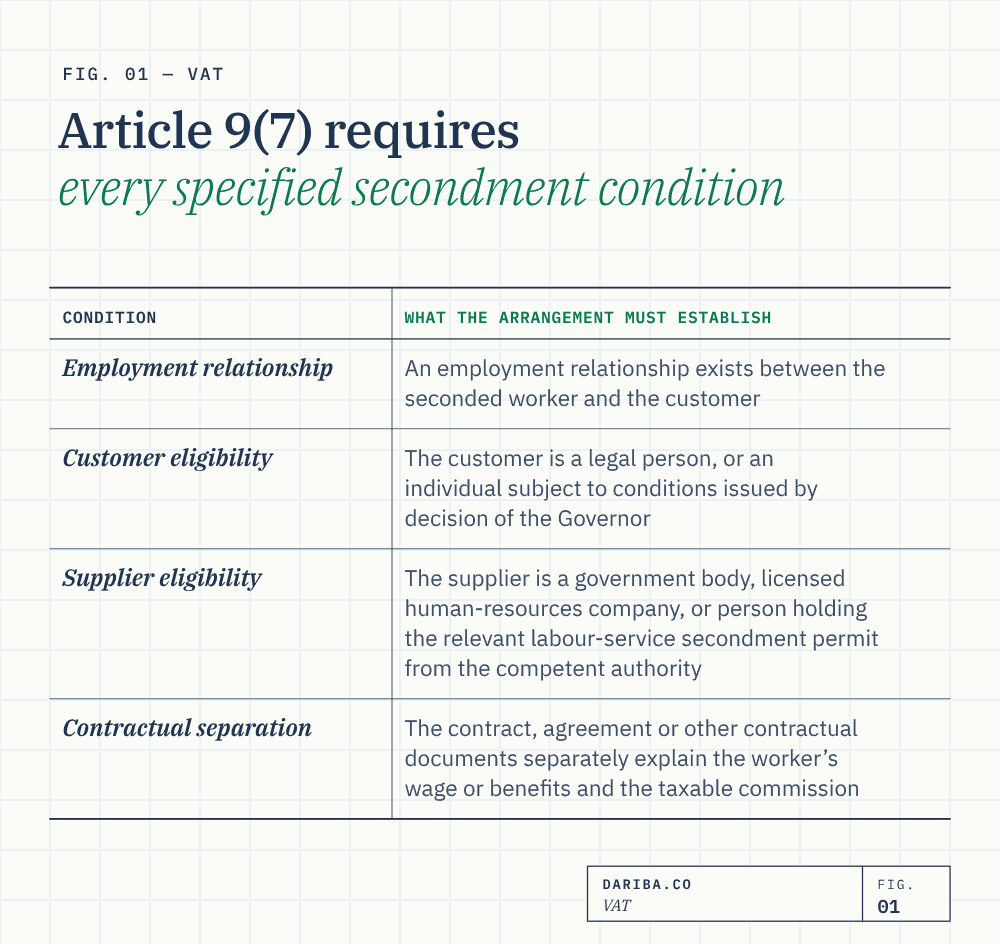
| Condition | What the arrangement must establish |
|---|---|
| Employment relationship | An employment relationship exists between the seconded worker and the customer |
| Customer eligibility | The customer is a legal person, or an individual subject to conditions issued by decision of the Governor |
| Supplier eligibility | The supplier is a government body, licensed human-resources company, or person holding the relevant labour-service secondment permit from the competent authority |
| Contractual separation | The contract, agreement or other contractual documents separately explain the worker’s wage or benefits and the taxable commission |
The natural-person customer limb refers to additional Governor-issued conditions. Do not assume that every household or individual qualifies from the paragraph’s existence alone. Confirm the applicable conditions and actual supplier authorisation rather than infer them from a company’s commercial name.
Separate the qualifying wage component from taxable commission
Dariba original illustration: assume a corporate customer and authorised supplier meet every Article 9(7) condition, with a genuine qualifying employment relationship. The contractual documents separately identify SAR 10,000 of covered wage or benefits and a SAR 1,000 ordinary standard-rated commission exclusive of VAT. Under those assumptions, the specified wage component receives the paragraph’s treatment; VAT on the commission is SAR 150. Total payable in this limited example is SAR 11,150.
The example does not approve the legal relationship, authorisation or composition of benefits. It also does not establish that every allowance, insurance charge, recruitment cost or other amount belongs in the covered wage component. Reconcile the actual item and documentation with the provision before excluding it.
The paragraph expressly distinguishes taxable commission. A contract allocating the entire charge to wages without explaining an actual fee does not establish that every amount is outside scope. The documents must accurately reflect the transaction rather than serve only as a tax allocation exercise.
Ordinary managed services require their own analysis
A business can purchase a management outcome, IT support or other outsourced service for a fee even where the supplier’s main expenditure is employee remuneration. Its own supply is not automatically employment activity merely because it pays salaries.
Dariba original comparison: assume a separate ordinary Saudi standard-rated managed service has total consideration of SAR 11,000 exclusive of VAT and does not qualify for the secondment wage treatment. Its output VAT is SAR 1,650 and the invoice total SAR 12,650. That result follows the assumed taxable service; it is not a universal conclusion for every arrangement failing one secondment condition.
The holding-company and management guide uses ZATCA’s own service-company example. It illustrates why a company-to-company management charge must be analysed separately from the employees’ remuneration. A recharge without a profit element is not automatically outside scope either.
Keep input recovery and supplier liability separate
A customer can only deduct VAT actually and correctly charged under the applicable entitlement conditions. The absence of VAT on a qualifying wage component does not create notional input tax to recover. VAT on a correctly taxable service fee remains subject to Articles 49–51, including actual use and evidence.
Foreign suppliers and reverse-charge cases require the actual liable person and place considered separately. Neither an employment label nor an overseas invoice address settles that question. Do not claim that paying the provider has necessarily completed every Saudi VAT obligation.
Document the position and review changes
Dariba recommends keeping the service or secondment agreement, evidence supporting the actual employment relationship, supplier authorisation, customer eligibility, wage and commission breakdown, invoices and reporting reconciliation. These are practical controls for the identified statutory conditions, rather than a newly prescribed universal form.
Reassess the analysis if the provider, customer, role, supervision, contract or charging structure changes. A position supported for one eligible arrangement should not be copied to every subsidiary, individual customer or different staffing product. Where a material condition remains unresolved, obtain clarification before treating the wage component as covered.
Key takeaways
- Employment activity is outside economic activity under Article 9(6).
- An independent consultant can carry on economic activity despite doing similar work.
- Article 9(7) requires an employment relationship with the customer and an eligible supplier.
- Contracts must separately identify the wage or benefit and taxable commission.
- An individual customer requires the applicable Governor-issued conditions considered.
- Original numerical illustrations assume the complete stated facts; they do not approve a staffing model.
Sources
- VAT Implementing Regulations, current amended Arabic textArticle 9(6)–(7): employment and all specified labour-secondment conditions. Articles 49–51: deduction and attribution. Article 70: designated-person eligibility, approval and separate refund framework; no duplicate ordinary deduction. Arabic controls.
- ZATCA Value Added Tax Provisions in Economic Activity, second version May 2026Section 5.1, Example 5: independent IT consultant Rima, SAR 2,000 daily fee and conditional registration. Sections 3–4 and 5.3: no profit motive requirement, genuine donations/grants and separately fee-earning charitable activities.
- ZATCA Input Tax Deduction guideline, third version May 2026Actual economic/taxable use, direct attribution, shared costs and supporting evidence; an invoice or charitable purpose alone is not unrestricted recovery.
General information only. Actual supplies, facts, applicable periods and controlling Arabic legislation determine the result. Official examples are distinguished from Dariba analysis and original illustrations. Seek advice or clarification where the arrangement or source material leaves a specific issue unresolved.