In brief
Technology delivery does not decide exemption or recovery. Fees, financing, actual asset supplies, fund roles, client-money income and exports each need an evidenced classification before the appropriate input-tax method is applied.
A fintech, manager or broker should classify its actual supplies before describing itself as fully taxable or targeting a near-100% recovery ratio. Payment processing, lending, asset transfers, management services and proprietary investment activity can create different VAT results within the same entity.
The same Article 29 framework applies as for other financial suppliers, with specific provisions and geographic qualifications. The technology used to deliver a service does not itself establish its exemption, customer or input-tax entitlement.
Identify the service, consideration and actual supplier role
Article 29(1)-(2) generally exempts the financial services it covers unless consideration is an explicit fee, commission or commercial discount. The Financial Services Guideline, second edition, May 2026, section 4.1, pages 15-16 distinguishes a principal assuming financial risk and earning an implicit margin from a fee-earning intermediary.
A percentage commission can be explicit. Precisely calculated interest can remain financing. Separate underlying asset supplies, qualifying securities and life-contract provisions also need their own treatment. A provider cannot settle the result by naming the charge a platform fee or profit share.
Official stockbroker example: the fee is not the securities supply
ZATCA’s Guideline for Agents under VAT Provisions, second version May 2026, section 9.3, Example 16, describes a stockbroker arranging a Saudi investor’s portfolio of locally listed securities. The broker executes transactions under the investor’s standing authorisation and charges a percentage of transaction value as commission.
The guideline distinguishes the exempt securities supply from the broker’s own service for an explicit fee. The broker must charge VAT on that commission. Article 29(6)’s securities exemption does not automatically exempt a separate arrangement or execution fee; Article 29(1) requires the actual consideration to be identified.
Dariba original illustration: assume an ordinary Saudi standard-rated brokerage fee of 0.5% on a SAR 100,000 securities transaction, with the fee stated exclusive of VAT. The commission is SAR 500, its VAT at 15% is SAR 75, and the broker’s fee invoice totals SAR 575. The guideline’s Example 16 does not specify these amounts. The transaction value is the assumed fee-calculation base; it is not automatically SAR 100,000 of the broker’s own service revenue subject to 15%.
The example addresses the broker’s output obligation. It does not give the investor an automatic input deduction or settle every overseas-customer case. The actual customer, place, export conditions and use of the acquired service remain separate questions. Retain the investor mandate, executed transactions, fee schedule and actual invoice rather than infer the service solely from a net settlement statement.
Own-account margin dealing is a different role
Section 9.3 contrasts an intermediary’s explicit fee with an actual implicit profit margin or bid–ask spread earned through securities dealing for its own account. The latter acts as principal. Current Article 29(5)(d) addresses the specified implicit-margin or spread-based brokerage, Mudarabah and agency-contract financial services within its exemption framework.
Dariba analysis: a percentage of transaction value is not an implicit margin merely because it varies with the investment. Conversely, calculating an actual principal’s spread precisely does not turn it into a separate explicit commission. Establish the contractual role, instrument supply, financial exposure and actual consideration.
Where a business earns both a genuine implicit return and an explicit service fee, analyse each actual component. Renaming commission as profit share, netting the fee from client money or reporting only a retained settlement amount does not establish exemption. Output classification must then feed the relevant cost-attribution and recovery analysis without assuming that every cost of a mixed desk has the same use.
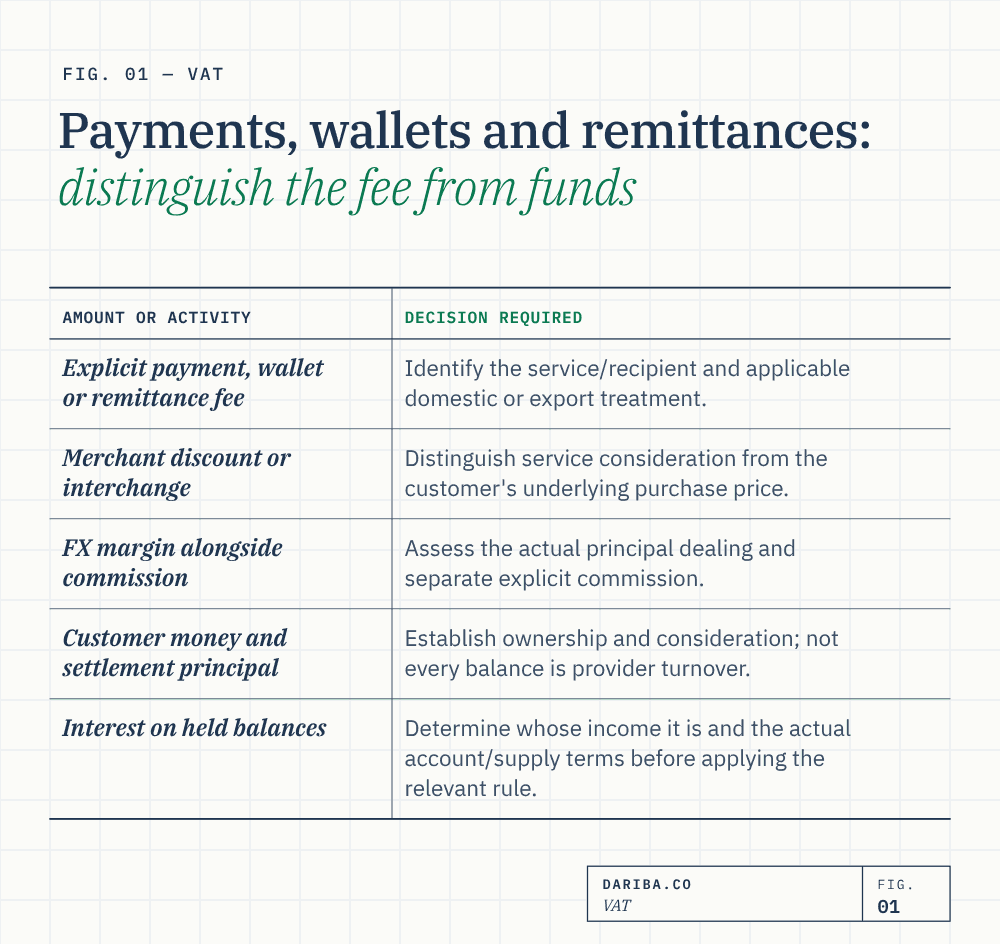
Payments, wallets and remittances: distinguish the fee from funds
| Amount or activity | Decision required |
|---|---|
| Explicit payment, wallet or remittance fee | Identify the service/recipient and applicable domestic or export treatment. |
| Merchant discount or interchange | Distinguish service consideration from the customer’s underlying purchase price. |
| FX margin alongside commission | Assess the actual principal dealing and separate explicit commission. |
| Customer money and settlement principal | Establish ownership and consideration; not every balance is provider turnover. |
| Interest on held balances | Determine whose income it is and the actual account/supply terms before applying the relevant rule. |
Official example: Financial Services section 6, Example 16, page 44 taxes a SAR 40 commission on a SAR 2,000 FX transaction at SAR 6 VAT while exempting the implicit exchange margin. The mixed result depends on those services; it is not a desk-wide valuation convention.
Section 4.2.2 and Appendix 3 Q&A 2, pages 18-19 and 100 retain gross interchange-fee invoicing despite net settlement. Do not substitute net cash settlement for gross service consideration or confuse that fee with the transaction principal.
Lending and instalment products require the actual asset path
Identify a provider lending as principal, an intermediary arranging finance, a merchant paying for a service and any actual goods supply. Merchant-paid consideration is not automatically the same supply as the customer’s financing return. Late/early settlement charges require a service, financing or genuine-compensation analysis rather than treatment from the label alone.
Financial Services sections 4.2.6 and 4.2.9, pages 24-27 and 32-35 distinguish temporary financing steps from genuine asset supplies. Metals Murabaha/Tawarruq Example 11 on page 33 is not a rule that every financed asset or commodity leg is outside scope. The car Ijarah illustration, also numbered Example 11 on page 34, demonstrates actual asset supply plus financing.
Digital delivery does not remove this distinction. See the margins and asset-finance guide for the conditions and calculations.
Fund managers, funds and clients are not automatically one VAT person
The actual management, custody, administration or brokerage service and its explicit consideration require their own classification. Calculating a management fee as a percentage of assets or performance does not, by itself, make it an implicit financing margin.
Financial Services section 4.4, page 38 distinguishes the fund’s capacity to make/receive supplies and any registration in its own name from the manager’s independent activity. The manager does not fulfil a fund’s separate obligations by simply reporting all flows through its own return. Review the actual fund documents and supplier/recipient roles rather than assume one result for every fund structure.
Principal securities dealings are also different from broker fees under Article 29(6). Whether an instrument’s value belongs in an Article 51 fraction requires the actual supply, consideration and capital-asset status; no blanket gross-proceeds or all-capital-assets rule is supplied here.
Exports depend on the customer, establishment and benefit
Current Non-GCC Services Guideline, fourth version, May 2026, sections 4-5.3, pages 11-26 and Financial Services section 7.5 explain conditional zero rating, including services otherwise exempt domestically. Foreign fund/investor residence is not alone sufficient to establish the actual customer of a management service.
Test the customer and relevant establishment, special place-of-supply rules, applicable GCC transition, direct benefit and related-beneficiary conditions. A local related person’s full input entitlement concerns the specific service. A foreign customer or its employees directly benefiting while present in a Member State has a different analysis.
The Non-GCC Services Example 18, page 25 distinguishes exclusive UK deliverables from administrative contact with a Saudi affiliate. It does not establish zero-rating for every local service under a foreign master contract.
Apply cost attribution even when it lowers recovery
Remove restricted and non-economic use before classifying direct taxable, direct exempt and eligible shared costs. An exempt lending cost is not rescued by the fact that most other platform revenue is taxable. Nor is every technology invoice exclusively taxable because its cost centre serves a payment business.
Dariba illustration: assume valid prior-year values of SAR 200,000 taxable domestic fees, SAR 100,000 qualifying zero-rated services and SAR 100,000 exempt financing. No relevant exclusions apply, so the ordinary default is 75%. Current eligible input VAT comprises SAR 20,000 exclusively taxable, SAR 10,000 exclusively exempt and SAR 40,000 shared.
Correct recovery is SAR 20,000 + (SAR 40,000 x 75%) = SAR 50,000. Applying 75% to the entire SAR 70,000 would give SAR 52,500, overstating recovery by SAR 2,500. These are original Dariba assumptions, not an official example or an approved rate. Annual actual-values reconciliation still applies.
Input Tax Deduction Q&A 6, page 71, has a particular treatment for the account holder’s immediately accessible current-account interest. It does not classify all safeguarded/client-money income or all other investments automatically. Establish the actual entitlement to the return, arrangement and related cost use.
Foreign services and platform roles require separate tests
Ordinary taxable services from a non-resident supplier may create reverse-charge VAT for a Saudi registered recipient, with input recovery determined independently. Exempt financial services do not become reverse-charge taxable merely because they are supplied from abroad. Same-person branches, subsidiaries and unmodified third-party pass-throughs also have distinct statutory scope; see the financial-institution framework.
Dariba illustration: if an ordinary taxable software service of SAR 200,000 is received in Saudi Arabia and reverse charge applies at 15%, output VAT is SAR 30,000. If it is eligible shared use at the assumed 75%, input deduction is SAR 22,500 and the unrecovered amount SAR 7,500. Exclusive qualifying taxable use or exempt use would change the input result. This is not a rule that all foreign invoices carry VAT or every group recharge has the same result.
A payment gateway’s own service is also distinct from the underlying seller’s supply. Marketplace/deemed-supplier obligations require the Article 47 conditions and actual facilitation role to be assessed separately. Processing a payment does not by itself establish that the provider supplies the merchant’s goods, and adding a feature does not by itself prove all deemed-supplier conditions. This guide does not substitute a general fintech label for that separate assessment.
Trace capital raising to the issuer and use of funds
Input Tax Deduction Guideline, third version, May 2026, section 14, Example 33, page 60 concerns new equity solely funding the issuer’s ongoing fully taxable expansion, not a shareholder’s disposal. Article 51(11) has specified categories and conditions; repeated fundraising or an exit label does not automatically establish the event or recipient.
Dariba illustration: assume qualifying issuer costs with SAR 18,000 input VAT and an applicable overall recovery proportion of 75%. The event deduction would be SAR 13,500, subject to the usual entitlement conditions. These assumed facts do not establish full recovery for all start-ups or company payment of a shareholder’s advisory bill.
We recommend a supply/customer map, client-money and principal reconciliation, input-use coding and review on new product or pricing changes. The objective is the correct claim in both directions. Use the incidental-event guide and method design where their particular conditions arise.
Key takeaways
- A fintech or manager label does not establish taxable status or a near-100% recovery entitlement.
- Explicit service fees, customer/settlement money and a principal's implicit financing return require distinct analysis.
- A manager and the fund it serves are not automatically one VAT person; identify the actual supplier, customer and registration obligations.
- Qualifying exports depend on the customer, establishment, exceptions, direct benefit and service-specific related-beneficiary deduction.
- The original 75% example gives SAR 50,000 with correct attribution; treating all SAR 70,000 input VAT as shared overstates recovery by SAR 2,500.
- Reverse-charge output and input entitlement are separate; Article 47 marketplace obligations require a separate actual-role assessment.
- Issuer purpose and use of funds control qualifying fundraising costs; shareholder costs and exits do not automatically receive the same treatment.
Sources
- ZATCA - VAT Implementing Regulations, Arabic tenth edition, April 2025Articles 29,33 and 49-51; actual supplies and applicable geographic conditions.
- ZATCA - Financial Services Guideline, second edition, May 2026Section 4.1 pp15-16; FX Example 16 p44; asset structures pp32-35; investment funds p38; interchange Q&A2 p100; foreign services pp52-54.
- ZATCA - Input Tax Deduction Guideline, third version, May 2026Sections 12-14; Example 33 p60; Q&A6 p71.
- ZATCA - Non-GCC Services Guideline, fourth version, May 2026Sections 4-5.3.2 pp11-26; Example 18 p25 distinguishes local administrative contact from direct benefit.
- ZATCA Guideline for Agents under VAT Provisions, second version May 2026Section 9.3, Example 16: explicit stockbroker commission is distinct from exempt securities; own-account implicit-margin contrast. Current Arabic Article 29(1), (5)(d) and (6) controls.
General information only. Actual supplies, facts, applicable periods and controlling Arabic legislation determine the result. Official examples are distinguished from Dariba analysis and original illustrations. Seek advice or clarification where the arrangement or source material leaves a specific issue unresolved.