In brief
Another person can become liable for VAT under specific legal routes. Deliberate participation, group membership, representation and activity transfers have different conditions; Article 67 supplies the assessment procedure.
Saudi VAT liability can extend beyond the person who made the supply or filed the return. The result depends on an identified legal route, not simply on who worked on the accounts, belongs to the corporate group or signed a contract. A proper review separates the basis of liability, ZATCA’s assessment against that person and the amount still outstanding.
Identify the legal route before applying Article 67
Unified VAT Agreement Article 43(1) makes a person who wilfully participates in breaching the Agreement or domestic-law obligations jointly liable with the person required to pay the tax and amounts resulting from the breach. Article 43(2) permits additional domestic cases.
Saudi VAT Law Article 37 preserves the Agreement and Law cases and provides for additional cases and procedures in the Implementing Regulations. Regulations Article 67 then permits an assessment against a person who is jointly liable and specifies its contents. Article 67 is not a freestanding rule making every adviser, employee, customer or shareholder responsible for another person’s VAT.
The first practical question is therefore: which provision creates liability, and which facts satisfy it? A payment demand should be analysed against that route before considering the calculation or response.
Distinguish deliberate participation from ordinary error
The wilful-participation route requires deliberate involvement in the breach. Merely preparing records, supplying advice or being appointed to file a return does not, without more, establish that element. An incorrect return still needs correction and may have consequences under other provisions; that is different from concluding that every person involved knowingly participated.
ZATCA’s Guideline on Examination, Assessment, Correction and Objection on VAT Decisions, section 4.5, explains the deliberate-participation rule and refers to Agreement Article 43. Its Example 4 relies on evidence of intentional conduct, not just the existence of an accounting engagement.
Dariba’s advisory approach is to preserve instructions, factual information supplied, technical advice, review comments, return approvals and correspondence about disputed entries. These records should explain what each person actually knew and did. The absence of deliberate misconduct does not resolve a separate group, representative or transaction-based liability route.
Follow ZATCA’s external-accountant example accurately
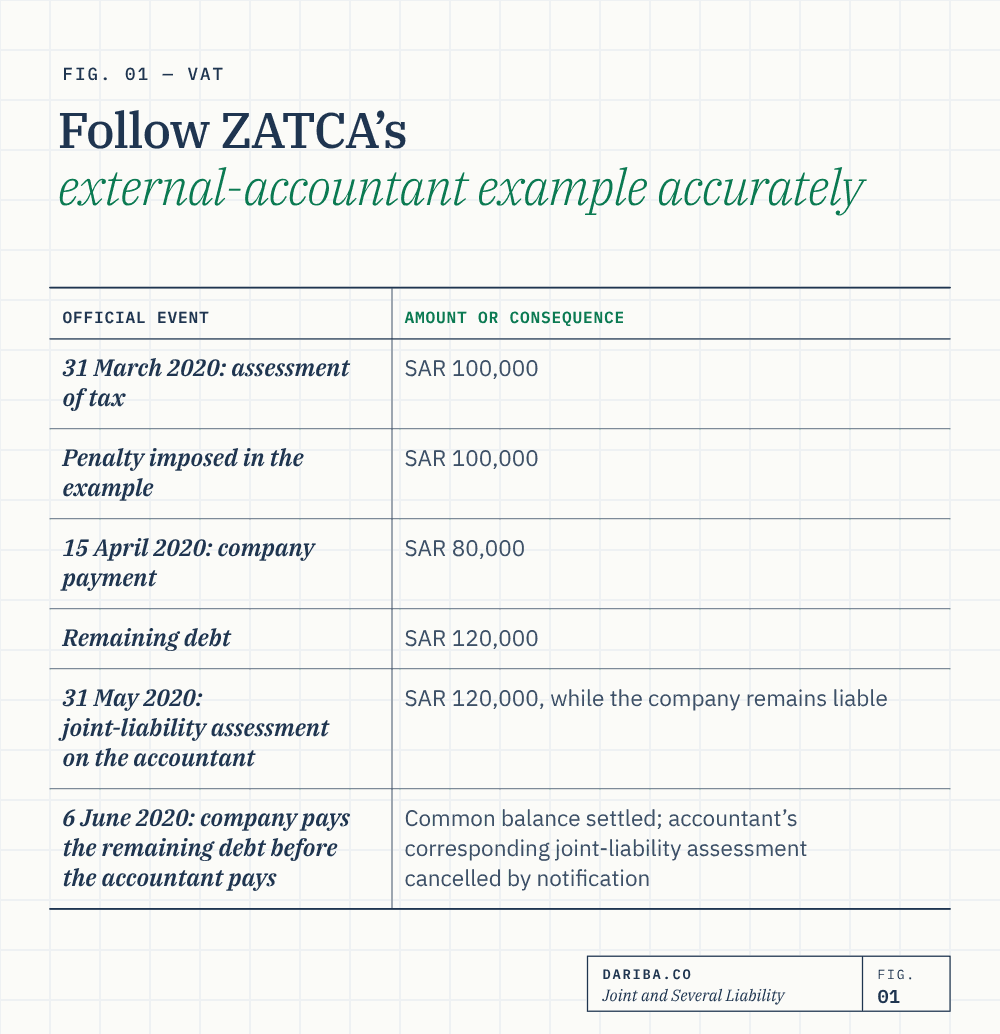
In section 4.5, Example 4, The Green House Ltd., a Jeddah construction company, files false returns with the wilful participation of its external accountant. Emails between them evidence that participation. The example’s sequence is:
| Official event | Amount or consequence |
|---|---|
| 31 March 2020: assessment of tax | SAR 100,000 |
| Penalty imposed in the example | SAR 100,000 |
| 15 April 2020: company payment | SAR 80,000 |
| Remaining debt | SAR 120,000 |
| 31 May 2020: joint-liability assessment on the accountant | SAR 120,000, while the company remains liable |
| 6 June 2020: company pays the remaining debt before the accountant pays | Common balance settled; accountant’s corresponding joint-liability assessment cancelled by notification |
The arithmetic is SAR 100,000 + SAR 100,000 − SAR 80,000 = SAR 120,000. The accountant’s assessment does not create a second SAR 120,000 debt for the same outstanding amount. The company’s later payment extinguishes that common liability in the example.
Preserve the dates and penalty amount as the official example’s facts. The equal-sized tax and penalty do not establish a universal current penalty percentage for every error. The guideline also expressly preserves ZATCA’s ability to impose separate individual penalties on the accountant for intentional conduct.
Read the assessment and reconcile the common balance
Article 67(1) requires the assessment to identify the tax due in respect of the breach, any penalty payable and the payment due date. Review those items together with the legal basis, relevant taxpayer, periods, underlying breach and payments already credited. Request clarification where the assessment or account reconciliation leaves a material issue unresolved.
The guideline’s section 4.5 states that settlement by one liable person extinguishes the corresponding liability of the other. This concerns the common debt actually settled; it does not automatically cancel a separate penalty imposed on someone for that person’s own conduct.
Dariba original variation: start with the official example’s SAR 120,000 remaining joint balance, but assume the accountant instead pays SAR 50,000 and that this payment is correctly applied to that same balance. The remaining common debt is SAR 70,000. Record the payment against the relevant assessment and obtain a reconciled statement. This changed payment sequence is Dariba’s illustration, not ZATCA’s official facts, and does not determine who ultimately bears the cost under a private contract.
Keep VAT-group liability separate from misconduct
Current Regulations Article 11(1) makes the representative primarily responsible before ZATCA without prejudice to members’ joint liability for the tax obligations, penalties and other obligations arising during their membership. Tax Groups Guideline section 6.3 explains that ZATCA may pursue another member for relevant unpaid tax or penalties; reliance on the representative’s administrative role does not erase that exposure.
This route does not depend on proving that every group member wilfully helped file a false return. Group membership is a substantive commitment, not only an opportunity to disregard internal supplies for VAT purposes.
For withdrawal or dissolution, Article 12(6) preserves the stated liability for tax due on deregistration and the group’s rights and obligations during membership. Do not assume a later exit erases earlier exposure, or that every pre-entry or post-exit obligation automatically falls on every former member. Match the effective membership dates and the actual statutory wording to each obligation.
Distinguish a tax representative from an ordinary agent
Article 77(2) addresses a non-resident’s resident tax representative. It provides liability with the taxpayer for VAT-related financial obligations, subject to its annual cap of twice the average quarterly output VAT and its provisions on cessation of representation and earlier potential obligations. That specific framework should not be replaced by the accountant example’s misconduct test, nor should its cap be exported to every liability route.
Article 77(4) permits a resident taxpayer to appoint an agent while preserving the taxpayer’s personal responsibility for its obligations. Appointment alone does not establish the agent’s wilful participation under Agreement Article 43. Equally, appointing an agent does not discharge the taxpayer.
Identify the legal capacity accepted, the actual appointment and termination decisions, the relevant periods and any separate conduct. The representatives and agents guide explains the appointment, security and records requirements in detail.
Preserve every condition in the business-transfer rule
Article 47(5) provides another specific joint-liability route for tax and fines arising before an activity transfer. Its conditions include non-application of Article 17, a transfer causing the transferor to cease the economic activity completely, and failure to notify ZATCA under Article 13(13).
Do not describe this as automatic joint liability whenever any asset is sold or any Article 17 document is missing. Test the conditions together. The distinction matters when buying an operating activity, negotiating tax warranties and deciding what diligence and notification evidence is needed.
The business-transfer guide separately explains Article 17’s outside-scope treatment and continuing obligations. A private indemnity may allocate cost between the parties, but should not be treated as proof that a statutory liability condition has disappeared.
Respond through the correct procedural route
For a joint-liability assessment, preserve the notice, delivery evidence, legal basis, underlying records and complete payment history. Distinguish a challenge to the liability trigger from a dispute over tax, penalties or an uncredited payment. Article 68 and the applicable committee rules govern objections; the current procedure and deadlines require their own review. A request to another liable person to pay should not be assumed to preserve an objection deadline or suspend collection.
The assessments overview explains the different filing, correction, assessment and refund clocks. For outsourced compliance, group membership and transactions, the stronger advisory file connects each legal trigger to its evidence and maintains one reconciled record of the debt, payments and any separate individual exposure.
Key takeaways
- Article 67 does not make every adviser or counterparty liable.
- Wilful participation is an express route under Agreement Article 43.
- VAT-group obligations can arise without proving deliberate misconduct.
- The assessment must state the tax, payable penalty and payment due date.
- Settlement of the common debt reduces the corresponding joint liability.
- Separate personal penalties and private reimbursement claims require their own analysis.
Sources
- Saudi VAT Implementing Regulations, current amended Arabic textArticles 11(1), 12(6), 47(5), 67 and 77(2)/(4): group obligations, departure, activity transfers, joint-liability assessments and representative/agent distinctions.
- Unified VAT Agreement for the GCC StatesArticle 43(1) identifies wilful participation in a breach as a joint-liability route; paragraph 2 permits additional domestic cases.
- Saudi VAT LawArticle 37 preserves Agreement/Law cases and delegates additional joint-liability cases and procedures to the Implementing Regulations.
- ZATCA Guideline, Examination, Assessment, Correction and Objection on VAT DecisionsSection 4.5 and Example 4: deliberate participation by an external accountant, the remaining common debt, subsequent payment, cancellation and separate individual penalties.
- ZATCA Guideline on Tax Groups under VAT ProvisionsSection 6.3 explains group-member liability and the representative’s practical role. Current Regulations Articles 11(1) and 12(6) govern the membership and exit conditions.
- ZATCA - Tax Invoicing and Records Guideline, version 3, May 2026Sections 9-10 pp44-49; filing and credit/refund explanation p49. Primary legislation controls the detailed routes.
- ZATCA - VAT Implementing Regulations Amendments Guideline, first issue, April 2025Section 2.13 Example 27 p43: same-company refundable credit and unpaid import/export fines; Example 26 on overstatement correction p43. Issue date is not universal commencement proof.
- ZATCA - Input Tax Deduction Guideline, third version, May 2026Evidence, restrictions, attribution and later first deductions remain separate from refund/correction procedures.
General information only. Actual supplies, facts, applicable periods and controlling Arabic legislation determine the result. Official examples are distinguished from Dariba analysis and original illustrations. Seek advice or clarification where the arrangement or source material leaves a specific issue unresolved.