In brief
Article 77 distinguishes a non-resident representative, a resident taxpayer’s agent and an appointed administrator. Security, local records and notices require separate controls.
Delegating VAT work requires more than appointing someone to submit a return. Current Article 77 gives different roles to a non-resident taxpayer’s representative, a resident taxpayer’s agent and a legally appointed administrator. Their responsibilities must be read with the security, record and notice provisions. A commercial sales-agent agreement does not, by itself, create the same appointment.
Identify the statutory role before signing the engagement
Article 77(1) allows ZATCA, in coordination with the relevant authorities, to approve tax representatives and tax agents and requires publication of the approved list. Confirm the provider’s appropriate approval and the actual role being accepted; a familiar job title or access to the taxpayer’s portal is insufficient evidence of the whole legal arrangement.
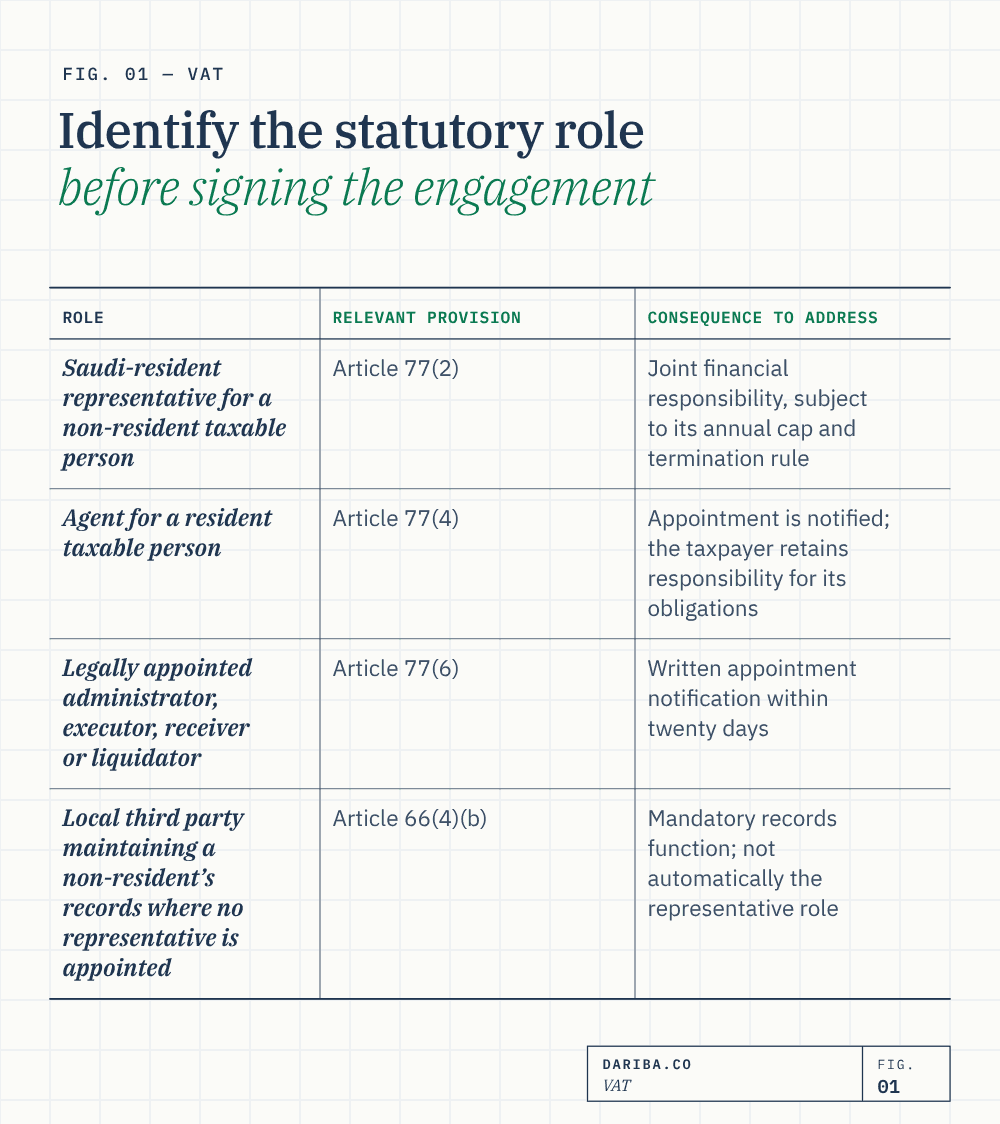
| Role | Relevant provision | Consequence to address |
|---|---|---|
| Saudi-resident representative for a non-resident taxable person | Article 77(2) | Joint financial responsibility, subject to its annual cap and termination rule |
| Agent for a resident taxable person | Article 77(4) | Appointment is notified; the taxpayer retains responsibility for its obligations |
| Legally appointed administrator, executor, receiver or liquidator | Article 77(6) | Written appointment notification within twenty days |
| Local third party maintaining a non-resident’s records where no representative is appointed | Article 66(4)(b) | Mandatory records function; not automatically the representative role |
The separate commercial-agency guide addresses who supplies goods or services and who charges VAT. An intermediary can have commercial duties without being appointed under Article 77. Analyse each appointment on its own terms.
A non-resident can apply directly without removing other conditions
Article 9(3) permits the non-resident registration application to be made directly or through an approved representative, whose details are included where applicable. Current Article 77(2) permits appointment of a representative resident in Saudi Arabia. It should not be rewritten as a universal requirement that every non-resident must appoint one.
However, Article 77(3) separately requires all non-resident taxable persons to provide security under Article 65 as a precondition of VAT registration. The ability to apply directly therefore does not remove the security requirement. Nor does it remove the local records requirement discussed below.
Dariba analysis: evaluate the complete compliance arrangement. Compare the representative’s accepted role and exposure, the applicable security determination, records access and the business’s own ability to monitor compliance. The choice is broader than comparing two advisers’ filing fees. Whether the non-resident is liable to register in the first place remains a separate supply and customer analysis.
Preserve the representative’s actual annual liability cap
Under Article 77(2), the representative is jointly responsible with the non-resident for relevant financial VAT obligations. Its annual responsibility must not exceed twice the taxpayer’s average quarterly output VAT. This is not an unlimited transfer of every liability to the adviser, and the stated measure is output VAT rather than turnover or net VAT payable after input deductions.
Dariba original illustration: assume the relevant quarterly output-VAT amounts used to establish an annual average are SAR 40,000, 60,000, 50,000 and 50,000. Their total is SAR 200,000 and the average is SAR 50,000. Twice that average is SAR 100,000 for the stated cap calculation. This illustrates the arithmetic only; it does not determine the applicable averaging period, resolve a part-year appointment or establish the amount recoverable under an actual case.
The cap concerns the representative’s statutory exposure under this paragraph. It does not reduce the taxpayer’s own VAT debt to that amount. Likewise, a private indemnity or professional fee does not replace the statutory calculation. Where the appointment spans unusual periods, obtain a clear position on the applicable calculation rather than inventing a first-year or nil-output safe harbour.
Security is separate from the representative’s liability
Article 65(1)(b) bases ordinary security on estimated average quarterly output VAT, with twice that average for a non-resident who does not appoint a representative. ZATCA retains the stated discretion over minimum and maximum amounts and other calculation methods in cases it considers necessary. The actual required security follows the Authority’s determination.
Dariba original illustration: with an estimated quarterly output-VAT average of SAR 50,000, the ordinary basis is SAR 50,000, and the stated no-representative non-resident basis is SAR 100,000. The doubled amount resembles the representative-cap arithmetic above, but the two rules perform different functions. One concerns security; the other limits the representative’s annual financial responsibility.
Under Article 65(1)(a), the written security notice identifies type, value, duration and submission deadline, allows at least twenty days from notification and states an initial term not exceeding twelve months under this limb. Later renewal or retention remains possible under paragraph (1)(f). Do not budget for an unconditional release at the first anniversary.
Cash security is held separately from the tax account. Provision of a guarantee is not itself payment of the tax, approval of instalments or waiver of penalties. See the payment and security guide for enforcement, renewal and the separate dispute and temporary-import routes.
Arrange local records even where registration is direct
Article 66(4)(b) requires a non-resident without a Saudi tax representative to appoint a third party established in the Kingdom to fulfil the prescribed invoice, document, book and record obligations. Where a representative is appointed, Article 66(5) makes that representative responsible for retaining the non-resident’s relevant records.
Dariba recommendation: identify the records custodian expressly, the records it actually holds or can retrieve, the access arrangement and the handover on termination. Keep appointment evidence alongside registration, security and return records. A filing service or storage subscription should not be treated as proof that the required local appointment and access arrangements exist.
The applicable retention, language and electronic-access conditions still need to be met. Appointing a local custodian does not make a missing supplier invoice, an unsupported input claim or an inaccessible accounting system compliant. The arrangement must work when ZATCA asks for the underlying material.
A resident taxpayer remains responsible after appointing an agent
Article 77(4) permits a resident taxable person to appoint a tax agent for its Saudi VAT obligations by notifying ZATCA. It expressly preserves the taxpayer’s own responsibility for those obligations. The representative’s paragraph (2) liability rule should not simply be copied into the resident-agent relationship.
Dariba analysis: a sound engagement allocates preparation, review, approval, filing, payment instruction and error escalation. These are practical governance steps rather than a new statutory form. For example, an adviser may prepare a return while the company retains payment control; both parties need a clear deadline and confirmation process.
Under Article 77(5), ZATCA can make relevant information requests to the representative or agent for the period of representation. Ensure that information requests reach the responsible business team and that the adviser has the records and authority needed to respond. Delegation should create a functioning response route, not a second unattended inbox.
Manage changes and termination through the Authority’s process
Article 9(4) requires a non-resident changing its tax representative to notify ZATCA within twenty days of the change. Separately, Article 77(2) continues the representative’s responsibility until the date ZATCA issues its decision confirming that it no longer represents the taxpayer, without prejudice to potential obligations before that decision.
Consequently, the date an engagement letter expires and the date statutory representation ends are not necessarily identical. Retain the notification, the Authority’s confirmation, the liability reconciliation and the handover record. Do not promise the outgoing representative a statutory release merely because the new adviser has received a retainer.
Article 78(4) requires copies of notifications and correspondence to the appointed representative, agent or appointed person in the same form. Article 78(1) generally deems receipt on the sending date, subject to evidence of delayed receipt in circumstances beyond the taxpayer’s control. Diary and respond to the actual notice; internal forwarding delays should not be assumed to create extra time.
Administrators and liquidators have a separate notification duty
Article 77(6) covers legally appointed administrators, personal representatives, executors, receivers and liquidators administering, managing, liquidating or winding up a taxable person’s affairs, including those of a deceased individual. The appointed person must notify ZATCA in writing within twenty days of appointment.
This duty is not the same as a non-resident’s notification of a change of representative. Identify the legal appointment date, retain the instrument and send the required notification through the applicable process. Article 76 governs prescribed forms and receipt of submissions; keep evidence of what the Authority received and when.
The appointment provision alone does not determine every VAT consequence of liquidation, final supplies, asset sales or deregistration. Review those events separately. A practical handover identifies outstanding returns, actual notices, record locations, security and the person responsible for each next action, while preserving the distinct statutory role of the appointment.
These calculations and operational recommendations are Dariba’s own illustrations and analysis. No official ZATCA worked example is attributed for the representative cap. The current amended Arabic provisions determine the legal position, including any fact-specific question the examples leave open.
Key takeaways
- Non-resident representation is permitted under current Article 77; security remains a separate registration condition.
- A representative’s annual financial cap uses average quarterly output VAT.
- A resident taxpayer remains responsible after appointing an agent.
- A non-resident without a representative must appoint a local records provider.
- Contract termination alone does not end the representative’s statutory exposure.
- Administrators and liquidators have a separate twenty-day notification duty.
Sources
- VAT Implementing Regulations, current amended Arabic textArticles 9(3)–(4), 65(1), 66(4)–(5), 77(1)–(6) and 78: application, security, records, appointments, liability and notices.
General information only. Actual supplies, facts, applicable periods and controlling Arabic legislation determine the result. Official examples are distinguished from Dariba analysis and original illustrations. Seek advice or clarification where the arrangement or source material leaves a specific issue unresolved.