In brief
Apply Zakat biological-asset conditions to productive assets and agricultural stock, with official examples, closing values and inventory distinctions.
A farm’s animals, plants and produce can serve very different commercial purposes. Assets retained for use in the business and stock held for sale do not receive the same Zakat deduction merely because both are essential to agricultural production.
Article 51 of the Implementing Regulations for Zakat Collection, 1445H addresses biological assets for an accounts-based payer. Read its classification and sale-purpose conditions with Article 48’s general asset controls and Article 52’s separate inventory rules. ZATCA’s Guideline for Deduction Items from the Zakat Base, July 2025, section 3.2.3, provides contrasting official applications.
Identify the actual living asset and its accounting category
The guideline describes biological assets as living animals or plants used in the payer’s activity. Its examples include herds, poultry and plants. The translated term vital assets does not mean all equipment that management considers important to the business.
Section 3.2.3 also distinguishes bearer plants, which it discusses under the property, plant and equipment accounting requirements rather than the same biological-asset accounting category. That distinction does not establish an automatic Zakat deduction or exclusion: identify the actual recognised item and apply its relevant asset provision.
Dariba recommendation: maintain separate records for the living assets, bearer plants where relevant, agricultural produce, machinery and other inventory. Avoid deducting the same recognised value once as a fixed asset and again as a biological asset simply because both descriptions appear in supporting schedules.
Satisfy both the non-current and non-sale conditions
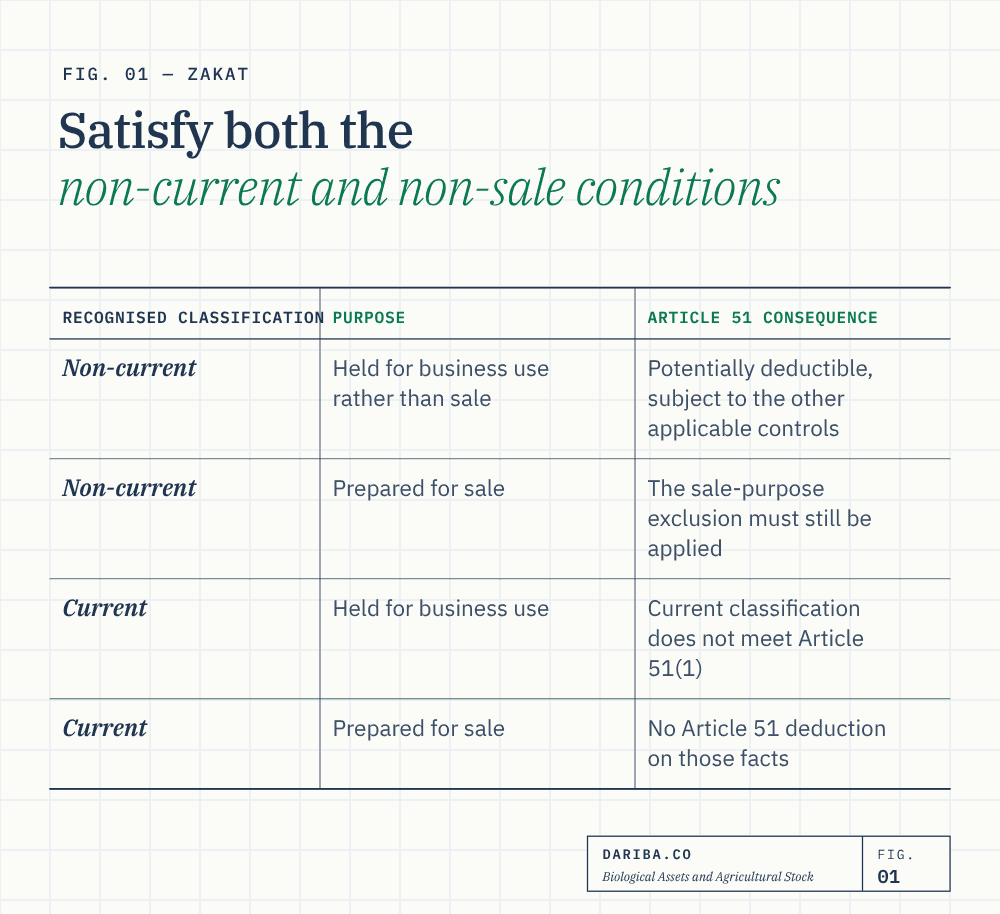
Article 51(1) permits deduction where biological assets are classified as non-current in the accounts-based payer’s financial statements and expressly disallows the deduction where they are current. Article 51(2) separately excludes biological assets prepared for sale from the deductible fixed-asset category.
| Recognised classification | Purpose | Article 51 consequence |
|---|---|---|
| Non-current | Held for business use rather than sale | Potentially deductible, subject to the other applicable controls |
| Non-current | Prepared for sale | The sale-purpose exclusion must still be applied |
| Current | Held for business use | Current classification does not meet Article 51(1) |
| Current | Prepared for sale | No Article 51 deduction on those facts |
The tests operate together. A non-current presentation does not override a sale purpose, while a useful productive role does not override the express current-asset restriction.
Dariba analysis: the tax schedule should follow supportable financial-statement classification and the actual facts. Moving an asset between spreadsheet headings, without a proper change in its underlying treatment, does not demonstrate that the deduction conditions have been met.
Apply the general recognition and net-value controls
Article 48 addresses non-current assets and equivalents recorded in the financial statements, their use rather than resale and deduction at the recognised net value. Its separate rules address recorded assets not registered in the payer’s name. Biological-asset eligibility should not be assessed as if Article 51 replaces those general controls.
Section 3.2.3 of the dedicated guideline uses the supported closing balance. Its discussion of accounting measurement does not authorise an independently chosen tax value or make the original purchase cost the deduction for every year.
Dariba recommendation: reconcile the asset register to the closing financial statements, including purchases, births or growth where relevant, disposals, deaths, transfers and valuation movements. These are practical reconciliation categories, not an additional statutory checklist. Identify any title, control or recognition issue under its actual provision before claiming the closing balance.
Use ZATCA’s qualifying non-current example accurately
Official Example 8, section 3.2.3: the company’s closing non-current biological assets comprise SAR 18,126,070 of agricultural assets and SAR 27,189,105 of animal assets. Both categories are stated to be not held for sale. Their total is SAR 45,315,175.
The guide allows those biological assets on the example’s non-current and non-sale facts, subject to the other deduction conditions. It combines them with SAR 3,898,125 of property, plant and equipment and SAR 1,727,550 of intangible assets, producing total deductible assets of SAR 50,940,850.
The SAR 45,315,175 biological component is already included in that total. It is not an additional deduction to subtract again after the total has been used. The example’s prior-year biological balance of SAR 41,813,928 is comparative information, rather than a second current-year deduction.
Dariba analysis: the example demonstrates a route and its stated facts, rather than a general exemption for every agricultural balance. It does not establish that an asset described as agricultural is necessarily non-current, non-sale or properly recognised.
Preserve the contrasting current-stock example
Official Example 9, section 3.2.3: the agricultural company’s statement includes current agricultural product inventory of SAR 1,464,891 and property, plant and equipment of SAR 3,031,875. The guide does not deduct the current agricultural inventory and identifies only SAR 3,031,875 of deductible property and equipment on its stated facts.
It would be incorrect to add the inventory merely because it arose from biological production or is held by an agricultural company. The company’s business sector does not remove the item’s current classification or turn sale stock into a fixed asset.
Dariba recommendation: split the asset register and inventory records at the level needed to support purpose and classification. Where productive assets are withdrawn from use and prepared for sale, examine the actual closing facts and accounting treatment. Do not assume the previous year’s deduction continues indefinitely after a material change.
Keep the inventory exceptions within their actual boundaries
Article 52 ordinarily excludes inventory, including sale goods and materials forming part of the final product before manufacture is complete. It separately addresses non-sale materials such as spare parts, and current raw materials that do not form part of the final product, with the applicable current-liability correction.
Those exceptions do not convert all agricultural stock or all production expenditure into deductible assets. Consumption in the production process alone does not establish that a material falls outside the final product or satisfies another permitted category.
The operational-assets and inventory guide gives ZATCA’s mixed-stock illustrations and the distinction between qualifying non-sale spare parts and parts intended for sale. The liability-apportionment guide explains why a qualifying current-asset deduction can also require a corresponding liability adjustment.
Separate the asset deduction from the activity-result calculation
The closing asset deduction is different from an expense or gain reflected in the activity result. A valuation movement, impairment, depreciation charge or sale requires its own applicable treatment; it is not a second claim for the full asset value.
Dariba recommendation: reconcile the closing asset and the profit/equity movements in separate schedules. Then connect them to the actual Zakat adjustments. Use the unrealised-gains guide and the relevant expense rules where appropriate, without assuming that every agricultural valuation movement follows the same route.
Finally, apply the complete base calculation, including relevant additions, other deductions and statutory limits. The official examples’ qualifying deduction amounts are not, by themselves, the payer’s final Zakat liability.
Key takeaways
- Biological assets are living animals or plants, not all important equipment.
- Non-current classification and non-sale purpose both matter.
- General recognition and net-value controls remain.
- Official Examples 8 and 9 show contrasting outcomes.
- Inventory exceptions do not cover all agricultural stock.
- The asset deduction differs from the activity-result adjustment.
Sources
- Implementing Regulations for Zakat Collection, 1445H, current Arabic textArticles 48–52: recognition/net value, biological non-current classification and sale exclusion, and separate inventory exceptions; existing Article 63 expense discussion retained in the overview.
- ZATCA Guideline for Deduction Items from the Zakat Base, July 2025Section 3.2.3, Examples 8–9: qualifying non-current biological assets versus current agricultural product stock; section 3.6.1 and earlier overview examples retain their own facts.
General information only. Actual supplies, facts, applicable periods and controlling Arabic legislation determine the result. Official examples are distinguished from Dariba analysis and original illustrations. Seek advice or clarification where the arrangement or source material leaves a specific issue unresolved.