In brief
Apply Saudi Zakat deduction conditions for assets, inventory, housing, property projects and statutory deposits, with corresponding liability corrections.
A Zakat deduction depends on the actual asset and its statutory conditions. A non-current label alone is insufficient, while certain current assets can qualify under express exceptions with corresponding liability adjustments. Use the deduction schedule as a reconciled analysis of each balance, rather than a list of accounting headings assumed to be outside Zakat.
Start with Article 26 and the detailed provisions
Current amended Arabic Zakat Implementing Regulations Article 26, p. 17, identifies ten deduction categories by reference to their detailed provisions. These include qualifying investments, net fixed assets/equivalents, intangibles, the specified materials, financing funds, qualifying sukuk/bonds, statutory deposits and deferred tax assets.
The Zakat General Guideline, first version October 2024, section 5.3, pp. 201–204, groups the detailed items into operational assets, property, investments, receivables and other deductions. Articles 31–32 and amended Article 73 also provide particular routes requiring their own conditions.
Dariba recommends identifying the governing provision beside each proposed balance. The fact that a useful asset is not cash does not itself establish a deduction.
Apply the general recognition and value controls
Article 48, Arabic text, p. 27, addresses the relevant assets/equivalents listed in the payer’s financial statements, acquired for use rather than resale and deducted at their net financial-statement value. General Guideline pp. 201–203 explains these controls.
Where an asset is not registered in the payer’s name, Article 48(2) preserves its stated cases: an impediment to transfer, use in the activity, an in-kind capital contribution, or recognition of its revenues or expenses. The paragraph says any of the stated cases; it does not require inventing a fifth condition or treating mere use of an unrecorded asset as sufficient.
Keep the actual recognition, value and ownership/exception evidence. An independent market appraisal is not automatically a substitute for the prescribed financial-statement value.
Separate fixed assets, biological assets and inventory
Articles 49–52, Arabic text, pp. 27–29, distinguish fixed-asset equivalents, non-trading intangibles, biological assets and the specified inventory exceptions. Biological assets concern living animals/plants; the English heading vital assets does not mean every asset essential to a business.
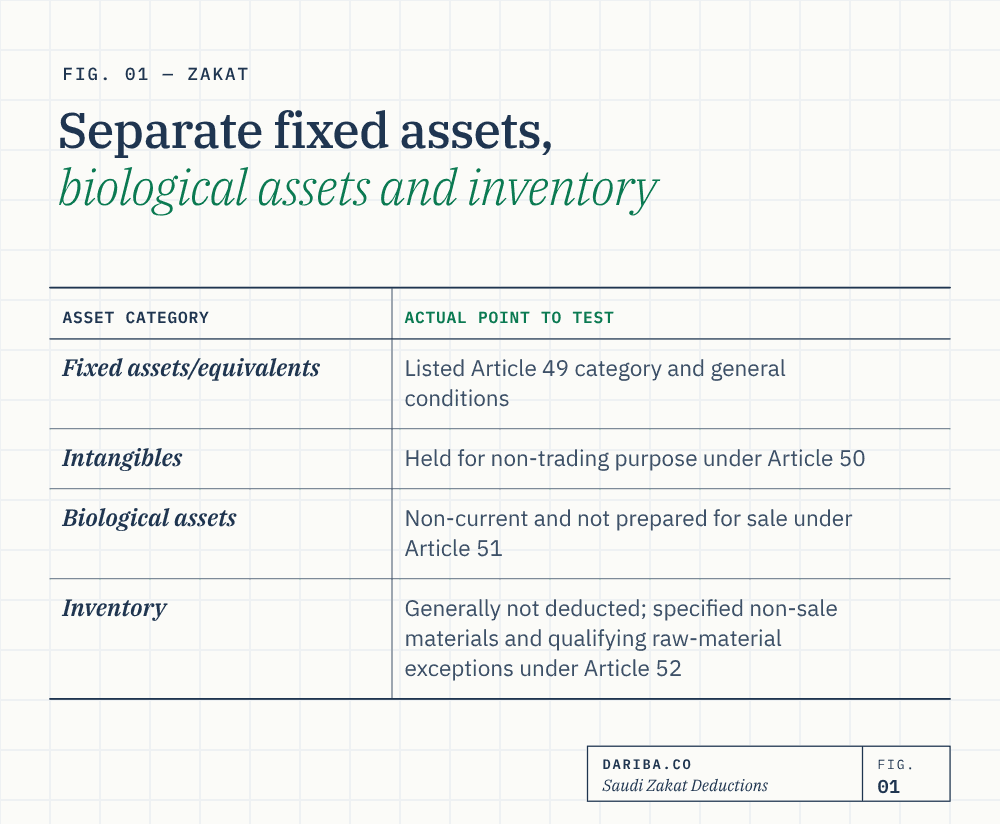
| Asset category | Actual point to test |
|---|---|
| Fixed assets/equivalents | Listed Article 49 category and general conditions |
| Intangibles | Held for non-trading purpose under Article 50 |
| Biological assets | Non-current and not prepared for sale under Article 51 |
| Inventory | Generally not deducted; specified non-sale materials and qualifying raw-material exceptions under Article 52 |
The operational-assets guide explains ZATCA’s examples. Not every production input qualifies: material forming part of the final product remains outside the stated inventory deduction even before manufacturing is complete.
Distinguish employee housing and property-project routes
Articles 53–54 address employer-owned housing and qualified employee housing finance separately. Housing-loan contracts must meet the no-profit/no-extra-fee and actual-cost conditions, including early termination. The employee-housing guide explains those differences.
Article 49 also addresses non-current investment properties not prepared for sale, operational raw land and own-use construction. Amended Article 73 separately addresses construction for sale and licensed off-plan projects.
The property-project guide uses the current Arabic Article 73, pp. 37–38, including its project-specific formula and current-asset consequences. Do not treat every development as either fully deductible fixed assets or automatically non-deductible inventory without that route analysis.
Apply investment and receivable conditions independently
The investment guide distinguishes Article 42 trading controls and the particular domestic, foreign, fund and instrument routes. Some deductions require separately calculated investment Zakat, certification and payment; non-trading intention alone is insufficient.
Articles 31–32 separately address qualifying partner receivables and delayed government dues. A current receivable is not universally deductible, but neither should those express exceptions be erased by a blanket rule that no debtor balance can qualify.
The government-receivables guide explains entitlement, cause of delay, current classification and linked liabilities. Assess each balance rather than allowing one qualifying debtor to determine an entire mixed ledger.
Test statutory deposits by obligation and return entitlement
Article 56, Arabic text, p. 30, requires the payer to be obliged to deposit with the competent authority under the relevant laws and not to be entitled to returns. The condition concerns entitlement, rather than merely whether a return happened to be received before year-end.
General Guideline section 5.3.5.1, p. 237, explains the restricted statutory-deposit category. A voluntary commercial security deposit or an ordinary bank deposit is not automatically within it because management cannot immediately spend the funds.
Dariba recommends obtaining the actual legal requirement, competent authority, deposit terms and return entitlement. Do not substitute a generic restricted-cash label for these conditions.
Recognise the deferred-tax-asset item without expanding it
Article 26(10) expressly identifies the deferred tax asset. General Guideline section 5.3.5.2, p. 237, discusses deductible temporary differences, unused tax losses and unused tax credits in this context.
Official General Guideline Example 88, pp. 238–239: the deductions include property/equipment SAR 500,000, deferred tax assets SAR 120,000, statutory deposits SAR 900,000, spare parts SAR 120,000 and qualifying raw materials SAR 80,000, totalling SAR 1,720,000 on the example’s facts.
The guide retains Article 48 controls and flags the applicable Article 25 corrections. The example does not authorise deducting every current-tax receivable, unrecognised loss or deposit without its own applicable basis.
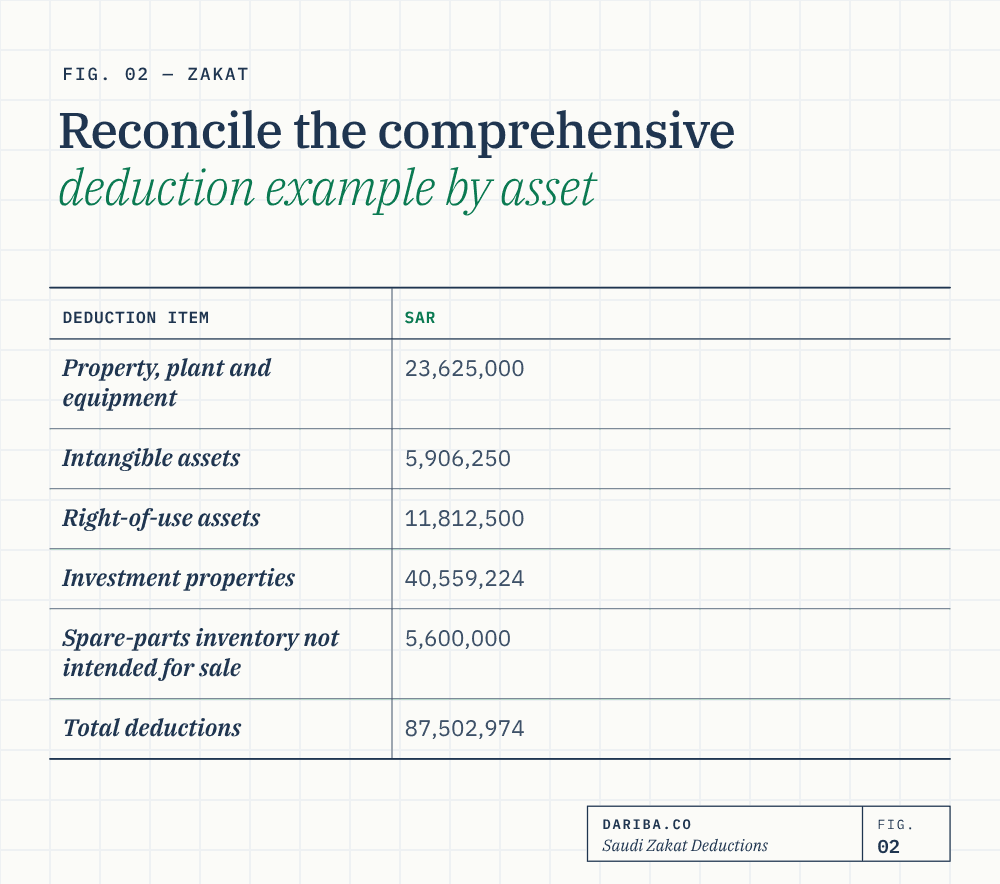
Reconcile the comprehensive deduction example by asset
Official example: ZATCA’s Guideline for Deduction Items from the Zakat Base, first edition July 2025, section 3.7, Example 42, identifies these accepted closing balances on its stated facts:
| Deduction item | SAR |
|---|---|
| Property, plant and equipment | 23,625,000 |
| Intangible assets | 5,906,250 |
| Right-of-use assets | 11,812,500 |
| Investment properties | 40,559,224 |
| Spare-parts inventory not intended for sale | 5,600,000 |
| Total deductions | 87,502,974 |
The example states that the non-current assets are intended for use rather than sale. Its separate SAR 18,025,000 finished-goods inventory is for sale and is not included in those deductions. The SAR 5,600,000 qualifying spare parts are the identified current-asset deduction; the guide expressly requires the related classification/liability corrections.
Dariba analysis: the deduction schedule crosses accounting categories. A qualifying inventory item can enter through an express exception while finished goods in the same inventory total remain outside. The accepted asset values are not annual depreciation expenses, and the SAR 87,502,974 total is not the final Zakat base or a guaranteed equal reduction in it.
Use the operational-assets guide for the particular recognition, use and inventory conditions, then recalculate the linked liability categories and final limits. The example’s stated facts do not establish that every asset presented under a similar heading qualifies.
Reconcile deductions with additions and the final limits
Article 25’s liability corrections and Article 23’s liability-addition limit can change alongside deductions. Articles 27–28 then address the applicable alternative and maximum base. The base guide connects those steps.
Dariba analysis: a qualifying current-asset deduction can also increase the liability amount added under the stated rules. Its gross value therefore does not establish the net reduction in final base or the cash saving.
Retain the closing values, provision-by-provision eligibility, classification, source documents, corresponding corrections and final calculation. That enables a reviewer to understand both the claimed deduction and its actual effect without assuming every supporting condition has been resolved by an accounting label.
Key takeaways
- Use each deduction category with its detailed conditions.
- Recognised net values and Article 48 exceptions matter.
- Biological assets concern living animals and plants.
- Not all production inventory qualifies for deduction.
- Statutory deposits require the legal obligation and no return entitlement.
- A gross deduction does not guarantee an equal final-base reduction.
Sources
- Controlling amended Arabic Zakat Implementing Regulations,1445HArticles 26,48-56 p. 17,27-30; current amended Article 73 pp. 37–38, with Decision 1248 footnote. Current Arabic controls.
- Official English Zakat regulations, read with current ArabicArticles 48-56 pp. 32–35 and amended 73 pp. 44–45; translated terms do not replace actual Arabic conditions.
- ZATCA General Guideline, first version October 2024Sections 5.3.1-5.3.2 pp. 201–215,5.3.5 pp. 237–239; Examples 73-76 and 88. Predates Decision 1248; does not replace amended off-plan rule.
- ZATCA Guideline for Deduction Items from the Zakat Base, July 2025Section 2.3, Example 1 and section 3.7, Example 42: recognition, title exceptions and the comprehensive deduction bridge.
General information only. Actual supplies, facts, applicable periods and controlling Arabic legislation determine the result. Official examples are distinguished from Dariba analysis and original illustrations. Seek advice or clarification where the arrangement or source material leaves a specific issue unresolved.