In brief
Apply the Saudi equity-fund monthly trading ratio, highest-month selection and closing-balance split with checked ZATCA examples and clear rounding.
Distinguish the investor’s units from the fund’s underlying equities
An investor can hold fund units for non-trading purposes while the fund buys and sells underlying shares. These are two levels of analysis. The investor’s deduction conditions under Article 77 should not be replaced by the fund’s portfolio-turnover calculation under Article 78.
Article 78(2)(c) of the Zakat Collection Regulations, 1445H, provides a specific monthly method for qualifying equity funds. ZATCA’s August 2024 investment-fund guideline, sections 3.5 and 3.7.3, explains that distinction and illustrates the calculation. The method is not an instruction to classify every fund unitholder as a trader.
Confirm that the fund meets the rule’s activity condition
The regulation requires the fund’s principal activity to be investment in shares of local or international financial markets. Identify the fund’s actual activity and relevant equity investments before applying the formula to its whole asset balance.
The guideline discusses the rule in the context of equity funds and their underlying listed shares. It should not automatically be transplanted to a property fund, a loan portfolio or an investor’s ordinary bank deposit.
Dariba recommendation: obtain the fund’s terms and financial information and identify which closing item the calculation will split. Keep other assets under their own provisions. Registration with ZATCA does not establish that every type of fund uses this particular monthly ratio.
Calculate each month’s net purchases and net sales
For each month, calculate purchases of equities less subscriptions, and sales of equities less redemptions. Take the higher of those two amounts and divide it by the fund’s net equity-investment value for that same month. Section 3.7.3 identifies the monthly closing investment value in its practical calculation.
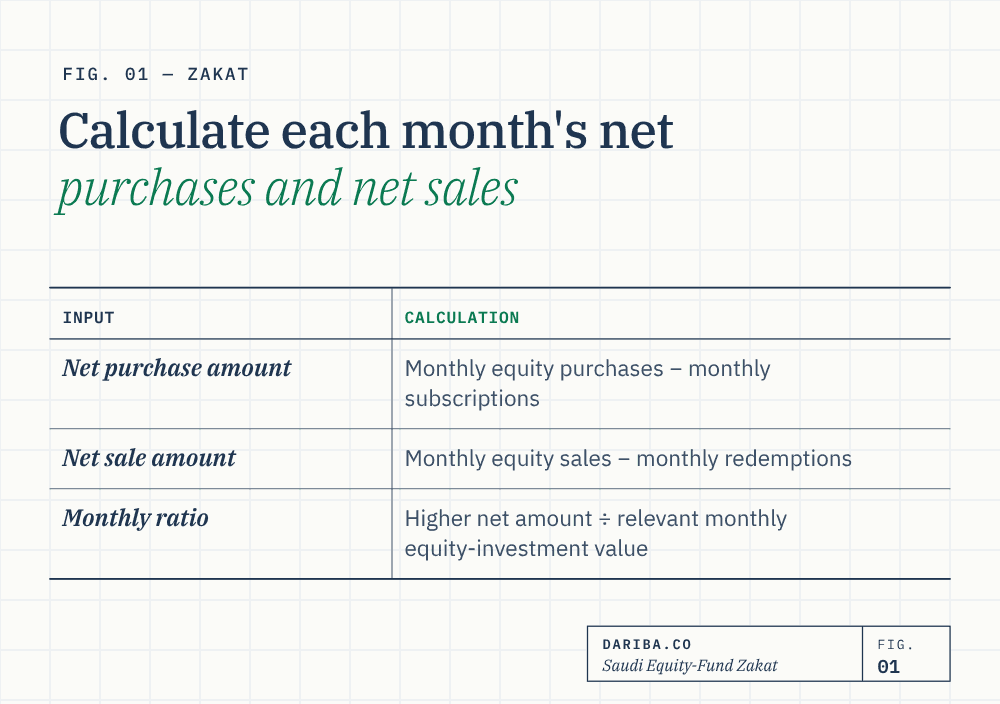
| Input | Calculation |
|---|---|
| Net purchase amount | Monthly equity purchases − monthly subscriptions |
| Net sale amount | Monthly equity sales − monthly redemptions |
| Monthly ratio | Higher net amount ÷ relevant monthly equity-investment value |
Subscriptions and redemptions concern unitholder cash flows, whereas purchases and sales concern the underlying shares. Reversing those pairs can materially change the result. The translated table headings should not override the Arabic rule’s subtraction direction.
Use the highest monthly ratio, not an annual average
Repeat the calculation for every month in the fund’s year and select the highest ratio. Multiply that ratio by the value of the relevant equities in the closing financial statements. The result is the trading portion; the remainder is the non-trading portion, subject to the applicable deduction rules.
Do not divide annual net transactions by the December balance or average the monthly percentages. Both shortcuts replace the statutory maximum-month method with a different calculation.
Dariba recommendation: retain the complete monthly schedule, not only the selected month. An annual total can conceal the month that determines the result, and the month with the highest cash amount need not have the highest percentage if investment values differ.
Read the domestic-equity illustration with its rounding assumption
Official illustration: the first domestic-equity hypothetical example in section 3.7.3 identifies August as the highest month: SAR 550,000 divided by SAR 35 million. The guideline displays 1.57% and applies that rounded percentage to SAR 40 million at year-end, giving SAR 628,000 trading and SAR 39,372,000 non-trading investments.
Dariba precision check: the underlying ratio is approximately 1.57142857%. Applying that unrounded fraction gives SAR 628,571.43 trading and SAR 39,371,428.57 non-trading. The difference results from intermediate rounding, not a different legal formula.
Keep the source’s published rounding identifiable when reproducing its illustration. For an actual calculation, maintain a consistent precision policy and reconcile the figure used in the return; a displayed percentage should not silently replace the underlying fraction.
The foreign-equity illustration shows why displayed percentages need care
Official illustration: the foreign-equity example in section 3.7.3 identifies August using SAR 700,000 over SAR 4.75 million and a SAR 4.95 million year-end equity balance. The displayed ratio is 14.74%. Applying the full underlying fraction gives approximately SAR 729,474 trading and SAR 4,220,526 non-trading, matching the published whole-riyal results.
Multiplying the displayed 14.74% directly would give a different amount. The published result therefore needs the underlying ratio, rather than the rounded percentage shown alongside it.
The guideline also requires the applicable Article 44 treatment where qualifying foreign investments are deducted. The non-trading classification is not, by itself, permission to omit the separate underlying-investment Zakat or its required evidence.
Keep the remaining deduction conditions and unusual cases visible
Article 78 treats the residual portion under the relevant investment provisions; other applicable conditions remain important, including the domestic or foreign nature of the holdings. Do not assume every calculated non-trading amount is deductible regardless of the underlying legal tests.
The regulation and the reviewed examples do not provide a complete special-case algorithm for a zero monthly denominator, an anomalous percentage above 100% or every negative-flow pattern. Do not silently introduce a cap, replace a zero with one or discard an inconvenient month.
Dariba recommendation: first reconcile the data and the scope of the investment item. If a material boundary remains unresolved, obtain clarification on that fact pattern before relying on an invented adjustment. Source examples with inconsistent intermediate entries should likewise be checked against their underlying data.
Obtain a reproducible schedule from the fund manager
Request the monthly purchases, sales, subscriptions, redemptions and relevant investment values, together with the year-end balance. The schedule should identify the selected ratio, the trading and non-trading amounts and any rounding applied. Reconcile those amounts to the fund’s statements and information return.
Article 76 requires the fund to provide investors with information needed for their Zakat calculation and addresses ZATCA’s requests to both fund and investor. The investor’s deduction responsibility is not discharged simply by obtaining an unexplained percentage from the manager.
Read the fund scope and compliance guide and fund-base calculation guide to connect this portfolio split to the investor’s actual deduction and payment.
Key takeaways
- Separate trading in fund units from the fund’s underlying equities.
- Use the rule only where the fund’s principal activity qualifies.
- Subtract subscriptions from purchases and redemptions from sales.
- Select the highest monthly ratio, not the annual average.
- Keep underlying precision separate from displayed percentages.
- The residual classification does not remove other deduction conditions.
Sources
- Implementing Regulations for Zakat Collection, 1445H, current Arabic textArticles and conditions identified in the analysis. Controlling text checked against original headings and formulas.
- ZATCA Guideline for Treatment of Investments in Investment Funds, August 2024Sections 3.2–3.7 and the specified examples. Translation, actual-day and rounding qualifications retained.
- Implementing Regulations for Zakat Collection, English referenceExplanatory translation only; the Arabic text governs inconsistencies.
General information only. Actual supplies, facts, applicable periods and controlling Arabic legislation determine the result. Official examples are distinguished from Dariba analysis and original illustrations. Seek advice or clarification where the arrangement or source material leaves a specific issue unresolved.