In brief
Choose the correct Saudi Zakat investment route, with trading controls, domestic and foreign conditions, separate payments and exact official examples.
An investment being strategic, non-current or subject to foreign income tax does not by itself establish a Saudi Zakat deduction. Start with the non-trading controls, then the route for the actual investee or instrument. For certain investments, deducting the carrying amount from the investor’s ordinary base comes with a separate Zakat calculation and payment.
Identify the investment and the applicable route
Current amended Arabic Zakat Implementing Regulations Articles 42–47, pp. 24–27, distinguish general trading controls, domestic establishments, foreign establishments, funds and investments in companies not subject to collection. Article 55 separately addresses non-governmental sukuk/bonds.
The Zakat General Guideline, first version October 2024, section 5.3.3, pp. 215–230, explains these routes. Its rationale does not replace the detailed conditions in the current regulations.
Dariba recommends identifying the legal investee, instrument, location, accounting category and Zakat status before recording a deduction. An equity interest, shareholder receivable, fund unit and sukuk are not interchangeable merely because they share an investments ledger heading.
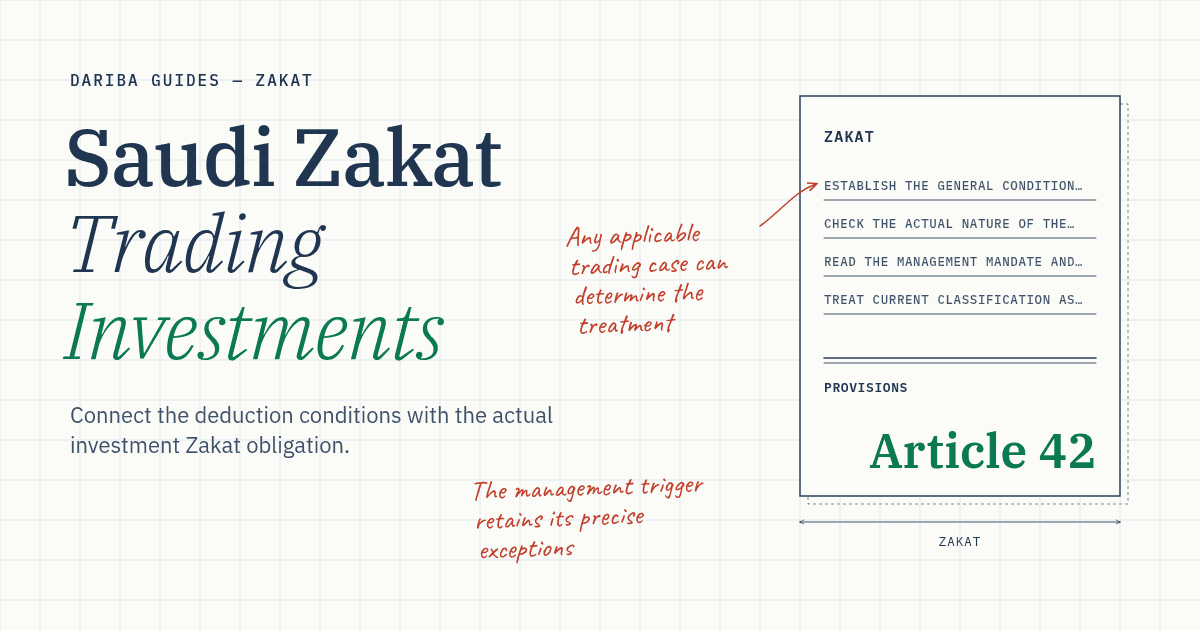
Apply all Article 42 trading controls
Article 42 requires non-trading purpose, subject to the particular investment’s provisions. Any of its six stated cases can establish trading treatment. These include the nature of the payer’s activity, the qualified management mandate, current-asset classification, the specified listed-portfolio transaction sequence, disposal intention and the liquidity-presentation test.
The trading-portfolio guide explains the actual exceptions and boundaries. A manager’s licence alone does not replace the management-agreement wording or make every managed investment non-trading.
Article 42(2) applies the consequence to the relevant portfolio assets without automatically contaminating every investment shown in the same financial-statement line. Establish the actual portfolio and retain its transaction record.
Substantiate domestic investee eligibility
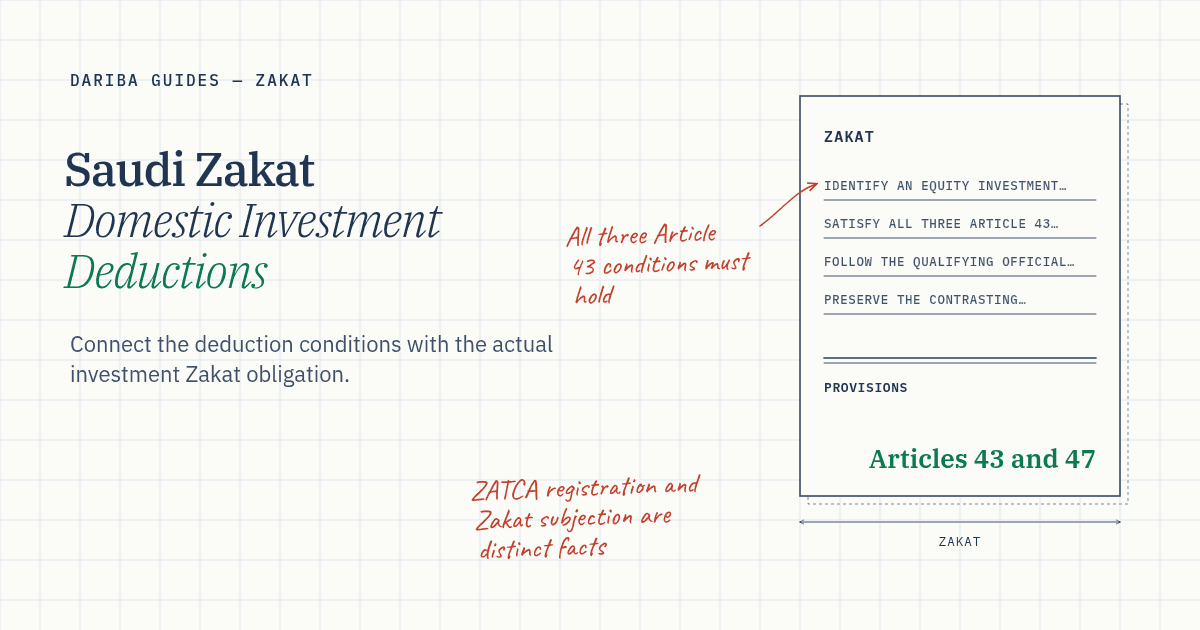
Article 43 requires non-current classification, non-trading purpose and the investee’s registration with ZATCA and subjection to Zakat collection. Being incorporated in Saudi Arabia is only part of the enquiry.
Official General Guideline Example 77, p. 219: the SAR 5 million local-company investment is deductible on the stated non-current, non-trading and registered/Zakat-subject facts. Example 78, p. 220: a SAR 8 million local-company investment is not deductible because it is current, despite the investee being subject to Zakat.
The domestic-investment guide develops the distinction. These examples do not establish an automatic deduction for every subsidiary, associate or joint venture, or independently prove another investee’s status.
Preserve the foreign-investment payment and certificate conditions
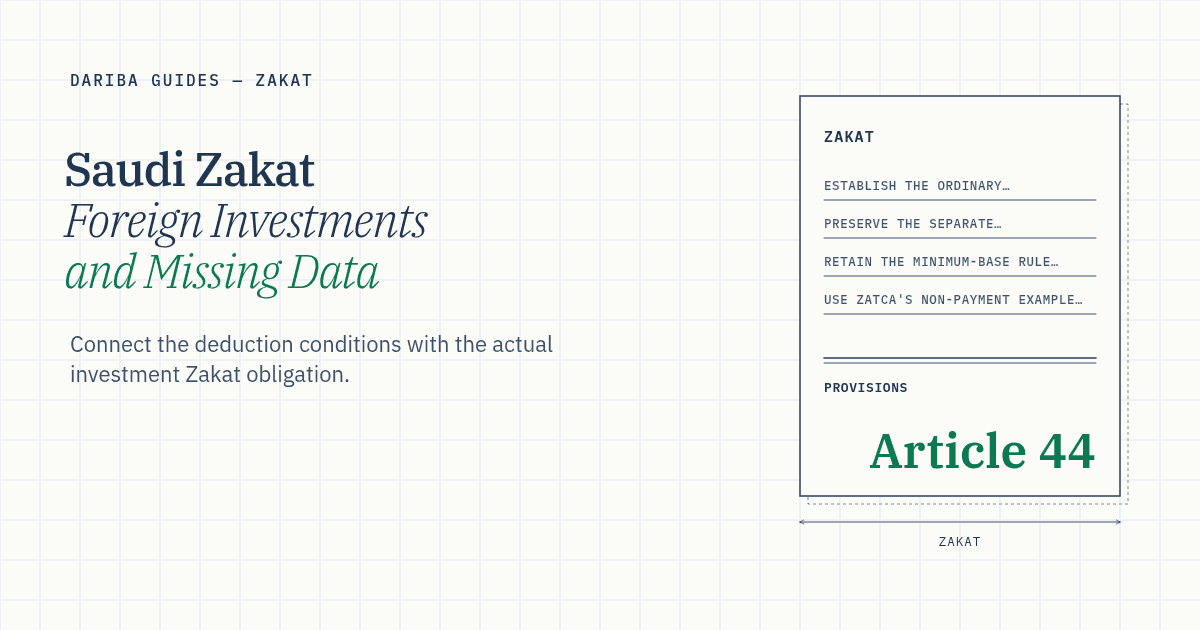
Article 44 requires non-current classification and non-trading purpose, plus payment of the investment’s Zakat to ZATCA within the return. The investment’s Zakat is calculated independently under a certificate prepared according to the regulations and approved by a Saudi-licensed chartered accountant. Article 27’s minimum applies as stated whether profits are distributed or not.
Official General Guideline Example 79, p. 222: the SAR 9 million foreign-company investment is not deductible where the investor does not pay its share of the investment’s Zakat. Non-current classification does not cure that failure.
The foreign-investment guide explains the separate calculation and Article 46’s conditional data-unavailability route. Foreign income tax is not a substitute for the expressly required Zakat payment.
Distinguish non-subject investees and the wholly-owned foreign rule
Article 47(1) addresses investments in companies not subject to collection, subject to Article 42, non-current classification, the separate calculation/certification and payment, and Article 27’s stated minimum. The investee’s exemption does not itself exempt the investor’s investment.
Official General Guideline Example 80, p. 224: the SAR 3 million local-company investment concerns an investee with a ZATCA exemption letter; the investor has paid its share of the investment’s Zakat. The guide permits deduction on those facts, read with the full statutory conditions.
Article 47(2) separately treats an investment in a foreign company wholly owned by payers subject to ZATCA Zakat collection as domestic under Article 43. Establish the complete ownership and subjection rather than extending that rule to every partly Saudi-owned foreign company.
Separate financing funds from other fund investments
Article 45 distinguishes financing funds from the route under Articles 77–79 for other investment funds. The latter is conditional on non-trading purpose and the required unitholder calculation, documentation and payment; a fund investment is not automatically deductible merely because the fund itself is not subject to collection.
General Guideline section 5.3.3.4, pp. 225–226, explains the distinction. Example 81, p. 226: the SAR 14 million investment in the stated licensed direct-financing fund is deductible on its specific non-current, non-trading and Zakat-subject facts.
This overview identifies the routes. It does not perform every fund-specific Article 78 calculation or extend a particular financing-fund example to all funds, REITs or unit classes.
Obtain the actual sukuk or bond evidence
Article 42(4) refers to Article 55. The latter permits the issuer’s stated capital treatment for non-governmental instruments, regardless of accounting classification, with the prescribed statement through evidence accepted by ZATCA and consistency over the maturity term. The investor’s non-trading condition remains relevant.
Official General Guideline Example 82, p. 227: the SAR 25 million sukuk holding lacks evidence of the issuer’s capital treatment and is not deductible on the stated facts. A product name or long maturity is insufficient.
Dariba recommends obtaining the actual issuer evidence and tracing its period and instrument coverage. Do not substitute the investor’s preferred accounting category or a broad Islamic-finance label for the Article 55 conditions.
Reconcile the deduction with the full calculation
The base guide and minimum/maximum guide explain the corresponding liability limits, corrections and conditional alternative base. A deduction is not a guarantee of an equal reduction in final base or Zakat due.
Dariba original assumptions: a SAR 2 million investment satisfies its deduction route and the period’s applicable rate is exactly 2.5%. SAR 50,000 is only the arithmetic product of those assumptions; it is not an assured saving before the full base and separate investment-Zakat requirements are assessed.
Keep status evidence, mandates, portfolio records, year-end values, ownership, certificates, separate calculations and payment reconciliations together. The useful advisory conclusion is the actual route and its financial consequences, including what still needs evidence.
Key takeaways
- Non-trading is necessary but does not replace investment-specific conditions.
- Domestic holdings require non-current classification and registered Zakat-subject investees.
- Certain foreign and non-subject investments need separate Zakat calculation and payment.
- Article 46 is a conditional data-unavailability route.
- Financing funds and other funds follow different routes.
- A deduction does not automatically equal a reduction in final tax.
Sources
- Controlling Arabic Zakat Implementing Regulations, 1445HArticles 42-47, pp. 24–27; Article 55 p. 29 and fund routes77-79 pp. 40–42. Current amended Arabic controls.
- Official English Zakat regulations, read with current ArabicArticles 42-47 pp. 28–31;55 p. 34;77-79 pp. 48–50. Translation assists; Arabic conditions control.
- ZATCA General Guideline, first version October 2024Section 5.3.3, pp. 215–230; Examples 77-82 pp. 219–220,222,224,226-227. Exact facts and conditions retained.
General information only. Actual supplies, facts, applicable periods and controlling Arabic legislation determine the result. Official examples are distinguished from Dariba analysis and original illustrations. Seek advice or clarification where the arrangement or source material leaves a specific issue unresolved.