In brief
Test delayed government dues, current-asset deductions, linked liabilities, debit loans and separate balances under Saudi Zakat Articles 32-35.
An unpaid receivable is not automatically deductible from the Zakat base. Articles 32–35 distinguish delayed government dues, other debit loans, separate creditor/debtor balances and the stated finance-leased asset case. Establish what the balance represents and which conditions apply before describing it as unavailable cash or reducing a liability by the same counterparty’s receivable.
Start with the actual receivable and statutory route
Current amended Arabic Zakat Implementing Regulations Articles 32–35, pp. 21–22, provide specific treatments. A trade receivable, partner loan, other loan and lessor’s finance-leased asset should not be combined under one general overdue-debt rule.
The Zakat General Guideline, first version October 2024, section 5.3.4, pp. 233–236, explains partner debit loans and delayed government dues. The detailed provisions, actual classification and evidence remain necessary.
Dariba recommends identifying the legal debtor, basis of entitlement, accounting category, transaction type and reason for delay. Government ownership of a commercial customer should not be assumed identical to the actual government-entity limb without establishing the relevant legal person.
Establish the cause and evidence of government delay
Article 32 begins with government debts in the payer’s assets not being deducted, unless its stated conditions hold. The payer must prove that the reason for delayed payment rests with the government entity and provide documents establishing entitlement and the government’s delay.
Ageing alone is insufficient. A balance remaining unpaid for a long period does not by itself prove its legal entitlement, the responsible cause or eligibility under this paragraph.
Dariba recommends retaining the contract/award, performance or acceptance evidence, payment entitlement, communications and actual reasons for delay. These are practical evidence examples, not a claim that one prescribed invoice-age threshold or document list automatically qualifies every case.
Do not invent a fixed overdue period
Official clarification: ZATCA’s Guideline for Deduction Items from the Zakat Base, first edition July 2025, section 4.2, question 4, states that the Regulations do not prescribe a particular delay period for accepting delayed government dues. Acceptance remains subject to the statutory conditions.
Dariba analysis: a mandatory 90-day, one-year or other ageing threshold should not be added to Article 32 without an applicable source. Equally, the absence of a fixed minimum does not make every unpaid government invoice deductible on the first day after billing. Establish actual entitlement, a delay attributable to the government entity, the required current classification and the corresponding liability treatment.
The evidence needs to explain the delay, not simply count days. Retain the contractual due date, performance or acceptance position and communications showing the cause. These are practical evidence suggestions, not a substitute prescribed-document list or a newly invented automatic eligibility date.
Preserve the current-asset condition
Article 32(2) requires the relevant classification in financial statements as current assets. Do not disregard that condition because management expects eventual collection, or simply relabel a non-current asset in the tax schedule without its accounting basis.
General Guideline section 5.3.4.2, p. 235, repeats the government-delay and current-asset conditions. It explains the collection obstacle but does not create a deduction for all doubtful or disputed customer accounts.
The valuation/classification guide addresses the relevant year-end and liquidity-presentation rules. An impairment expense or accounting provision also has its own result/base treatment; it is not automatically the same as deducting the receivable itself.
Apply the linked current-liability consequence
Article 32(3) requires the relevant current liabilities, if any, to be added up to the amount of delayed government dues deducted, subject to Article 25. The asset-side benefit therefore cannot be assessed in isolation.
The apportionment guide explains its ratio and cap framework. Use the actual current assets/liabilities and deductions, considering the specific government-dues provision rather than inventing an unrestricted independent adjustment.
Dariba recommends showing the asset deduction, its corresponding liability analysis and final permitted liability total in the same schedule. The word deductible alone does not establish an equal reduction in the final Zakat base or a guaranteed cash saving.
Use ZATCA’s example within its stated facts
Official General Guideline Example 87, pp. 235–236: the debtors include SAR 30,000 delayed government dues with evidence that the government caused the delay and that the company is entitled to the amount. The guide includes that amount among the stated deductions and expressly flags the correction for deducted current assets.
The same example separately addresses a qualifying related-party financing balance and other assets under their own conditions. It does not make all debtors deductible or exempt the entire mixed ledger.
Dariba analysis: preserve the connection between the supporting facts and the particular SAR 30,000. An unrelated unpaid amount in the same account requires its own route and evidence instead of borrowing the example’s conclusion.
Compare the four debtors in the detailed government-delay example
Official example: ZATCA’s Guideline for Deduction Items from the Zakat Base, section 3.5.2, Example 29, analyses four delayed current receivables:
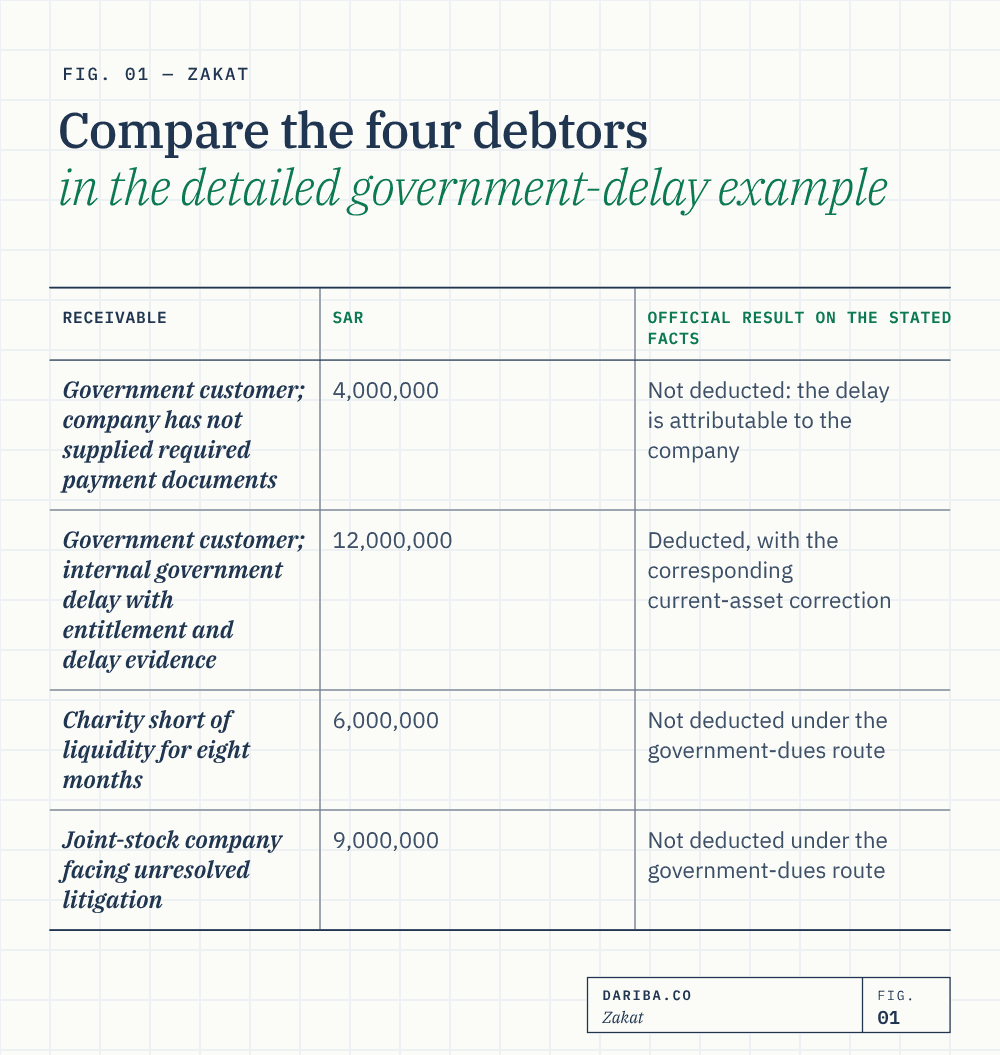
| Receivable | SAR | Official result on the stated facts |
|---|---|---|
| Government customer; company has not supplied required payment documents | 4,000,000 | Not deducted: the delay is attributable to the company |
| Government customer; internal government delay with entitlement and delay evidence | 12,000,000 | Deducted, with the corresponding current-asset correction |
| Charity short of liquidity for eight months | 6,000,000 | Not deducted under the government-dues route |
| Joint-stock company facing unresolved litigation | 9,000,000 | Not deducted under the government-dues route |
Dariba analysis: the reason for the delay and the legal debtor matter independently of its age. A company cannot establish government-caused delay merely by leaving its own payment-document requirements incomplete. A charity’s liquidity problem or a commercial debtor’s litigation does not turn that debtor into a government entity.
The case does not decide every separate bad-debt expense, partner-loan deduction or later legal outcome. It applies the specified government-dues route to these actual receivables. Keep the evidence of completed work, due date, entitlement, submitted payment documents and cause of delay together, without inventing a fixed ageing safe harbour.
Preserve the non-current contrast and its liability consequence
Official example: section 3.5.2, Example 30, identifies SAR 8 million due from a government entity. The company has evidence of entitlement and delay caused by the government entity, but the amount is classified as non-current. The guide denies the Article 32 deduction because the current-asset condition is not satisfied, and requires the corresponding placement correction for the non-deducted non-current asset.
Dariba recommendation: review the approved financial-statement classification and the facts supporting it before calculating the deduction. Do not simply relabel an asset in the tax schedule because the alternative classification would be favourable. Both this example and the accepted SAR 12 million case require consistent liability analysis, although the classification and correction routes differ.
A denial under Article 32 does not by itself supply the final Zakat base or prove the receivable has no value. The final result still depends on the applicable additions, deduction limits and base comparisons.
Do not extend partner-loan deductions to all debit loans
Article 33, Arabic text, p. 22, excludes debit loans/equivalents from deduction except the stated partner debit loans under Article 31. A financing asset being non-current does not automatically satisfy a deduction condition.
The partner-loans guide explains the listed-company, borrower-subjection, contractual and ownership conditions. The borrower’s accounting entry or a related-party label is not alone sufficient.
Do not equate non-deduction of a balance-sheet loan with a final decision on every related expense, bad-debt write-off or other tax. Those questions require their own provisions and actual evidence.
Preserve separate balances in the Zakat calculation
Article 34 requires the stated creditor and debtor balances to be considered separately, subject to Articles 30–31, even where the counterparty is the same or an owner. The liability is added if its actual addition conditions hold.
Dariba original assumptions: a payer owes a counterparty SAR 500,000 and holds a SAR 100,000 receivable from it at year-end. A tax-schedule entry showing only SAR 400,000 does not by itself establish the correct Zakat treatment. Assess the actual SAR 500,000 liability and SAR 100,000 asset under their respective rules.
This is a calculation rule, not an invented general prohibition on commercial settlement. If an actual legally effective settlement changes the year-end balances, establish those facts and their treatment; do not use a notional offset as a substitute for them.
Keep the finance-lessor boundary and the evidence file
Article 35, Arabic text, p. 22, provides that, except for financing-activity payers, the stated finance-leased assets are not deductible investment in the lessor’s base regardless of accounting classification, subject to the specific build-operate-transfer project route under Article 74.
The lessor’s treatment should not be confused with the lessee’s right-of-use assets or every entity with the word finance in its name. Confirm the actual payer, asset and activity before relying on an exception.
Dariba recommends retaining the contract, debtor identity, entitlement/delay evidence, approved classification, actual settlement and corresponding asset/liability calculations. That explains why the relevant route applies instead of assuming all receivables, all government-related customers or all leases have identical treatment.
Key takeaways
- Delayed government dues require entitlement and government-delay evidence.
- Current-asset classification is an express condition.
- Related current liabilities must be assessed under the stated limits.
- Other debit loans do not inherit the partner-loan exception.
- Assess actual creditor and debtor balances separately.
- The finance-lessor rule differs from lessee right-of-use treatment.
Sources
- Controlling Arabic Zakat Implementing Regulations, 1445HArticles 32-35, with Articles 25 and 30-31. Current amended Arabic text controls; pp. 15-23.
- Official English Zakat regulations, read with current ArabicArticles 23-41. Translation assists navigation; current Arabic and actual conditions control.
- ZATCA General Guideline, first version October 2024Examples 13, 86-87, pp. 53–54 and 233-236; apply the particular facts and corresponding corrections.
- ZATCA Guideline for Zakat Base Additions, version 1 January 2025Relevant sections 2.4-2.5, 3.1, 3.3-3.6 and 5; exact examples and physical pp. identified in the article.
- ZATCA Guideline for Deduction Items from the Zakat Base, July 2025Section 4.2, questions 1, 4 and 5: investee results in the minimum base, delayed government dues and statutory-deposit return entitlement.
General information only. Actual supplies, facts, applicable periods and controlling Arabic legislation determine the result. Official examples are distinguished from Dariba analysis and original illustrations. Seek advice or clarification where the arrangement or source material leaves a specific issue unresolved.