In brief
Reconcile the tax point, ledger, e-invoice status and return. The worked example shows a delayed reporting acceptance and a later credit note.
A Saudi VAT return follows the VAT rules for the underlying transactions. Use Fatoora status to check whether the related invoices and notes were cleared or reported. The close should explain both the tax reported and any documents that still need action.
Build one reconciliation by registration and period
- Export sales, refunds and adjustments from every issuing system and the general ledger. Keep net value, VAT value, document type, tax point, invoice or note date and source transaction ID.
- Add Fatoora responses with the document identifier, submission time and status. Link retries or corrected documents to the same underlying transaction and keep the original records in the audit trail.
- Assign each sale to its VAT period using its tax point. Under the ordinary rule, check the earliest of supply, issue of the tax invoice and payment to the extent received. Check any applicable special timing regime, including cash accounting or qualifying government contracts.
- Summarise the supported amounts by return category. Reconcile purchases, imports and reverse charge using their own records. Confirm where the return requires entries outside the sales export.
Worked example for a monthly filer
Assume the October 2026 ledger contains SAR 100,000 of completed domestic sales at 15%, excluding VAT. One simplified invoice representing SAR 5,000 of sales was issued for an October supply. The first reporting attempt was rejected. The corrected document was successfully reported in November. The sale had its tax point in October, and the example assumes the seller followed the applicable correction process.
| October reconciliation | Net sales | Output VAT |
|---|---|---|
| October sales with successful Fatoora status by 31 October | SAR 95,000 | SAR 14,250 |
| October sale still open in the reporting queue at month-end | SAR 5,000 | SAR 750 |
| October totals for these transactions | SAR 100,000 | SAR 15,000 |
Retain the original rejection, corrected document, successful response and ledger reference. Use the November acceptance to close the invoice exception. Reporting success in November does not create an extra November sale or move October output VAT.
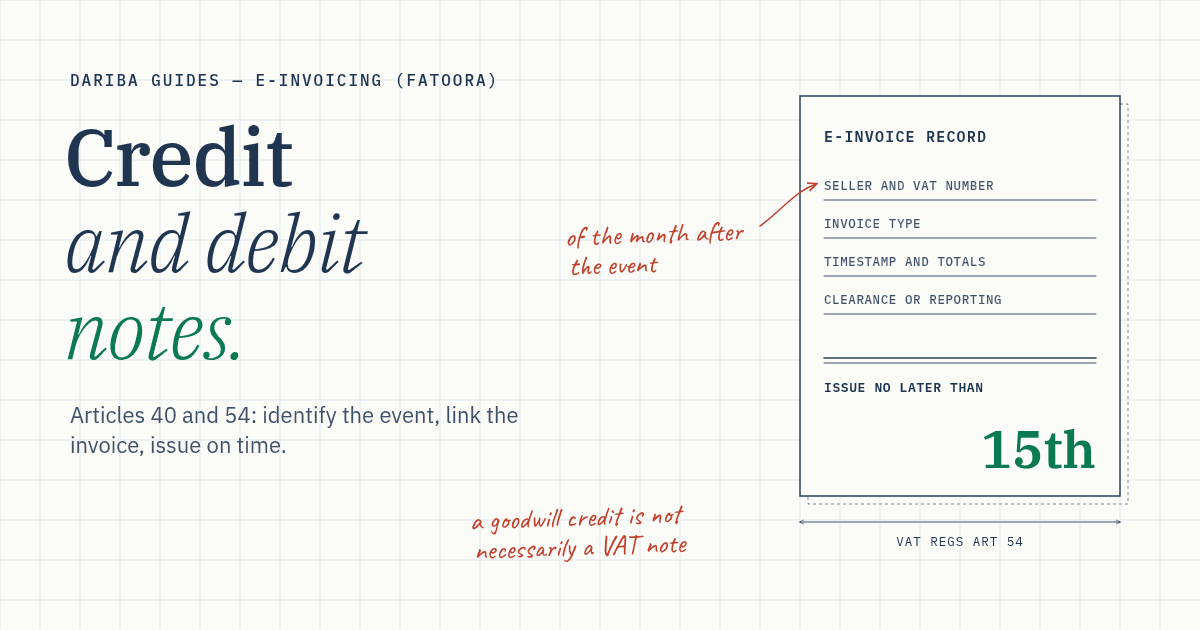
Now assume the seller had already correctly declared the October supply. On 30 November it accepts a return of goods from a different October sale worth SAR 2,000 before VAT. It issues the credit note to the customer on 3 December. Assuming Article 40 applies, the SAR 300 decrease goes in December, the later period. Keep the return acceptance and note together.
Route genuine adjustments and filed-return errors separately
For an Article 40 adjustment that increases supplier output VAT, use the period of the triggering event. For a decrease, use the later of the event period and the period the credit note is issued to the customer. If the earlier VAT return itself was incorrect, review the Article 63 correction route on its own facts. A corrected XML submission may fix the document while a return error still needs separate action.
A vendor or customer master-data warning can require a document fix even where the sales amount and tax agree. Where the issue affects a customer’s input deduction, check Article 49 and the available evidence before assigning the deduction period.
Leave a trace that someone else can follow
For each unresolved item, retain the source transaction, the affected VAT period, any Fatoora identifiers and responses, and the reason for keeping, moving or correcting the amount. Totals should tie back to the ledger and each relevant return category. Keep the reconciliation and the document archive even when all submissions succeeded.
Dariba is independent of ZATCA. This is general information. The amounts and dates are illustrative.
Sources
- Saudi VAT Implementing Regulations, Arabic compilationArticles 20, 40, 46, 49, 53–54, 63 and 66. Timing, notes, deductions, filed returns and records.
- ZATCA E-Invoicing Implementation Resolution, Arabic textClauses First, Second and Fifth to Seventh and Annexes One and Two. Document routes, integration, incidents and records.
- ZATCA Detailed Technical Guideline for E-InvoicingSections 3.5 and 4.1–4.3. EGS architecture, onboarding, clearance, reporting and rejection FAQs.
- GCC Unified VAT AgreementArticle 23, ordinary date VAT becomes due, subject to special rules.
- ZATCA Guideline for Tax Invoicing and Records under VAT Provisions, version 3Sections on invoice timing, credit and debit notes and record retention.