In brief
Article 13 separates mandatory and optional cancellation. Temporary inactivity, partial transfer and VAT-group exit do not always terminate registration. Deemed stock and capital-asset supplies have distinct valuation rules.
VAT deregistration requires a legal basis, an application where required, and an effective date determined under the applicable rules. A quiet month, a change of owner or an application upload does not automatically end registration. Article 13 distinguishes cessation, non-resident inactivity, resident threshold tests and optional cancellation; retained goods, capital assets, final reporting and older obligations require separate analysis.
Cessation means reviewing the actual continuing activity
Article 13(1) addresses stopping economic activity, including termination of legal personality or transfer of the activity resulting in complete cessation. Cancellation takes effect from the date ZATCA determines following approval; the taxpayer must fulfil all tax obligations for approval. Under paragraph (4), the relevant mandatory application is due within thirty days of the qualifying event.
ZATCA’s Amendments guideline, first issue April 2025, section 2.2, Example 5, p. 16, describes a contracting company transferring all operations to another company in its sector and ceasing all economic activity. It must seek deregistration, fulfil outstanding tax obligations and preserve records after cancellation.
Example 6, p. 17, instead transfers residential construction operations while commercial contracting continues. The company remains subject to its obligations while the mandatory-registration criteria continue. Dariba analysis: a partial transfer is not complete cessation, and even complete transfer does not, without the separate conditions, establish that the transfer itself is outside VAT under Article 17.
Temporary inactivity is not necessarily cessation
ZATCA’s Economic Activity guideline, second version May 2026, section 3.1, Example 1, p. 10, describes a Jeddah restaurant closed from May 2018 for refurbishment and reopening in November after kitchen installation and recruitment. Economic activity continues during the interruption.
This is not a universal six-month safe harbour. It illustrates why continued preparation and intention matter. A business should establish whether it is genuinely ceasing, temporarily unavailable or continuing another activity before selecting a deregistration reason.
Article 13(2) separately addresses a non-resident with no taxable Saudi supplies in the preceding twelve months, tested at month end. Do not substitute the resident SAR thresholds for that non-resident rule.
Resident mandatory threshold cancellation has three limbs
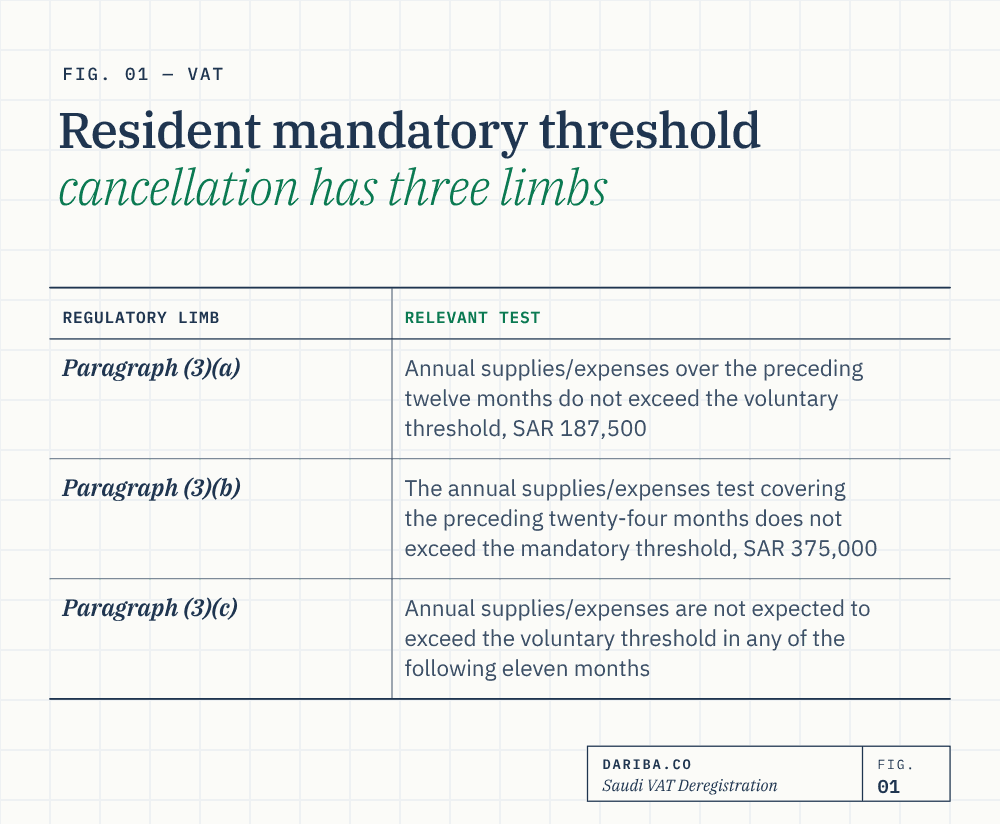
Article 13(3) requires all its conditions at month end. It refers to supplies or expenses, not revenue alone, and uses the voluntary and mandatory thresholds differently:
| Regulatory limb | Relevant test |
|---|---|
| Paragraph (3)(a) | Annual supplies/expenses over the preceding twelve months do not exceed the voluntary threshold, SAR 187,500 |
| Paragraph (3)(b) | The annual supplies/expenses test covering the preceding twenty-four months does not exceed the mandatory threshold, SAR 375,000 |
| Paragraph (3)(c) | Annual supplies/expenses are not expected to exceed the voluntary threshold in any of the following eleven months |
Maintain the rolling annual history and monthly forecast supporting each limb. Do not replace the paragraph’s annual-value wording with a single calendar year’s accounting revenue, or use only the latest twelve-month sales total. The thirty-day application rule in paragraph (4) then requires attention.
Where the period calculation or the supply/expense basis is material and unclear on actual records, obtain clarification rather than invent a universal averaging or aggregation algorithm. Moving wholly to exempt supplies also needs a complete eligibility review; it is not permission simply to stop filing while registration remains active.
Optional cancellation and the voluntary-registration restriction
Under Article 13(6), a taxpayer not required to cancel may apply at month end where annual Saudi supplies in the preceding twelve months do not exceed the mandatory threshold and annual supplies are not expected to exceed it in that month and the following eleven months. This is distinct from paragraph (3)‘s lower-threshold mandatory tests. Paragraph (7) uses the effective date ZATCA determines after approval.
Paragraph (8) restricts an Article 7 voluntary registrant from applying where its registration period has not exceeded twelve months and it has not ceased economic activity, without restricting ZATCA’s paragraph (5) powers. Do not reduce the wording to an unconditional right to exit on the twelve-month anniversary, or assume it removes genuine cessation obligations.
Dariba recommends assessing exit costs and future obligations before applying. Falling below SAR 375,000 does not, on its own, establish that every cancellation condition is satisfied.
Authority cancellation can proceed without an application
Article 13(5)(a) addresses a registered person who does not apply when cancellation is required under paragraphs (1), (2) or (3). In those circumstances, ZATCA must cancel the registration. The effective date is when the person ceased to be eligible, or another date the Authority determines. Failure to apply does not preserve registration indefinitely.
Paragraph (5)(b) separately addresses a person whom ZATCA determines was registered without being entitled to registration in the first place. The Authority must cancel that registration from the date it determines. This is different from a business that was properly registered and subsequently ceased its activity or ceased to qualify.
In both cases, paragraph (5) requires a cancellation notice stating the effective date. Reconcile the actual notice to returns, issued documents, input deductions, retained assets and outstanding liabilities. Neither a change in portal status nor an expected cancellation date should be used to erase the pre-cancellation obligations expressly preserved by paragraph (14).
Retained goods are not always valued at market value
Article 15(7) treats retention of goods after cessation or loss of registration eligibility as a deemed supply. Related deduction/recovery conditions, proportional treatment and applicable exclusions require review. Article 20(6) connects the cessation deemed supply to deregistration timing.
Current Article 39(1) ordinarily uses purchase value or cost for deemed supplies. If that cannot be determined, fair market value at the deemed-supply date is used under Article 38’s rules. Article 15(8) also adjusts the deemed value for the proportion of relevant direct VAT actually deducted or recovered.
Dariba illustration — original, ordinary non-capital stock: assume a relevant deemed supply of retained stock, determinable purchase cost of SAR 20,000, full associated deduction and a 15% applicable rate. Output VAT is SAR 3,000. This does not establish that every asset uses that value, or that an asset with a separate Article 52 rule should receive an additional identical charge.
Capital assets require the specific cessation rule
Article 52 ordinarily uses six-year adjustment periods for movable capital assets and ten years for immovable capital assets, subject to the shorter-useful-life provisions. But paragraph (8), where its conditions apply, provides a deemed supply when a capital asset permanently ceases taxable use, rather than an additional ordinary input-tax adjustment for the same remaining periods.
ZATCA’s Capital Assets guideline, second version May 2026, section 6.6, p. 41, explains the deemed value as purchase value multiplied by initial recovery percentage and remaining useful life, divided by the adjustment period. Section 6.6.1, page 42, explains relevant cases where a deemed supply does not arise, including no prior input deduction and an asset temporarily idle but available for economic use.
Dariba calculation — assumed qualifying movable asset: purchase value SAR 120,000, initial recovery 60%, three remaining years out of a six-year adjustment period. Deemed value is SAR 36,000, and 15% output VAT is SAR 5,400. Establish the correct years, asset classification, permanent cessation, rate and applicable special rules before using that result. Do not automatically stack a second remaining-life repayment on top of the same cessation deemed supply.
A group exit is not always deregistration
The Tax Groups guideline, third version May 2026, section 5.3, Example 8, p. 19, describes companies leaving group treatment in June 2019. A and B require individual registration, while C, on the example’s facts, is ineligible and its retained SAR 20,000 assets produce SAR 1,000 deemed VAT at the historical 5% rate.
The historical 5% is not today’s standard rate. Nor does the example prove that low sales always prevent voluntary registration: qualifying expenses and other conditions still matter. Article 12 distinguishes continuing individual registration after group exit from genuine cancellation. Use the actual status and effective dates; see the group registration guide.
Complete the application and transfer notifications
The application requirements should be tracked separately from eligibility:
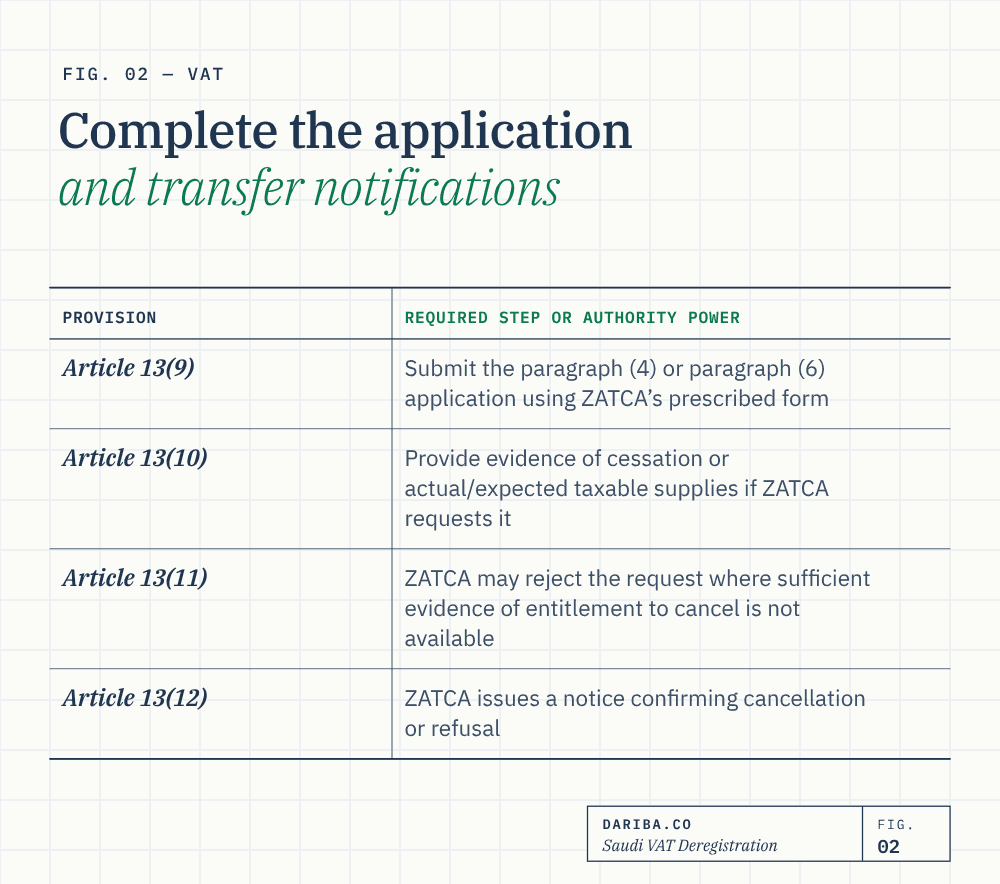
| Provision | Required step or Authority power |
|---|---|
| Article 13(9) | Submit the paragraph (4) or paragraph (6) application using ZATCA’s prescribed form |
| Article 13(10) | Provide evidence of cessation or actual/expected taxable supplies if ZATCA requests it |
| Article 13(11) | ZATCA may reject the request where sufficient evidence of entitlement to cancel is not available |
| Article 13(12) | ZATCA issues a notice confirming cancellation or refusal |
Retain the application, requested documents, response and resulting notice together. These paragraphs do not establish that submitting an application automatically ends filing obligations. Read the actual effective date under the applicable cancellation route and complete the relevant final reporting.
Paragraph (13) separately requires the transferee to notify a transfer within thirty days from the transfer under ZATCA’s mechanism, subject to the stated exception concerning the transferor’s paragraph (4) deregistration. Establish that the statutory exception is actually met rather than treating any application receipt as sufficient evidence. Article 17 has its own conditions and notifications for a qualifying transfer of economic activity; one notification should not be assumed to satisfy every other provision.
Records and earlier liabilities survive cancellation
Article 13(14) expressly preserves invoices, notes, books and records for Article 66’s periods and leaves pre-cancellation dues payable. Cancellation is not a release from older assessments or collection.
Dariba recommends a close-out file containing the notice, basis and effective date, final returns, stock and capital-asset calculations, transfer documents, payments, unresolved requests and retention schedule. That file should show how each exit obligation was resolved, rather than merely that a portal status changed.
Key takeaways
- Cessation, non-resident inactivity, resident threshold cancellation and optional cancellation have different tests.
- A partial transfer or temporary business interruption is not necessarily full cessation.
- Thirty-day applications and ZATCA approval/effective dates must be distinguished.
- Current deemed-supply valuation ordinarily uses purchase/cost, with market value as the specified fallback; capital assets have a special rule.
- Article 52(8) may produce a cessation deemed supply instead of an additional remaining-period input adjustment for the same asset.
- Transfer notifications, final reporting, retained records and older liabilities require their own close-out review.
- Authority-initiated cancellation and the application, evidence and notice rules require separate effective-date review.
Sources
- Controlling Arabic VAT Implementing RegulationsTenth edition April 2025. Registration Articles 2-13, pp. 7-16; deemed supply Articles 15,20,39 and capital rule 52; Arabic controls.
- ZATCA VAT Amendments guidelineFirst issue April 2025. Section 2.1 pages13-15, historical transition and group powers; section2.2 Examples 5-6 pages16-17 and section2.4 page19, cessation and deemed supply.
- ZATCA Economic Activity guidelineSecond version May 2026. Sections 3-5, pp. 8-15: preparation, continuity, private/employment activity and resident registration; Examples 1,2 and 5 retain their facts.
- ZATCA Tax Groups guidelineThird version May 2026. Sections 3-8, pp. 9-26; Examples 1,2,3,5,8,9,10. Historic 5% distinguished. Natural-owner example and application/request wording compared with Arabic.
- ZATCA Capital Assets guidelineSecond version May 2026. Sections 6.6 and 6.6.1, pp. 41-42: permanent cessation deemed value and exclusions; no automatic duplicate input adjustment.
General information only. Actual supplies, facts, applicable periods and controlling Arabic legislation determine the result. Official examples are distinguished from Dariba analysis and original illustrations. Seek advice or clarification where the arrangement or source material leaves a specific issue unresolved.