In brief
Resident mandatory registration uses historical and expected taxable supplies. Voluntary registration can use qualifying expenses; effective dates, zero-rated-only cases, non-residents and input recovery require separate analysis.
Saudi VAT registration depends on the person, economic activity, residence, qualifying supplies or expenses, and the relevant dates. For an unregistered resident, the ordinary mandatory threshold is SAR 375,000 of taxable supplies; both historical and expected supplies must be monitored at month end. Voluntary registration can also depend on qualifying expenses, so low sales alone do not settle eligibility. Registration does not guarantee recovery of every cost incurred before or after it.
Establish the person and economic activity
Article 2 concerns independent economic activity undertaken to generate income and a person registered or required to register. Legal form and profit are not decisive: an individual can conduct a business, and preparatory activity can precede the first customer invoice. Conversely, employment remuneration and purely private transactions require different treatment.
Article 1 imports the Agreement and VAT Law meanings unless context requires otherwise. Apply those defined terms to the actual person and transaction; a business description in the commercial register is not a substitute for the statutory analysis.
Article 9(5) excludes a government body’s activity as a public authority only where all stated conditions are met: legal authority to conduct it, operation outside economic/commercial criteria, and exclusive public provision without private-sector competition. Government ownership or a government customer alone does not establish that result. The public-functions guide explains the official cases.
Article 9(6) separately excludes an employee’s activity under an employment relationship. Article 9(7) addresses specified wages or benefits in qualifying labour secondments: the worker/client employment relationship, eligible client and supplier status, and separately stated wages or benefits and taxable commission all matter. A natural-person client requires the specified Governor’s controls, and the supplier must fall within the stated government, licensed HR-company or licensed-individual category. The employment and secondment guide explains the conditions; an entire staffing invoice should not be treated as outside VAT merely because it includes payroll.
ZATCA’s Economic Activity guideline, second version May 2026, section 3.1, Example 2, p. 10, describes an Al Jubail plastic-packaging factory established in 2019, importing production equipment that year and beginning production in 2021. It conducts economic activity throughout that preparatory period. The example does not automatically award registration or all input deductions; those conditions remain separate.
Dariba analysis: a credible pre-launch business may need registration analysis before revenue begins. An isolated invoice or lack of commercial registration is not a complete test of economic activity. Review the actual conduct, intention, preparation and nature of supplies.
Apply both mandatory tests at month end
Article 3 requires an unregistered resident to calculate the preceding twelve months’ supplies at each month end under the applicable calculation rules. Where the mandatory threshold is exceeded, apply within thirty days from that month end. Article 3(2)‘s ordinary effective date is the beginning of the month following the application month. Late/non-application is separately addressed by Article 6; delaying an application is not a compliant way to choose a later taxable start.
Where a person required to register fails to apply, Article 6(1) permits ZATCA to register that person without a submitted application, using the effective-date provisions of Articles 3 and 4. Waiting for an Authority notice does not postpone an existing obligation.
Article 4 separately requires estimation of supplies over the following twelve months at month end. If expected supplies exceed the threshold, the application is due within thirty days from that month end, with effectiveness from the beginning of the first month in which annual supplies are expected to exceed it. Establish what the forecast actually supports; the effective date is not automatically the contract-signature date or the date cumulative invoices physically pass SAR 375,000.
Dariba illustration: assume the historical test is first met at 30 April and the ordinary application is submitted in May. Thirty days from 30 April is 30 May, not automatically 31 May. Article 3’s ordinary start is 1 June. This illustration assumes no earlier Article 4 obligation or alternative effective-date decision. Applicable non-working-day rules under Article 74(2) should be considered separately; “within thirty days” does not mean “whenever the next month ends”.
Classify supplies before adding them
Taxable supplies include standard-rated and qualifying zero-rated supplies; exempt supplies and genuinely out-of-scope transactions are different. VAT itself and accounting profit are not the registration threshold. Customer location, place-of-supply rules, reverse charge and applicable transitional GCC provisions may affect the calculation. An invoice labelled “export” does not establish zero rating or its place of supply.
Article 6(5) excludes capital-asset supplies under its specific operational-use conditions, including use in carrying on the activity under the relevant registration/licence and not holding the asset for rental/similar income or later supply. Do not exclude trading stock merely because it is valuable or capitalised in an account.
Agreement Article 52(2)(b) also includes qualifying goods/services received for which the customer must account for tax in the threshold calculation. ZATCA’s Imports and Exports guideline, second edition May 2026, section 6.4, p. 33, expressly discusses received services and possible mandatory registration. This is different from the voluntary-expense test; not every private, exempt or outside-Saudi purchase is included. Dariba illustration: assuming the applicable calculation includes SAR 300,000 own taxable supplies plus SAR 100,000 qualifying received supplies, the combined value is SAR 400,000, exceeding SAR 375,000. The actual periods, supply treatment and liability conditions must be established.
Article 9(1) provides the mandatory-registration exception where all supplies are zero-rated and permits voluntary registration. This is not the same as making exempt supplies, and a single standard-rated supply changes the factual premise. Under Article 9(2), ZATCA may notify related persons carrying on similar or connected activities to aggregate supplies for the specified period; this is not automatic VAT-group registration.
Voluntary registration can use expenses
Article 7 allows an eligible resident who is not required to register to apply where qualifying supplies or expenses in the previous twelve months reach the voluntary threshold of SAR 187,500, or are expected not to fall below it over the next twelve months. The Arabic provision includes equality; a table saying that no one with low sales can register omits the expense route and forecast.
ZATCA’s Tax Groups guideline, third version May 2026, section 3.3, Example 1, p. 10, describes Golden Falcon Company’s SAR 2,000,000 local feasibility/design costs in Q1 2019 before client invoicing begins in January 2020. It supports voluntary registration on taxable expenses. It does not state a current-rate input refund amount or certify deduction of each expense.
Dariba recommendation: compare expected eligible input recovery with output tax, contractual pricing, customer recovery and compliance cost. Registration is not commercially costless merely because customers are businesses, and it does not allow a consumer-facing supplier to omit output VAT to preserve its price. A VAT-inclusive price can reduce the supplier’s net revenue.
Earlier dates and pre-registration recovery have conditions
Article 6(2) permits an approved later effective date on the applicant’s request, but no later than the beginning of the month following submission of the application. It does not provide unlimited discretion to defer mandatory registration to any chosen date. Under Article 6(3), an approved earlier date requires eligibility for registration at that date.
Voluntary applications have the separate Article 7(3) rule: on request, ZATCA may approve an earlier or later effective date if the applicant is eligible at that date. Do not silently apply Article 6(2)’s mandatory-registration limit to this distinct voluntary rule. An application or proposed date is not approval.
Article 6(4) also retains a transition provision for persons registered in other Member States before their relevant VAT legislation enters into force. Establish the applicable state, period, Agreement and Article 79 transition conditions before relying on that provision. A foreign VAT number does not by itself settle the Saudi registration obligation.
Deduction of costs acquired before registration also requires Article 49’s pre-registration conditions and evidence, with particular treatment for consumed services, goods and capital assets. Backdating and first-return pre-registration deduction are different routes.
See pre-registration input VAT and the capital-goods book-value analysis. Approval to register does not make private, exempt-use or otherwise blocked costs deductible.
Non-residents use a different trigger
Article 5 applies to a non-resident obliged to pay VAT on supplies made or received in the Kingdom, without the resident turnover threshold. Apply within thirty days from the first supply for which that person is liable, with effect from that supply. A Saudi customer alone does not establish that the foreign supplier must pay: analyse the actual supply and any applicable reverse charge.
Article 9(3) addresses application directly or through an approved representative, with representative details where applicable; paragraph (4) requires notification of a representative change within twenty days. Read these alongside the applicable Article 77 requirements. Do not turn the direct-application wording into a blanket assurance that no representative obligation can apply.
Submit and maintain the registration properly
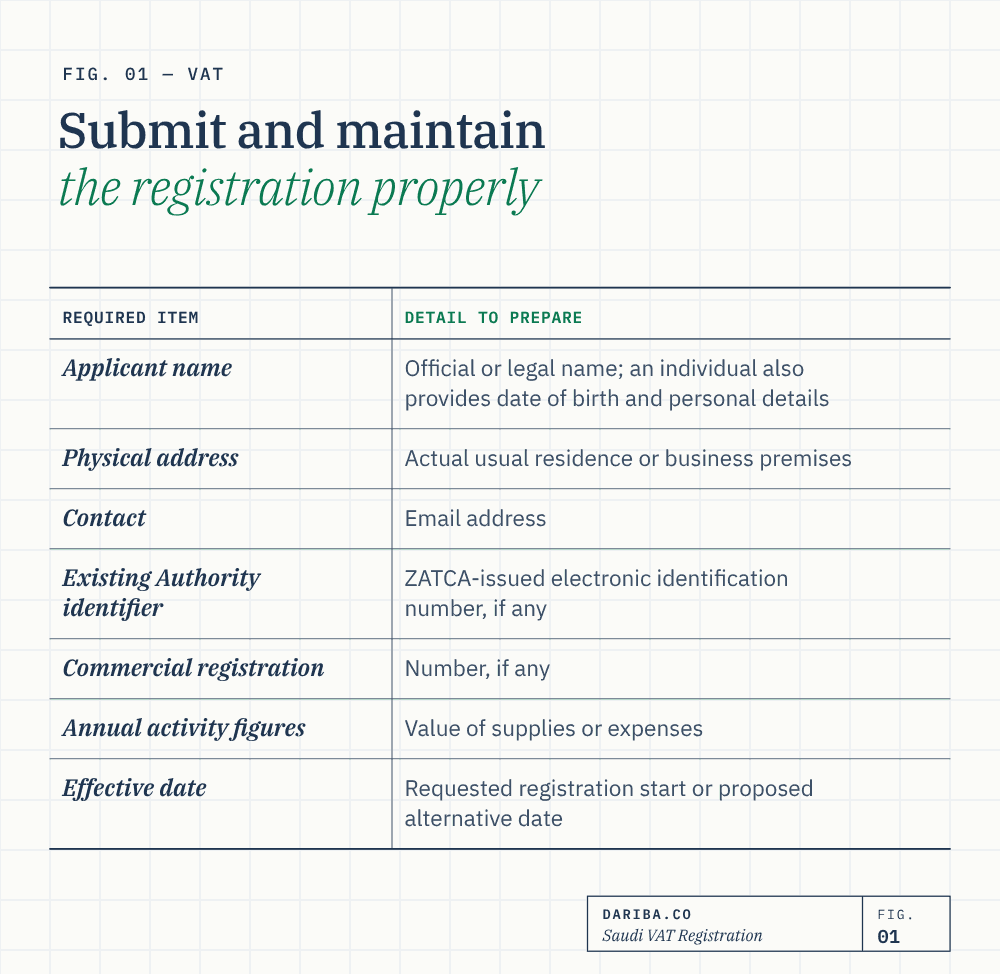
Article 8(1) requires the prescribed application form. Paragraph (2) specifies at least the following information:
| Required item | Detail to prepare |
|---|---|
| Applicant name | Official or legal name; an individual also provides date of birth and personal details |
| Physical address | Actual usual residence or business premises |
| Contact | Email address |
| Existing Authority identifier | ZATCA-issued electronic identification number, if any |
| Commercial registration | Number, if any |
| Annual activity figures | Value of supplies or expenses |
| Effective date | Requested registration start or proposed alternative date |
Under Article 8(3), ZATCA may request documents supporting the application and eligibility, in paper or electronic form, and must allow at least twenty days to provide them. Keep the request, due date and response evidence. This is the supporting-document period, not a promise that every application will be approved within twenty days.
Article 8(4) permits rejection where information is incorrect or the applicant is ineligible, by a rejection notice. On acceptance, paragraph (5) provides for a certificate with the effective date and tax identification number and notification to the applicant. Verify those details rather than assume the requested date was accepted. Paragraph (6) provides for ZATCA’s register of registered taxable persons.
Article 8(7) requires notification of a change to application information within twenty days of the change. Paragraph (8) requires the resident registered taxpayer to display the certificate at its principal place of business, branches and electronic stores so it is visible to the public. Article 57 separately requires the tax number on invoices and VAT correspondence. Follow the current official service process; Fatoora integration and VAT registration are different processes.
Registration begins continuing obligations
From the applicable effective date, apply the correct supply treatment, issue required invoices, file returns and pay net tax by the applicable dates. A nil period does not by itself remove filing obligations. General records ordinarily have a six-year rule under Article 66, with longer asset-related requirements.
Maintain a monthly threshold/forecast file, supporting classification and registration notice. When activity or eligibility changes, review deregistration rather than simply stopping invoices or returns. The right registration decision links the person’s actual activity to its obligations and recovery conditions, not to a threshold figure in isolation.
Key takeaways
- Run both resident mandatory tests at month end; ordinary applications are due within thirty days from that month end.
- Voluntary registration can be based on qualifying supplies or expenses at SAR 187,500, including the specified forecast route.
- Exclusive zero-rated supplies have the Article 9(1) exception; a mixed supply population is different.
- Pre-registration recovery and earlier effective dates have separate conditions; registration does not guarantee a refund of every startup cost.
- Non-residents use the actual VAT-liability trigger rather than the resident threshold.
- Registration changes, certificate display, invoices, filing and records remain continuing duties.
- Qualifying received supplies on which the customer must account for VAT also enter the applicable registration calculation under Agreement Article 52(2)(b); low sales alone are not a shield.
- The application, supporting-document period, approved effective date and twenty-day change notice are separate controls.
Sources
- Controlling Arabic VAT Implementing RegulationsTenth edition April 2025. Registration Articles 2-13, pp. 7-16; deemed supply Articles 15,20,39 and capital rule 52; Arabic controls.
- ZATCA Economic Activity guidelineSecond version May 2026. Sections 3-5, pp. 8-15: preparation, continuity, private/employment activity and resident registration; Examples 1,2 and 5 retain their facts.
- ZATCA Tax Groups guidelineThird version May 2026. Sections 3-8, pp. 9-26; Examples 1,2,3,5,8,9,10. Historic 5% distinguished. Natural-owner example and application/request wording compared with Arabic.
- ZATCA Input Tax Deduction guidelineThird version May 2026. Qualifying recovery and pre-registration conditions remain separate from registration eligibility; section 8.1 Example 22 supports qualified evidence analysis.
- GCC VAT Agreement — official Arabic textArticles 1,9,16,18-23,41,44,50-52; pp. 3-6,9-11,15-16,18-19. Read with Saudi law, implementing provisions and applicable transitional rules.
- ZATCA Imports and Exports guidelineSecond edition May 2026. Sections 6.1-6.4, pp. 29-33, Examples 3-7; Field 9, exempt/outside services, branch/subsidiary and qualifying received-supply threshold effects. Historical5% is preserved.
General information only. Actual supplies, facts, applicable periods and controlling Arabic legislation determine the result. Official examples are distinguished from Dariba analysis and original illustrations. Seek advice or clarification where the arrangement or source material leaves a specific issue unresolved.