In brief
Articles 10-12 require continuing eligibility and approved membership. Internal supplies are disregarded, but external input recovery, joint liability and actual effective dates remain material; source wording conflicts need care.
A Saudi VAT group treats approved members as one taxable person, but it does not combine every commonly owned business automatically or make every external input fully recoverable. Articles 10–12 govern eligibility, application, representation, effective dates, changes and liability. The practical value comes from applying those rules to the group’s actual activities and transactions, with particular care where exempt activities or special-refund status are involved.
Start with eligible legal persons
Article 10 requires two or more legal persons, each Saudi resident for VAT purposes and entitled to register as a taxable person, together with the ownership/control and other conditions. They must remain satisfied throughout membership. A natural person cannot itself join merely because that person owns companies, and a dormant entity is not eligible simply because its subsidiaries trade.
ZATCA’s Tax Groups guideline, third version May 2026, section 4.1.1, p. 11, explains independent legal personality and taxable-person eligibility, including relevant Saudi fixed-establishment cases. Residence is not interchangeable with the nationality of the ultimate shareholder. An overseas owner may be relevant to control without being an eligible Saudi group member.
Analyse ownership and control without oversimplifying either
Current Arabic Article 10(1)(b) refers to at least 50% of capital, voting rights or market value held directly or indirectly by the same legal person(s), or a legal person within or outside the group having power to control the other group persons. The control alternative is real; a mechanical share percentage alone is not a full analysis. Equally, a vague statement that a company is “influential” does not document qualifying control.
The guideline section 4.1.2, Example 2, p. 13, describes a Saudi parent owning a Bahrain company, which owns Saudi A and B. It permits the eligible Saudi entities to group notwithstanding the intermediate foreign ownership; the non-resident Bahrain company cannot join on those facts. Dariba analysis: distinguish the ownership chain from the actual membership boundary. A foreign intermediate company is not automatically fatal to Saudi grouping.
There is also a wording boundary worth resolving in an actual application. Example 3 on page 13 illustrates Mohammed, a natural person, owning 100% of Al Hilal and 50% of Al Amal and permits the companies to group, while current Arabic paragraph (1)(b) uses legal-person wording for common ownership/control. If reliance on individual ownership is decisive, identify the accepted basis and obtain clarification rather than presenting the example as amending the Arabic provision.
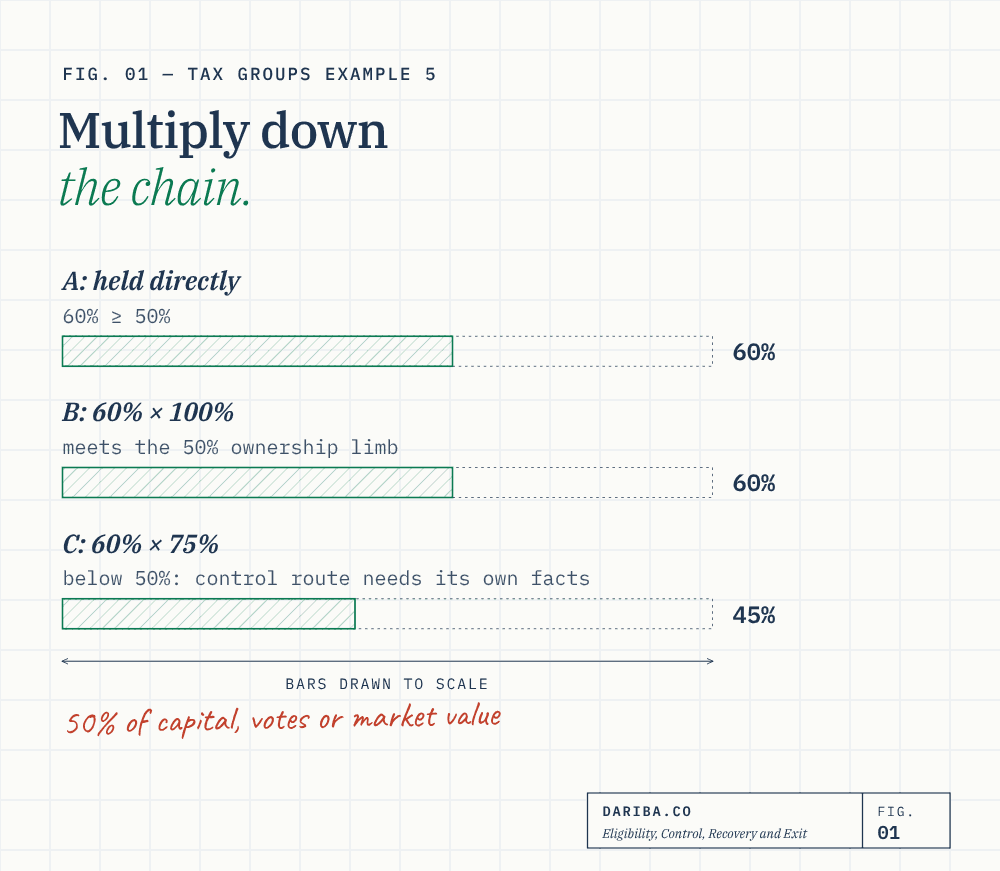
Example 5, page 14, illustrates a parent’s 60% holding in A, with A owning 100% of B and 75% of C. The resulting indirect holdings are 60% and 45%. The example analyses the ownership-based grouping outcomes. Do not extend its 45% result into a universal rejection where an independently supportable statutory control alternative applies; that needs its own facts and assessment.
Check zone, other-group and refund exclusions
Article 10(1)(c) excludes membership in another VAT group and the specified licensing to operate in a special zone with customs-suspension status. Not every location informally called a free zone establishes that condition; check the actual legal status and licence.
Paragraph (1)(d) excludes Article 70 refund-eligible applicants/members, with two express exceptions: the specified licensed developer whose activity is limited to sales/ownership transfers exclusively to employees, and an eligible donor in public-benefit projects. The exceptions do not cover every developer or charity. The guideline section 4.1.3, p. 15, explains these categories.
The Amendments guideline section 2.1.2, p. 13, describes the historical 180-day transition from official publication for existing groups. It should not be advertised in October 2026 as a fresh grace period starting whenever a company reads the article. Verify the actual commencement/publication and compliance history if transition treatment matters.
Apply through the representative and confirm the start date
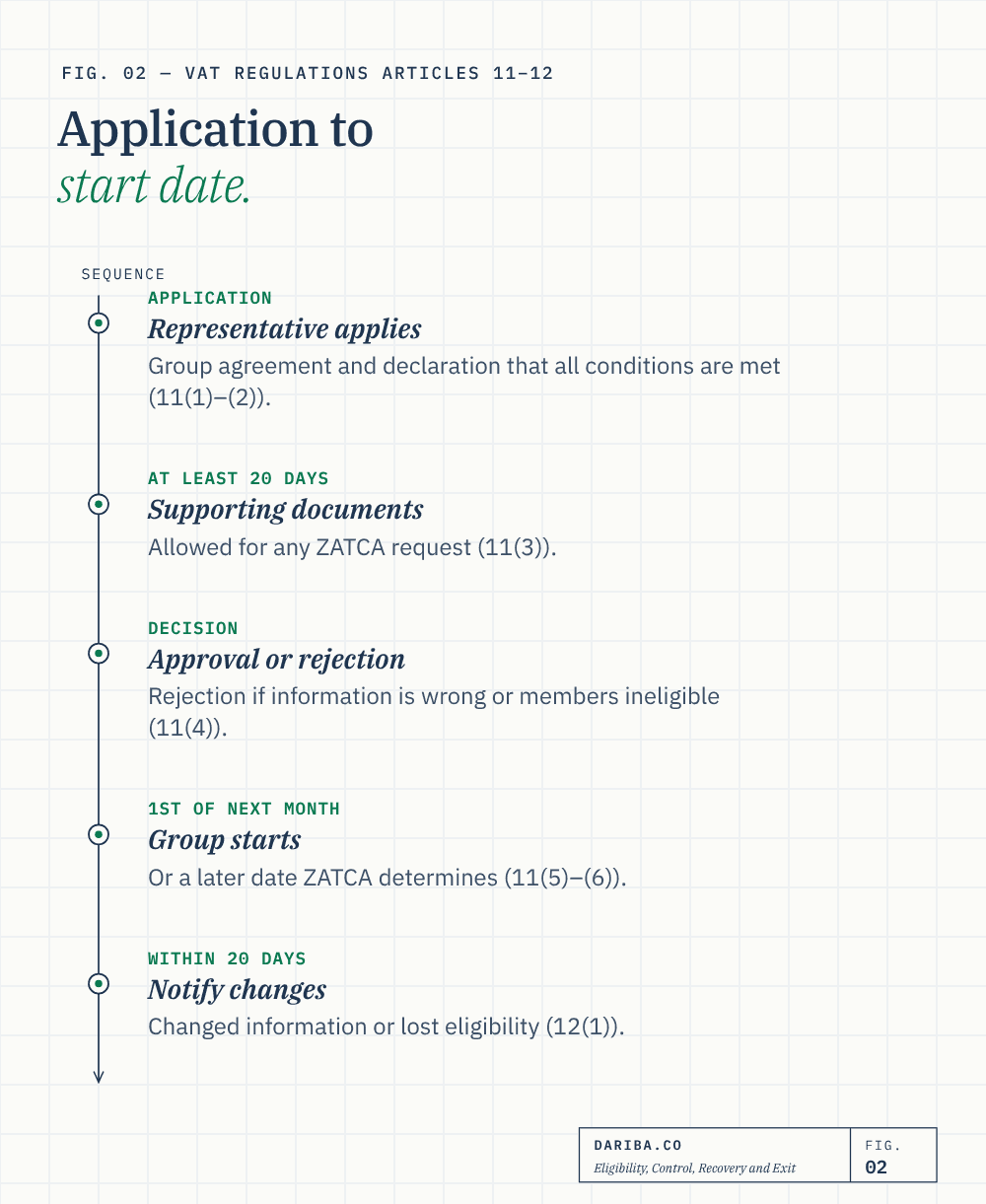
Article 11 requires an appointed member representative, the prescribed application, Article 8 information for members and the group agreement appointing the representative with evidence of acceptance. The representative has primary responsibility for the group’s rights and obligations, without removing members’ joint liability.
Paragraph (2) also requires a declaration from the representative that all conditions for group registration are satisfied. This is a statement about the actual members and eligibility conditions, not just confirmation that the form has been uploaded. Reconcile it to the ownership/control evidence, registration status, exclusions and group agreement. The representative’s acceptance of appointment and its eligibility declaration are separate supporting requirements.
Under Article 11(3), additional supporting documents may be requested with at least twenty days from the request allowed. The guideline section 4.3.1, p. 17, instead describes twenty days from application submission. For an actual request, use the controlling regulatory rule and clarify inconsistent instructions; the application date is not a universal substitute for the request date.
Article 11(4) permits ZATCA to reject the application where information is incorrect or group members are not eligible, by a rejection notice sent to the applicant. A signed declaration does not prevent that eligibility review. If clarification or a revised application is needed, address the actual reason and evidence rather than treat the supporting-document period as deemed approval.
Under paragraphs (5)–(6), the ordinary start is the first day of the month following approval or a later date ZATCA determines. On acceptance, the Authority issues a new registration certificate and tax identification number for the group and suspends previously registered members’ individual numbers. Check the actual notice and certificate against the proposed date. Sending an application does not immediately switch all intragroup supplies to group treatment.
Internal supplies and external recovery are different
Article 11(7) attributes members’ activities, supplies, imports and output/input tax to the group. Qualifying supplies between current members are disregarded under the group framework. This is not a general zero-rated invoice category, or a rule covering every related company or foreign establishment outside the approved membership.
The group’s external input deduction still depends on actual use, direct attribution, exempt activities, blocked costs and apportionment. The guideline sections 6.2 and 8, pp. 21 and 25–26, exclude internal supplies from the taxable/exempt turnover calculation rather than treating an internal management fee as new external taxable revenue.
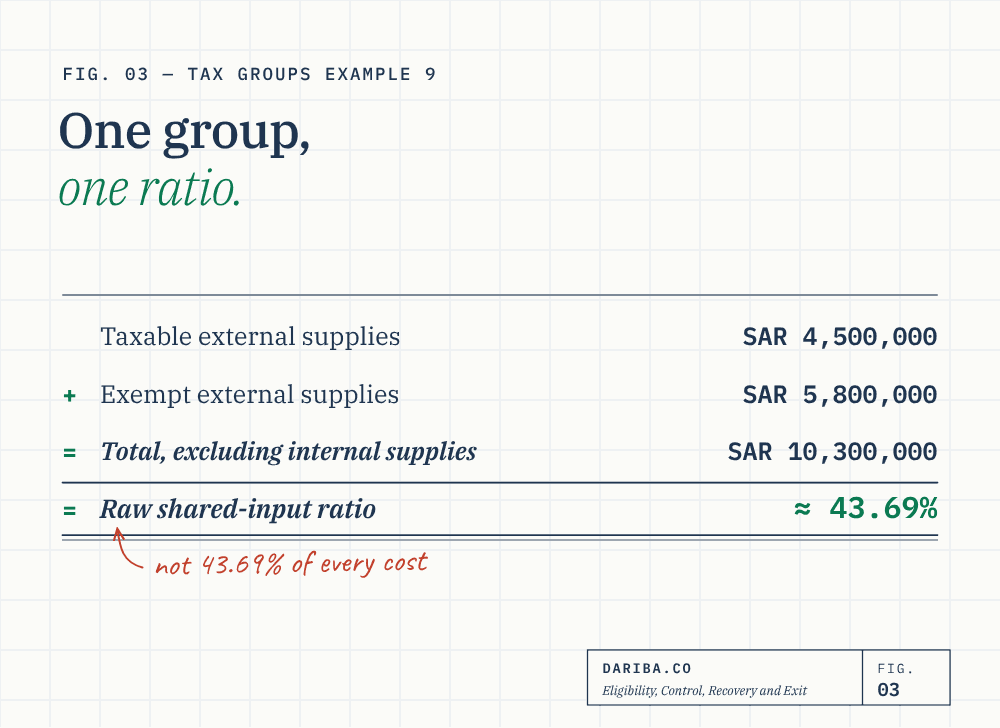
Official example: section 6.2, Example 9, page 21, gives three financial-services members with total taxable supplies SAR 4,500,000 and exempt supplies SAR 5,800,000, excluding internal supplies. The raw shared-input ratio is SAR 4,500,000 divided by SAR 10,300,000, approximately 43.69%. That is the guideline’s displayed ratio, not a promise to deduct 43.69% of every cost. Direct attribution and Article 51’s applicable method, rounding and adjustment rules still govern.
Assess the commercial benefit with actual cash timing
Dariba illustration: assume a qualifying SAR 200,000 monthly internal service otherwise bears 15% VAT of SAR 30,000, and the recipients would fully recover it. Disregarding the service removes that charge within the approved group. Twelve such charges total SAR 360,000 of annual VAT throughput, not necessarily SAR 360,000 cash trapped at once or a permanent tax saving. Actual funding benefit depends on payment, return timing and recoverability.
Grouping may change external recovery where activities are mixed; it is not automatically beneficial for every member. Model the combined business and retain evidence for group-wide and any applicable permitted method calculations. The financial-group guide addresses those recovery considerations.
Changes can take effect before notification
Article 12(1) requires notification of changed application information or lost eligibility within twenty days. Paragraph (2) addresses the effective exclusion/dissolution date for those events; late notification does not preserve an otherwise invalid membership. Paragraphs (3)-(4) permit member addition/exclusion, representative replacement or dissolution with all members’ approval, generally effective from the application date unless ZATCA determines otherwise.
Article 12(5) provides a new individual tax number where a continuing eligible member had no individual number before joining the group. Whether or not such a new number is needed, the continuing member’s registration is not treated as cancelled.
Paragraphs (5)-(6) distinguish continuing independent registration from genuine deregistration after exit. A continuing taxpayer’s registration is not treated as cancelled merely because membership ends; an ineligible former member needs the applicable cancellation and final reporting review. Preserve transaction cut-offs, registration notices and tax-number changes so invoices and returns use the correct status.
Joint liability and ZATCA intervention remain material
Articles 11(1) and 12 preserve relevant membership-period liabilities. The representative’s filing role does not ring-fence every other member from unpaid group VAT or penalties. An acquisition review should therefore examine the actual group history and surviving exposure, rather than only the target’s standalone ledger.
Article 12(7) permits the specified retrospective/prospective removal of group treatment, cancellation or member exclusion where the statutory conditions apply. Paragraph (8) permits requiring eligible persons to be grouped where separate registration produces contrary-purpose tax advantages. The current text should not be narrowed by inventing an additional universal “principal purpose” threshold.
The guideline section 7.1, Example 10, pp. 22–23, describes artificial inflated third-party transactions used to improve shared-input recovery for a group containing exempt activities. It illustrates intervention against that artificial result. Ordinary disregard of genuine internal supplies is itself an intended group feature, not proof of abuse merely because it produces a VAT benefit.
Carry the approved group change into Fatoora
A VAT group change also needs an e-invoicing credential review. ZATCA’s E-Invoicing Detailed Technical Guidelines sections 3.3.8 and 3.4 distinguish joining and departing members, member-specific and shared devices, dissolution and a change of representative. The group VAT number and relevant member TIN have different CSR identification roles.
The Fatoora VAT group onboarding guide follows the five change scenarios and explains which portal steps belong to the representative or member. Its worked unit inventory keeps a departing member’s former group credential distinct from any later individual onboarding. Confirm the actual approved registration change and effective date alongside the operational completion evidence.
Key takeaways
- Eligible legal persons must satisfy the continuing residence, registration, ownership/control and exclusion conditions.
- Current common-ownership wording and the guideline natural-person example require careful reconciliation where decisive.
- Specified Article 70 exclusions have narrow exceptions; not every charity or developer qualifies for a VAT group.
- Approval and the actual effective date govern group treatment, not merely application submission.
- Internal supplies do not create external taxable turnover or automatic full recovery of all costs.
- The historical 180-day transition is not a fresh grace period in October 2026.
- Joint liability, changed eligibility and ZATCA intervention remain relevant through transactions and group exit.
Sources
- Controlling Arabic VAT Implementing RegulationsTenth edition April 2025. Registration Articles 2-13, pp. 7-16; deemed supply Articles 15,20,39 and capital rule 52; Arabic controls.
- ZATCA Tax Groups guidelineThird version May 2026. Sections 3-8, pp. 9-26; Examples 1,2,3,5,8,9,10. Historic 5% distinguished. Natural-owner example and application/request wording compared with Arabic.
- ZATCA VAT Amendments guidelineFirst issue April 2025. Section 2.1 pages13-15, historical transition and group powers; section2.2 Examples 5-6 pages16-17 and section2.4 page19, cessation and deemed supply.
- ZATCA E-Invoicing Detailed Technical Guidelines, version 2, November 2022Sections 3.3.8 and 3.4, printed pp.38–42: registration and VAT-group changes, identifiers and onboarding roles.
General information only. Actual supplies, facts, applicable periods and controlling Arabic legislation determine the result. Official examples are distinguished from Dariba analysis and original illustrations. Seek advice or clarification where the arrangement or source material leaves a specific issue unresolved.