In brief
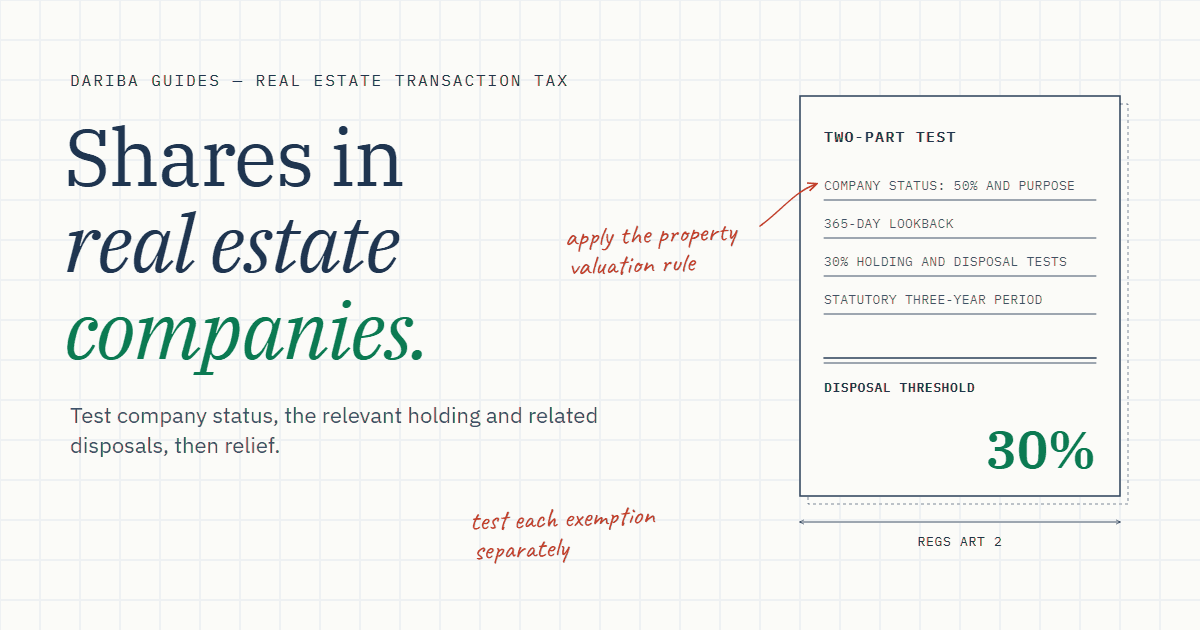
Regulations Article 2(i) uses both the relevant holding and aggregate disposal tests. The company definition, linked transactions and concerted parties matter. Crossing a scope threshold does not by itself decide exemption, valuation or the actual payment date.
A private share sale is not brought within Saudi RETT merely because the buyer acquires a large stake. The Zakat, Tax and Customs Authority’s Implementing Regulations of the Real Estate Transaction Tax Law require the company definition, the relevant holdings and linked disposals to be tested.
Establish the real estate company definition
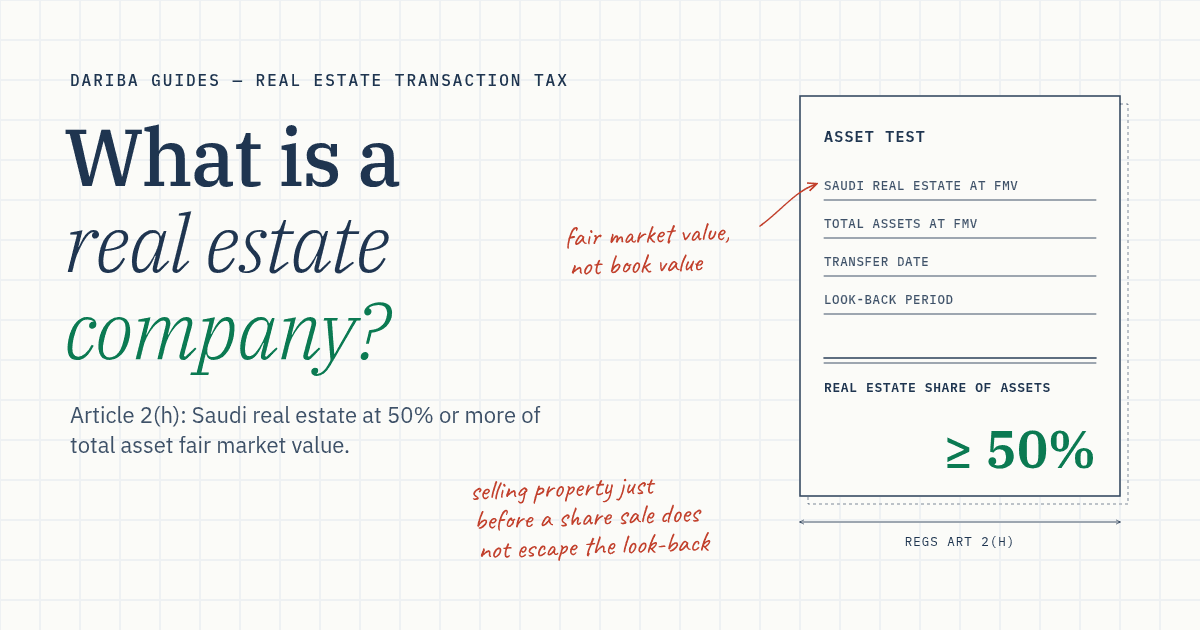
Under Regulations Article 2(h), the company, fund or entity holds Saudi property directly or indirectly for revenue generation through sale or leasing. The relevant property’s total fair market value must be at least 50% of total asset fair market value at the interest-transfer date or at any time in the preceding 365 days.
Book-value labels and a single balance-sheet date do not settle that test. Once the definition applies, the share-transfer valuation rule can include property held for any purpose; definition and taxable base are different questions.
Both 30% tests matter
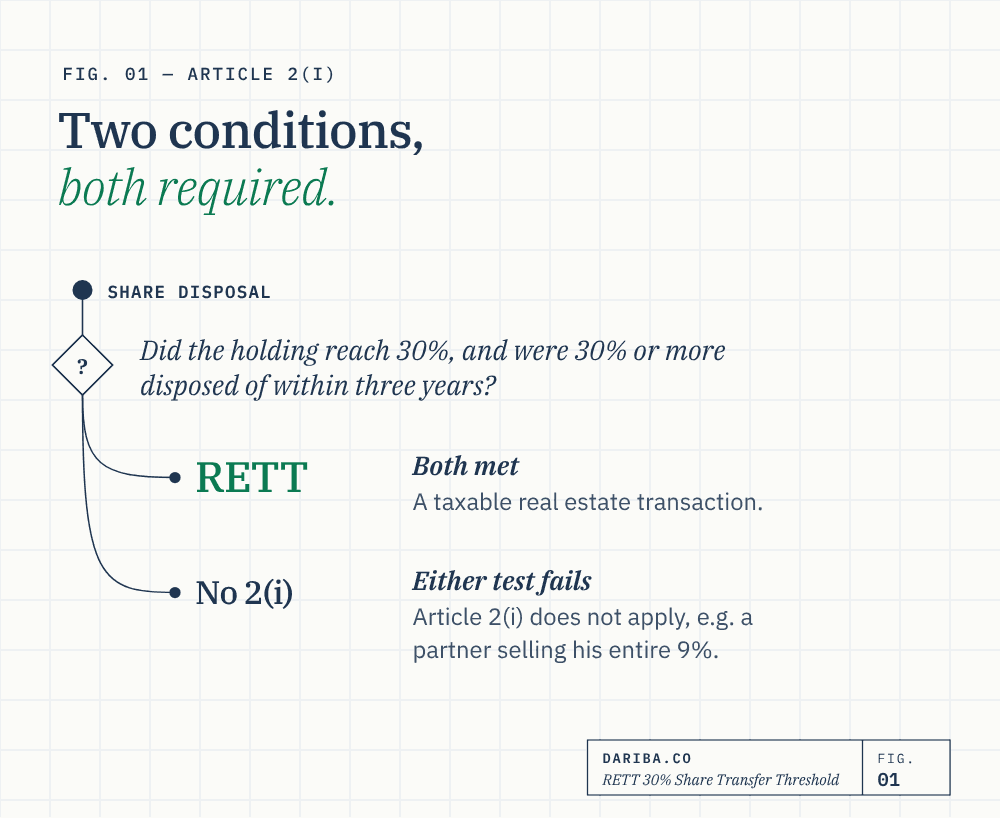
Article 2(i) addresses a person or persons acting in concert disposing of at least 30% in aggregate through one or more related transactions within the specified three-year period beginning on or after the date their holding reached at least 30%.
| Check | Evidence |
|---|---|
| Relevant holding reached 30% or more | Ownership registers, dates and the concerted group’s interests. |
| Aggregate related disposals reach 30% or more | Transfer agreements and the connected series. |
| Transactions fall within the specified period | An actual dated schedule, including the relevant holding date. |
These are percentages of the company interests. Do not substitute 30% of a seller’s personal holding or only the buyer’s resulting percentage.
Related transactions and acting in concert
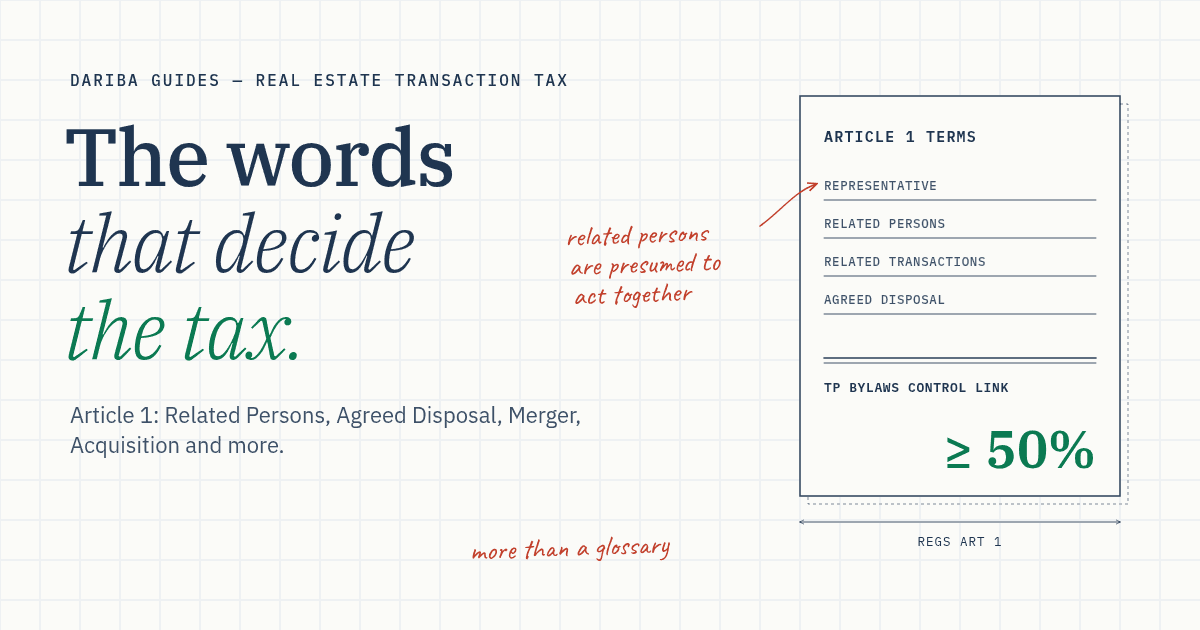
Regulations Article 1 includes transfers under one agreement or series and transactions by people acting in agreement. Acting in concert can involve formal or informal, binding or non-binding cooperation.
Related persons are presumed to act in concert unless proved otherwise. Preserve evidence for the actual position. The presumption is neither automatically disregarded because contracts are separate nor conclusive merely because people are related.
A family sell-down therefore needs a combined schedule where the relevant presumption or actual concerted conduct applies. A buyer using several acquisition vehicles does not by itself explain whether the selling parties’ disposals form a related series.
Official examples and historical dates
ZATCA’s Detailed Guideline version 6, section 3.1, Example 1 uses a 9% entire holding and treats that transfer as outside the taxable share-disposal rule. Example 2 describes 10% in January 2023, 15% in June 2024 and 10% in June 2025, reaching 35%, with tax due on those transactions as of the last transfer.
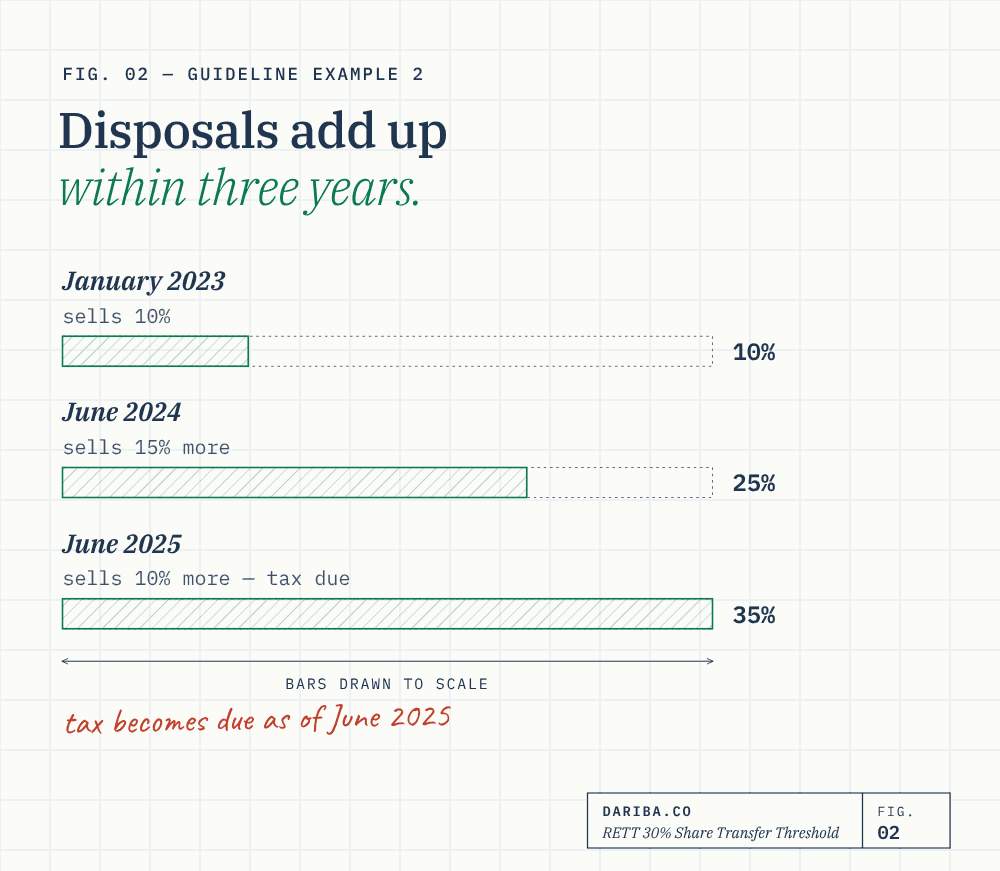
The retained diagram reproduces that example’s historical dates. It is not a direction to apply the 2025 Law identically to every earlier transaction. Check the actual historical regime and Article 14 transition where tax was due before commencement.
Dariba current-period illustration: assume the relevant seller originally holds 60%, the company meets Article 2(h), and connected transfers of 10%, 15% and 10% occur within three years beginning in 2026. The cumulative percentages are 10%, 25% and 35%; the threshold is crossed at the third transfer. This illustration demonstrates aggregation, not a universal rule for allocating tax and payment dates to every possible series.
Scope, exemption and value are separate
A transfer failing Article 2(i)‘s conditions is outside that selected share-transfer rule. Do not extend that conclusion to a separate direct property disposal, a different linked series or another arrangement.
Where the rule is met, examine any actual exemption, including the relevant securities or qualifying restructuring route. If taxable, Article 2(e) uses the appropriate property-based value or higher agreed allocation, as explained in the share valuation guide.
Dariba amount illustration: if the relevant taxable percentage is 35%, the appropriate property FMV is SAR 100 million and there is no higher agreed property allocation, the assumed base is SAR 35 million and 5% tax is SAR 1.75 million. Those assumptions require verification; reaching 35% does not itself prove the correct valuation.
Payment and registration
Regulations 4(d) and 5(a)(1) use the earlier of the share transfer and the unconditional agreement to transfer those interests, with the specified 30-day payment period. Article 11(a)(7) connects taxable real estate company share-transfer registration to the Article 5 payment date.
A timetable that starts only at closing can therefore be late. Where threshold aggregation crystallises through a later event, reconcile the actual documents and the guideline example with the operative provisions; do not invent a new automatic window each time a holding rises above 30%.
Maintain a dated holding/disposal schedule, the concerted-party analysis, company-definition evidence, valuation, exemption conclusion and actual filing/payment record.
Key takeaways
- Check the revenue-purpose and 50% fair-market-value/365-day company definition before applying the share-disposal threshold.
- Article 2(i) requires the relevant holding to reach at least 30% and linked aggregate disposals of at least 30% within its specified three-year period.
- Related persons are presumed to act in concert unless proved otherwise; do not omit the rebuttal.
- Outside the selected scope rule is different from a taxable transaction or a statutory exemption.
- For a taxable share transfer, the payment period uses the earlier of transfer and the unconditional transfer agreement, not invariably closing.
- Do not invent an automatic new three-year window whenever holdings rise again; map the actual related series.
Frequently asked questions
Is any purchase taking a buyer above 30% automatically taxable?
Article 2(i) addresses the relevant person's or concerted group's holdings and aggregate related disposals. Apply the real estate company definition, both 30% tests and the specified period, then consider actual exemptions.
Are family members conclusively treated as acting together?
The Regulations presume related persons to act in concert unless proved otherwise. Keep the relevant evidence; neither automatic separation nor an irrebuttable presumption accurately states the rule.
Does payment always fall 30 days after share completion?
Regulations 5(a)(1) uses 30 days from the earlier of share transfer and the unconditional agreement to transfer those interests. The actual agreement and any staged-threshold facts need review.
Sources
Reviewed against the Arabic RETT Law and Implementing Regulations on 20 November 2026. ZATCA's Detailed Guideline version 6 (May 2026) is explanatory; its English text does not override the Arabic instruments. Dariba is independent of ZATCA. General information, not advice on a specific transaction.