In brief
Article 11(b) links correction to awareness of incorrect data or the specified breach event. Additional tax follows the applicable payment rule; reductions use Article 9.
A RETT correction should show what changed, when the transferor became aware of the incorrect registered data and how the change affects the tax. Keep the submission deadline separate from the date for paying any additional amount.
Regulations Article 11(b)(1)–(4) sets the correction procedure. Payment and refunds remain governed by their own provisions.
Establish the correction trigger
Article 11(b)(1) requires the prescribed electronic request within thirty days from awareness that the registered data is incorrect. It also refers to the occurrence of an event breaching exemption criteria and controls. Preserve the actual event date; later discovery should not be substituted for the breach date when applying the separate payment rule.
Record the actual discovery or breach event with supporting documents. A note saying “found at year-end” is insufficient to explain an actual awareness date.
| Workpaper field | Evidence |
|---|---|
| Original registered facts | Filed data, transaction reference and acknowledgement |
| Correct facts | Executed documents, value support, party details or actual rights |
| Awareness or breach event | Dated review, correspondence and underlying event |
| Tax effect | Original and revised calculation, or explanation of no tax change |
| Submission | Corrected data, filing date and acknowledgement |
The relevant facts may concern an original error or a later event. Establish that distinction before attributing an understatement to the original filing.
Keep the payment rule separate
Article 11(b)(2) makes additional tax payable using Law Article 5 and Regulations Article 5. The correction period does not give every transaction thirty new days to pay.
For a failed conditional exemption, Regulations Articles 4(f) and 5(a)(2) connect the original transaction and the thirty-day payment period from the breach. For another type of correction, establish its own applicable payment date.
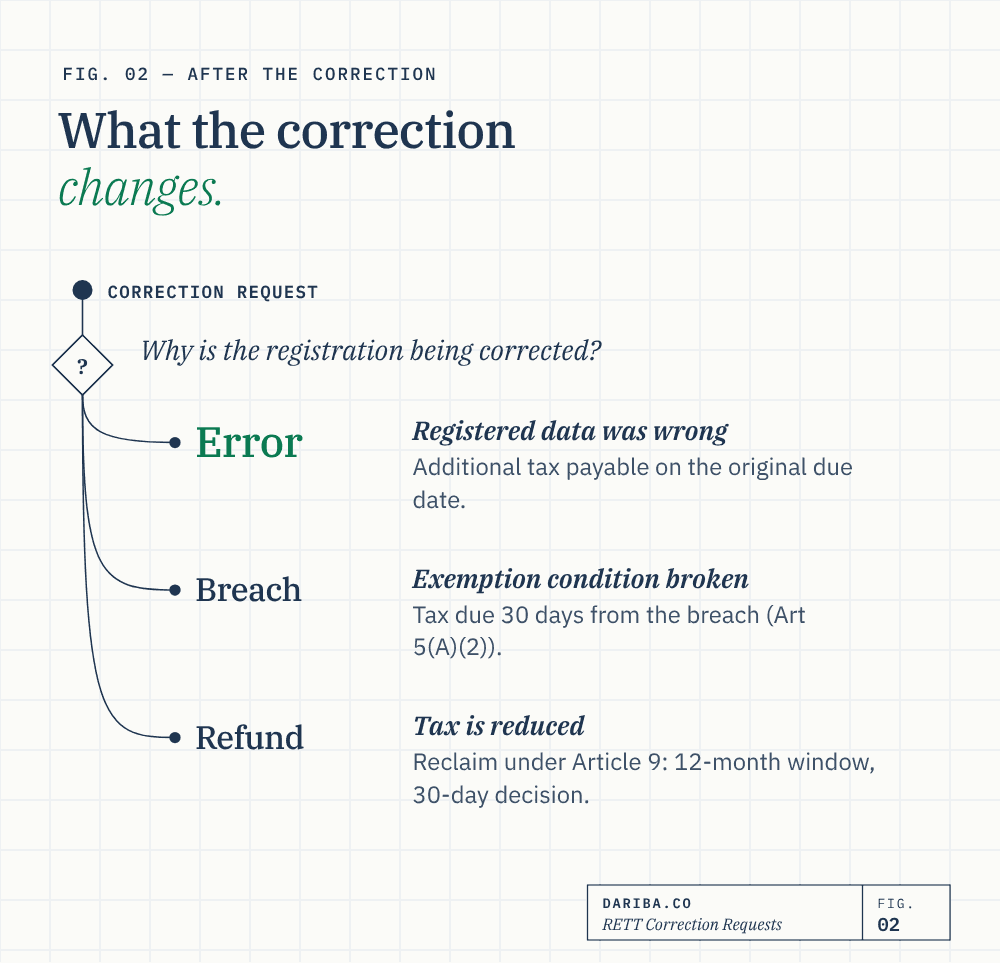
The diagram separates the ordinary routes. Actual facts, the payment provision and any Authority adjustment notice still need to be recorded.
Reconcile an original understatement
Dariba illustration. Assume a taxable sale was incorrectly registered at SAR 4 million even though the correct taxable value at the relevant transaction date was SAR 4.3 million. No exemption applies.
| Calculation | Amount |
|---|---|
| Originally calculated tax: SAR 4 million × 5% | SAR 200,000 |
| Correct tax: SAR 4.3 million × 5% | SAR 215,000 |
| Additional tax | SAR 15,000 |
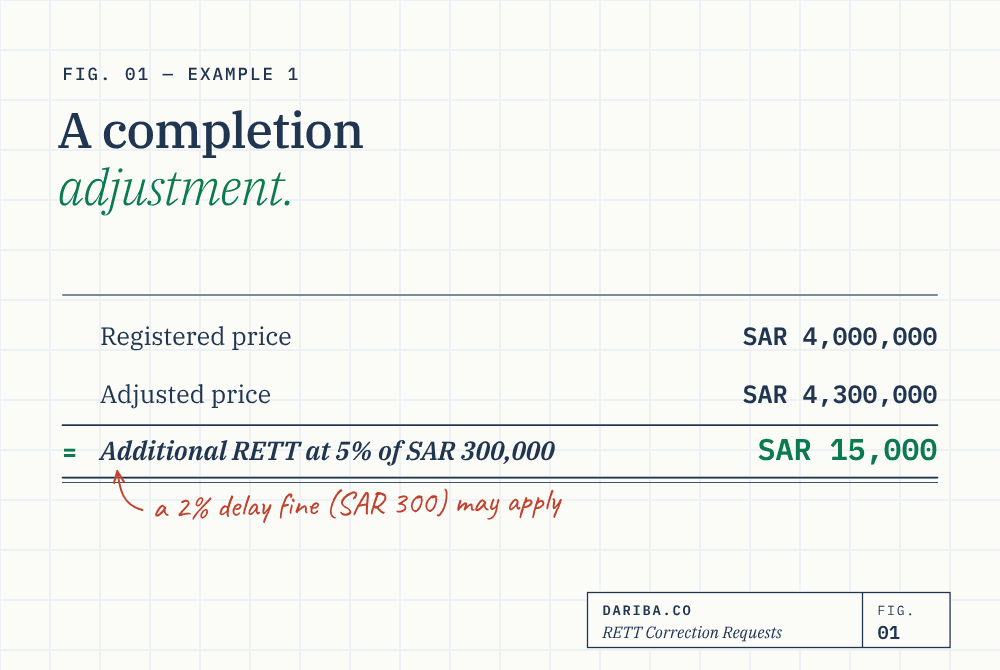
If the actual facts produce one counted month or part for the ordinary 2% delay component on SAR 15,000, that component is SAR 300. This is conditional arithmetic. It does not determine the dates, a separate adjustment-related fine or the complete penalty position.
The penalties guide explains the additional 1% rule’s separate notice-based trigger. Filing the correction within its own deadline does not itself settle that analysis.
Use a separate refund claim for a reduction
Article 11(b)(3) allows a request to recover excess tax where the correction reduces the amount due, subject to Article 9’s procedures and restrictions.
Retain both the correction acknowledgement and the refund submission. The refund guide distinguishes the refund ground, payment-due-date filing trigger, decision period and settlement. A lower number entered in the record does not itself approve repayment.
Preserve review rights and close the reconciliation
Article 11(b)(4) addresses notification of the Authority’s right to reassess the property’s value under its statutory powers. Keep the valuation and transaction support even after submitting the correction.
Reconcile the corrected tax to payments, any separately assessed penalties and any approved refund or credit settlement. Record unresolved differences and the next applicable procedural step.
For a historical case, review the pre-law transition as well. The correction procedure does not replace the rules governing the original transaction period.
Key takeaways
- Record awareness of incorrect data and the relevant exemption-breach event.
- The thirty-day correction period does not create a new thirty-day payment extension.
- Additional tax follows Law Article 5 and Regulations Article 5.
- A lower corrected amount may support an Article 9 claim; it does not approve its own refund.
- Submission does not remove the Authority's statutory reassessment powers.
Frequently asked questions
When is a RETT correction required?
Article 11(b)(1) identifies thirty days from awareness of incorrect registered data and separately refers to an event breaching exemption criteria and controls. Establish the actual trigger and evidence; the payment period for a breach must use its own rule.
Does correcting the record give another thirty days to pay?
No new payment extension is created by the correction period. Article 11(b)(2) directs additional tax to the payment dates under Law Article 5 and Regulations Article 5.
How is a tax reduction recovered?
Article 11(b)(3) permits a refund request for excess tax subject to Article 9's procedures and restrictions. Keep the correction and refund claim separately acknowledged.
Does acceptance of a correction settle the value permanently?
Article 11(b)(4) preserves the Authority's reassessment rights under its statutory powers. A correction submission should not be treated as immunity from a later review.
Sources
- RETT Implementing Regulations, Board Resolution 01-03-25 of 24 March 2025, Arabic textArticle 11(b)(1)–(4), p.16; Articles 4(f), 5 and 9 govern payment and refunds.
- Saudi Real Estate Transaction Tax Law, Royal Decree M/84, controlling Arabic textArticles 5, 8 and 15: payment, reassessment and separate penalty rules.
- ZATCA Detailed RETT Guideline, version 6, May 2026Sections 10.2–10.3 and 11: data correction, payment responsibility and refund procedure.
Based on the RETT Law (Royal Decree No. M/84, effective 10 April 2025), the RETT Implementing Regulations (ZATCA Board Resolution No. 01-03-25 dated 24 March 2025, unofficial English translation) and ZATCA's Detailed RETT Guideline Version 6 (May 2026). The Arabic text prevails. This article is general information, not advice on any specific transaction. dariba.co is an independent knowledge platform and is not affiliated with ZATCA.