In brief
Article 9 provides refund grounds and separate filing, decision and payment periods. A registered-data correction alone does not establish a refund approval.
A RETT refund requires an established ground, a timely claim by the specified person and supporting evidence. Keep those questions separate from correcting the transaction’s registered data.
Article 9 of the RETT Law identifies the statutory grounds. Article 9 of the Implementing Regulations sets the conditions, filing periods, decision process and settlement rules.
Establish the actual refund ground
| Ground in Regulations Article 9(a) | Evidence to establish |
|---|---|
| Tax paid in excess or by mistake, including a transaction later shown to be exempt | Correct tax calculation, original payment and the actual exemption or overpayment basis |
| An incomplete transaction | Evidence of non-completion and return of consideration received |
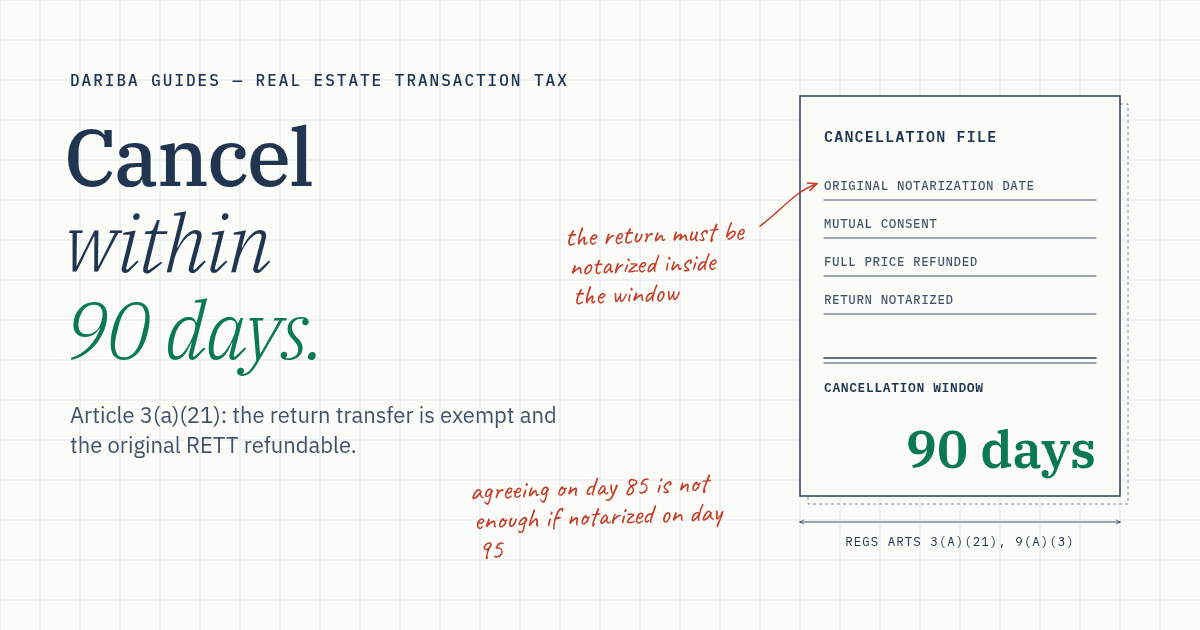
| A qualifying cancellation under Law Article 3(a)(21) | Full value returned, property transferred back through the stated notarization within ninety days, unchanged property description and required notification |
A completed transaction later reversed is not automatically an incomplete transaction. For a cancellation, establish the particular ninety-day conditions and the original and return-leg notarization dates.
Article 9(a) identifies the claimant as the transferor or their representative. If the buyer funded the original tax, preserve the parties’ arrangement for dealing with any eventual repayment without substituting a different statutory claimant.
Separate the filing dates in the workpaper
Article 9(b) requires submission through the Authority’s specified mechanism within twelve months from the payment due date under Law Article 5 and Regulations Article 5, or within sixty days from the stated final judicial decision or Authority settlement decision.
| Date | Purpose |
|---|---|
| Transaction and applicable payment due date | Establish the ordinary twelve-month trigger |
| Actual payment | Prove the amount paid; do not automatically substitute it for the statutory trigger |
| Incompletion or cancellation | Establish the refund event and its conditions |
| Final judicial or settlement decision | Establish whether the stated sixty-day alternative is relevant |
| Claim submission and acknowledgement | Prove the actual filing |
The Arabic Regulation states the alternatives without express earlier/later ordering. Section 11 of ZATCA’s version 6 English guideline adds “whichever is earlier.” Keep that difference explicit rather than rewriting the Regulation through a summary. Obtain clarification where the interaction determines a real claim.
For tax due before 10 April 2025, also review Article 14(c)‘s separate transition. The transitional guide explains why the ordinary commencement-based window should not be presented as still open in November 2026.
Track submission, decision and payment separately
Article 9(c) gives the Authority thirty days from submission to issue its decision, with full or partial rejection reasons and notification. It does not replace that trigger with a newly invented complete-application date.
Article 9(d) permits one equivalent extension. The extension decision must be made before the first period ends and the applicant must be notified. If no decision is made in the applicable period, the request is deemed rejected under the provision.
An approved refund has a separate thirty-day period from approval for the refund procedures and payment to the stated bank account.
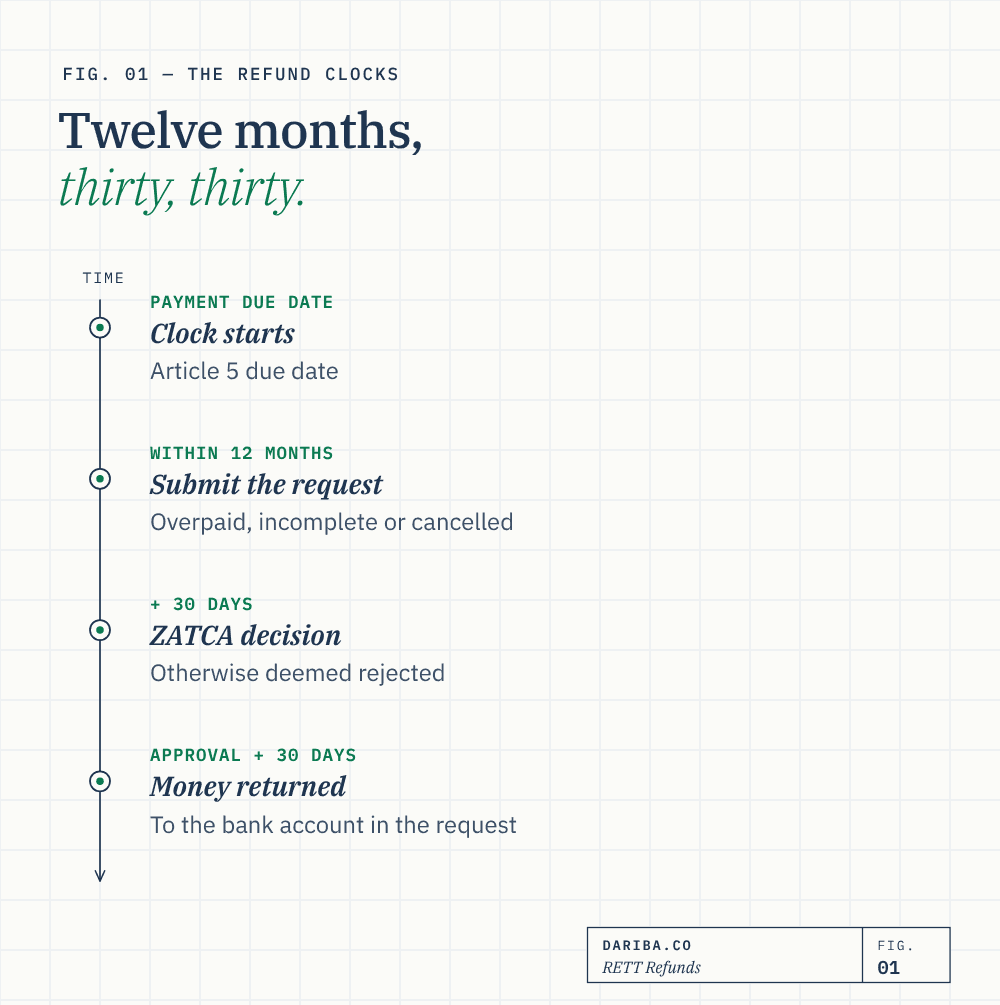
Read the timeline with the extension, dispute and offset provisions. A thirty-day decision period is not a promise of bank receipt thirty days after every claim.
Reconcile the approved credit and its settlement
Dariba illustration. Assume SAR 200,000 was paid on an originally registered SAR 4 million taxable value. A properly supported correction establishes a SAR 3.6 million base and SAR 180,000 tax, and the Authority approves the resulting SAR 20,000 refund.
Assume the Authority then notifies a permitted SAR 5,000 offset against another due amount.
| Reconciliation | Amount |
|---|---|
| Tax originally paid | SAR 200,000 |
| Correct tax at 5% of SAR 3.6 million | SAR 180,000 |
| Approved refund | SAR 20,000 |
| Assumed notified offset | SAR 5,000 |
| Remaining refund settlement | SAR 15,000 |
The example assumes eligibility, timely submission, approval and a valid notified offset. The arithmetic does not establish those legal conclusions.
Article 9(f) allows deduction or retention where the transferor has other unpaid tax, Zakat, fines or other due amounts, with notification of the credit settlement. Reconcile the approved amount and actual bank movement.
Resolve disputed amounts and preserve the file
Article 9(e) postpones consideration of requests concerning the stated surplus amounts under objection or grievance until the specified final resolution. Establish whether that provision applies to the actual amount claimed.
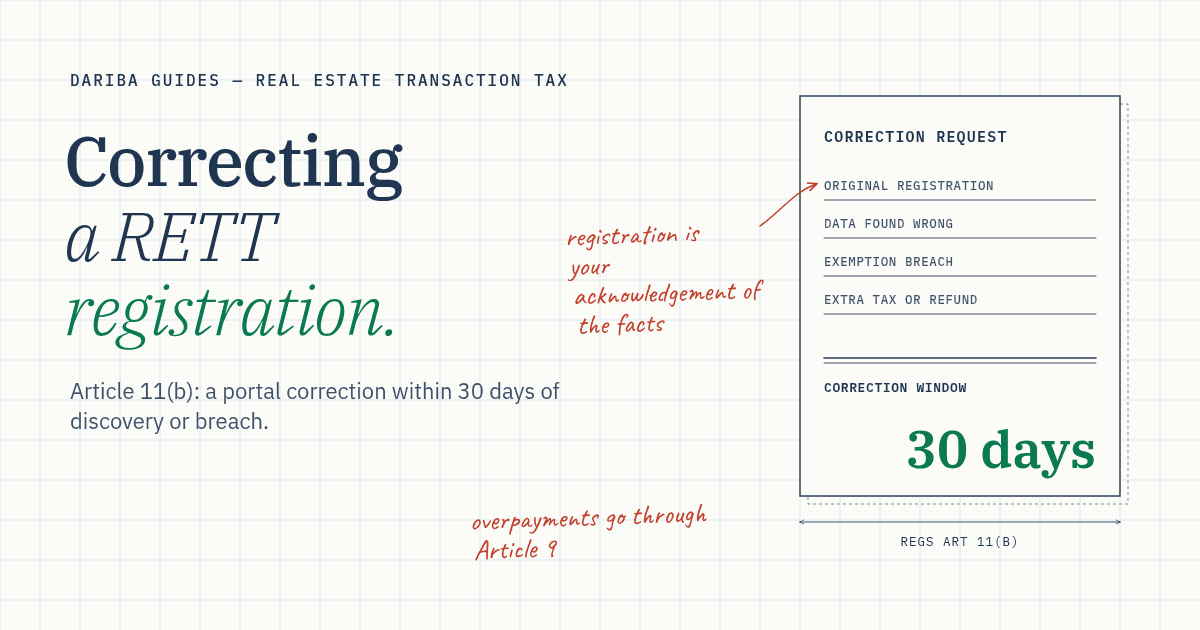
Retain the original registration, payment, corrected facts, refund ground, consideration-return records, claim, extension notice, decision and settlement. The correction guide explains the related data procedure. A submitted correction is not itself a refund approval.
Key takeaways
- Establish excess payment, incomplete transaction or the qualifying cancellation ground.
- The ordinary twelve-month trigger is the payment due date, not automatically the bank-payment date.
- Keep the stated judicial-decision or settlement alternative and any source wording difference explicit.
- The decision period starts from submission; an extension has its own timing and notice conditions.
- Approved refunds can be subject to notified offsets or retention.
Frequently asked questions
Who can submit the RETT refund claim?
Regulations Article 9(a) gives the claim route to the transferor or their representative. A buyer's funding of the original payment does not itself replace the specified claimant.
Does the twelve-month period run from when I paid?
Article 9(b) refers to the payment due date under Law Article 5 and Regulations Article 5. Preserve that date separately from actual payment, cancellation, discovery and any final decision.
Which deadline controls if there is also a final decision?
The Arabic Regulation sets out the twelve-month and sixty-day alternatives without express earlier/later ordering. Section 11 of the English guideline adds earlier wording. Do not silently turn the guidance into an amendment; establish the actual route and obtain clarification where decisive.
When must ZATCA decide and pay?
Article 9(c) provides thirty days from submission for a decision, with deemed rejection if no decision in the applicable period. Article 9(d) permits one equivalent extension decided before the first period ends and notified. Approved refunds have a separate thirty-day payment period from approval.
Sources
- Saudi Real Estate Transaction Tax Law, Royal Decree M/84, controlling Arabic textArticle 9: statutory refund grounds and delegated procedure.
- RETT Implementing Regulations, Board Resolution 01-03-25 of 24 March 2025, Arabic textArticle 9(a)–(f), pp.13–14; Articles 3(a)(21), 5, 11(b) and 14(c) as relevant.
- ZATCA Detailed RETT Guideline, version 6, May 2026Section 11, pp.60–61. Its earlier-deadline wording is expressly distinguished from the Arabic Regulation; section 7.2 addresses transition.
Based on the RETT Law (Royal Decree No. M/84, effective 10 April 2025), the RETT Implementing Regulations (ZATCA Board Resolution No. 01-03-25 dated 24 March 2025, unofficial English translation) and ZATCA's Detailed RETT Guideline Version 6 (May 2026). The Arabic text prevails. This article is general information, not advice on any specific transaction. dariba.co is an independent knowledge platform and is not affiliated with ZATCA.