In brief
Regulations Article 3(a)(19) gives conditional relief for the actual licensed developer and project transfer. Establish on-time payment or equivalent security and the project decision’s issue and submission dates before concluding release or refund.
Article 3(a)(19) of ZATCA’s RETT Implementing Regulations provides a conditional exemption for a transfer to a licensed off-plan developer for the specified licensed project. It distinguishes the developer’s licence from the project licensing decision. The limited pending-project procedure does not extend the developer’s own licensing deadline.
Start with the actual property transaction, property allocation and licence evidence. A development label or a promise to obtain documents later does not establish relief.
The five parts of Article 3(a)(19)
The controlling Arabic provision is in the RETT Implementing Regulations, printed pages 8–9. Its conditions operate together:
| Subparagraph | Requirement or consequence |
|---|---|
| (a) | The developer is licensed for off-plan sale and rental activities under the applicable framework on or before the property transaction date. |
| (b) | The property is allocated to an off-plan sale project, with the competent authority’s project licensing decision issued on or before that date. |
| (c) | If that project decision is pending, the transferor has the specified 90-day submission period, provided the tax is paid or equivalent cash or bank security is provided to ZATCA on or before the transaction date. |
| (d) | Where the qualifying licence is issued within the relevant period, the provided security is returned in full or paid tax is refundable under the Regulations, where applicable. Apply this with the submission condition and every other requirement. |
| (e) | If the licence is not issued or is not submitted within the period, ZATCA may liquidate the security as payment of tax due; the paragraph also restricts refund of tax paid after the period expires. |
The 90-day mechanism concerns the project decision. A developer first licensed after the transaction does not meet subparagraph (a), even if that occurs within 90 days.
ZATCA’s official illustration
ZATCA’s Detailed Guideline for the Real Estate Transaction Tax, Version 6, May 2026, section 5.1.20, Example 55, printed page 44, describes a person transferring property to a developer licensed for off-plan sales, with the property licensed for an off-plan project. It explains the exemption’s supporting purpose and lists its conditions.
That example does not contain a SAR 50 million value, a day-60 decision, a mixed-use allocation formula or a general exemption for every later unit delivery. The calculations and changed scenarios below are Dariba illustrations.
The English guideline’s description of the failure outcome should be read against the controlling Arabic Regulations. The Arabic permits ZATCA to liquidate the security; it does not make the English word “shall” a separate amendment of the legislation.
The pending-project timeline
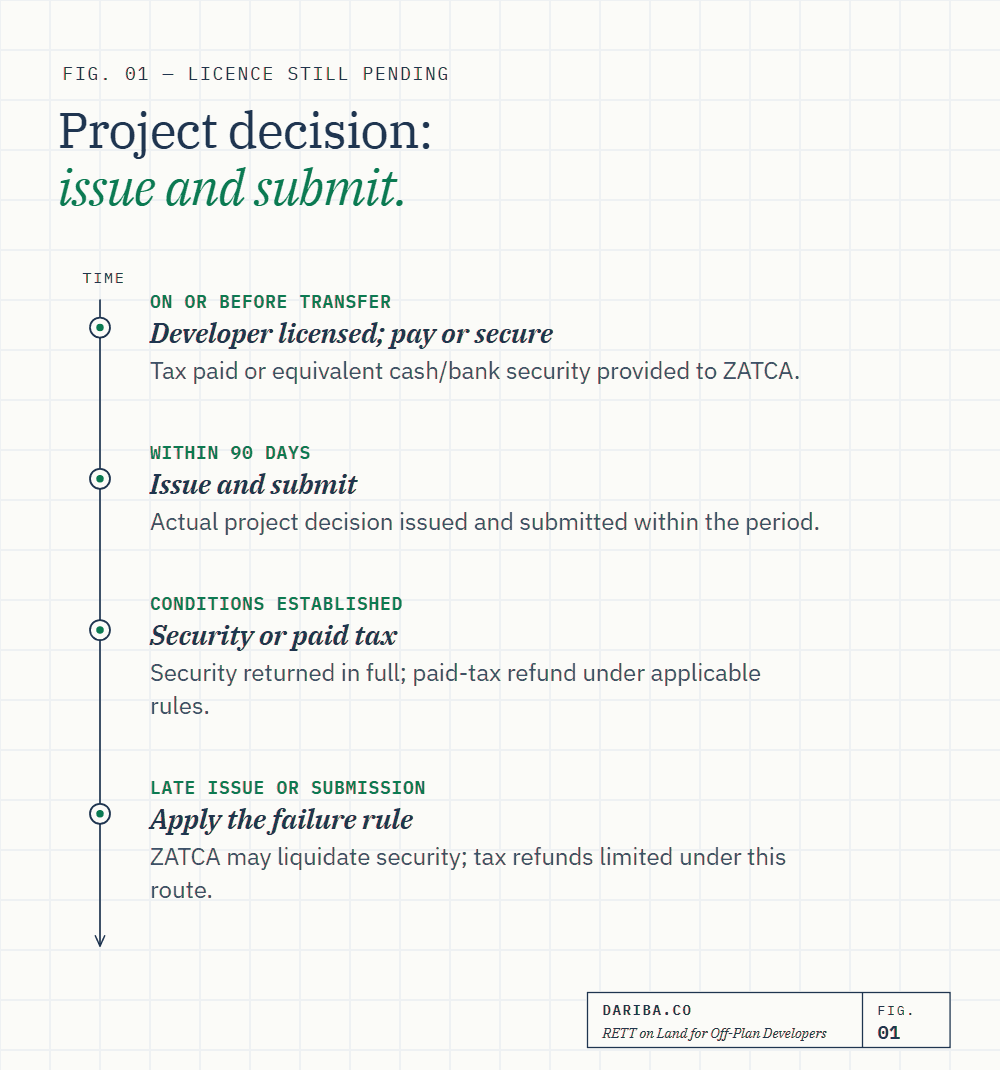
For the pending-project route, keep distinct evidence of:
- The transaction date, already valid developer licence and actual project/property allocation.
- Tax payment or qualifying security for the proper amount on or before that date.
- The project’s competent licensing decision and its issue date.
- Submission to ZATCA and its receipt date, within the relevant period.
- The applicable security-release or tax-refund procedure and outcome.
An application for a licence is not the licensing decision. Issue within 90 days without timely submission also fails the procedure’s stated condition. Timely submission does not cure late issue or late payment/security.
Do not postpone the tax/security requirement to day 90 or to an agreed later closing merely because the project decision is pending. Determine the actual transaction and payment dates first.
Dariba scenarios
Both licences already in place
Assume a SAR 50 million governing taxable value before exemption, a qualifying transfer to the developer, the required developer licence and project decision in place before the transaction, and all other conditions met. The otherwise applicable 5% amount is SAR 2.5 million; the transfer qualifies for exemption on those assumptions.
Project decision issued and submitted in time
Assume the same facts except that the project decision is pending. The transferor provides equivalent SAR 2.5 million bank security to ZATCA on the transaction date. The decision is issued on day 60 and submitted on day 62, with the other requirements established.
Those dates satisfy the stated issue/submission time limbs, and the provided security is returned in full under subparagraph (d). This is a security example, not a tax refund merely because a document was uploaded. Actual tax paid instead would need the applicable refund procedure.
Timely issue, late submission
Assume the decision is issued on day 60 but first submitted on day 95. Timely issue alone does not satisfy the submission requirement. Subparagraph (e)‘s failure consequences need to be addressed; do not promise release based only on the issue date.
Decision first issued on day 120
The 90-day route is not met. ZATCA may liquidate the security as payment of tax due, with the paragraph’s restriction on refund of paid tax. This does not itself decide every independent exemption, objection or different legal refund ground.
Developer first licensed after transfer
A developer licence issued two weeks after the transaction fails subparagraph (a). The pending-project mechanism does not cure that failure. Analyse any other actual relief before concluding the complete tax treatment.
Project changes, mixed land and later unit transfers
| Arrangement | Analysis required |
|---|---|
| Part of the land belongs to the licensed off-plan project; part has another use | Establish the actual project boundary, transferred legal components and supported valuation. Article 3(a)(19) does not prescribe a universal partial-land allocation formula or make separate deeds an automatic cure. |
| Project changes or is cancelled after the transaction | Check what the transaction actually satisfied, the event’s legal effect and any separate disposal or provision. The paragraph does not state a universal project-cancellation clawback, but that is not immunity from the actual law. |
| Landowner contributes land and later receives completed units | Analyse the land transfer and the later transfer of unit rights separately. Relief for the first does not establish relief for the second. The parties’ rights, consideration and any independent exemption matter. |
| Same group or joint venture | Establish the real transaction and applicable exemption conditions. An off-plan description does not replace the separate group, contribution or other relief tests. |
RETT Regulations Article 6 addresses the actual deceptive or hidden transaction rules. Neither a project change alone nor an uneven allocation automatically establishes abuse. Apply the facts rather than inventing a safe harbour or a presumed violation.
For a relevant non-Saudi developer’s later unit sale, Ownership Regulations Article 10(10) provides a separate possible zero REGA disposal fee, with its own completion and sale conditions. It does not replace this RETT exemption or exempt the unit sale from RETT. See the separate fee guide.
Responsibility, records and contractual risk
The transferor’s statutory responsibility and applicable buyer joint-liability conditions come from the RETT Law and Regulations, including Law Article 7. A private indemnity or price adjustment can allocate commercial consequences between the parties; it does not itself change ZATCA’s rights, the due date or the required security.
The agreement should address who obtains and supplies the project decision, evidence of delivery, the consequences of delay and any security cost or reimbursement. Those are commercial provisions to document for the actual arrangement, rather than a guaranteed statutory transfer of liability.
Register the transaction under the applicable Regulations Article 11 process. Keep developer and project licences, property allocation, the issue/submission trail, valuation and payment/security records, and the actual authority decision. The ordinary statutory record period is five years from the property transaction, without prejudice to longer periods in other laws.
Where tax was paid and a refund is sought, establish the actual refund ground and procedure under Article 9. A transaction correction, exemption registration or security-release request is not automatically a completed or approved refund claim. The refund guide explains the separate filing issues.
Key takeaways
- The developer must hold its qualifying licence on or before the transaction date.
- The 90-day pending-project mechanism concerns the project decision, with timely tax payment or equivalent cash/bank security.
- Both issue and submission of the qualifying decision must meet the applicable period.
- Security return and a refund of paid tax have distinct procedural consequences.
- The controlling Arabic permits liquidation on the stated failure; a guidance translation does not amend that wording.
- Mixed land, later unit transfers and contractual risk allocation need their actual facts and independent tax analysis.
Frequently asked questions
Does the 90-day period cover an unlicensed developer?
No. The developer licensing condition applies on or before the transaction date. The pending-decision mechanism concerns the project decision and its other requirements.
Is issue on day 60 enough if the project decision is first submitted on day 95?
No. The procedure requires submission within the relevant period as well as timely issue, on-time payment/security and every other applicable condition.
Is a security release the same as a tax refund?
No. With the conditions established, subparagraph (d) provides full return of the security or refundability of paid tax under the Regulations where applicable. A refund of tax actually paid requires the applicable claim process.
Does failing this exemption decide the complete tax result?
No. Apply the stated failure rule, but assess other actual exemption or independent legal grounds rather than treating this paragraph as a ruling on every possible outcome.
Sources
Reviewed against the controlling Arabic RETT Law and Implementing Regulations on 21 November 2026, with original Regulations pages 8–9 and Detailed Guideline Version 6 Example 55 checked. Guidance does not override the Arabic legislation. Dariba is independent of ZATCA. Actual transaction, licensing and refund conditions require their own verification.