In brief
For an eligible Saudi first-home purchase, the State can bear up to SAR 50,000 of RETT on SAR 1 million of home value. Confirm eligibility and the certificate.
An eligible Saudi citizen buying a qualifying first home can receive State support for RETT on up to SAR 1 million of the home’s value. At the ordinary 5% rate, the maximum tax support is SAR 50,000.
Show the gross tax, the amount borne by the State and any remaining payment separately. The first-home support is distinct from the statutory exemptions in Article 3 of the RETT Law.
Confirm eligibility through the current service
The Ministry of Municipalities and Housing’s Sakani tax-bearing service states the citizen, home and certificate conditions. It requires the buyer’s information and verification of the home, and provides a certificate where the conditions are met.
Use that actual eligibility process for the buyer and property. Confirm joint purchases, previous ownership or support, and unusual property arrangements against the current criteria. A general article cannot determine a household’s eligibility merely from a description of its ownership history.
The current service page still has a legacy VAT heading, while its operative description identifies RETT at 5%, the SAR 1 million home-value ceiling and maximum SAR 50,000 support. Apply the stated RETT mechanism and confirm the actual service outcome.
Distinguish the tax rate from State support
ZATCA’s Detailed RETT Guideline, version 6, section 6, printed page 50, describes the certificate and transaction process. Support does not change the statutory RETT rate to zero.
| Component | Treatment for an eligible purchase |
|---|---|
| Gross RETT | Calculate the tax on the applicable taxable value at 5%. |
| State support | Apply the supported amount through the verified mechanism, up to SAR 50,000. |
| Remaining tax | Settle the balance through the applicable transaction process. |
A purchase entirely within the supported value can leave nothing for the parties to pay. Keep the tax and support visible in the reconciliation rather than recording a new zero-rate category.
Follow the certificate into the transaction
- Sign in to Sakani and select the current first-home tax-bearing service.
- Complete the requested personal, income and home information and submit it for eligibility verification.
- Obtain the certificate where eligible and provide it to the seller.
- The seller registers the property and buyer information through ZATCA’s RETT process.
- ZATCA verifies the support eligibility in that process. Confirm the support applied and settle any remaining tax before completing the applicable transfer procedure.
These steps reflect Sakani’s current service description and the mechanism in section 6 of ZATCA’s guideline. Follow the actual live fields, required evidence and certificate conditions.
Work through the tax and support
Dariba illustrations. Assume the purchases have the stated taxable values, the first two buyers qualify for the indicated support, the full applicable support is accepted and no other exemption or adjustment applies.
| Purchase | Gross RETT at 5% | State support | Tax remaining |
|---|---|---|---|
| Eligible first home, SAR 1,800,000 | SAR 90,000 | SAR 50,000 | SAR 40,000 |
| Eligible first home, SAR 950,000 | SAR 47,500 | SAR 47,500 | SAR 0 |
| SAR 1,500,000 subsequent purchase with no applicable support or exemption | SAR 75,000 | SAR 0 | SAR 75,000 |
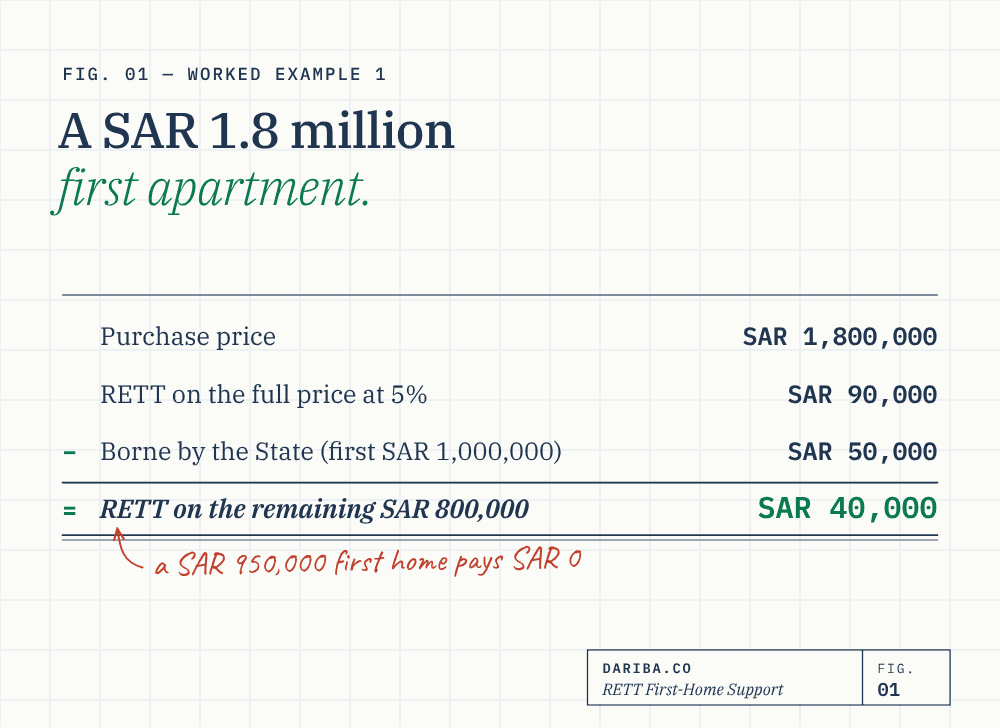
The SAR 950,000 purchase still produces SAR 47,500 of gross RETT; the assumed support covers it. The SAR 1.8 million purchase uses the maximum SAR 50,000 support and leaves SAR 40,000 to settle. The amounts illustrate the mechanism rather than establishing a real buyer’s eligibility.
Keep liability and the certificate evidence together
Law Article 7 makes the transferor responsible for the due tax. A contract allocating the cost to the buyer does not remove that responsibility.
Where eligibility is questioned, establish the facts and any amount due. The buyer’s joint liability requires the statutory causal involvement in non-payment to be established; a certificate discrepancy alone should not be described as an automatic finding of that liability.
Retain the eligibility result, certificate, property and buyer details, registered value, support calculation, acknowledgement and settlement evidence. For an off-plan or joint purchase, confirm the actual eligibility and timing rather than assuming the result of a straightforward completed-home example.
The RETT overview explains the wider charge. The payment-date guide and exemptions guide address their separate rules.
Key takeaways
- Support covers up to SAR 1 million of eligible home value, equivalent to at most SAR 50,000 of tax.
- The 5% charge and the amount borne by the State should be shown separately.
- Use Sakani's current certificate and eligibility process and ZATCA's transaction verification.
- Confirm joint-purchase and property-specific facts through the actual eligibility process.
- A cost-sharing agreement does not remove the transferor's statutory responsibility.
Frequently asked questions
How much first-home RETT support is available?
For an eligible qualifying first-home purchase, support covers 5% on up to SAR 1 million of home value: a maximum of SAR 50,000 in tax support. It is not SAR 1 million of tax relief.
Is the purchase taxed at 0%?
The ordinary RETT rate remains 5%. The State bears the supported amount for an eligible purchase; a zero amount remaining for the parties is different from a zero tax rate.
How is eligibility confirmed?
Use the current Sakani service, complete the required information and obtain the tax-bearing certificate where eligible. Provide it to the seller for ZATCA's transaction process. Confirm the actual property, buyer and certificate conditions.
What happens above SAR 1 million?
Assuming the full support ceiling applies, a SAR 1.8 million taxable purchase has SAR 90,000 gross RETT, SAR 50,000 State support and SAR 40,000 remaining. The actual eligibility and tax-base conditions must hold.
Who remains legally responsible for the tax?
Law Article 7 makes the transferor responsible. The transferee can be jointly liable where ZATCA establishes the statutory causal involvement in non-payment. A support or cost-sharing arrangement does not dispense with that analysis.
Sources
- Ministry of Municipalities and Housing, Sakani first-home tax-bearing serviceCurrent service conditions, certificate process, SAR 1 million home-value ceiling and maximum SAR 50,000 support, checked 20 November 2026.
- ZATCA Detailed RETT Guideline, version 6, May 2026Introduction section 1.1 and section 6, printed p.50: State-bearing mechanism, buyer certificate, seller registration and ZATCA verification.
- Saudi Real Estate Transaction Tax Law, Royal Decree M/84, controlling Arabic textArticles 3 and 7: statutory exemptions and transferor/transferee liability.
This article reflects the RETT Law (Royal Decree No. M/84), its Implementing Regulations (Board Resolution No. 01-03-25 dated 24 March 2025), and ZATCA's Detailed RETT Guideline, together with the ZATCA–MoMRAH first-home mechanism. First-home eligibility is administered by the Ministry of Municipalities and Housing and is subject to its current criteria. This article is for informational purposes only and does not constitute legal or tax advice. Confirm any position with current ZATCA and MoMRAH guidance or a qualified Saudi tax advisor. dariba.co is an independent platform with no consulting relationships.