In brief
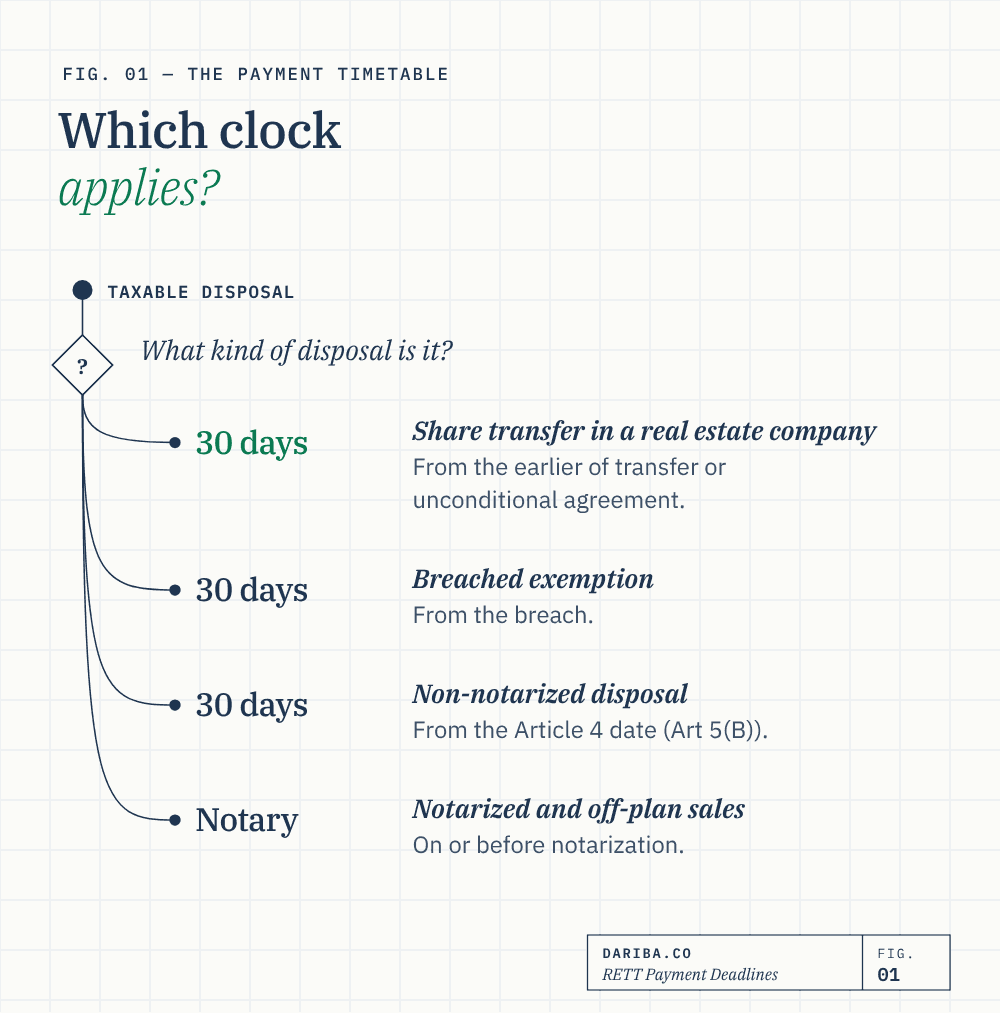
Law Article 5(1) supplies the general payment rule; Regulations Article 5 supplies specific payment dates. Keep a share transaction's earlier unconditional agreement, a later exemption breach, non-notarized timing and off-plan notarization distinct.
A RETT file needs both a transaction date and a payment deadline. They can differ. First establish whether the actual transaction is taxable or exempt, then identify the provisions fixing each date. A 30-day payment rule does not make an otherwise exempt transaction taxable or remove the need to establish a charge.
The general rule and the specific timetable
Article 5(1) of ZATCA’s Real Estate Transaction Tax Law provides payment on the transaction date and permits earlier payment. Paragraph (2) authorizes the Regulations’ cases where payment can occur later.
For ordinary notarized transfers, payment or the appropriate exemption evidence must be resolved through the relevant process before notarization. Do not assume that every transaction has a 30-day period after a deed is signed.
| Case | Payment rule | Provision in the RETT Implementing Regulations |
|---|---|---|
| Taxable transfer of interests in a real estate company | Within 30 days of share transfer or conclusion of an unconditional agreement to transfer, whichever is earlier | Article 5(a)(1) |
| Originally exempt transaction later losing a continuing exemption condition | Within 30 days of the actual breach | Article 5(a)(2) |
| Applicable non-notarized transaction | Within 30 days of its Article 4 date, without prejudice to paragraph (a) | Article 5(b) |
| Qualifying off-plan sale under the stated legal framework | On or before notarization with the notary public or accredited notary | Article 5(c) |
| Deferral found by ZATCA to be the transferor’s main purpose | ZATCA may demand payment within 30 days of the transaction date | Article 5(d) |
ZATCA’s Detailed RETT Guideline, Version 6, section 4.3, printed pages 18–20, presents the related tax-date and payment-date table. Section 4.4 and Examples 11–12 explain non-notarized usufruct and BOOT cases.
Share transfers: do not substitute completion for an earlier agreement
The Article 5(a)(1) starting point is the earlier specified date. Article 11(a)(7) also requires registration of the share transaction by its payment deadline.
Dariba date illustration: assume that chargeability under the real-estate-company and disposal tests has already been established. An unconditional agreement to transfer a 35% interest is concluded on 1 August 2026; the shares transfer on 20 August 2026. Applying the stated 30-day period gives 31 August 2026, counted from the earlier agreement date.
The 35% figure alone does not establish the company’s property-purpose and asset tests, the full disposal test or the absence of relief. Nor does every draft or conditional agreement establish an unconditional transfer agreement.
For staged disposals, reconcile Article 2(i)‘s related-disposal rules and the actual agreements with Articles 4(d) and 5(a)(1). Do not universally postpone payment to the final threshold-crossing transfer without checking an earlier operative unconditional agreement. See the share-valuation guide.
Exemption breaches: preserve the two different dates
Article 4(f) refers the tax event back to the originally exempt transaction that no longer satisfies its exemption conditions. Article 5(a)(2) separately gives a payment period running from the breach. The later payment period does not rewrite the original transaction’s value or create an entirely new transaction date for every purpose.
Dariba date illustration: assume a genuine continuing-condition breach on 1 November 2026. Thirty days from that event is 1 December 2026. Ordinary late-payment exposure begins after that payment deadline, rather than automatically from the original exempt transfer date.
Establish the actual condition before calling an event a breach. A sale of retained consideration shares can differ from a permitted later restructuring. Under Article 3(a)(7), the controlling Arabic gift condition concerns the specified onward gift, not every later sale. See the permitted-changes guide and exemption-breach guide.
Non-notarized transfers and qualifying off-plan sales
Article 5(b) works with the relevant Article 4 date. These include possession transferred for ownership, a qualifying long usufruct, the relevant BOOT transfer and the residual unconditional-agreement rule. Apply the specific paragraph that fits the actual rights. A later upload, invoice or administrative confirmation does not automatically start a fresh period.
For a qualifying off-plan sale, Articles 4(e) and 5(c) align the tax date and payment requirement with ownership-transfer notarization. A reservation or instalment payment is not automatically the relevant notarization. The rule does not defer a separate land acquisition, share disposal or other transaction merely because it forms part of an off-plan development.
First-home State support is a separate eligibility and amount question; it is not a general statutory exemption from registration or a reason to ignore payment reconciliation.
Late payment: start after the deadline
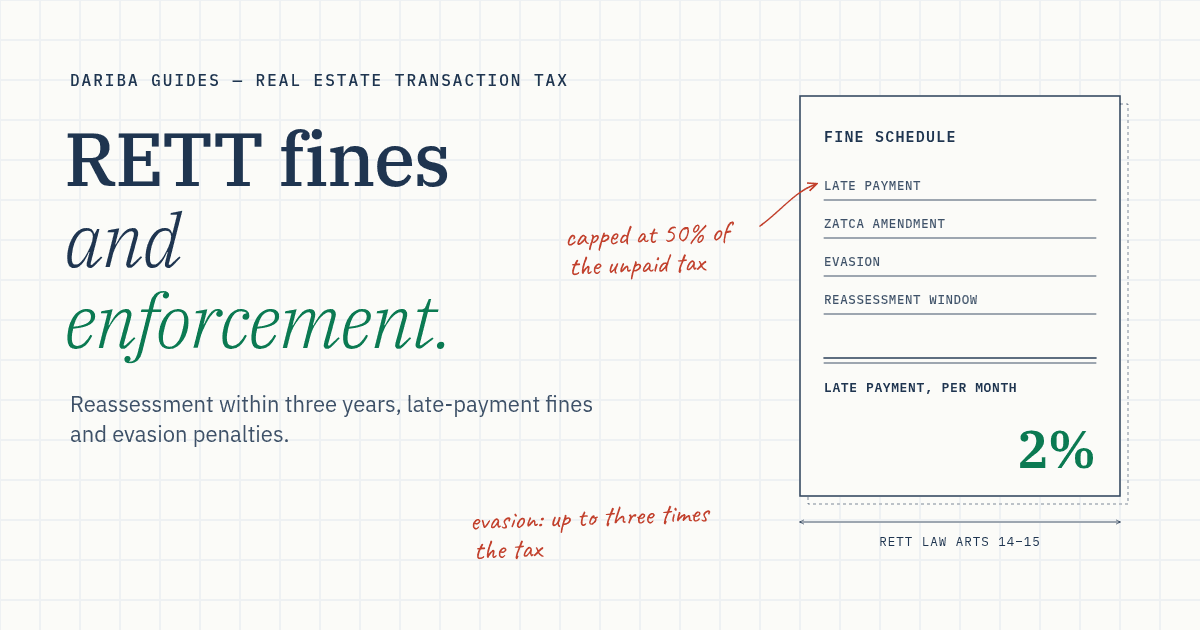
Law Article 15(2) sets an ordinary fine of 2% of unpaid tax for each month or part of a month, capped at 50% of that unpaid tax. It starts on the day after the payment period ends.
Dariba date and arithmetic illustration: assume a taxable non-notarized 55-year usufruct is granted on 1 February 2026, is not cancelled within the relevant exception, and has SAR 600,000 unpaid tax. Thirty days later is 3 March 2026. Payment on 4 March 2026 is one day after that deadline. On these assumptions, the first part-month ordinary fine is SAR 12,000: SAR 600,000 × 2%.
That example does not calculate a fine from the grant date or from the deadline day itself. It also assumes no other relevant facts, adjustments or relief.
Article 15(2)‘s additional 1% fine for a ZATCA amendment has a separate trigger after 30 days from the amendment notice. The ordinary 50% cap should not be described as a universal combined cap for every additional fine. See the penalties guide.
Article 5(d) and a usable closing record
Article 5(d) concerns cases where it is established to ZATCA that delaying tax payment was the transferor’s main purpose. It does not say that every conditional transaction or every use of an express statutory payment period is abusive. Nor does its wording establish a complete procedural burden-of-proof code.
Record the legal transaction, relevant event dates, applicable provision, registration deadline, payment deadline and evidence of payment or relief. Keep the actual chronology rather than relying on a generic 30-day label. Resolve any assessment or correction against that record; neither automatically erases the original due position.
Key takeaways
- A payment deadline does not itself establish chargeability or replace the transaction-date rules.
- For a taxable real-estate-company share transfer, the earlier unconditional agreement can start the 30-day clock.
- A qualifying exemption breach has a later payment period even though Article 4(f) refers back to the original transaction.
- Article 5(b)'s 30 days apply to the applicable non-notarized case; later paperwork does not automatically restart the period.
- Off-plan rules apply to qualifying sales under the stated legal framework, rather than any contract carrying that label.
- Ordinary late-payment fines start after the payment deadline. An assessment-related 1% fine has its own notice-based clock.
Frequently asked questions
Can I always wait 30 days after signing a property deed?
No. Law Article 5(1) provides payment on the transaction date or earlier. The Regulations contain specific exceptions and dates. For ordinary notarization, resolve payment or exemption evidence before the formal transfer; do not assume the non-notarized 30-day rule extends it.
Does a later share completion date restart the deadline?
For a taxable share transfer under Article 5(a)(1), use the earlier of the share transfer and conclusion of an unconditional transfer agreement. A later completion does not automatically restart that period. Scope and any aggregation rules must first be established.
Does any onward sale of gifted property breach the gift exemption?
No. Apply the actual Article 3(a)(7) condition. Its Arabic wording addresses a specified onward gift within three years; it is not a universal prohibition on every later sale. A sale may have its own tax consequences without automatically breaching the original gift exemption.
Does a correction request automatically provide another 30 days to pay?
No. Identify the applicable payment provision and original due position. Filing a correction or receiving an assessment does not automatically replace all earlier payment deadlines. The additional assessment-related fine has a separate statutory notice-based rule.
Is late RETT always limited to a single 50% combined fine?
Law Article 15(2) caps the ordinary 2% monthly or part-month late-payment fine at 50% of unpaid tax. It separately provides an additional 1% monthly or part-month fine after 30 days from an amendment notice where its conditions apply. Do not assume the ordinary cap is a universal cap on every additional fine.
Sources
Reviewed against the RETT Law, the controlling Arabic Implementing Regulations and ZATCA's Detailed RETT Guideline Version 6 (May 2026). The guideline does not amend the legislation. Historical transactions need their applicable-period analysis. General information, not transaction-specific advice. Dariba.co is independent of ZATCA.