In brief
Article 2(d) includes the specified permits, real rights and similar rights closely connected to and inseparable from the property in its total value. It is a valuation provision, not an automatic separate charge on every approval or a guaranteed exclusion for all operator rights.
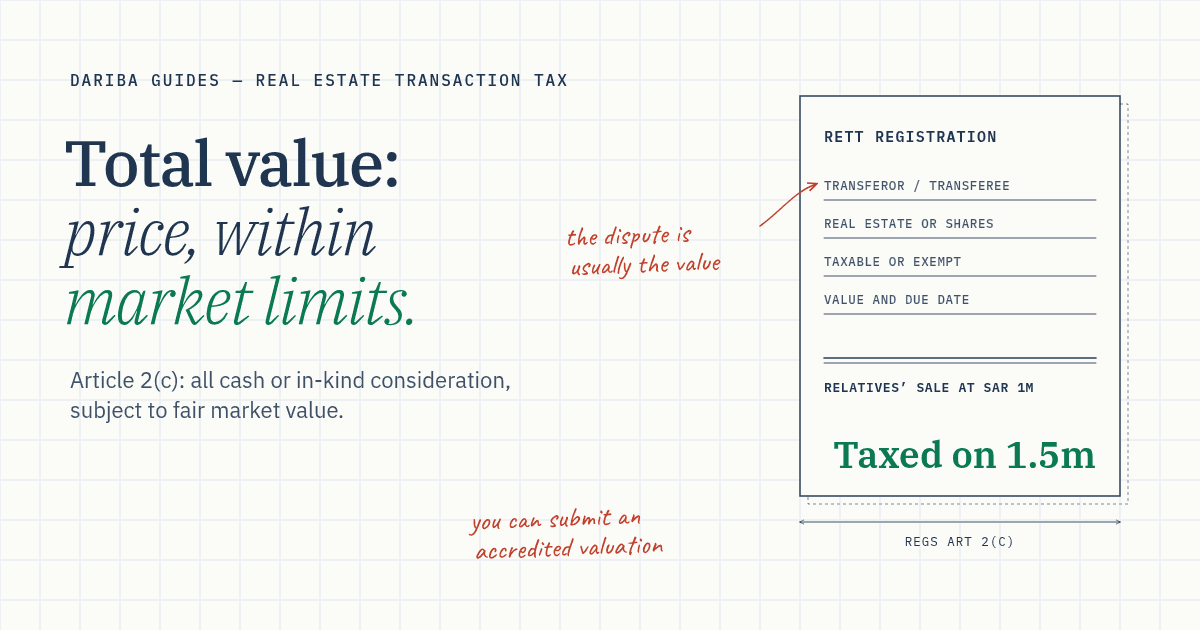
Permits and property rights can affect what a buyer acquires and pays for. Article 2(d) of ZATCA’s RETT Implementing Regulations requires relevant closely connected, inseparable rights to form part of the property’s total value.
Start with the actual right
The provision names permits, primary and accessory rights in rem, and similar rights closely linked to the property so they cannot be treated as separate from it. Identify the actual holder, legal terms, duration, connection and transfer.
A building approval, access right or development permission is a candidate for analysis, not an automatic classification ruling from its name. Read the operative instrument before asserting whether it attaches to the property, transfers with it, expires or belongs personally to an operator.
ZATCA’s Detailed RETT Guideline, Version 6, section 4.2, printed page 16, includes inseparable elements and closely linked real rights in the property value. It does not provide a complete licensing-law ruling for every approval.
Separate pricing does not decide inclusion
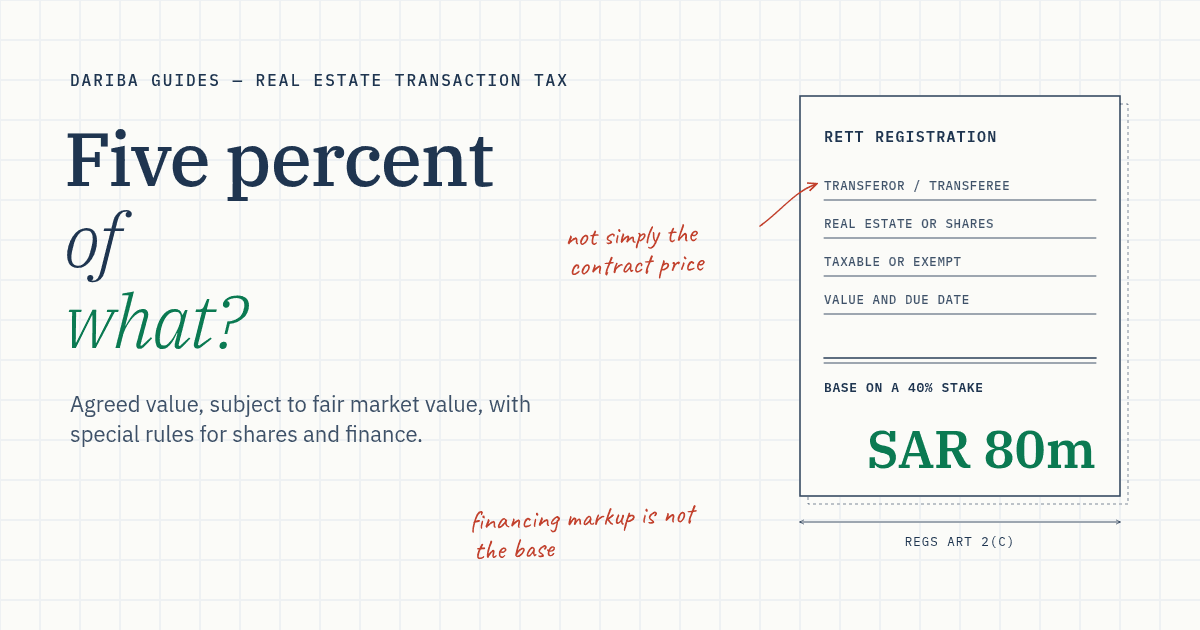
A sale contract may allocate value between land and permits. If the actual rights fall within Article 2(d), a separate price does not remove them from the property base.
The reverse shortcut is also unsafe. An item labelled an operator licence, brand or franchise does not automatically receive an exclusion merely because of the label. Establish whether the actual rights are genuinely separate, what is transferred and how the amount is supported.
A genuinely separate business right must not simply be treated as disguised property consideration without evidence. Nor should a fee label conceal value actually paid for the property.
Dariba land-and-rights illustration
Assume a contract allocates SAR 22 million to land and SAR 8 million to rights. Assume the actual rights meet Article 2(d), the proper total real-estate value is SAR 30 million and no exemption applies.
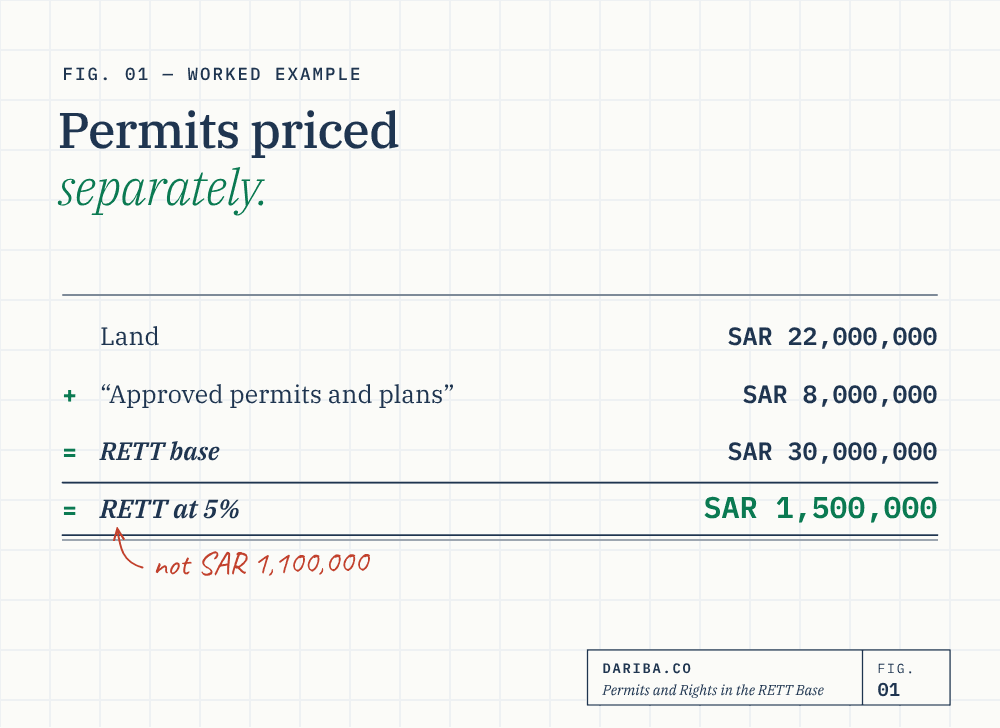
| Calculation | Amount |
|---|---|
| Proper combined base | SAR 30 million |
| RETT at 5% | SAR 1.5 million |
| Tax if only SAR 22 million were wrongly used | SAR 1.1 million |
| Difference | SAR 400,000 |
These are Dariba’s explicit classification and value assumptions. They do not establish that every plan approval is automatically inseparable or always worth its allocated amount.
If an all-inclusive valuation already gives SAR 30 million for the property with these rights, adding SAR 8 million again would produce a false SAR 38 million base. Include each relevant value once.
A valuation component is not a separate charge by itself
Article 2(d) concerns the total value of the relevant transaction. It does not itself establish that every administrative approval, discharge or creation of a security right is a separately taxable disposal.
Primary and accessory property rights must be identified under the actual legal instruments. Do not automatically add the principal amount of a secured debt as another permit or right value. Whether debt assumption is actual additional consideration is a separate Article 2(c) enquiry; temporary security may raise Article 3(a)(14).
The same care applies where a right burdens the property rather than simply increasing its value. Establish the transferred rights and proper valuation rather than presume every listed right creates a positive cash addition.
Support classification and valuation separately
Keep the operative rights and licensing documents, ownership/holder details, transfer terms, contract allocation and valuation scope. Explain why a right is included or separate and whether its value is already reflected elsewhere.
Regulations Article 8 permits scrutiny of allocations. A valuation report supports a figure without guaranteeing acceptance or curing a wrong legal classification.
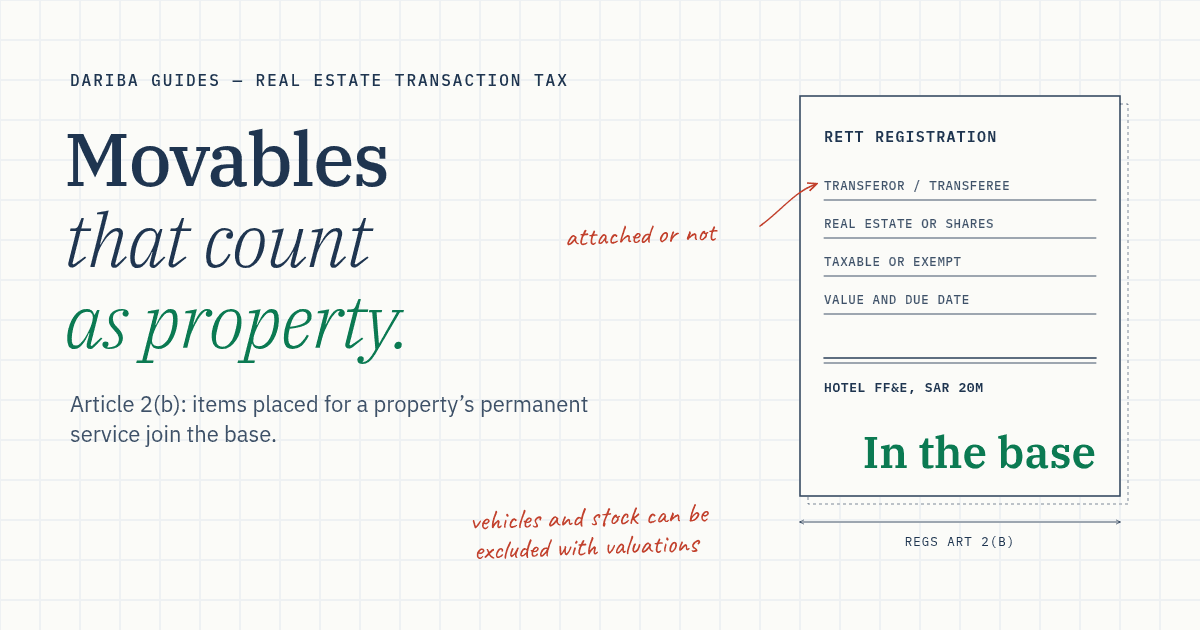
See the movable-property guide for Article 2(b), the total-value guide for consideration, and the security guide for that separate exemption.
Key takeaways
- Read the actual right, holder, legal terms and transfer rather than apply an unconditional list of permit names.
- A property-specific approval can affect market value without creating a separate taxable transaction for every administrative act.
- Operator licences, brands and franchises are not categorically excluded merely by label.
- Inseparable rights already reflected in the whole-property value should not be added a second time.
- An accessory security right does not automatically make its principal debt additional property consideration.
- The actual licence/rights instruments must be read before claiming their legal effect.
Frequently asked questions
Is every building or operating permit automatically in or out?
Apply the actual connection and inseparability test to the rights and legal terms. A property-specific description, operator label or accounting allocation alone is insufficient. This RETT provision does not determine every licensing instrument's transfer rules.
Does a separately priced permit escape the base?
Not if it is actually within Article 2(d). Separate pricing alone does not change that classification. Conversely, the article does not prove that every item called a permit must be included without examining the actual right.
Should permit value be added to an all-inclusive property valuation?
Avoid double counting. If the proper whole-property value already reflects the relevant rights, adding the same component again inflates the base. Establish what the valuation actually includes.
Does every mortgage create an extra taxable permit/right value?
No automatic extra base or separate charge follows from Article 2(d)'s valuation wording. Establish the actual transfer, rights, consideration and any security exemption. The secured debt is not universally an additional asset value.
Sources
- ZATCA — Real Estate Transaction Tax Law (Arabic), Articles 1–3 and 8
- ZATCA — RETT Implementing Regulations (Arabic)Articles 2(b)–(g), 3(a)(14) and 8
- ZATCA — Detailed RETT Guideline, Version 6, May 2026Definitions of real estate; section 4.2 and Examples 8–9, printed pages 16–17
Reviewed against the controlling Arabic RETT Law and Implementing Regulations and ZATCA's Detailed RETT Guideline Version 6 (May 2026). Classifications and Dariba numerical illustrations require their stated ownership, rights, value and other facts. General information; no individual valuation or exemption approval is implied.