In brief
Article 11(d) provides electronic delivery through a confirming mechanism to approved addresses and deemed receipt on sending, subject to evidence of delay beyond the recipient's control. The relevant obligation's rules determine how a deadline is counted.
An electronic notice can start a RETT response or objection period before the recipient opens it. The practical task is to identify the legally relevant notification, preserve its evidence and apply the correct deadline rule.
Article 11(d) of the Implementing Regulations for the Real Estate Transaction Tax Law, issued by the Zakat, Tax and Customs Authority (ZATCA), addresses notices of ZATCA decisions. Article 11(e) separately addresses forms and document formats.
Electronic delivery and deemed receipt
Article 11(d)(1) requires electronic notices through a mechanism confirming delivery to the recipient’s addresses approved by ZATCA. Establish the actual approved address, notice and delivery record. Do not reduce this requirement to an unsupported claim that sending anything to any old address is sufficient.
Article 11(d)(2) deems ZATCA’s notice received on the sending date unless there is evidence that receipt was delayed by circumstances beyond the recipient’s control. The rule is not simply “the date you read it,” but it is also not an irrebuttable sending-date rule.
Keep the message, attachments, portal records, transmission and delivery timestamps and any evidence of disruption. An outage label alone does not establish its duration, causal effect on receipt or absence of control. Equally, do not state that a particular fact pattern can never qualify without considering its evidence.
Receipt is a trigger; counting needs the applicable rule
A receipt date does not itself tell you which day is counted as day one. RETT Regulations Article 13(a) refers the detailed objection procedures to the Zakat, Tax and Customs Committee Procedures, approved by Royal Order No. 25711 dated 8 Rabi II 1445 AH.
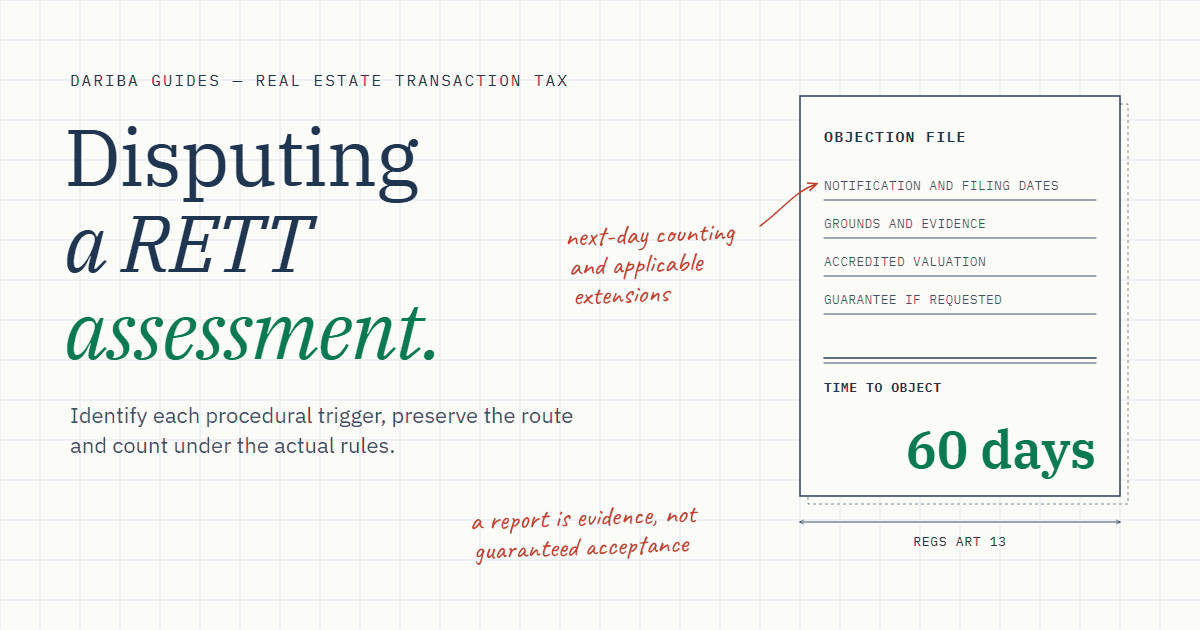
For the relevant procedures, Article 5 addresses the objection to ZATCA and the subsequent options after rejection, partial acceptance or the prescribed period without a decision. Article 46 counts periods from the day following the triggering event, addresses expiry at the end of the final day, and extends a final day falling on an official holiday to the following working day. It also addresses the Gregorian calculation and dates in the Secretariat’s electronic system.
Do not conflate this with Article 11(d)‘s deemed-receipt rule. Nor should ZATCA’s notice provision automatically be applied to every notice issued by the committees themselves.
| Situation | What to identify |
|---|---|
| Objection to a notified ZATCA decision | The actual notification trigger, applicable 60-day period, next-day calculation and any relevant extension. |
| Rejection or partial acceptance of an objection | The notified decision and the applicable subsequent procedural options and period. |
| No decision within the prescribed 90 days | The objection’s applicable procedural date and expiry of that period; no new notice is required merely to make the silence relevant. |
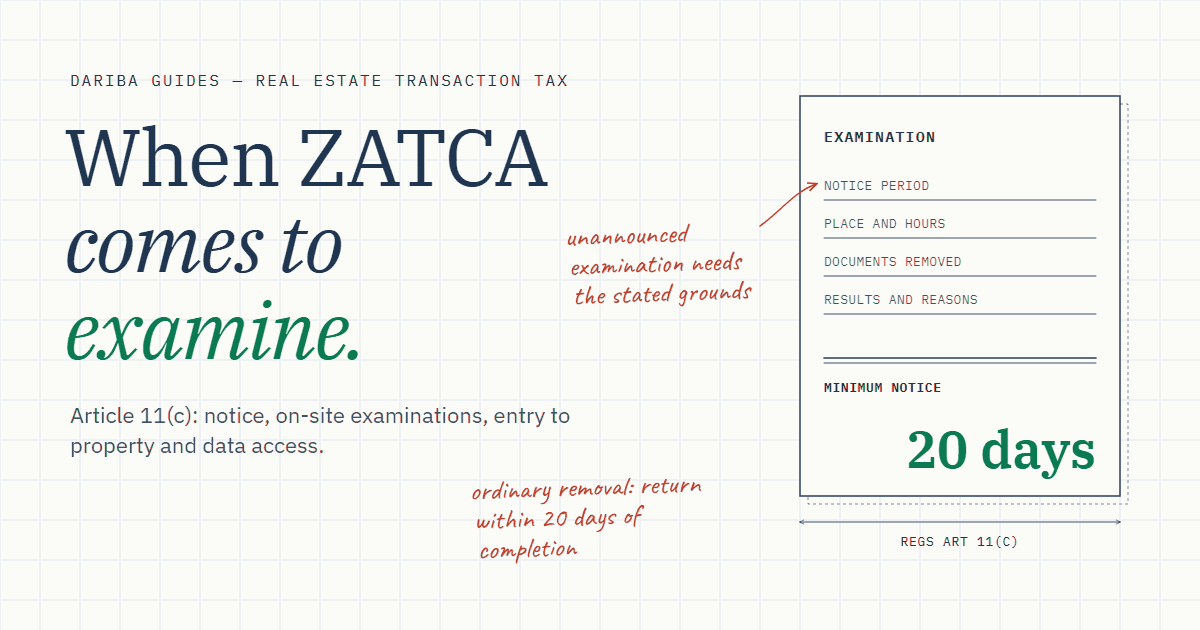
| Tax payment, examination or document demand | Its own statutory rule and the actual notice terms; not every period is the same objection period. |
A refund decision and a payment demand may therefore have different practical consequences even though both arrive electronically.
Worked Example: a message read much later
Dariba example: assume an assessment is properly notified through the required mechanism on 1 June 2026, the ordinary deemed-receipt rule applies, and the recipient only reads it on 15 August.
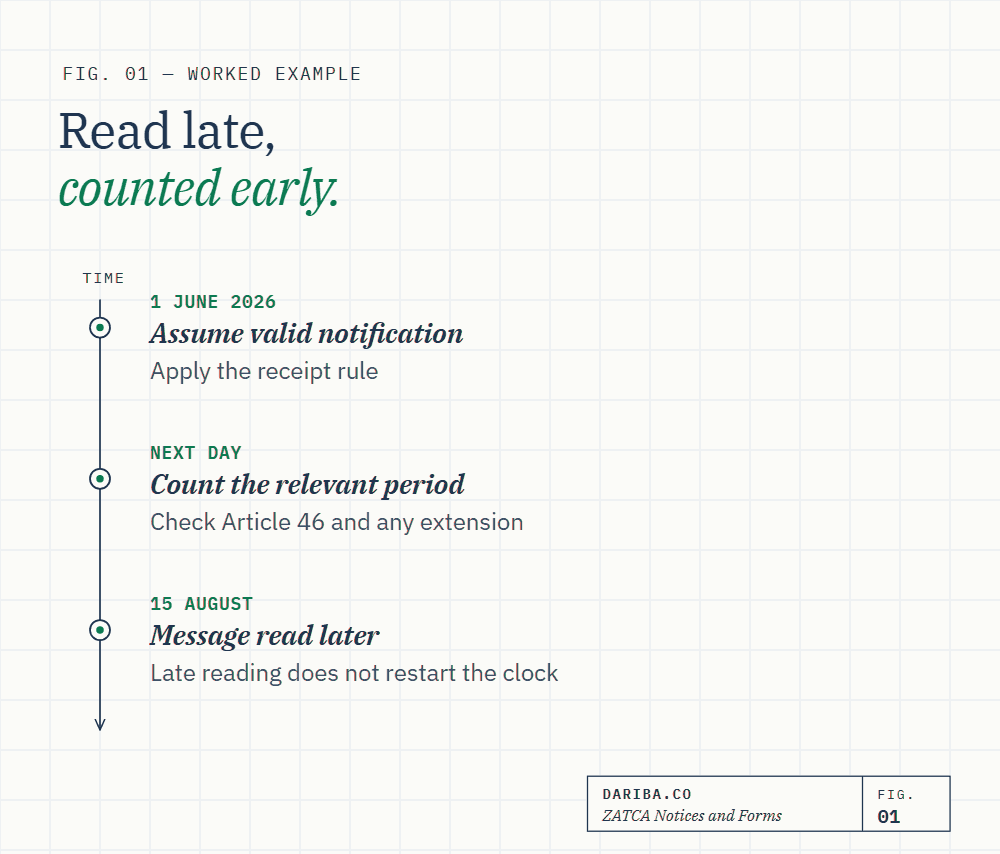
There are 75 days between those dates. The ordinary 60-day objection count begins from the following day under the applicable committee rules; its raw 60th calendar day is 31 July, before considering any applicable final-day holiday extension.
Late reading does not itself restart the objection period. Determine the actual operative deadline, any supported receipt-delay exception and any other applicable procedural provision. Do not replace that assessment with a blanket statement that missing an email always makes every possible remedy unavailable.
Mandatory forms and document formats
Article 11(e) permits ZATCA to specify mandatory electronic forms or formats for registration, requests and other obligations. It also permits requirements for electronic or written documents where necessary.
Using an informal email is not automatically a valid substitute for a prescribed request. Conversely, the Regulations do not require every possible supporting document to exist only in one electronic format. Follow the current mandatory channel and the particular request’s requirements.
Save the completed submission, uploaded documents, timestamp and acknowledgement. A draft or successful login is different from evidence that the required request was submitted.
Practical controls
Maintain the approved contact details and monitored access, identify who reviews decisions, and record the trigger and calculation separately for each deadline. Preserve evidence of genuine receipt problems as soon as they occur.
For a dispute, use the objection procedure guide with the operative committee rules. For filing obligations, use the transaction-registration guide. Neither a pending enquiry nor an unanswered informal message should be assumed to suspend a statutory period.
Key takeaways
- Electronic notices use a mechanism confirming delivery to the recipient's ZATCA-approved addresses.
- Deemed receipt on sending has an express evidence-based exception for delay beyond the recipient's control.
- The receipt trigger and the first counted day are distinct questions.
- Committee Procedures Articles 5 and 46 govern relevant objection periods, next-day counting and official-holiday extensions.
- A 90-day no-response period follows the objection's procedural trigger, not a new notice sent to the taxpayer.
- Mandatory formats, document requirements and proof of submission should be tracked separately.
Frequently asked questions
Does every deadline count its first day as the day ZATCA sends a notice?
No. Establish valid notification and deemed receipt, then apply the particular counting rule. For relevant committee procedures, Article 46 counts from the following day and addresses an official holiday on the last day.
Does a documented outage automatically extend the period?
No automatic outcome is established by the word outage. Preserve evidence showing the delay in receiving the notice, its cause and why it was beyond the recipient's control. The actual notification and procedural rules must be applied.
Is the sending rule also the calculation rule for committee-issued notices?
Do not assume so. Article 11(d) addresses ZATCA's notices under the RETT framework. Committee proceedings have their own applicable notification and procedural rules.
Sources
- ZATCA — Real Estate Transaction Tax Law (Royal Decree No. M/84)
- ZATCA — Implementing Regulations for the Real Estate Transaction Tax Law (Arabic; Board Resolution No. 25-03-01)
- ZATCA — Detailed Guideline for the Real Estate Transaction Tax (Version 6, May 2026)
- General Secretariat of Zakat, Tax and Customs Committees — Committee Procedures (Royal Order No. 25711, 8 Rabi II 1445 AH)
Based on the RETT Law (Royal Decree No. M/84, effective 10 April 2025) and the RETT Implementing Regulations (ZATCA Board Resolution No. 01-03-25 dated 24 March 2025, unofficial English translation). The Arabic text prevails. This article is general information, not advice on any specific transaction. dariba.co is an independent knowledge platform and is not affiliated with ZATCA.