In brief
The signed Riyadh decision specifies three uses and includes exactly 5,000 m² under its area wording. The 2025 registration window, later-acquisition reporting and 2026 billing commencement are separate events; parcel scope and relief require their own evidence.
Read the Riyadh Decision with the National Rules
Riyadh white-land liability needs both the national framework and the city application decision. The national legislation sets the conditions, bands and administrative powers. The city decision identifies the application in Riyadh, relevant uses and announced geographic scope. A national ceiling alone does not establish the rate on a particular title.
The Ministry’s published packet includes the signed Riyadh decision numbered 4700162523/1, dated 4 Rabi al-Awwal 1447 AH. Its operative text refers separately to the national White-Land Fees Implementing Regulations issued by Decision 7000121073/1 dated 19 Safar 1447 AH. Keep those instruments distinct when explaining a property’s obligations.
The Riyadh decision applies the fee to residential, residential-commercial and commercial land uses within its stated geographic map. It does not establish that every parcel described commercially as being in Riyadh is inside the legal scope or subject to the highest rate. The national white-land guide explains the underlying conditions.
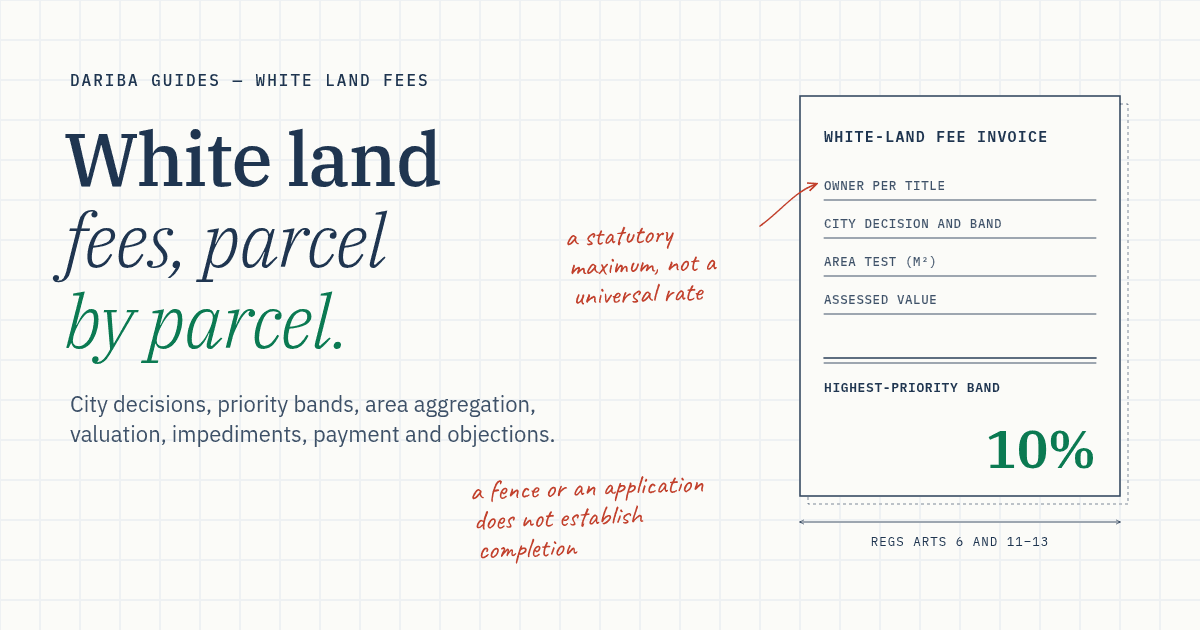
Exactly 5,000 Square Metres Is Included
The city decision requires registration of land within its geographic scope where the parcel’s area is 5,000 m² or more, or the relevant aggregate area is 5,000 m² or more. National Regulations Article 7 also uses a floor that includes equality, alongside its other conditions.
The Ministry’s December 2025 billing announcement informally describes land exceeding 5,000 m². That short news wording should not be used to exclude a title at exactly 5,000 m² when the operative decision and regulation include it. A boundary conclusion requires the primary wording and actual ownership/parcel facts.
National Articles 2, 6 and 7 also require attention to the owner, city scope, designated use and other eligibility conditions. Do not combine land held by distinct legal persons merely because they belong to one commercial group, or assume that dividing one owner’s land among several titles removes the applicable aggregation rule. Joint ownership has its separate proportional-payment rule under Article 2(3).
The Five Bands Determine Different Annual Charges
National Article 6 provides the priority bands, and the official Riyadh map announcement confirms their use for the capital’s declared geographic scopes.
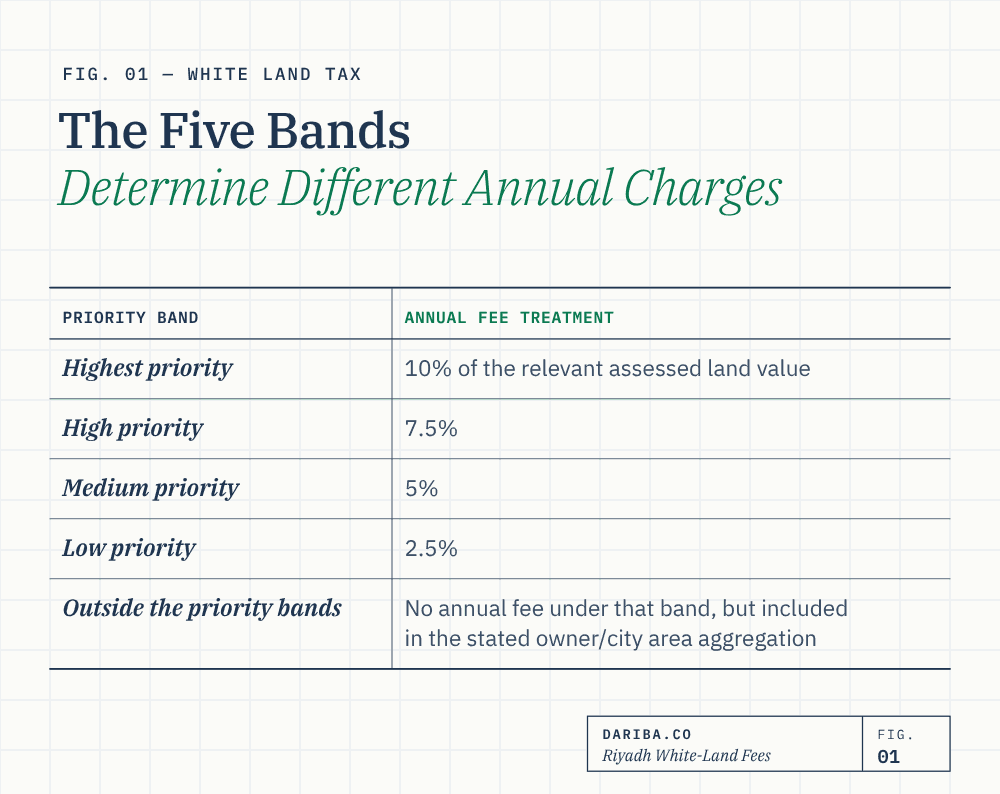
| Priority band | Annual fee treatment |
|---|---|
| Highest priority | 10% of the relevant assessed land value |
| High priority | 7.5% |
| Medium priority | 5% |
| Low priority | 2.5% |
| Outside the priority bands | No annual fee under that band, but included in the stated owner/city area aggregation |
The fifth band is therefore not simply land that can always be ignored. Its stated aggregation role can affect the threshold analysis for the owner’s other qualifying land. Conversely, that aggregation role does not itself turn fifth-band land into a 10% parcel.
Dariba illustration: assume one owner has qualifying parcels of 3,000 m² and 2,500 m² in the relevant Riyadh scope, with the latter in the fifth band. The stated aggregate is 5,500 m². If the first parcel is properly assigned to the high-priority band and its relevant assessed value is SAR 2 million, its annual fee calculation is SAR 150,000 at 7.5%. These original assumptions do not establish the actual legal scope, band or valuation of a real parcel.
Match the Title to the Official Geographic Information
The signed order refers to the geographic map attached to the decision. The programme’s official Riyadh map announcement directs owners to the official programme portal for the interactive maps and band information. A neighbourhood name, broker’s diagram or general city boundary is insufficient evidence of a particular title’s classification.
Dariba recommends preserving the title number, parcel/location information, applicable official map or enquiry result, selected band and the date of that result. Reconcile those details with the invoice and any planning-use records. A parcel can require closer review where boundaries, subdivision, use or ownership have changed.
This guide does not certify a particular parcel boundary or reproduce a verified cadastral map. National Article 6 also provides for annual review of the city or geographic position. An old screenshot should not be treated as permanent protection against a later valid change, and a later general announcement should not be assumed to alter every title retrospectively.
Separate the 2025 Registration Window from Later Transfers
The Riyadh decision’s original registration window ran for sixty days, from 1 September 2025 to 30 October 2025. Owners within its stated scope were required to provide ownership documents and land information through the programme’s electronic portal. Those are historical dates; they should not be presented as an upcoming registration window in 2026.
National Article 5(4) separately requires new owners who acquire the land after the announced registration period to provide the relevant documents and data within thirty days of ownership transfer. The original city window and the later-acquisition obligation are different clocks.
Keep acquisition, registration, submission and acknowledgement evidence together. A seller’s historic registration does not remove the need to examine the new owner’s obligation, and a pending ownership-record update does not by itself establish that every deadline has been suspended. Apply the actual facts and official procedures rather than assuming that the old 2025 window is the only reporting duty.
Billing Began on 1 January 2026; Read the Actual Invoice
In its 25 December 2025 announcement, the Ministry stated that first billing for the declared Riyadh scopes would start on 1 January 2026. This identifies the announced billing commencement. It is not a statement that every owner received the same invoice, notification or payment date.
National Articles 11 and 12 govern invoice particulars and notification. Reconcile the owner, title, location, legal basis, valuation, percentage, amount and procedural information with the actual invoice. A fee calculated from a general online land-price estimate is not a substitute for the relevant official valuation and invoice.
For ordinary white-land invoices, Article 13(2) uses one Gregorian year from issuance. The provision separately addresses earlier-year invoices using ninety days from notification, and approved additional development periods have their own consequences. Identify the invoice type and relevant dates before calculating the actual payment obligation.
Development Relief Requires the Actual Conditions
National Article 8 distinguishes genuine impediments, completed development/construction and approved additional development time. The definitions and actual permits matter: fencing, an intention to sell or the start of site work should not be assumed to satisfy completed development.
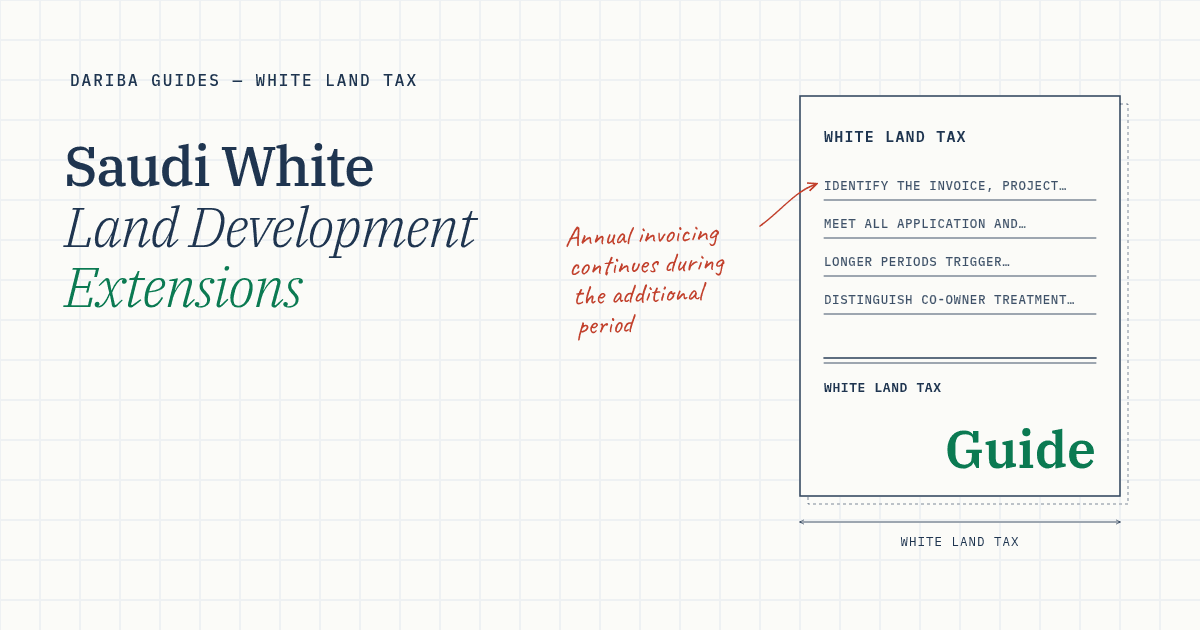
The Ministry’s billing announcement also explains that an additional period requires the competent committee’s approval and the applicable controls. If development is not completed during that period, the stated fees remain due for the full relevant duration. Submitting an application alone is not the same event as obtaining approval or completing the required work.
The additional-development-period guide explains licences, progress evidence, continued invoicing and the consequences of cancellation, sale or completion. Keep the actual approval and conditions with the project programme and fee schedule; a broad construction budget does not establish statutory relief.
Preserve Objection Rights Alongside the Property Review
Law Article 8 gives the specified sixty-day objection period from notification of the relevant application, valuation or amount decision. The committee’s statutory decision period and subsequent review route require separate attention. A registration, map enquiry or extension application should not be treated as an objection merely because it contains some of the same property information.
Dariba recommends a property file connecting title and ownership history, city scope and use, area aggregation, band, valuation, invoice/notification dates, registration duties and any development or objection evidence. That makes a disagreement about one element easier to identify and support without assuming that the entire regime is inapplicable.
This is a Riyadh application guide based on the reviewed decision and official announcements. It does not certify every later city amendment or individual property outcome. Other cities require their own decisions, and vacant buildings have a separate regulatory framework.
Key takeaways
- The signed Riyadh decision specifies residential, residential-commercial and commercial uses in its geographic scope.
- Exactly 5,000 m² is included by the primary wording; an informal news description does not exclude equality.
- Fifth-band land has no annual fee under that band but retains its stated area-aggregation role.
- The original registration window was 1 September–30 October 2025; later acquisitions have a separate thirty-day document duty.
- First billing was announced from 1 January 2026; individual invoice and notification dates still control their own deadlines.
- No individual parcel map, band, valuation, later amendment history or relief approval is certified.
Sources
- Ministry-published Riyadh signed application decision and accompanying textSigned operative decision at p. 2, number 4700162523/1 dated 4 Rabi al-Awwal 1447 AH: three land uses, at least 5,000 m² and the 1 September–30 October 2025 registration window. The cover title and separate national-regulation reference are distinguished; the reviewed packet does not verify its referenced map.
- National White Land and Vacant Property Fees Law, amended Arabic textSeparate national statutory framework, including application, ownership and objection rights.
- National White-Land Fees Implementing RegulationsArticles 2/5–8/11–13: ownership, city decision, area, bands, new-owner documents, development and invoice dates.
- Official Riyadh geographic-map announcementRiyadh band announcement and direction to official interactive maps. No individual cadastral boundary is certified.
- Ministry Riyadh first-billing announcement, 25 December 2025Billing starts 1 January 2026. Informal threshold wording is read against the controlling decision and Regulations, which include equality.
- Additional development-period technical controlsActual approval, licence, progress, continued annual invoicing and completion/sale conditions.
- Official programme portalCurrent programme entry point for maps and property enquiries; no private parcel data accessed.
Source-based explanation reviewed on 29 October 2026. Apply the controlling Arabic instruments, actual city/property decisions, current official map and invoice. Historical registration and billing announcements do not certify every later amendment, individual parcel liability, band or valuation. Dariba illustrations use original assumptions; no Ministry approval or independent legal certification is implied.