In brief
Apply the Saudi–Bangladesh treaty’s rules for warehousing, connected services and local profits.
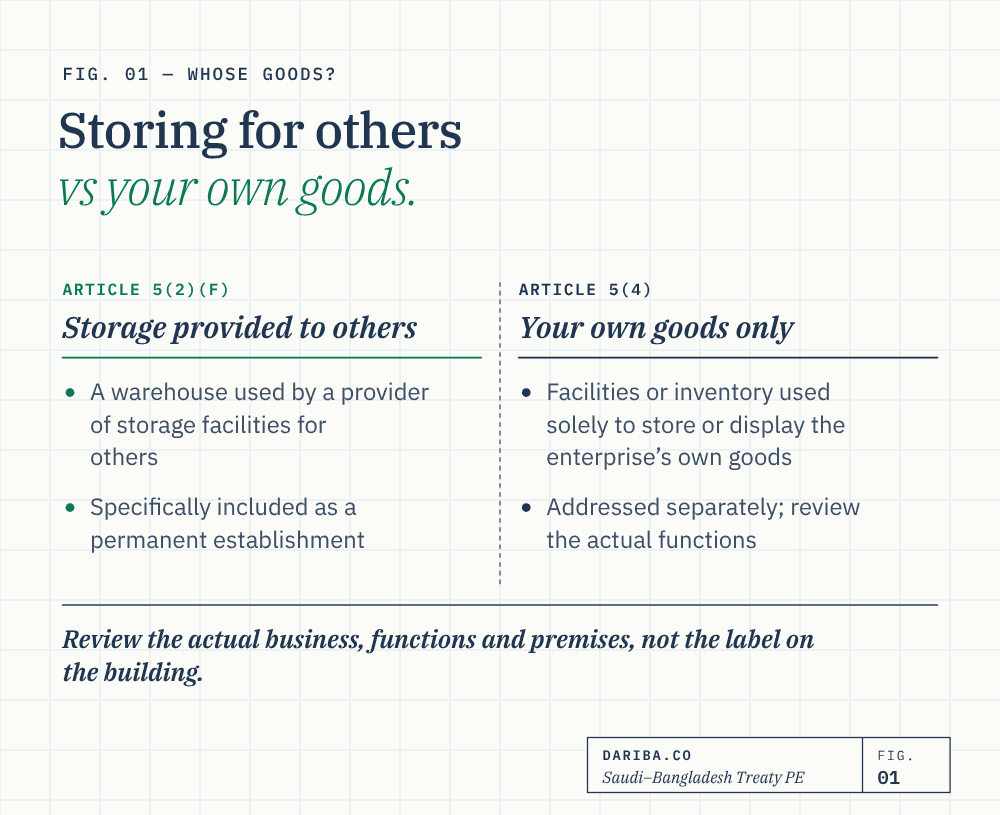
A Bangladeshi company operating a warehouse in Saudi Arabia should check whose goods it stores and what services it provides. Article 5(2)(f) of the Saudi–Bangladesh Double Taxation Convention specifically includes a warehouse used by a provider of storage facilities for others. Article 5(4) separately addresses facilities or inventory used solely to store or display the enterprise’s own goods. Review the actual business, functions and premises.
| Activity | Treaty provision | Duration test |
|---|---|---|
| Specified construction, assembly or installation and associated supervision | Article 5(3)(a) | More than six months |
| Services through personnel on the same or a connected project | Article 5(3)(b) | More than six months in aggregate within any 12 months |
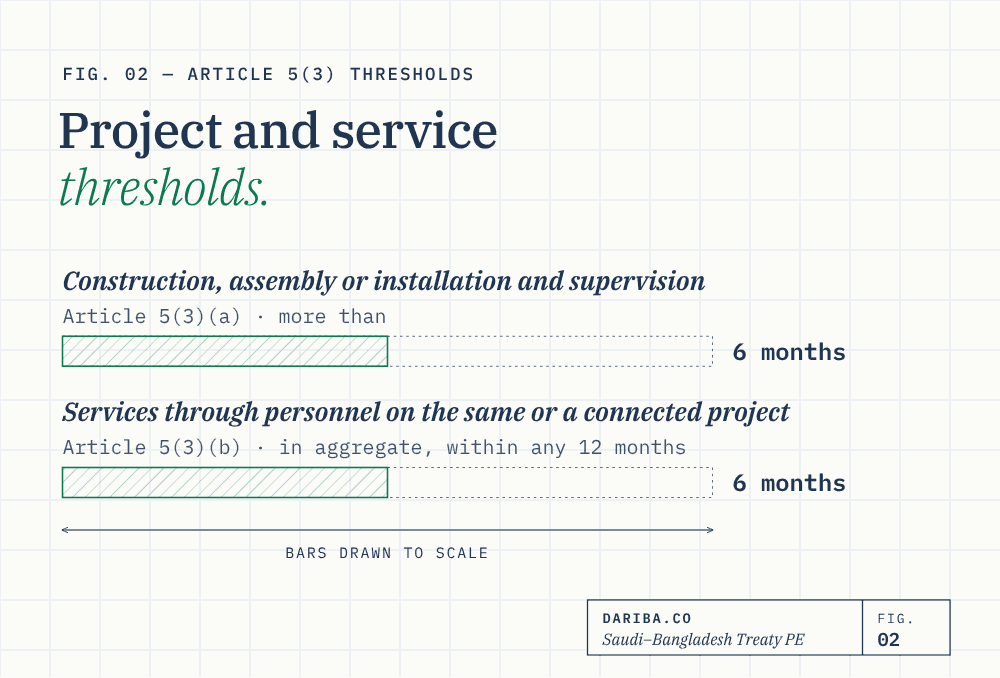
Test fixed premises and agency alongside these thresholds. The agency rule includes the habitual exercise of local contracting authority and a separate regular-delivery rule for stock kept locally on the enterprise’s behalf.
Work out which profits arise from local business
Article 7(1) reaches attributable profits and specified profits from similar local sales and activities once the enterprise carries on business through a permanent establishment. ZATCA’s Circular 2104001, Force of Attraction Rule in the Context of Permanent Establishment, explains the similarity test. Article 7(6) excludes covered merchandise export profits from taxation in the importing state and separately assigns profits from other local activities under the export contract to that state for taxation. Review the treaty conditions for the local work and reconcile the sales and project records.
Article 7(5) excludes profit attribution based solely on purchasing goods for the enterprise. Article 7(8) separately preserves domestic taxation of profits from insurance with nonresidents and provides for consultation after specified changes to the law. See the withholding guide for separately classified income.
Key takeaways
- Article 5(2)(f) covers a warehouse used to provide storage to others.
- Article 7(6) distinguishes exports from other local work under an export contract.
Sources
- Saudi–Bangladesh Convention for the Avoidance of Double Taxation and the Prevention of Tax EvasionArticles 5 and 7.
- ZATCA Treaty Register, Bangladesh ConventionSignature and entry into force.
- ZATCA Circular 2104001, Force of Attraction Rule in the Context of Permanent EstablishmentSimilarity and partial force of attraction.