In brief
The Saudi–Netherlands treaty provides 5% and 10% dividend ceilings, a 5% ordinary debt-income ceiling and a 7% royalty ceiling. The Protocol sets a specific period for refund claims on those categories.
When a Saudi company pays a Dutch resident, the Saudi–Netherlands Double Taxation Convention can limit the tax collected in Saudi Arabia. The result depends on the payment’s character, beneficial ownership and the conditions of the income article. The Convention entered into force on 1 December 2010. Article 27 applies its original withholding provisions to amounts paid from 1 January 2011.
Check the separate aviation agreement for airline income
Article 8(5) of the 2008 convention preserves the 1991 aviation agreement and gives it priority where the two instruments differ. The Saudi–Netherlands air transport guide explains airline designation, international routes and qualifying receipts.
Apply the dividend and royalty ceilings
| Payment | Treaty provision | Source-tax ceiling |
|---|---|---|
| Dividend to a qualifying company other than a partnership directly holding at least 10% of the payer’s capital | Article 10(2)(a) | 5% of gross dividends |
| Other dividend to a qualifying beneficial owner | Article 10(2)(b) | 10% of gross dividends |
| Ordinary debt-claim income to a qualifying beneficial owner | Article 11(2) | 5% of gross income |
| Qualifying royalty | Article 12(2) | 7% of gross royalties |
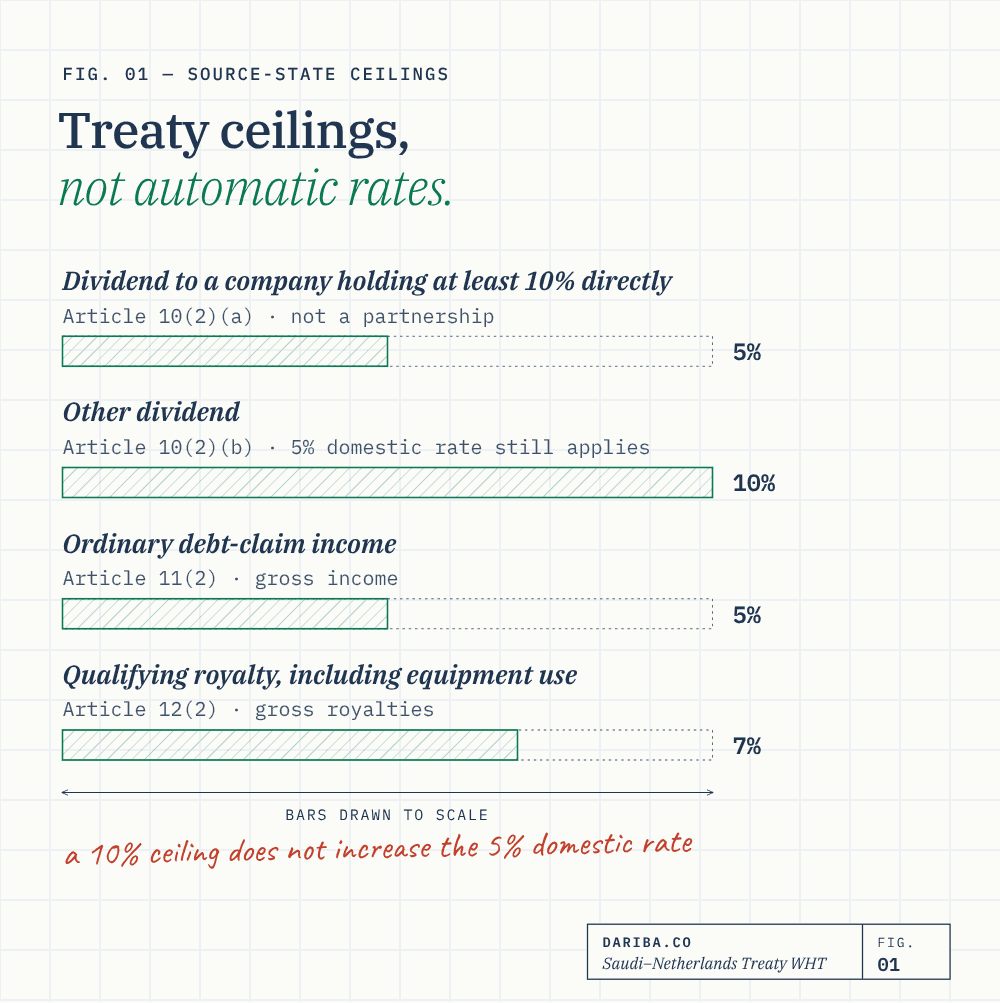
The ordinary Saudi domestic rate on dividends is 5% under Article 63 of the Income Tax Implementing Regulations. A 10% treaty ceiling does not increase it. Saudi Arabia’s reservation against Article 8 of the Multilateral Instrument (MLI) means that provision adds no 365-day holding test. Apply the MLI principal purpose test and document the reasons for the ownership structure and the recipient’s role.
Article 12(3) includes specified intellectual property rights, know-how and use of industrial, commercial or scientific equipment. The treaty gives those royalties the same 7% ceiling. A payment under a licence or hire contract still requires a separate domestic classification. Check whether a permanent establishment or fixed base is effectively connected with the right, and whether related-party pricing produces an excess under Article 12(6).
Identify the government role in the debt
Article 11(3) allocates qualifying debt-claim income exclusively to the beneficial owner’s residence state if the payment is made by the specified government or public authorities, made to the other state’s government or specified authorities, or made to its central bank or a corporate body covered by paragraph 3(c). For a public-sector lender, obtain evidence of ownership or control and the identity of the beneficial owner.
Article 11(4) excludes late-payment penalties from the debt-income definition. Identify the contractual return and classify arrangement fees, guarantee fees and late charges separately. Paragraphs 5–7 address effective connection, source and special-relationship excess. Paragraph 5 expressly refers to paragraphs 1 and 2, so read the precise limb of paragraph 3 and the other applicable provisions where there is a Saudi establishment.
Measure the refund period from the year of levy
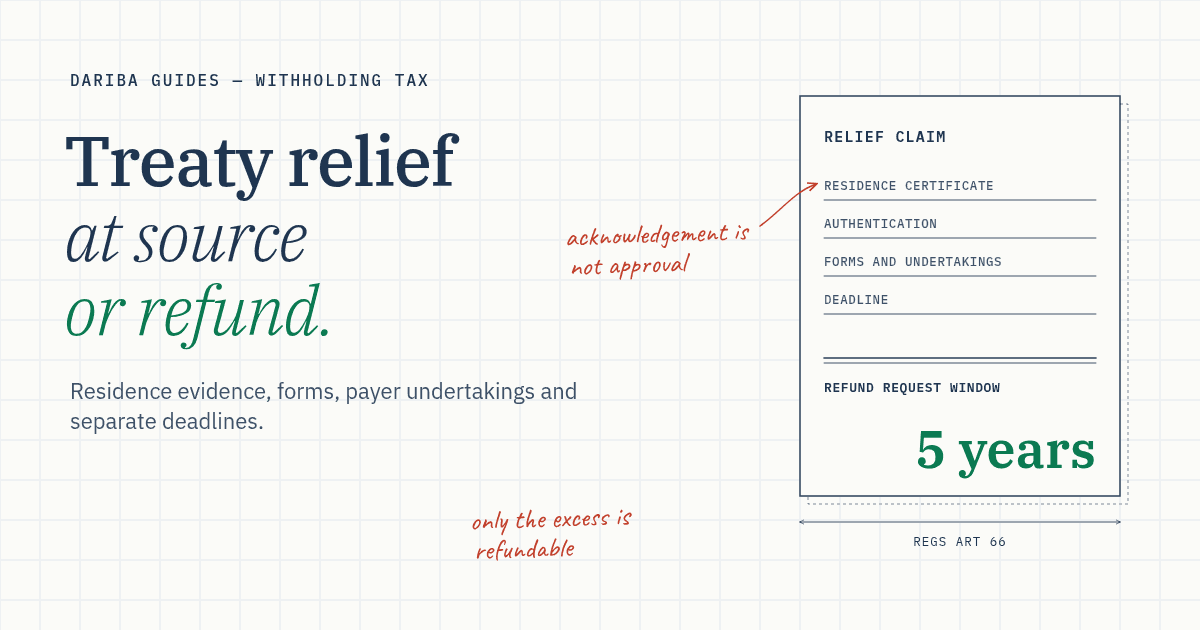
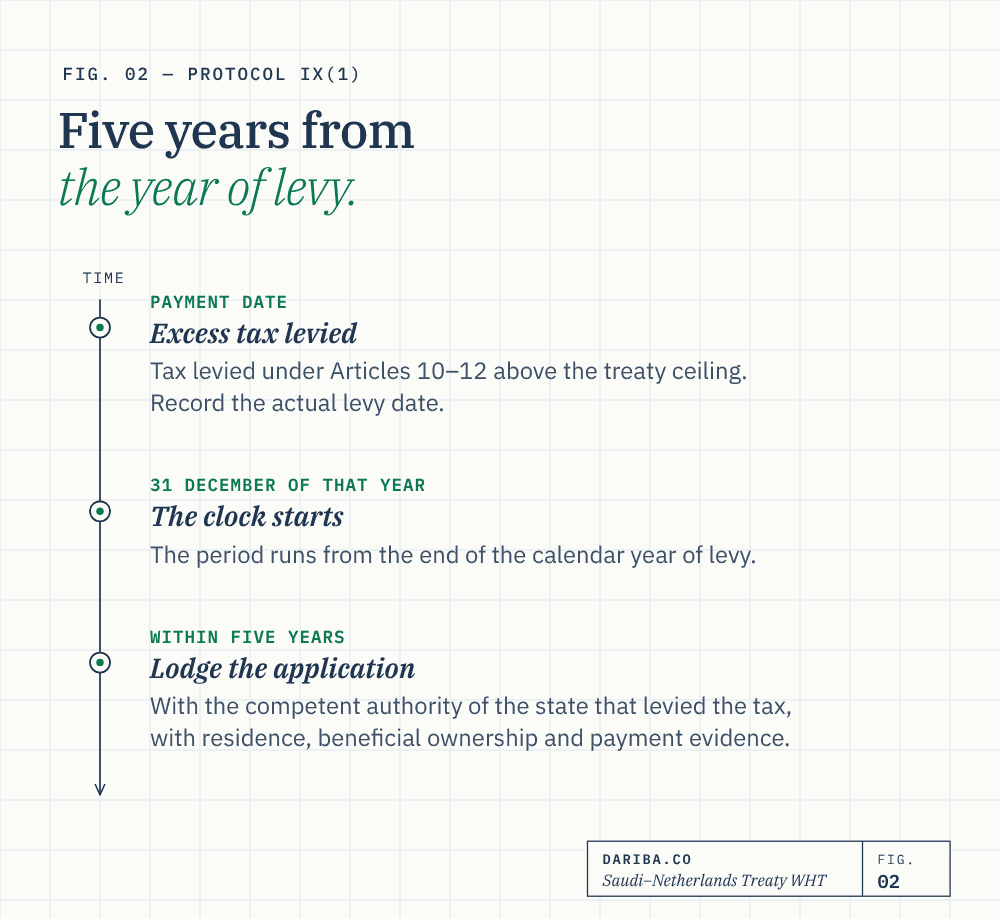
Protocol paragraph IX(1) requires an application for excess tax levied under Articles 10–12 to be lodged with the competent authority of the state that levied the tax within five years after the end of the calendar year of levy. Section 4 of ZATCA’s Tax Circular on Implementation of Withholding Tax Under the Double Taxation Agreement explains the evidence and procedure for relief at source or refund. Record the actual levy date and keep the residence and beneficial ownership evidence, the payment and remittance records, and a calculation by income category.
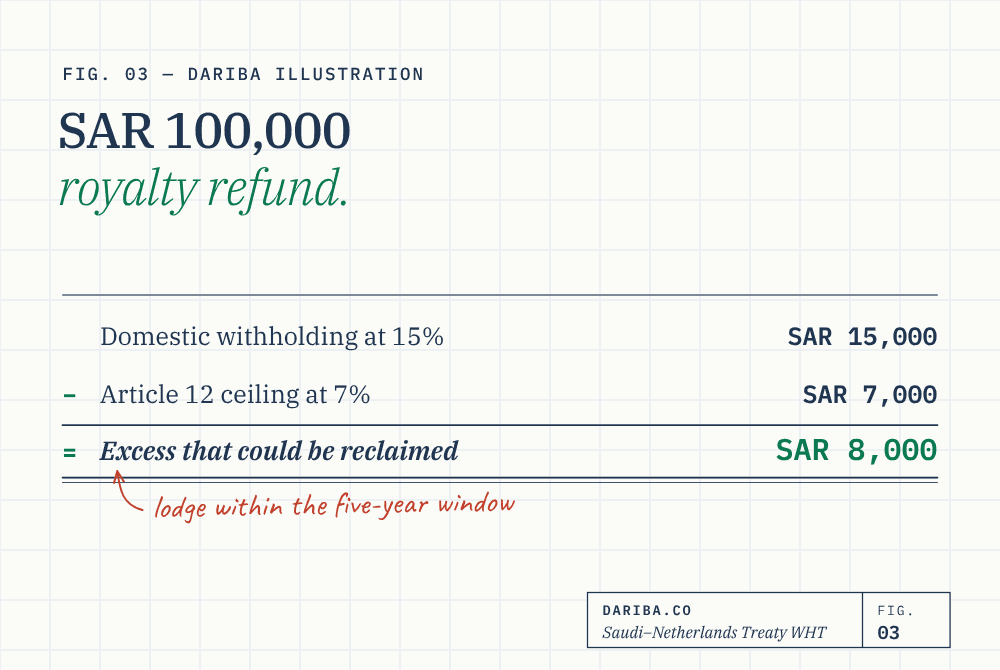
Dariba illustration. Assume a SAR 100,000 royalty subject to the ordinary 15% Saudi domestic royalty rate. If Article 12 applies, its 7% ceiling is SAR 7,000, compared with SAR 15,000 under domestic law. If the tax was levied in 2026, five years after the end of the year of levy is 31 December 2031 under Protocol paragraph IX(1). The SAR 8,000 difference assumes the full payment qualifies and the claim follows the applicable procedure.
Key takeaways
- The 5% dividend treaty ceiling requires a qualifying corporate beneficial owner directly holding at least 10% of the payer’s capital.
- Article 11(3) gives qualifying public-sector debt income exclusive residence-state taxation.
- Article 12 sets a 7% ceiling on qualifying royalties, including equipment-use royalties.
- Protocol paragraph IX(1) sets a five-year period measured from the end of the year in which the tax was levied.
Sources
- Saudi–Netherlands Convention for the Avoidance of Double Taxation and the Prevention of Tax Evasion with Respect to Taxes on Income, with ProtocolArticles 10–12 and 27 and Protocol IX(1).
- Dutch Treaty Database, Saudi–Netherlands income tax conventionTreaty 010307 records entry into force on 1 December 2010 and identifies the published corrections.
- Dutch Treaty Series 2019, No. 166English spacing corrections in Articles 10, 12 and 14.
- OECD Sixth Peer Review Report on Treaty Shopping, Saudi ArabiaThe Netherlands entry records the principal purpose test through the MLI.
- Saudi Arabia’s Deposited MLI Reservations and NotificationsCovered agreement 29 and Saudi Arabia’s Article 8 reservation.
- Saudi Income Tax Implementing RegulationsArticle 63 gives the domestic withholding rates.
- ZATCA Tax Circular on Implementation of Withholding Tax Under the Double Taxation AgreementSection 4 describes the relief-at-source and refund routes.