In brief
Understand Income Tax Law Article 59: permitted recipients, purpose limits, written consent and the relationship with lawful information requests.
Income Tax Law Article 59 protects taxpayer information obtained through official duties and identifies permitted disclosures. Its exceptions and recipient duties matter as much as the confidentiality principle. The provision protects information within a tax-administration framework; it does not prevent every lawful request for records.
Start with the duty imposed on ZATCA and its personnel
Article 59(a) requires ZATCA and all persons working for it to maintain the confidentiality of taxpayer information accessed by reason of their jobs. Identify the information, how it was obtained and the disclosure in question before drawing a conclusion about compliance.
Dariba recommendation: distinguish confidential tax information held by the Authority from a company’s own public disclosures, contractual data-sharing arrangements and other obligations. This guide analyses Article 59; a separate data-protection, employment or contractual issue requires its own legal basis rather than an assumption that this article resolves every form of business secrecy.
Check each permitted recipient and its statutory purpose
Article 59(a) permits disclosure only to the listed recipients under that paragraph and for the stated purposes:
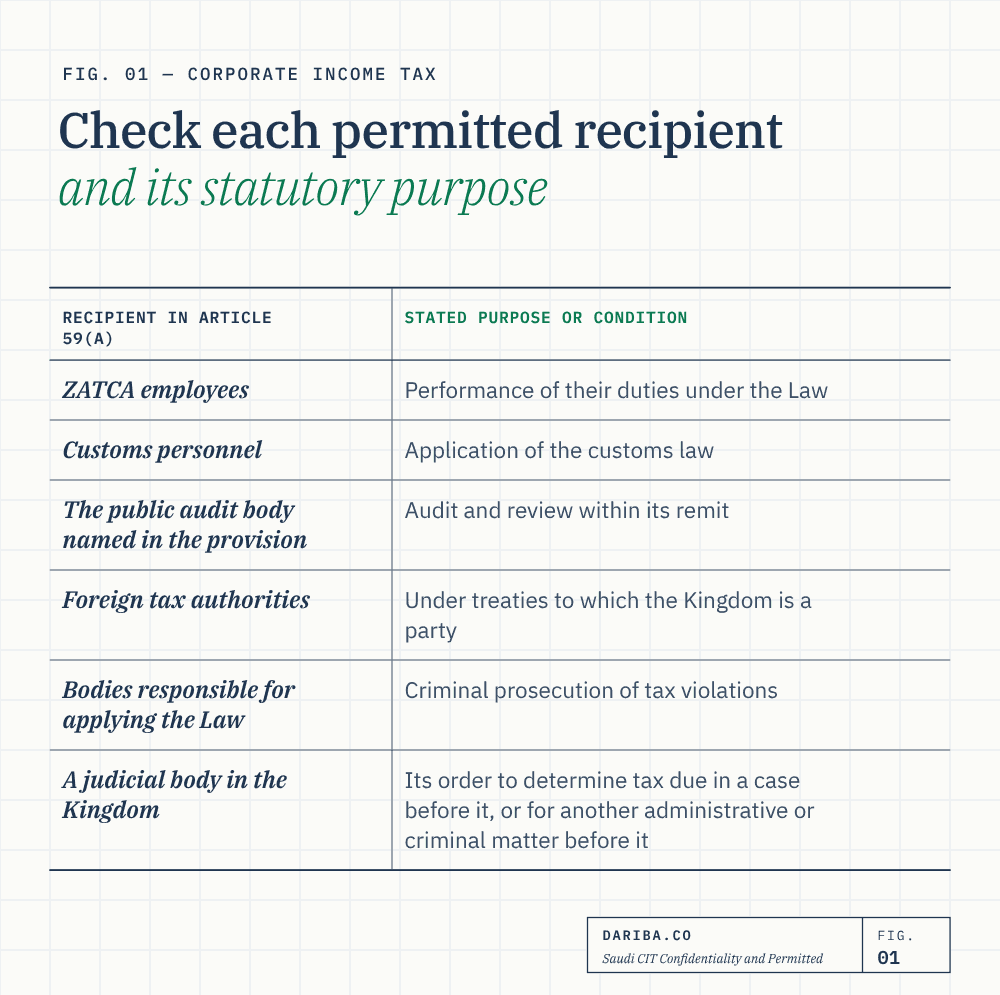
| Recipient in Article 59(a) | Stated purpose or condition |
|---|---|
| ZATCA employees | Performance of their duties under the Law |
| Customs personnel | Application of the customs law |
| The public audit body named in the provision | Audit and review within its remit |
| Foreign tax authorities | Under treaties to which the Kingdom is a party |
| Bodies responsible for applying the Law | Criminal prosecution of tax violations |
| A judicial body in the Kingdom | Its order to determine tax due in a case before it, or for another administrative or criminal matter before it |
A recipient’s title alone does not dispense with the purpose or condition. For example, the foreign-tax-authority exception is linked to the relevant treaty framework; it is not a general permission to send a taxpayer’s file to any overseas commercial counterparty.
Recipients under paragraph (a) must protect confidentiality
Article 59(b) requires a person receiving information under paragraph (a) to keep it confidential and use it only for the purpose for which it was requested. An authorised initial disclosure does not become unrestricted onward use.
Dariba illustration — application of the purpose condition: information supplied to an authorised recipient for the specified tax function should not be treated as available for an unrelated commercial use merely because that recipient lawfully received it. This illustrates the restriction; it is not a report of a ZATCA incident or an official worked example.
Dariba recommendation: where information is requested or shared through a permitted process, record the recipient, purpose, documents and legal basis. Access by the right organisation and use for the right purpose are separate elements of the review.
Written taxpayer consent provides a separate disclosure route
Article 59(c) allows information concerning a taxpayer to be disclosed to another person on that taxpayer’s written consent. A parent company, purchaser, adviser or financing bank should not assume that its commercial relationship is itself the taxpayer’s written consent under this paragraph.
Dariba recommendation: identify the consenting taxpayer and authorised signatory, intended recipient, information and permitted purpose. Use wording that reflects the intended disclosure and retain the consent with the request. These are practical controls; Article 59(c) does not prescribe a universal consent form or state that every consent automatically gives access to unrelated group companies’ records.
Confidentiality does not cancel lawful information obligations
Law Article 61 and Implementing Regulations Article 58 give ZATCA information powers that can reach persons who are not themselves ordinary CIT taxpayers, including information relevant to another taxpayer and applicable treaty obligations. Regulations Article 59 separately addresses field examination and document handling.
Dariba analysis: treat the duty to provide information and the Authority’s duty to protect it as connected obligations. A confidentiality clause between commercial parties does not, by itself, determine whether a statutory request must be answered. Verify the request’s authority and scope, provide the required material through the proper process and retain evidence of submission. The records and contract-disclosure guide explains the relevant information duties.
Use the actual regime and preserve an evidence trail
The CIT disclosure list is not identical to the Zakat confidentiality provisions. Use Article 59 for the CIT issue rather than copying an exception or control from another regime without checking its application.
If there is a concern about disclosure, preserve the communication, the material disclosed, the recipient and any stated legal basis or consent. Identify whether the issue concerns an initial disclosure, a recipient’s later use or a dispute about an information demand. Avoid further circulation of the sensitive material merely to demonstrate the concern.
Dariba recommendation: seek case-specific clarification through the appropriate channel where the facts or permitted purpose are unclear. Article 59 does not itself state a universal compensation amount, automatic assessment cancellation or a right to ignore an unrelated tax deadline. Any claim or procedural remedy needs its own applicable provisions and evidence.
Key takeaways
- The Authority and its personnel owe the statutory confidentiality duty.
- Each listed recipient has a stated purpose or condition.
- Recipients under paragraph (a) must preserve confidentiality.
- Written taxpayer consent is a separate disclosure route.
- Confidentiality and lawful information duties must be read together.
Sources
- Saudi Income Tax Law, current amended Arabic textArticles 34 and 63(b): estimated assessments; Article 59: confidentiality, permitted disclosures, recipient duties and written consent.
- Income Tax Implementing Regulations, current amended Arabic textArticle 16: estimated methods and conditions; Articles 58–59: information requests and examination procedures.
General information only. Actual supplies, facts, applicable periods and controlling Arabic legislation determine the result. Official examples are distinguished from Dariba analysis and original illustrations. Seek advice or clarification where the arrangement or source material leaves a specific issue unresolved.