In brief
CIT records must support the actual position. Article 56’s eight computer-account controls include Arabic reconciliations, quarterly outputs and system review; Law58(b)’s reasonable-cause condition is preserved alongside the separate contract and inspection duties.
Records support the legal conclusion, not just the totals
Income Tax Law Article 58 and Regulations Article 56 address records needed to determine Saudi tax. Article 57(3) of the Regulations places the burden of supporting return figures on the taxpayer. A financial statement can summarise a result without establishing the particular deduction, exemption or allocation behind it.
The useful file links the transaction, source document, accounting entry, tax adjustment and return. ZATCA’s May 2026 Guideline on the Conditions of Deductible Expenses, section 2.1, expressly recognises documents or other evidence allowing verification of an expense’s reality and eligibility. It does not reduce that requirement to possession of an invoice alone.
Establish the applicable Arabic and local-record requirements
Regulations Article 56 identifies the general journal, general ledger, inventory book and necessary accounting records, kept in Arabic in the Kingdom, together with supporting documents and explanations. It includes stated exceptions, including a non-resident without a Saudi PE and the specified Article 16 categories. Do not extend one exception to a taxpayer outside its conditions.
Outsourcing bookkeeping does not transfer the taxpayer’s responsibility. Dariba recommends agreeing access, language, document custody and handover before appointing an adviser. A complete overseas group accounting system does not independently demonstrate compliance with the branch’s particular local requirements.
Electronic records have particular safeguards
Regulations Article 56(2)(a)–(h) permits computerised accounts subject to eight stated controls. The provision addresses the records and system actually used; purchasing a particular accounting product does not, by itself, establish compliance.
| Paragraph | Control stated in the Regulations |
|---|---|
| (a) | A computer located in the Kingdom; for a taxpayer operating through a Saudi PE, an overseas central computer is permitted with a local terminal giving access to all relevant PE entries and data. |
| (b) | Arabic computerised book data reflecting the same information as the prescribed books. |
| (c) | Local retention of the original documents supporting all entries in the accounting books. |
| (d) | Final accounts and balance sheet extracted directly from the computer; where conventional accounts are combined with computer accounts for some items, include all reconciliation entries in Arabic. |
| (e) | Quarterly printed computer outputs containing all the information. |
| (f) | Documentation of the system for entering and directing accounting-entry information so it can be referred to when needed. |
| (g) | Necessary security and adequate controls preventing manipulation of information that can be examined and reviewed. |
| (h) | ZATCA’s right to conduct automated review of the systems and programs used by the taxpayer to prepare computerised accounts. |
Dariba recommendation: map each condition to actual evidence: system location and PE access, Arabic entries, original-document custody, extraction and reconciliation routines, quarterly outputs, process documentation and security. A read-only login alone does not demonstrate every condition, and a printed trial balance alone does not establish the entire control set.
Outsourced or shared systems need the same factual review. Identify who can supply the records, originals, reconciliations and system information when requested. The taxpayer’s responsibility in Article 56(1) remains relevant even where a professional provider maintains the books.
These provisions should not be compressed into either a universal ban on overseas group systems or permission for any remotely accessible system. The stated overseas-central-system case has PE and local-terminal conditions. This guide does not independently certify a software product, hosting architecture or a particular electronic-document arrangement.
Source: current Arabic Regulations, Article 56(1)–(2), p. 28.
Keep the evidence required by each tax position
An exempt dividend needs ownership and holding-period evidence; a bad debt needs the authorised write-off, accountant certificate and collection file; a branch recharge needs its actual cost and benefit support. The deductions guide explains these different tests. The same invoice template cannot establish all of them.
For withholding, Regulations Article 63(9)(c) specifically requires beneficiary, payment and withholding records for at least ten years after payment, extended where the matter remains under review until resolved. Do not assume this particular ten-year rule settles every retention period under other tax or commercial provisions. Preserve documents needed for an unresolved assessment or dispute.
Law Article 58(b) also permits ZATCA to reject an expense deduction where the taxpayer, without reasonable cause, cannot produce the expense document or other evidence supporting the claim. Keep that condition in the analysis rather than turning every unavailable invoice into an automatic identical outcome.
Dariba recommendation: document what is missing, why, the steps taken to obtain it and the other evidence supporting the transaction and deduction conditions. The reasonable-cause wording does not guarantee acceptance of an unsupported amount or remove the taxpayer’s substantiation burden. An accounting-system balance, supplier confirmation and contractual evidence perform different evidential functions.
Source: Income Tax Law, Article 58(a)–(b), p. 23, read with Regulations Article 57(3)‘s return-evidence requirement and the expense guideline’s section 2.1.
Contract disclosure can reach persons outside CIT filing
Law Article 61(c) and Regulations Article 58(2)(b) impose reporting concerning private-sector contracts. The Regulations cover natural and legal persons whether taxpayers or not, including the specified charitable, endowment and public bodies. A person’s Zakat status or absence of an annual CIT return does not by itself remove this separate obligation.
The exception is for contracts valued below SAR 100,000. Exactly SAR 100,000 is not below that boundary. Report the required basic information and amendments within no more than three months of signing. A supplier’s tax registration does not independently establish that the contracting party has discharged its own disclosure duty.
Signing, amendment and cessation have different triggers
Law Article 61(c) identifies the parties, addresses, subject, value, financial terms and implementation dates. Article 58(2)(b) also requires notification of cessation for any reason and the rights arising for each party within 30 days after cessation. Keep the actual contract and be ready to supply a copy if requested.
Dariba recommends linking procurement and project-closeout records to the tax calendar. An annual supplier list may miss a three-month disclosure deadline or the separate 30-day cessation notice. These are process implications of the provisions, not an assertion that every administrative change necessarily creates a new reportable contract.
Information requests and inspections need a controlled response
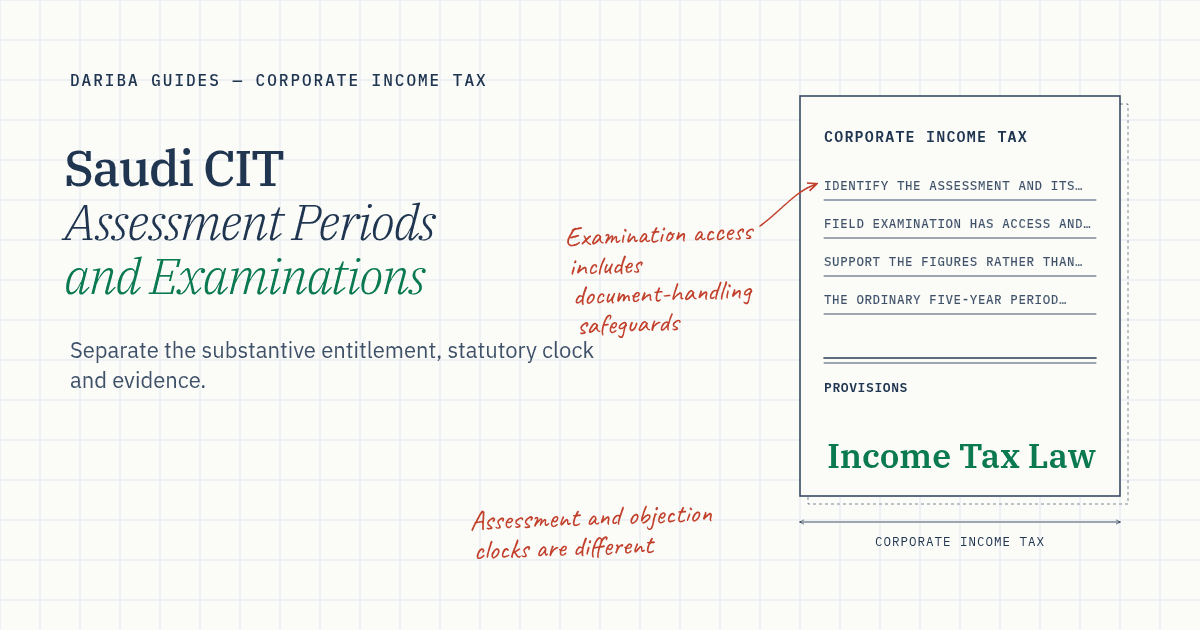
Law Article 61 and Regulations Articles 58–59 address information and inspections, including information about other taxpayers and applicable treaty obligations. Article 59 permits examination without advance notice under its conditions, while addressing the official examination letter, working hours and receipts for removed documents. Paragraph (6) requires documents to be returned within fifteen days after examination ends and permits retained copies where needed. The assessment and examination guide explains those safeguards and the distinct assessment periods. Record the request, scope, responsible owner and documents supplied.
Non-cooperation can have statutory consequences. Article 58(2)(b) also addresses joint liability in connection with failure to meet the contract-disclosure obligation. Do not assume that a filing error is merely a clerical matter, or that providing one part of a request resolves every outstanding item. Obtain clarification where the request or relevant data is genuinely uncertain.
Distinguish an information refusal from contract-reporting liability
Regulations Article 58(1) provides for a SAR 3,000 fine for failure to cooperate with the competent examination officer so that the examination and necessary work can be completed. It also permits recourse to the competent executive bodies to require the information. Where the taxpayer fails to provide the required information, the provision permits the Authority to complete its assessment or other procedures using the information available.
Those consequences are distinct from Article 58(2)(b)’s contract-disclosure responsibility. A person who fails to meet that reporting obligation is stated to be jointly responsible with the contracting party for the tax obligations resulting from the contract and any fines arising. An annual return, the supplier’s registration or paying an information-related fine does not by itself discharge that separate reporting duty.
Dariba analysis: identify the actual missing act and legal basis before describing a consequence. Do not treat SAR 3,000 as a universal maximum for every information failure or assume every contract omission has already established a particular quantified liability. Determine the relevant contract, tax, fines and conduct on the facts.
Document-handling and public-body duties keep their own conditions
Article 59(5) addresses compelled cooperation and provision of requested documents. Its document-preservation power also requires a reason to believe that the taxpayer is trying to conceal, destroy or damage the records. Non-cooperation and that stated document-risk condition should not be compressed into a rule that any unanswered question automatically permits every enforcement measure.
Keep the request, scope, response, missing items and reason for any genuine difficulty together. The separate Article 59(3) receipt requirement for records removed and paragraph 6’s return-of-documents rule remain relevant. A disagreement about the request should be recorded while the applicable response and challenge steps are protected.
Article 58(4) separately makes the specified senior finance, accounting and project officials in government bodies and public institutions responsible for supplying the required private-sector contract information within Article 58(2)(b)’s period. It refers to sanctions under the relevant systems. Do not automatically substitute the paragraph 1 fine for that separate wording.
Article 58(3) likewise refers failures involving information or forms for international agreements to its stated separate disclosure-penalty framework. That reference does not establish that an ordinary domestic information fine is the complete consequence for every treaty-reporting failure; identify the actual reporting obligation and applicable current instrument before quantifying an exposure.
Build a practical evidence register
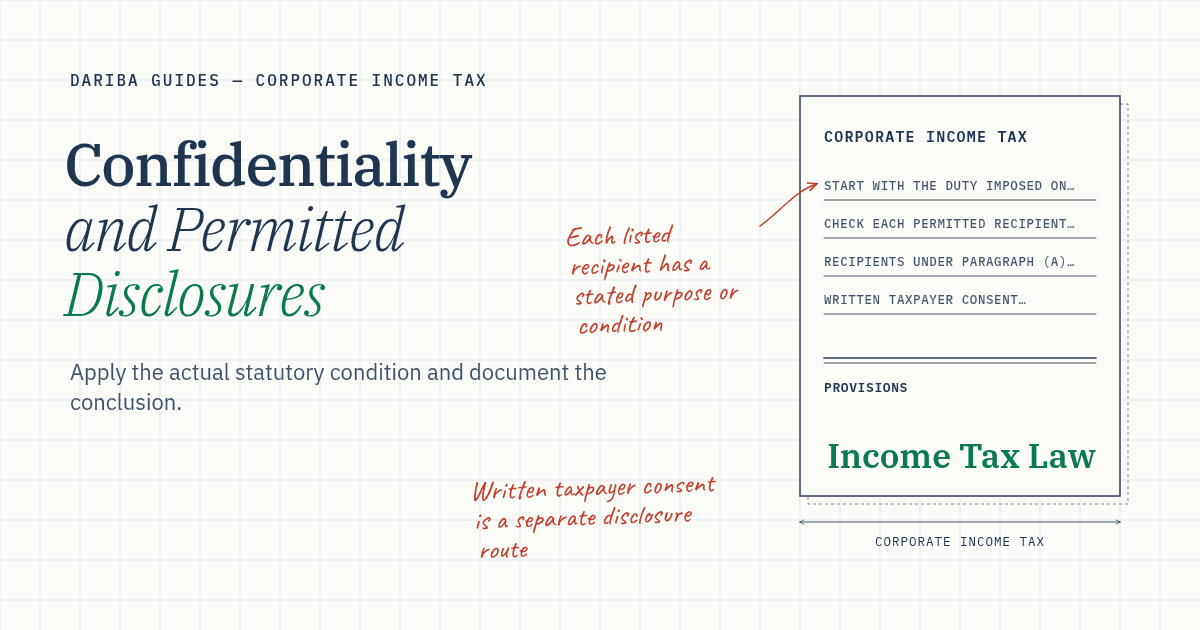
Maintain a register for tax positions, requests and reportable contracts, with the relevant rule, trigger date, required evidence, responsible person, submission and acknowledgement. Reconcile it to finance, procurement and project systems. Preserve confidentiality and authorised access while meeting lawful information obligations. The CIT confidentiality guide identifies Article 59 of the Law’s permitted recipients, purpose limits and written-consent route; that Law provision is distinct from Regulations Article 59 on examinations.
This gives the finance team a clear account of what was concluded and what was actually delivered. The return guide explains the annual submission process. Neither that annual filing nor an external audit substitutes for the distinct record, information and contract obligations described here; unusual privilege, data and procedural issues require their own legal review.
Key takeaways
- Records must support the actual tax position as well as its total.
- Arabic and local-record rules retain their specified exceptions.
- Electronic records have particular access and control requirements.
- The ten-year withholding rule does not settle every retention period.
- Contract disclosure can apply to persons outside ordinary CIT filing.
- Exactly SAR 100,000 is outside the below-threshold contract exception.
- The Article 58(1) information fine and contract-reporting joint responsibility are different consequences.
- Document-preservation powers and public-body reporting duties retain their stated conditions.
- Article56(2) sets eight computer-account controls, including Arabic mixed-system reconciliations and ZATCA system-review access.
- Law58(b)’s expense-evidence rule includes a without-reasonable-cause condition; it does not guarantee unsupported deductions.
Sources
- Saudi Income Tax Law, current amended Arabic textArticles 58, 60-62 and 78: records, returns, information, examination, assessment and the distinct accountant-liability conditions. Article 58(b),p.23:withoutreasonablecauseexpense-documentcondition.
- Saudi Income Tax Implementing Regulations, current amended Arabic textArticles 56-59, especially 57(7), 58(1)-(4) and 59(5): responsible-person notification/returns and conditional joint liability; information, contract reporting and examination safeguards. Article 56(2)(a)–(h),p.28:alleightelectroniccontrols.
- ZATCA Simplified Guideline for Income Tax, second version May 2026Sections 5-6: ordinary filing/payment and electronic submission. The simplified process does not replace the detailed liquidation and information provisions.
- ZATCA Guideline on the Conditions of Deductible Expenses, second version May 2026Section 2.1: documents or other evidence supporting the reality and eligibility of an expense. An invoice alone does not decide every deduction.
General information only. Actual supplies, facts, applicable periods and controlling Arabic legislation determine the result. Official examples are distinguished from Dariba analysis and original illustrations. Seek advice or clarification where the arrangement or source material leaves a specific issue unresolved.