In brief
Apply Saudi branch income attribution, head-office expense restrictions, profit-transfer withholding and the actual filing and advance-payment conditions.
A branch has its own Saudi income-tax computation
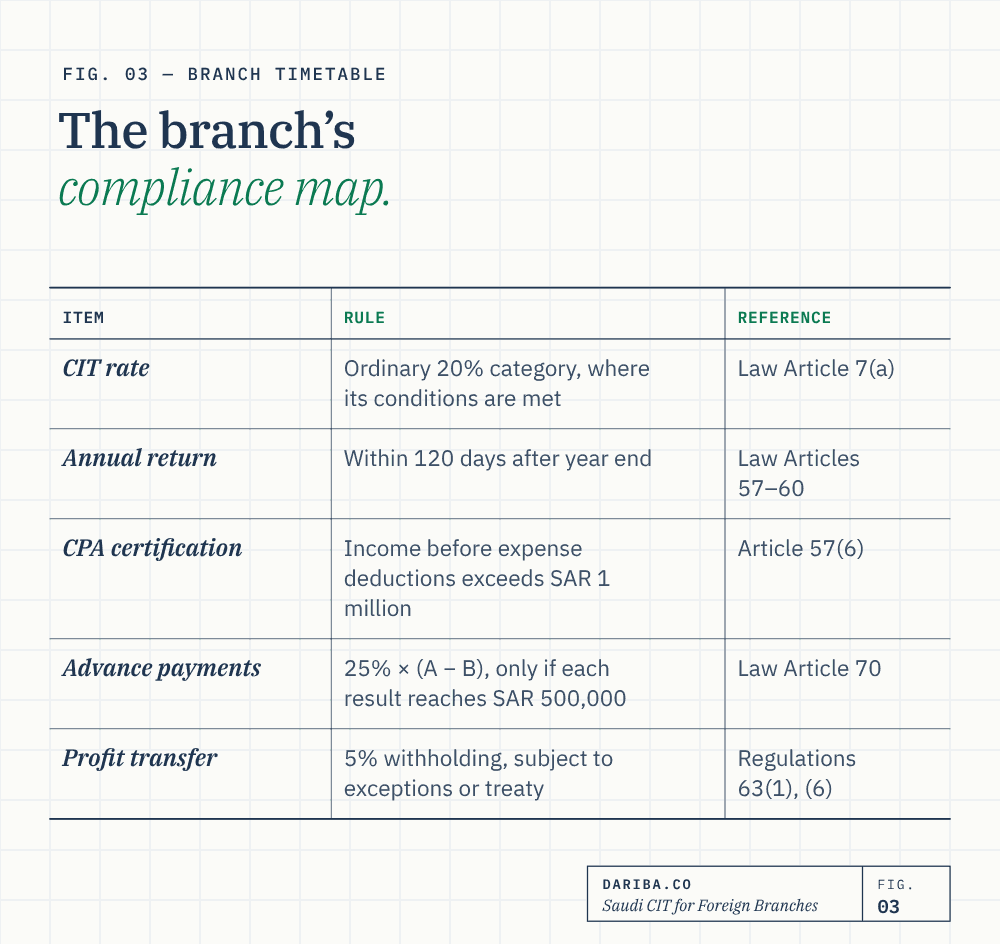
A licensed Saudi branch of a non-resident company is expressly within the PE cases in Law Article 4(b). Its tax base follows Article 6(c): taxable income arising from, or connected with, the PE activity after allowable deductions. The ordinary 20% category under Article 7(a) applies where its conditions are met; specific sector and treaty provisions need separate consideration.
Head-office financial statements do not replace the Saudi computation. Establish the actual branch income, deductions, asset pools, financing and withholding. The commercial comparison with a subsidiary must use those facts rather than a generic assumption that either legal form always produces less tax.
Review connected income and treaty attribution
Law Article 5(a)(10) addresses specified same or similar Saudi sales, services and activities in the PE context. An overseas invoice or payment account does not, by itself, establish that the income is outside the Saudi base. Read this with Article 6(c) and any applicable treaty’s actual attribution rules.
Dariba recommends a revenue map identifying the contract, performing personnel, location, branch role and economic connection. This supports both amounts included and a properly evidenced exclusion. It does not mean that all worldwide group revenue is automatically taxable in the branch or that a foreign signature settles attribution.
Qualifying direct costs differ from estimated head-office overhead
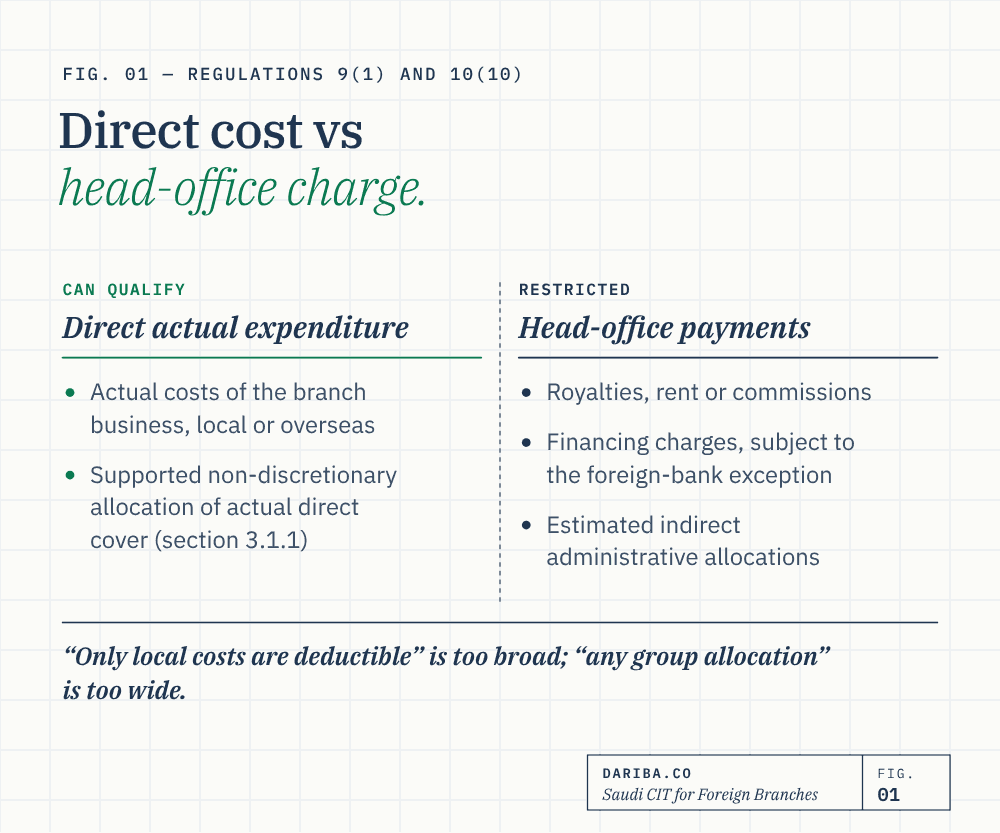
Regulations Articles 9(1) and 10(10) and ZATCA’s May 2026 Guideline on the Conditions of Deductible Expenses, section 3.1, distinguish qualifying direct actual expenditure from restricted head-office payments. The restrictions include royalties, rent or commissions, financing charges subject to the foreign-bank exception, and estimated indirect administrative allocations.
Section 3.1.1’s insurance illustration accepts a supported non-discretionary allocation of actual direct cover on its stated facts. It does not approve every formula-based allocation or group mark-up. The head-office guide explains that evidence and the guideline’s numbered branch examples. A blanket statement that only costs incurred locally can be deducted is too broad.
Banking and other sectors require their own rules
Section 3.1.3, Example 2, distinguishes a foreign-bank branch’s qualifying head-office financing from its estimated group overhead. The exception does not make every bank expense deductible. Section 3.2 also addresses bank financing and interbank transactions, retaining the actual conditions rather than a general exemption for all cross-border banking payments.
Other sectors can have their own computation rules. Regulations Article 15 addresses insurance, while Law Article 34 and Regulations Article 16 address specified estimated assessments. In the stated foreign transport cases, 5% of the relevant gross income is the tax base; it is not a universal 5% tax rate or a withholding category. Article 16(1) also defines the relevant journey income by reference to journeys starting in the Kingdom through the agreed final destination, including intermediate stops, regardless of where travel documents are issued or sold.
The estimated-assessment guide distinguishes transport, compliance-failure cases, activity profit minimums, unpriced ancillary work and disposal valuations. Confirm why the route applies before selecting a percentage. This ordinary branch guide does not certify every transport, insurance, natural-resource or treaty computation.
Profit transfers can attract withholding
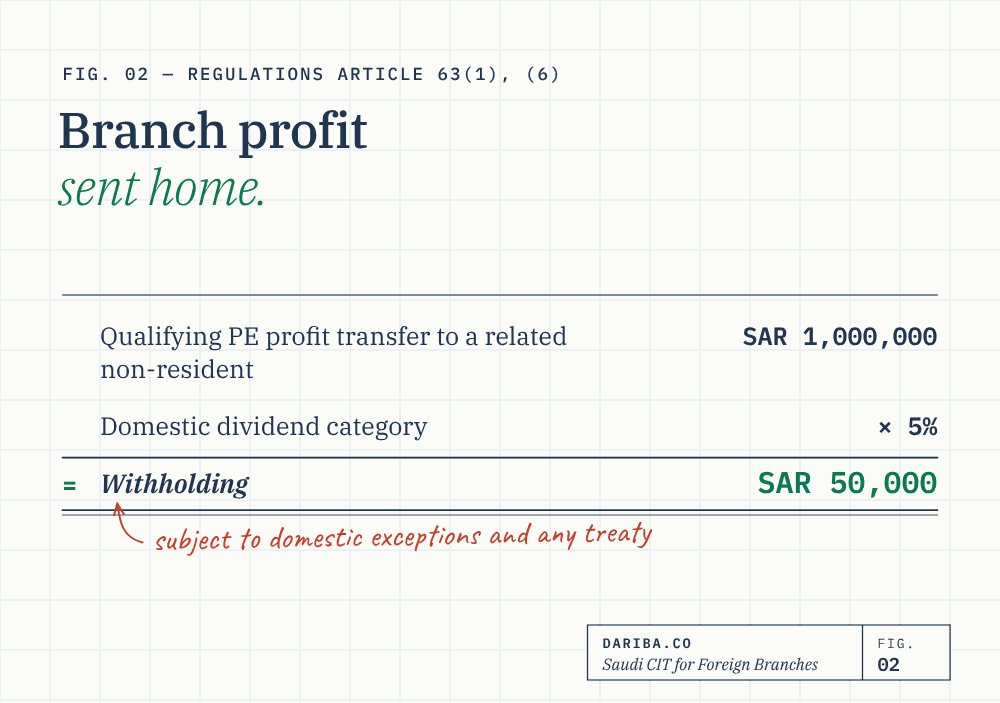
Regulations Article 63(6) includes profits transferred from a PE to related parties in the dividend definition. Article 63(1) provides the relevant domestic 5% category, subject to specific exceptions and any actual treaty. It is therefore unsafe to describe all branch profit repatriation as free of withholding.
Dariba illustration: assume SAR 1 million is a qualifying PE profit transfer to a non-resident related party and no domestic exception or treaty relief changes the result. Domestic withholding at 5% would be SAR 50,000. This is an original illustration, not a conclusion that every cash movement is profit. A capital repayment, reimbursement or loan settlement requires its actual character to be established.
Expense payments and withholding credits are separate
Law Article 68 and Regulations Article 63 govern relevant non-resident payments independently from the expense deduction. A restricted head-office charge may still require withholding. The guideline, section 3.1.2, explains the distinct current-year credit treatment for qualifying non-deductible head-office payments and its limitations, including the treatment of transfer-pricing adjustments.
Use separate schedules for the expense, withholding paid, legal credit basis and annual tax liability. Paying withholding does not validate the expense or make every adjusted amount creditable. For a proposed restructuring, compare the complete tax and cash flows rather than assuming a subsidiary deduction or a branch credit without the underlying conditions.
The branch needs a complete compliance timetable
Registration, Arabic records, the annual return and payment must be addressed under Law Articles 57–60 and 69 and Regulations Articles 55–57. The ordinary annual period is 120 days after year end. CPA certification under Article 57(6) uses the relevant income before expense deductions exceeding SAR 1 million, rather than net profit or exact equality.
Advance payments under Law Article 70 require the statutory formula and SAR 500,000 per-instalment threshold; they are not unconditional payments for every profitable branch. The advance-payment guide explains reductions. Cessation and liquidation require their own notices, returns and settlement, so closing the commercial file does not automatically close the tax account.
Compare structures using the actual arrangements
Model attributable income, genuine local and overseas costs, restricted head-office charges, financing, asset depreciation, losses, distributions, withholding and administration. Use the applicable treaty and period. The PE guide explains exposure before branch registration, while the deductions guide provides the expense framework.
The advisory conclusion should explain what drives the difference in the particular business. A numerical comparison that assumes every parent charge is deductible for a subsidiary and every branch distribution is exempt can materially misstate the decision. Document the uncertain items and obtain specific clarification before presenting a legal-form choice as a settled tax saving.
Key takeaways
- A Saudi branch requires its own supported income-tax computation.
- Connected income is not determined solely by invoicing location.
- Direct actual head-office costs differ from restricted allocations.
- Banking and other sectors require their own provisions.
- PE profit transfers to related parties can attract withholding.
- Filing, certification and advance-payment conditions must be preserved.
Sources
- Saudi Income Tax Law, current amended Arabic textScope, branch base, Article 34 transport estimation, filing, withholding and advance-payment provisions; actual conditions and periods govern.
- Income Tax Implementing Regulations, current amended Arabic textArticles 9–10, 16 and 55–68: branch costs, specified estimated assessments and compliance. Distinguish base percentages from tax and withholding rates.
- ZATCA Guideline on the Conditions of Deductible Expenses, second version May 2026Sections 3.1–3.2: direct costs, restricted head-office allocations and the stated banking examples; earlier reviewed analysis retained.
General information only. Actual supplies, facts, applicable periods and controlling Arabic legislation determine the result. Official examples are distinguished from Dariba analysis and original illustrations. Seek advice or clarification where the arrangement or source material leaves a specific issue unresolved.