In brief
Article 7(c) assigns 50%, 65%, 75% or 85% according to qualifying capital investment. Gas bases remain separate. M/261 extends specified downstream treatment to 2030 and states backdated collection if separation fails.
Oil and hydrocarbon production has a specific Saudi income-tax route and a rate schedule tied to capital investment in the Kingdom. The percentage applies to the relevant taxable base. Capital determines the applicable band; it is not itself the amount being taxed.
Three distinctions drive the computation: production versus other activities, qualifying gross capital investment versus accounting net assets, and the production base versus separate gas or qualifying downstream income. The downstream position also requires the later 2025 decree, rather than stopping at the older five-year wording retained in the law compilation.
Identify the producer and the relevant activity
Income Tax Law Article 2(f) covers a person working in oil and hydrocarbon production. This is a specific activity route. It should not be reduced to the ordinary description of income tax on a resident company’s foreign-owned interests.
The taxpayer’s own operations matter. Supplying equipment or professional services to a producer does not, solely because of the customer’s industry, establish that the supplier is itself a producer subject to Article 7(c). Establish the actual activity and applicable taxpayer route first. The general CIT guide explains the ordinary routes.
The direct or indirect ownership of interests in resident capital companies by oil and hydrocarbon producers is a different Article 2(a) question, with its stated listed-company exception. Do not apply the producer’s operating rate automatically to every investee. See listed shares and producer ownership.
Source: current Arabic Income Tax Law, Article 2, pp. 4–5.
Establish the production tax base separately
Article 6(f) defines the oil and hydrocarbon production base by reference to the relevant taxable income less permitted expenses. It excludes the natural-gas investment tax base. Article 6(g) separately defines the gas base and keeps it independent of the person’s other activities.
Accounting profit, gross revenue and taxable income are therefore different starting points. The applicable deduction, capitalisation, depreciation, loss and adjustment rules must be applied before a rate produces a defensible tax amount. A high production rate does not make an unsupported expense deductible.
Dariba recommendation: maintain a reconciliation from the operation’s accounts to the statutory base, with direct and shared costs explained. This article addresses the rate schedule and the selected downstream amendment; it does not approve a particular concession, asset valuation, production licence or allocation method.
Use the four capital-investment bands precisely
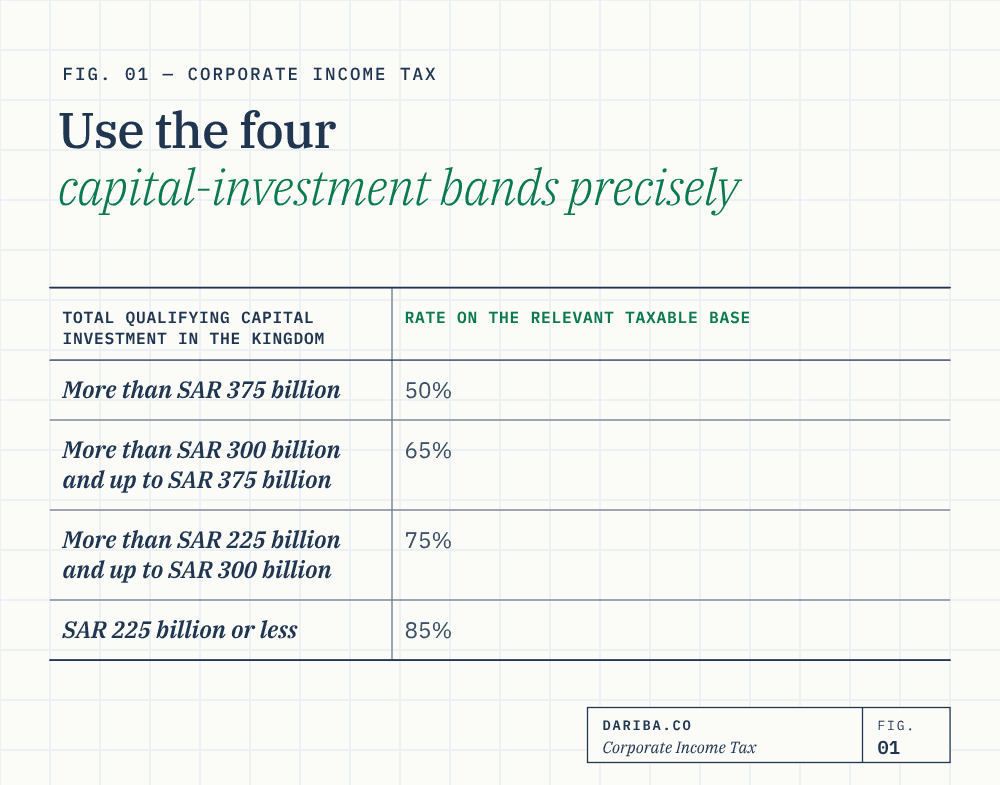
Article 7(c) specifies the following rates for the relevant production taxpayer and base:
| Total qualifying capital investment in the Kingdom | Rate on the relevant taxable base |
|---|---|
| More than SAR 375 billion | 50% |
| More than SAR 300 billion and up to SAR 375 billion | 65% |
| More than SAR 225 billion and up to SAR 300 billion | 75% |
| SAR 225 billion or less | 85% |
The boundaries are deliberate. Exactly SAR 225 billion falls in the 85% band; exactly SAR 300 billion in the 75% band; and exactly SAR 375 billion in the 65% band. The 50% band requires investment above SAR 375 billion.
These are rates selected by the taxpayer’s stated capital-investment category, not marginal slices of capital taxed successively at different rates. Once the relevant category and base are established, the applicable percentage is applied to that base. Do not calculate tax by applying the percentages to the capital amounts in the first column.
The compilation’s amendment note attributes this schedule to Royal Decree M/131 dated 29/12/1438 AH, with stated application from 1 January 2017. A historic-year conclusion requires its actual applicable text and effective period checked; this guide does not reconstruct every earlier assessment.
Source: Income Tax Law, Article 7(c), p. 8.
Measure cumulative gross investment before depreciation
For this paragraph, Article 7(c) defines total capital investment as the cumulative gross value of fixed assets, including property, equipment, machinery, fixtures and other such assets, together with intangible assets. It expressly includes oil and hydrocarbon exploration, prospecting and development costs, before deducting depreciation and amortisation.
Paid-up share capital, shareholder equity, market capitalisation and depreciated net book value are not interchangeable with that definition. Equally, the statutory reference to investment in the Kingdom should not be replaced by an unexamined worldwide group asset total.
Dariba analysis: prepare an asset and cost bridge supporting the particular statutory measure. Establish ownership, location, qualifying classification, cumulative gross amounts and the effect of actual changes. The wording does not, by itself, resolve every acquisition, disposal, restructuring, concession or valuation issue; those facts and any applicable sector instruments need their own analysis.
Dariba illustration: net book value selects the wrong band
Assume a qualifying producer has SAR 320 billion of capital investment measured under Article 7(c). Assume accumulated depreciation and amortisation of SAR 110 billion produce an accounting net book value of SAR 210 billion. Its correctly established production tax base is SAR 10 billion, with no other adjustments in this illustration.
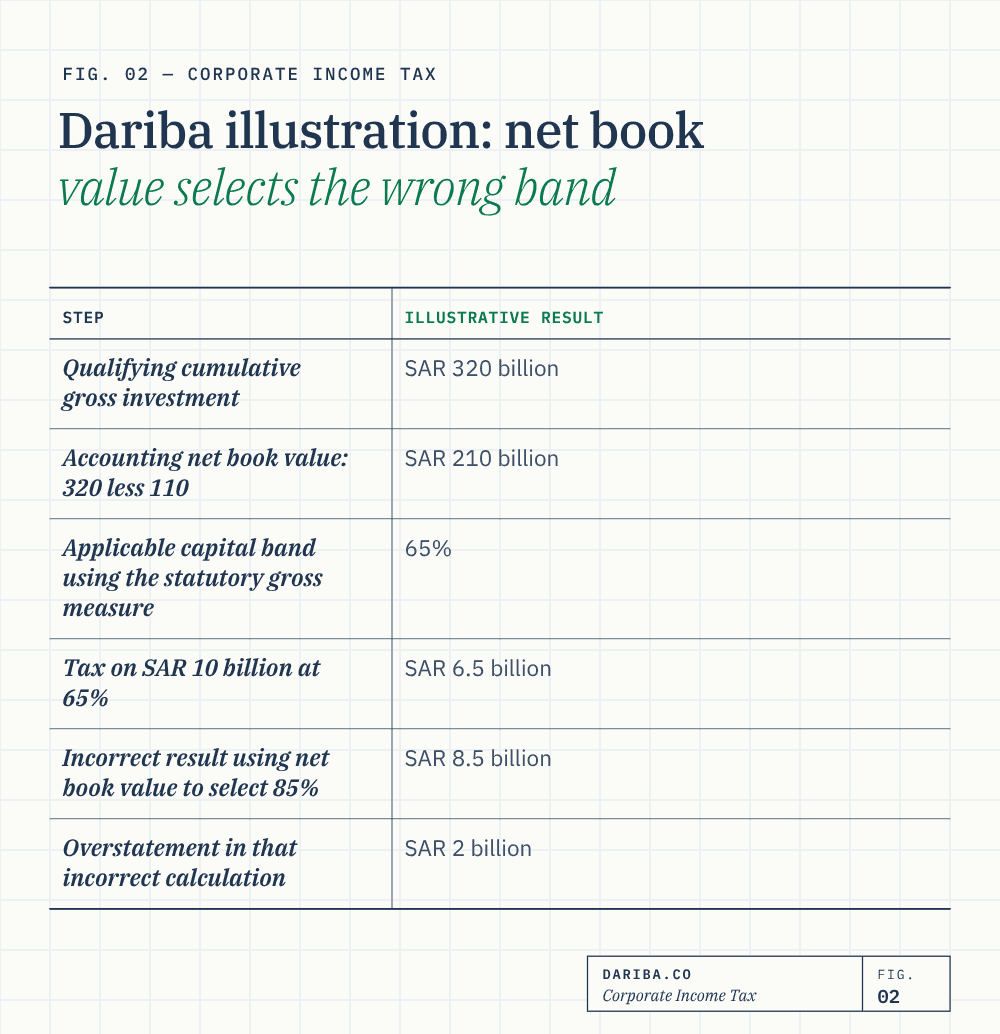
| Step | Illustrative result |
|---|---|
| Qualifying cumulative gross investment | SAR 320 billion |
| Accounting net book value: 320 less 110 | SAR 210 billion |
| Applicable capital band using the statutory gross measure | 65% |
| Tax on SAR 10 billion at 65% | SAR 6.5 billion |
| Incorrect result using net book value to select 85% | SAR 8.5 billion |
| Overstatement in that incorrect calculation | SAR 2 billion |
These are Dariba’s original assumptions and arithmetic, not a ZATCA worked example or an actual producer’s figures. The illustration isolates the gross-versus-net measurement error. It does not establish that an actual asset schedule qualifies, that SAR 10 billion is the correct taxable base, or that an entity’s reported capital investment can be accepted without evidence.
Add separately computed gas and production tax
Article 7(b) states 20% for the natural-gas investment tax base. Article 7(e) requires a person operating both production and natural-gas investment to pay the sum of the taxes computed under paragraphs (b) and (c). A single blended rate applied to combined accounting profit would bypass that separation.
Regulations Article 57(8) requires one return covering the two bases, with details of each base and its tax. The combined filing does not merge the computations. The natural-gas guide addresses the activity definitions, incidental income, relevant cost separation, quantities and transfer-value requirements.
Article 7(d) separately refers withholding rates to Article 68. A payment’s withholding classification is not settled simply by inserting the producer’s annual income-tax percentage into a payment calculation.
Read the 2025 downstream extension alongside the compilation
The older note under Article 7(b) reproduces the five-year downstream arrangement starting on 1 January 2020 under Royal Decree M/13 dated 18/1/1441 AH. That retained note is not the end of the amendment review.
Royal Decree M/261 dated 27/11/1446 AH, published with Council of Ministers Decision 826 dated 22/11/1446 AH in Umm Al-Qura, issue 5091 of 4 June 2025, p. 1, replaces clauses First and Second of M/13. The operative replacement provides:
| Replaced clause | Effect stated in the 2025 decree |
|---|---|
| First | The Article 7(b) rate applies to the downstream tax base arising from the downstream work of persons subject under Article 2(f), until 31 December 2030. |
| Second | If a person covered by clause First fails to separate downstream work from oil and hydrocarbon production by 31 December 2030, tax is collected under Article 7(c) from 1 January 2020. |
The Article 7(b) rate is 20% under the amended Law. The extension is therefore relevant to the specified downstream base and persons; it does not reduce all production income to 20% or create a blanket concession for every downstream contractor. The recitals describe separation through an independent legal entity; the operative clauses set the stated rate period and consequence of failing to separate.
Dariba analysis: the backdated collection consequence is explicit in the replacement clause Second. The separation deadline should be part of the tax forecast and restructuring evidence, rather than treated as a routine filing date. Identify the actual covered person, downstream activities, entity separation and applicable later instruments before reaching an entitlement conclusion. No automatic extension beyond 31 December 2030 is asserted.
Source: official Gazette issue 5091, M/261 and Decision 826, p. 1. This later original governs the point described here; an older compilation note should not be used to say the arrangement necessarily ended after 2024. Full historical assessments and any subsequent instruments remain separate questions.
Retain the evidence that supports the rate
The useful file connects the taxpayer’s legal and operating identity, the relevant activity and period, the qualifying gross capital schedule, the base reconciliation and the rate calculation. Where applicable, retain separate gas schedules and the downstream separation analysis with the actual legal-entity documents.
Revisit the position when investment, asset ownership, operations or entity structure changes. The practical conclusion is a supported rate on a supported base, with the precise threshold, deadline and unresolved classification questions recorded. A headline percentage alone is insufficient for an investment model or tax provision.
Key takeaways
- Oil and hydrocarbon production has its own activity-based income-tax route.
- The investment thresholds select a rate on the relevant taxable base; capital is not itself the tax base.
- Exactly SAR225billion, SAR300billion and SAR375billion select85%,75% and65%, respectively.
- The statutory investment measure is cumulative gross qualifying assets and costs before depreciation and amortisation.
- Gas and production tax are computed separately even where one return covers both.
- M/261 extends specified downstream Article7(b) treatment to31December2030; failure to separate has an express Article7(c) collection consequence from1January2020.
Sources
- Saudi Income Tax Law, amended Arabic compilationArticles 2(f),6(f)–(g),7(c) capital bands and cumulative gross investment definition;7(b)/(d)/(e) gas, withholding and sum of separate taxes. The retained historical downstream note is supplemented by M/261.
- Income Tax Implementing Regulations, amended Arabic textArticle 57(8),p.30: one return with separate oil/hydrocarbon and natural-gas base/tax details. Actual gas costs, sector allocation and other requirements remain separate.
- Umm Al-Qura issue5091: Royal DecreeM/261 and Council of Ministers Decision 8264June2025,p.1. M/261 dated27/11/1446 replaces M/13 First–Second: downstream Article 7(b) rate through31December2030; failure to separate by that date triggers Article 7(c) collection from1January2020. Operative original and recitals distinguished.
General information only. Actual supplies, facts, applicable periods and controlling Arabic legislation determine the result. Official examples are distinguished from Dariba analysis and original illustrations. Seek advice or clarification where the arrangement or source material leaves a specific issue unresolved.