In brief
M/70’s original establishes the amended gas framework and two-way operating-loss separation. Its commencement clause is compared with Decision 2568’s distinct tax-year wording; actual sector and transitional facts remain relevant.
Natural-gas activity has an express route into Saudi income tax. It should not be treated simply as an ordinary company’s foreign-owned share, or confused with every oil-related contract. The current amended Income Tax Law identifies the activity, requires a separate gas tax base and states a 20% rate for that base. The former gas-investment regime and its return-based rate calculations must be kept in their historical context.
Identify the actual activity and taxpayer
Law Article 2(e) expressly covers a person working in natural-gas investment. Regulations Article 1(3) applies income tax to natural or legal persons, Saudi or non-Saudi, working in natural-gas investment and transportation. ZATCA’s Simplified Guideline for Income Tax, second version May 2026, sections 1–2, includes these activities in its scope overview.
Dariba analysis: ownership nationality alone is insufficient. First establish what the person actually does and the statutory activity under which it falls. A Saudi-owned gas operator should not assume that ordinary shareholder-based descriptions settle its position, while a contractor supplying a gas project should not assume that its customer’s sector automatically determines its own tax classification.
Retain the actual licence, project or production agreement, operating functions, assets, contractual obligations and income streams. The tax analysis needs to identify the relevant operation, rather than stop at an energy-sector registration code or the description on an invoice.
Preserve the statutory gas and transportation boundaries
Article 1 defines natural-gas investment by reference to specified exploration and production of non-associated gas, including condensates, and the stated gathering, purification, processing, fractionation and transportation of associated and non-associated gas and related liquids, condensates and components.
Its transportation definition addresses movements between the relevant purification, processing or fractionation facilities and consumer facilities, and transport of condensates and liquids. It expressly excludes local distribution networks and pipelines established by a non-gas producer after official sale points. Amended Regulations Article 26 preserves this boundary.
This exclusion is not a general tax exemption for local distributors. It means their actual income-tax or Zakat route must be assessed under the relevant provisions instead of automatically assigning the transportation definition to every downstream network. Technical references in the sector provisions also need the applicable current energy instruments and actual licence considered.
Dariba recommendation: map the physical operation, the official sale point and who owns or operates each segment. A single project can contain production, processing, transport, local distribution and independent services with different legal facts.
Apply the current rate to the relevant gas base
The current amended Article 7(b) states a 20% rate for the taxpayer’s natural-gas investment tax base. Its amendment note identifies Royal Decree M/70 and the stated2018 application. This differs from original-law reproductions showing a 30% gas rate and from the deleted legacy internal-rate-of-return regime.
The rate applies to the correctly established taxable base, not to all gross cash receipts. Law Article 6(g) defines the gas base as relevant taxable income less permitted expenses and makes it separate from the person’s other activities. Article 6(f) likewise excludes that separate gas base from the oil and hydrocarbon production base.
Dariba original illustration: assume a correctly classified gas operation has SAR 12 million of relevant taxable income before permitted expense deductions and SAR 8 million of fully allowable directly attributable expenses. With no other adjustments, relief or shared costs in the illustration, the gas base is SAR 4 million and tax at 20% is SAR 800,000. These are Dariba assumptions, not an official ZATCA worked example or approval of the expense items.
Do not extend the ordinary gas rate to all oil-production income or assume that the same rate settles a separate downstream-transition arrangement. Article 7(c) and its capital-investment conditions govern the specified oil and hydrocarbon production category. Royal Decree M/261 of 2025 extends the specified downstream arrangement to 31 December 2030, with an express consequence if the required separation is not completed. That arrangement has a distinct scope, explained below.
Check the later downstream extension separately
Royal Decree M/261 dated 27/11/1446 AH replaces clauses First and Second of M/13. Its replacement First applies the Article 7(b) rate to the downstream tax base from downstream work performed by persons covered by Law Article 2(f), until 31 December 2030. This is a specific downstream rule for the stated persons, not a reclassification of all production income or every contractor’s activity as gas investment.
Replacement Second provides that, if the covered person fails to separate downstream work from oil and hydrocarbon production by 31 December 2030, tax is collected under Article 7(c) from 1 January 2020. The date and backdated collection consequence are express. The recitals describe separation through an independent legal entity; the operative clauses state the replacement rate period and failure consequence.
Read M/261 and Decision 826 in official Gazette issue 5091, 4 June 2025, p. 1. The older five-year wording starting in 2020 remains visible in the law compilation’s note, but it does not incorporate this later extension. Actual covered activities, entity separation, applicable period and any subsequent instruments still require examination.
The oil-production and downstream guide explains the four capital bands, gross investment measure and the amended downstream clauses. Keep this arrangement distinct from the ordinary 20% natural-gas base described above.
Classify incidental and non-operating gas-linked income
Amended Regulations Article 28 addresses income from gas sales, exchanges or transfers, related products and the specified gas activities. It also includes incidental or non-operating income connected with the principal activity, including income from third-party use of excess capacity in a relevant facility.
Consequently, a receipt should not be removed from the gas schedule merely because the ledger labels it miscellaneous income, capacity rental or a secondary service. Establish whether the actual receipt is connected with the defined principal activity. Conversely, this provision does not establish that every unrelated investment receipt of a gas operator belongs in the gas base.
Regulations Articles 30–31 retain relevant facility, third-party and principal-activity definitions. Dariba recommends linking the income analysis to the operating agreement and the facility’s actual function. The useful conclusion explains the connection or separation, rather than relying only on the customer’s identity or the accounting revenue code.
Separate oil and gas costs, transfer values and quantities
Amended Article 37 links gas deductions to Law Article 12 and Regulations Article 9 and addresses the stated royalty and surface-rent treatment on an accrual basis. It prohibits charging the gas base with costs relating to the oil and hydrocarbon base where the taxpayer operates both, and refers the allocation mechanism to the specified energy-authority framework.
Articles 34–35 separately address transfer pricing for the relevant oil/gas dealings and measurement of quantities using the prescribed sector approach. A financial allocation based solely on the relative tax rates is not a defensible substitute for the actual legal method, quantities, functions and underlying costs.
Dariba analysis: distinguish directly attributable costs from genuinely shared costs before applying a supported allocation. Avoid charging the same expense to both schedules, moving oil costs to gas without a basis, or assuming every group transfer price is accepted because both operations belong to one taxpayer. The ordinary deduction conditions and applicable related-party requirements remain separate controls.
The resource-cost guide addresses its own capitalisation and deduction provisions. Those rules should not be replaced with an invented sector-wide immediate deduction merely because the expenditure supports exploration or production.
A combined return does not merge the tax bases
Regulations Article 57(8) requires a taxpayer working in both oil/hydrocarbon production and natural-gas investment to submit one return covering both bases, with details of each base and the tax due on each. That reporting arrangement is consistent with separate computation; it does not authorise unrestricted netting of the operations.
Dariba recommends reconciled schedules for income, permitted expenses, adjustments, assets and the resulting tax in each applicable category. The consolidated financial statements or a single tax return are presentation documents, rather than proof that every tax classification can be combined.
Use the CIT return guide for the applicable annual filing, certification and payment framework. A particular activity classification does not remove ordinary evidence, filing or withholding questions associated with actual transactions.
Distinguish deleted legacy calculations from retained provisions
The current Law expressly records repeal of former Chapter 10, Articles 44–55, under Royal Decree M/70, with the stated2018 effect. The current regulations retain historical gas text alongside express deletion and amendment notes. In particular, the former cash-flow and internal-rate-of-return calculations and their illustrative rate table are marked deleted for the stated tax years.
This matters when an older reproduction or extracted passage presents an apparently complete worked calculation. Its continued visibility does not make it the current tax method. Equally, deletion of the old chapter does not mean that natural-gas activity is untaxed or that every gas-related definition in the regulations has been deleted.
For historic periods, identify the actual effective date, tax year and relevant amendment before reusing a calculation. For current operations, begin with the amended scope, separate-base and rate provisions described above. Detailed legacy disputes and the full standalone-decision or sector-instrument reconciliation require their own review; this guide does not certify those unresolved cases.
Compare the original Law amendment with the regulatory application clause
Royal Decree M/70 dated 11/7/1439 AH, published with Council of Ministers Decision 369 dated 10/7/1439 AH in Gazette issue 4719 on 13 April 2018, p. 5, approves eight Law amendments. They repeal former Chapter 10, add the gas-investment and transport definitions, establish separate oil and gas bases, set the gas rate at 20%, require the two taxes to be added, define the relevant income and prohibit cross-base operating-loss offsets.
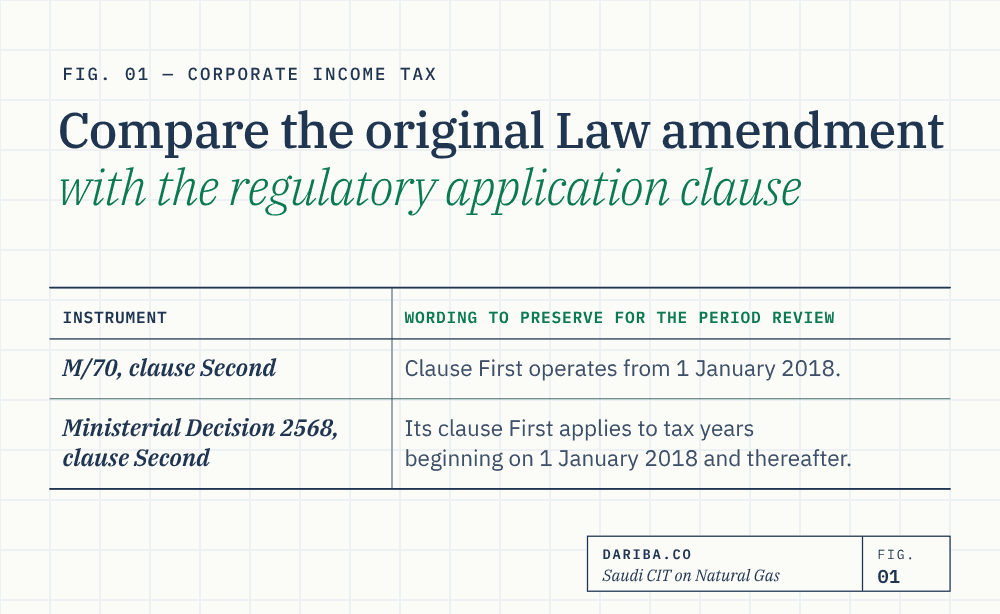
The decree and the later Ministerial Decision 2568 have their own application clauses:
| Instrument | Wording to preserve for the period review |
|---|---|
| M/70, clause Second | Clause First operates from 1 January 2018. |
| Ministerial Decision 2568, clause Second | Its clause First applies to tax years beginning on 1 January 2018 and thereafter. |
Dariba analysis: record each instrument, its wording, the actual tax-year dates and the event being analysed. Do not replace both clauses with the later Gazette publication date or assume that a payment date alone answers the tax-year question. A non-calendar or transitional period requires those provisions to be reconciled on its actual facts; this guide does not supply an invented universal transitional allocation.
Council Decision 369’s clause Third also provides for a joint committee process to implement the amendments, taking account of the procedures, formulas, bases and calculations used to determine tax bases subject to different rates. That instruction is not itself evidence that a particular allocation formula has been approved for a taxpayer. Obtain the actual applicable sector instruments and supporting calculations.
Source: original M/70, First(1)–(8) and Second–Third, and Decision 369, Gazette issue 4719, p. 5. The original Law amendment and the later regulatory amendment are read together, with their separate scopes preserved.
Keep the oil and gas operating-loss pools separate in both directions
M/70’s First(8) adds Law Article 21(d). It prevents a net operating loss belonging to the natural-gas investment base from being deducted against the oil/hydrocarbon production base, and prevents the reverse offset where the taxpayer carries on both activities.
This is more than a requirement to show two columns on one return. A common taxpayer and the combined return under Regulations Article 57(8) do not permit the loss in one base to shelter profit in the other. Preserve each loss’s origin, tax computation, eligible carry-forward and use within the proper base.
The loss carry-forward guide explains the separate origin, annual utilisation and continuity questions. The ban on cross-base offset does not, by itself, cancel every loss or establish that every carried amount qualifies for future relief. It also does not authorise moving shared costs between the bases to recreate an offset indirectly.
Read Decision 2568’s deletions and tax-year clause
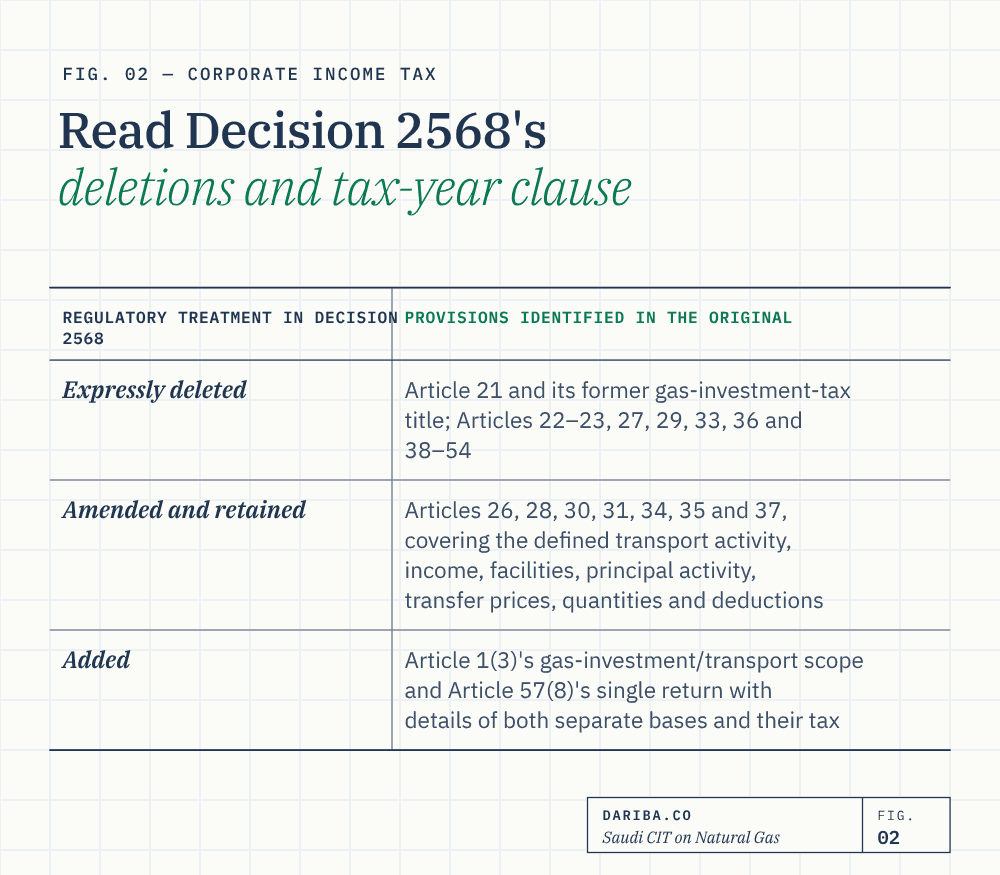
The original Ministerial Decision 2568 dated 12/8/1440 AH, published in Umm Al-Qura issue 4778 on 10 May 2019, p. 8, supplies the operative regulatory amendments. It does more than change an old rate table: clause First adds the gas scope provision in Article 1(3), amends retained operating provisions, deletes specified legacy provisions and adds the combined-return rule in Article 57(8).
| Regulatory treatment in Decision 2568 | Provisions identified in the original |
|---|---|
| Expressly deleted | Article 21 and its former gas-investment-tax title; Articles 22–23, 27, 29, 33, 36 and 38–54 |
| Amended and retained | Articles 26, 28, 30, 31, 34, 35 and 37, covering the defined transport activity, income, facilities, principal activity, transfer prices, quantities and deductions |
| Added | Article 1(3)‘s gas-investment/transport scope and Article 57(8)‘s single return with details of both separate bases and their tax |
Dariba analysis: deletion and amendment are different legal actions. The retained gas-transport and income definitions should not be discarded merely because the legacy return-based regime was removed. Equally, a deleted cash-flow or rate calculation does not become current simply because a compilation continues to display it.
Clause Second states that clause First applies to tax years beginning on 1 January 2018 and thereafter. Record that tax-year wording alongside the actual start and end of the period under review. The later Gazette publication date is not, by itself, the starting-year test stated in the decision. This clause should also not be paraphrased as a rule governing every individual payment solely by its payment date.
The Law’s repeal of former Chapter 10, Articles 44–55, under M/70 is separate from Decision 2568’s deletion of Regulations Articles 38–54. Both originals have now been read for this comparison. Keep their different document names, article ranges and application clauses in the historical-period file; the actual later sector-instrument chain and taxpayer’s transitional result remain separate enquiries.
Source: original Decision 2568, clauses First–Third, Gazette issue 4778, p. 8. Actual period classification, licence, energy-authority pricing or allocation requirements and case-specific consequences still require their own evidence.
Build the tax position around the operation’s evidence
Keep the activity and licence map, relevant agreements, ownership and operating roles, sale points, quantities, related receipts, direct and shared costs, allocation basis and return schedules together. Review changes in facilities, functions or contracts when they occur.
The advisory conclusion should identify the relevant activity, the applicable period, its separate tax base and the basis for each material income or expense decision. It should also identify any classification, valuation or sector-rule question that needs confirmation before the tax forecast is used for an investment or transaction.
Key takeaways
- Natural-gas scope is not limited to a foreign shareholder’s ordinary corporate-tax route.
- The current amended Article 7(b) states 20% for the relevant gas tax base.
- The gas base is separate from the taxpayer’s other activities.
- Incidental gas-linked income and excess-capacity receipts require classification.
- Oil and gas costs, transfer values and quantities require supported separation.
- A combined return does not merge the two taxable bases.
- M/261 extends the specified downstream rule to31December2030 and expressly backdates Article7(c) collection to2020 if separation fails.
- Decision2568 distinguishes express regulatory deletions from amended and retained gas provisions.
- Its clauseSecond applies clauseFirst to taxyears beginning1January2018 and thereafter; publication and payment dates are separate facts.
- M/70’s commencement clause and Decision2568’s tax-year-starting clause require separate period analysis.
- Oil and gas operating losses cannot offset the other base in either direction.
Sources
- Saudi Income Tax Law, current amended Arabic textArticles 1, 2(e), 6(f)–(g) and 7(b): natural-gas definitions, scope, separate base and current 20% rate. Chapter 10 repeal note: Articles 44–55, effective 2018. Current amended text distinguished from original-law reproductions.
- Income Tax Implementing Regulations, current amended Arabic textArticle 1(3), amended Articles 26/28/30/31/34/35/37 and Article 57(8): scope, gas income, oil/gas separation, pricing, quantities, costs and combined return with separate base details. Express deletion footnotes preserved.
- ZATCA Simplified Guideline for Income Tax, second version May 2026Sections 1–2 identify natural-gas investment and transportation within the income-tax scope. Detailed rates and separation follow current legislation; no official gas worked calculation is attributed.
- Umm Al-Qura issue5091: Royal DecreeM/261 and Council of Ministers Decision 8264June2025,p.1. M/261 dated27/11/1446 replaces M/13 First–Second: downstream Article 7(b) rate through31December2030; failure to separate by that date triggers Article 7(c) collection from1January2020. Operative original and recitals distinguished.
- Umm Al-Qura issue4778: original Ministerial Decision 2568Decisiondated12/8/1440AH,published10May2019,p.8. First(1)–(15):scope,retaineddefinitions/income/pricing/quantities/deductions,expressdeletionsand57(8)return. Second:taxyears beginning1January2018 andthereafter. SeparatefromLawM/70repeal.
- Umm Al-Qura issue4719: Royal DecreeM/70 and Council Decision 36913April2018,p.5. M/70 dated11/7/1439:Firsteightamendments,including21(d)two-waylossseparation;SecondappliesFirstfrom1January2018. Council369Thirdjointimplementationprocessreadseparately;notactualtaxpayerallocationapproval.
General information only. Actual supplies, facts, applicable periods and controlling Arabic legislation determine the result. Official examples are distinguished from Dariba analysis and original illustrations. Seek advice or clarification where the arrangement or source material leaves a specific issue unresolved.