In brief
Establish the statutory tax year, start date and permitted alternative before applying accounting and inventory rules. Related-company groups have a year-alignment requirement; short periods have a stated120-day return and payment timetable.
Establish the taxpayer’s required method and financial period
Income Tax Law Articles 22–25 govern the tax year and accounting methods; Article 27 addresses inventory. Implementing Regulations Articles 18–19 add the relevant period and natural-person threshold rules. The correct method depends on the actual taxpayer and record obligations, not merely which approach produces the lowest current tax.
Article 23 requires the method to show income clearly and connects commercial records to the tax computation through the required adjustments. Financial-statement profit and taxable income are therefore related but are not automatically identical.
Dariba recommendation: document the taxpayer’s legal form, book obligations, accounting method, approved year and relevant elections. Reconcile the accounting records to the tax treatment instead of switching methods for individual favourable items.
Establish the permitted tax year and its starting date
Law Article 22 begins with the state’s financial year and permits a different twelve-month tax year under the Regulations. Regulations Article 18(1) states that one taxpayer has a unified tax year for all its activities. It identifies the commercial registration or licence date as the start of the taxpayer’s financial year unless evidence establishes otherwise.
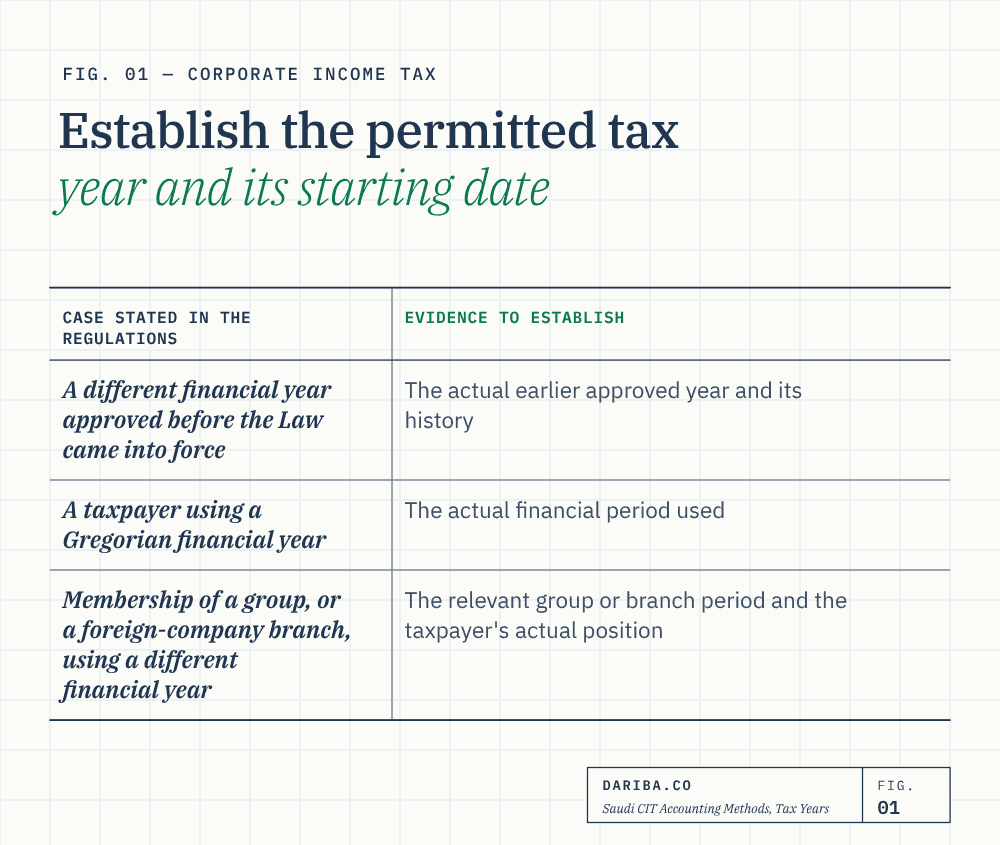
Article 18(1) identifies these cases for a different tax year:
| Case stated in the Regulations | Evidence to establish |
|---|---|
| A different financial year approved before the Law came into force | The actual earlier approved year and its history |
| A taxpayer using a Gregorian financial year | The actual financial period used |
| Membership of a group, or a foreign-company branch, using a different financial year | The relevant group or branch period and the taxpayer’s actual position |
Dariba recommendation: retain the applicable basis and dates with registration, licence and formation records. An alternative year must be assessed under the actual provision; a different management-reporting cycle does not, by itself, settle the statutory tax period. A change in year also requires the separate transition-period filing and payment analysis below.
Source: current Arabic Income Tax Law, Article 22, p. 16, and Regulations Article 18(1), pp. 17–18.
Align the tax years of the defined related-company group
Law Article 22(d) requires groups of related companies, as defined in Article 64, to use the same tax year. Establish the actual statutory relationship and retain the relevant entity and year-end schedule. The related-party guide explains the distinct relationship and control rules.
This alignment requirement does not itself combine the companies’ tax bases. Law Article 6(e)‘s separate capital-company computation and the separate-person rule remain relevant. Nor is it the same test as eligibility for a consolidated Zakat return. Use the independent-base guide when evaluating those different questions.
Dariba analysis: consider the Article 18(1) group or branch case together with Article 22(d), rather than treating the permitted different-year category as permission to disregard an applicable group-alignment obligation. Actual group composition, periods, changes and any required Authority determination should be resolved before return deadlines are forecast.
The five-million-riyal threshold concerns a natural person’s method
Law Article 23 and Regulations Article 19 allow the relevant natural person to use cash or accrual accounting, subject to the actual statutory conditions. Where annual gross income exceeds SAR 5 million, accrual accounting is required in all following tax years, even if income later falls below the threshold.
“Exceeds” matters: equality alone does not satisfy that particular trigger. It also does not remove any independent obligation to use accrual accounting. Companies keeping, or required to keep, the relevant commercial books must follow the applicable accrual rule; the natural-person threshold is not a general cash-accounting permission for all small companies.
Dariba recommendation: establish the actual gross-income measure and retain the history of crossing the threshold. Do not apply a VAT registration threshold or net-profit figure in its place.
Cash and accrual recognise different events
Article 24 records cash-method income when received or available for receipt and expenses when paid. The receipt rule is not limited to the date cash physically reaches one bank account.
Article 25 records accrual-method income and expenses when due. An amount becomes due to the taxpayer when the taxpayer has the right to receive it, even if payment is deferred or by instalments. An amount becomes due from the taxpayer when all events establishing the liability have occurred.
Dariba analysis: a delay in customer payment does not automatically defer accrual income. Equally, a budget or future intention to spend does not establish that a liability has been incurred. The separate deduction and capitalisation conditions still apply to the relevant item under either method.
Method changes require the actual approval and transition adjustments
Article 23(e) requires ZATCA’s approval for a change in accounting policy, apart from the specified required cash-to-accrual changes. Paragraph (f) requires adjustments to income, deductions, debt and other items in the following tax year so that amounts are neither omitted nor counted more than once.
Dariba recommendation: prepare a transition schedule of receivables, payables and previously recognised items, identifying the prior treatment and required adjustment. A software migration or financial-statement restatement does not, by itself, prove approval of a tax-method change.
Avoid a transition that leaves an accrued sale untaxed under both methods or deducts an expense twice. The actual opening items and earlier returns must be reconciled rather than applying one percentage to the entire balance sheet.
A short or long financial year has its own filing mechanics
Law Article 22 and Regulations Article 18 address permitted tax years and transition periods. A short period on a year change is separate; the regulation also addresses a short first or final year. The actual period must be identified before calculating the return deadline. Regulations Article 18(3) expressly requires the return and tax payment for a short financial period of less than twelve months within 120 days from the closing of the accounts. Do not treat a short period as eliminating either obligation.
For a first financial year longer than twelve months under the formation terms, Regulations Article 18(2) requires a return for the first twelve-month period within 120 days of that period ending, followed by the long-year return and payment with credit for the amount already paid for the first period. A long first accounting year does not therefore automatically permit waiting until its end before any return.
Dariba recommendation: retain the formation terms, permitted period, initial twelve-month computation and final reconciliation. A change of year also does not erase separately applicable advance-payment obligations.
Deduct the cost sold rather than all inventory purchases
Article 27 requires inventory records and allows cost of goods sold. The statutory calculation adds purchases to opening inventory and subtracts closing inventory.
Dariba illustration: opening stock SAR 200,000 plus purchases SAR 800,000, less closing inventory SAR 250,000, gives SAR 750,000 cost of goods sold on those isolated assumptions. Treating the whole SAR 800,000 purchased as that year’s expense would omit the opening and closing stock effects.
Cash-method taxpayers may use the stated direct-cost or full-cost method for inventory; accrual-method taxpayers must use full cost. Inventory records and valuation remain relevant even where the taxpayer otherwise uses cash accounting.
Apply the closing-value and weighted-average rules
Article 27(e) values closing inventory at the lower of book cost and market value at that date. It requires weighted-average book cost unless ZATCA gives written permission for another method; changing the selected method also requires approval.
Dariba recommendation: retain quantity and cost records, the calculation and support for the claimed closing market value. An accounting provision or a method permitted for financial reporting is not automatically proof of the statutory market-value test or written tax-method permission.
Use the resulting inventory value consistently in cost of sales and the tax reconciliation. A valuation reduction should not be claimed once through closing inventory and again as a separate unsupported deduction.
Connect the method to the actual tax computation
Review income timing, expense entitlement, capitalisation, inventory and any method transition together. Where a contract meets the statutory long-term definition, the separate percentage-of-completion rules apply to the relevant accrual computation.
Dariba analysis: a defensible method produces a complete sequence across years, not just a favourable result in one year. Keep opening balances, recognised income and costs, closing balances and tax adjustments traceable to the records and actual legal requirements.
Key takeaways
- Identify the taxpayer’s required method and actual tax year.
- The five-million-riyal rule is a natural-person threshold.
- A required accrual transition continues in later years.
- Method changes and transition adjustments have specific rules.
- A long first year can require an earlier twelve-month return.
- Inventory costs and methods retain their statutory controls.
- Regulations18(1) identifies the start date and stated cases for a different tax year.
- Law22(d) requires the defined related-company group to use the same tax year, without merging tax bases.
- A short period underRegulations18(3) has a120-day return/payment deadline from closing the accounts.
Sources
- Saudi Income Tax Law, current amended Arabic textArticle 22(a)–(d),p.16:taxyear,permittedalternative,transition/first/finalperiods andArticle64related-companyalignment. SeparateLaw6(e)companybase preserved. Retained23–27 method,recognition,contract andinventoryrules remain relevant.
- Income Tax Implementing Regulations, current amended Arabic textArticle 18(1)–(3),pp.17–18:unifiedtaxyear/startdate,threealternativeyearcases,transition,longfirstyear andshortperiod120-dayreturn/payment. Retained19–20 threshold andcontractrules remain relevant.
General information only. Actual supplies, facts, applicable periods and controlling Arabic legislation determine the result. Official examples are distinguished from Dariba analysis and original illustrations. Seek advice or clarification where the arrangement or source material leaves a specific issue unresolved.