In brief
Apply Saudi CIT anti-avoidance powers, form and substance, related-party tests, suspended losses and income-splitting conditions under Articles 63–64.
Read the two Article 63(a) powers separately
For determining tax, Article 63(a)(1) permits ZATCA to disregard a transaction with no tax effect. That is the wording of the current Arabic Law. The following limb, Article 63(a)(2), separately permits recharacterising a transaction whose form does not reflect its substance and placing it in its true form.
Dariba analysis: keep those two limbs distinct. The first limb’s reference to tax effect should not be silently rewritten as a different economic-effect or commercial-purpose test. Its short wording does not itself provide an exhaustive list of affected arrangements or a general safe harbour for any transaction described as tax neutral. Where a position depends on the first limb’s precise operation, identify the actual tax treatment and obtain focused clarification rather than asserting a broader settled doctrine from that sentence alone.
The form-and-substance limb has its own stated basis. The contractual name of a payment or transaction cannot, by itself, establish that its tax character reflects the actual arrangement. Equally, this provision should not be presented as permission to impose any preferred character without examining the facts and the applicable tax rules.
Support the actual arrangement before defending its label
Dariba recommendation: reconcile the contract, the services or assets actually supplied, the parties’ obligations, contemporaneous correspondence, performance evidence, invoicing, payment and accounting entries. Explain how those facts support the character used in the return. These are practical evidence suggestions, not an exhaustive statutory checklist or a promise that a particular document prevents recharacterisation.
Dariba illustration: a company describes a group payment as a service fee. The label and invoice alone do not establish what services were actually provided or which separate expense, source and withholding rules apply. Review the real rights, activities and evidence before concluding on the character. This illustration does not determine that a particular fee must be recharacterised or prescribe a substitute tax category without its facts.
Distinguish this exercise from Article 63(c)‘s related-party revenue/expense reallocation and Article 64’s relationship tests, discussed below. A transaction’s character, its arm’s-length amount and the deductibility or timing of that amount can raise different questions. Passing one test does not automatically settle the others.
Match each remaining anti-avoidance route to its actual trigger
Article 63(b) separately addresses estimated assessment where the stated filing or record requirements fail. The estimated-assessment guide explains those triggers and the applicable calculation routes. It is not a general election to use a deemed margin instead of a supported return.
Paragraphs (c)–(g), analysed below, address reallocation, related-party property losses and income splitting with their own conditions. Do not add the same amount repeatedly merely because several provisions may need consideration. Identify the legal route, the affected taxpayer, the adjustment and any corresponding treatment before reconciling the result.
Law Article 35 also preserves Article 63 in its treaty-conflict rule. The treaty and mutual-agreement guide explains why a treaty reference does not itself establish immunity from these domestic provisions or decide every actual treaty/MLI question.
Related-party analysis under the Income Tax Law is more than a transfer-pricing benchmark. Article 64 defines relationships and common control; Article 63(c)–(g) addresses reallocation, property-transfer losses and income splitting. A supportable tax position identifies the actual person, rights, transaction and provision before reaching a deduction or adjustment conclusion.
Identify the person and the legal relationship
Article 64(a) relates a natural person to a spouse, an in-law or a relative up to the fourth degree. This is a relationship test, rather than a requirement to find a particular percentage of share ownership between the individuals.
Article 64(b) then addresses a natural person’s connection to companies and the specified bodies administering assets for designated purposes. Different capacities use different rights and conditions. Record the legal form, parties and beneficial rights rather than rely on a generic “group company” label.
Dariba recommendation: maintain an ownership and relationship chart for the relevant period. Establish indirect holdings and relevant related persons as well as the direct shareholder register. A conclusion made for consolidated financial statements is not, by itself, a complete Article 64 analysis.
Apply the natural-person control tests to the right rights
Article 64(b) distinguishes the following cases:
| Connection | Relevant Article 64 condition |
|---|---|
| Individual and partnership | The individual is a partner and, alone or with persons related under the Article, controls 50% or more of income or capital rights, directly or indirectly through companies |
| Individual and capital company | The individual is a shareholder and, alone or with related persons, controls 50% or more of voting rights or value, directly or indirectly through companies |
| Individual and the specified body administering assets set aside for designated purposes | The individual benefits or can benefit, alone or with related persons, under the Article’s stated condition |
The third condition is not expressed as the same 50% capital-company test. Identify whether the particular body and benefit fall within the actual provision before applying it; the table does not classify every foreign trust or fund automatically.
Dariba illustration — direct rights without overlap: an individual holds 40% of a capital company’s voting rights and the spouse holds 10%. Aggregating the related persons’ stated holdings gives 50%, meeting that numerical boundary in Article 64(b)(2) on those facts. Exactly 50% is included; the text does not require more than 50%. Other rights and relationships still require review in a real ownership chain.
Common control requires the applicable ownership measure
Article 64(c) treats companies or bodies as under common control when 50% or more is controlled by the same person or persons related under the Article. For partnerships, the measure is income or capital rights; for capital companies, voting rights or value; and for the specified designated-purpose bodies, beneficial interests in income or assets. The stated direct and indirect company-holding rules also matter.
Dariba analysis: percentage, right and legal capacity must all be identified. A 50% voting-right test cannot be replaced indiscriminately with a 50% accounting-profit share or headcount test. Similarly, distinguish this common-control condition from the natural-person benefit condition in Article 64(b)(3).
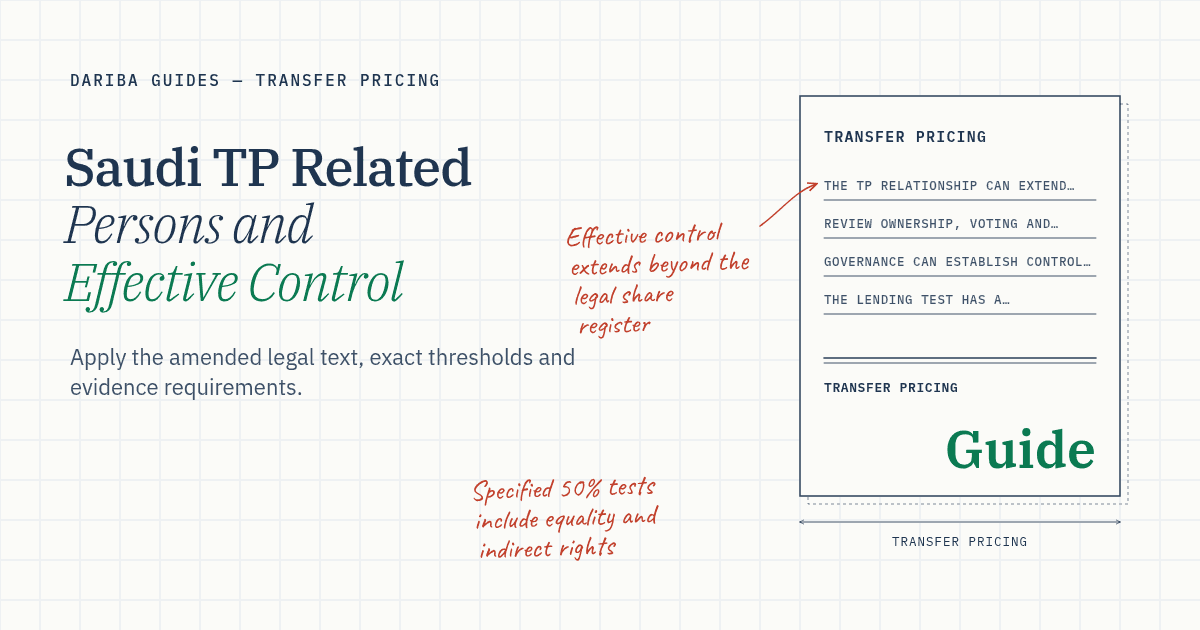
The transfer-pricing related-person and effective-control guide addresses the TP framework. Apply the definition required by the provision under review; it is unsafe to treat one ownership percentage as a universal exemption from every tax regime’s relationship or control rules.
Reallocation and expense deductibility are connected questions
Article 63(c) permits ZATCA to reallocate revenue and expenses in transactions between related parties or parties under common control to reflect what independent parties would have earned. Regulations Article 10(11) separately restricts deduction of related-party goods or services amounts exceeding independent-party prices, with the applicable fair-pricing rules.
Official example: ZATCA’s Guideline on the Conditions of Deductible Expenses, second version May 2026, section 2.3, Example 2, concerns loan charges paid by a Saudi resident company to a non-resident partner in a country without a Saudi tax treaty. The guideline requires business purpose, arm’s-length terms, the financing limitation and the other expense conditions. It also retains withholding even where the stated deduction conditions fail.
Dariba analysis: market pricing does not override a separate statutory deduction restriction. Likewise, withholding compliance does not establish an allowable CIT expense. Keep pricing, actual benefit, cost character, financing limits and withholding in separate schedules, using the financing-cost guide where relevant.
A related-party property-transfer loss can be suspended
Article 63(d) prevents deduction of a loss from a property transfer between a taxpayer and a related party. Unless the Law provides otherwise, the deduction is suspended until the related party disposes of the property to an unrelated party. The transaction and any overriding specific provision therefore matter before treating the loss as currently deductible.
Dariba illustration — timing only: assume a transfer would otherwise give a deductible tax loss of SAR 300,000, the recipient is related and no contrary provision changes the result. The taxpayer cannot deduct that SAR 300,000 in the transfer year merely because the sale is legally completed or an accounting loss is recorded. Article 63(d) requires the specified suspension analysis.
If the recipient later sells to an unrelated party, retain the actual disposal evidence and determine the available deduction under all relevant rules. This article does not promise that every later transaction produces an immediate deduction of the original amount without reviewing tax basis, the asset category and any other conditions.
Distinguish suspension from a carried-forward operating loss
A deduction suspended under Article 63(d) and an operating loss carried forward under Article 21 are different tax attributes. The loss carry-forward guide also explains the annual utilisation limit and Article 43’s ownership-change conditions. A suspended amount should not simply be entered as an unrestricted operating-loss balance.
The depreciation and disposal guide explains why a financial-reporting asset loss does not always translate into a separate tax deduction. Partnership-interest basis and the related transfer provisions also require their own analysis. These checks come before a tax forecast assumes that a group transaction creates a usable loss.
Income splitting has its own scope and conditions
Article 63(e) permits adjustment of an individual taxpayer’s base and the other person’s base where the individual splits income with that person, to prevent reduction of tax due. Article 63(f) defines the relevant splitting routes: direct or indirect transfer of income to a related person, and direct or indirect transfer of property, including money, to a related person who derives income from it where a reason or one of the reasons for the transfer is reducing the transferor’s or transferee’s total income tax.
The property-transfer route expressly includes the tax-reduction reason condition. Preserve the wording of each route rather than combine the paragraphs into a claim that every transfer, family arrangement or group payment necessarily has the same result.
Dariba recommendation: document who actually earned the income, who owns the property and rights, what was transferred, the consideration and the commercial reasons. A company invoice, bank-account change or assignment document alone does not establish every underlying entitlement or remove the need to examine Article 63.
Value given by the recipient is relevant evidence
Article 63(g) allows ZATCA to consider the value given by the transferee in determining whether the taxpayer seeks to split income. Keep valuation and consideration evidence with the transfer documents and the analysis of the purpose and income rights.
Dariba analysis: a supported transaction value is relevant evidence, but the paragraph does not state that a valuation report grants unconditional immunity from all income-splitting, pricing or substance rules. Conversely, an asserted tax reduction needs to be connected to the actual statutory conditions rather than substituted for them.
Reconcile the position by taxpayer, transaction and year
Maintain the relationship chart, rights calculation, transaction documents, price support, original and current tax basis, suspended-loss register, actual recipient disposal and income-allocation analysis. Keep the accounting entries reconciled to the tax treatment so that a retained loss or income item is not omitted or counted twice.
These sections address Article 64 and Article 63(c)–(g). Article 63 contains other powers, including the separately discussed estimated-assessment route; this guide should not be treated as an exhaustive opinion on every avoidance provision. An adjustment, notice and challenge still need the applicable assessment and procedural rules.
Key takeaways
- The two Article 63(a) powers use different statutory wording.
- Character, price and expense acceptance are separate questions.
- Different persons and rights have different relationship tests.
- Exactly 50% is within the stated numerical control boundary.
- Pricing support does not override a separate deduction restriction.
- Related-party property losses can be suspended.
Sources
- Saudi Income Tax Law, current amended Arabic textArticle 63(a)–(g): separate disregard, form/substance, estimation, reallocation, loss and splitting powers; Articles 35 and 64 retain their own scope.
- Income Tax Implementing Regulations, current amended Arabic textArticle 10(11): related-party goods/services amounts exceeding independent prices. Separate loss and financing requirements remain applicable.
- ZATCA Guideline on the Conditions of Deductible Expenses, second version May 2026Section 2.3, Example 2: partner loan charges, business purpose, arm’s-length terms, financing limits and separate withholding.
General information only. Actual supplies, facts, applicable periods and controlling Arabic legislation determine the result. Official examples are distinguished from Dariba analysis and original illustrations. Seek advice or clarification where the arrangement or source material leaves a specific issue unresolved.